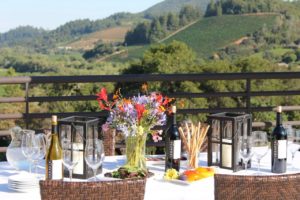
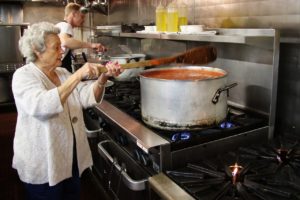
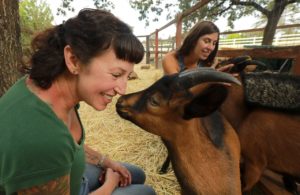
A selection of dishes at SingleThread Farm-Restaurant-Inn in Healdsburg. (Photo courtesy of Single Thread)
Long before there was a single plate of food, a single handmade pottery bowl or even a single orderly row of Japanese carrots growing at their Healdsburg farm, Kyle and Katina Connaughton had an exacting vision of what it would look like to eat the seasons.
Not just a broad approach of eating foods native to winter, spring, summer and fall, but separating the seasons into 72 distinct microseasons, each only five days long, that could showcase food at the precise moment of perfection. Inspired by an ancient Japanese farming technique called shichijuuni koo, which factors in everything from the sun and moon to precipitation, wind and tides, it requires the farmer to be constantly in touch with nature.
The guest is greeted with an array of dishes presented on a bed of wood, moss and ferns at Single Thread Farms Restaurant in Healdsburg. (John Burgess)
“These [small time periods] mark subtle changes in nature,” says Katina, who is the restaurant’s chief farmer, and wife to executive chef Kyle. “Being mindful and present, we can observe these environmental nuances and work in harmony with nature rather than outsmart or control it.”
In December, the culinary visionaries quietly opened the restaurant, which has been hailed as one of the most important new eateries in the country.
Cured Foie Gras, French Prunes, and Rooibos Tea from Single Thread Farms Restaurant in Healdsburg. (John Burgess)
Expectations have been dauntingly high, and in January a distraction emerged in the form of a claim by contractors that the restaurant’s investors had held back payment for nearly $400,000 in final construction costs. But the Connaughtons are doing their best to live up to their carefully curated trowel-to-table vision — which is why after nearly two years of planning, construction and menu testing, it’s little surprise to walk into the completed restaurant and find if not perfection, something awfully close.
An open kitchen design allows the guest to watch the creation of their meal at Single Thread Farms Restaurant in Healdsburg. (John Burgess)
A Zen-like tone is set from the moment diners enter. The restaurant’s spare exterior in the recently constructed building, which sits on a central corner in Healdsburg that was formerly home to the city’s post office, opens to a small, silent vestibule. Framed at the far end is a peek into the kitchen, also nearly silent, where white-jacketed chefs are hunched over plates creating edible still lifes with kitchen tweezers and flicks of moss, edible flowers and seaweed. There are just a handful of tables, the most fascinating of which is a theater table where guests sit side by side with an unobstructed view of the open kitchen where Connaughton and his staff work at two massive islands.
Chef Kyle Connaughton uses ceramic pots from his Japanese donabe collection to prepare his meticulous multicourse feasts. (John Burgess)
New York-based culinary firm AvroKO is behind the restaurant’s design. The firm has been responsible for a number of high-profile restaurant designs in Napa, San Francisco, New York, Las Vegas and Hong Kong. Expect lots of fine details, including signature brass accents and tiles, and a minimalist look that echoes Connaughton’s culinary style.
The 52-seat restaurant defies simple labels like “farmto- table” or “Japanese” or “Wine Country” or “modernist,” though it encompasses all of those things. Instead, the menu is a reflection of Kyle and Katina’s life experiences, ranging from Kyle’s time at restaurants like Spago Beverly Hills, three-Michelin-starred Michel Bras in Hokkaido, Japan, and Hesten Blumenthal’s Fat Duck Restaurant in the U.K. (which was named “Best Restaurant in the World” during his tenure there), and Katina’s experiences as a farmer in Japan and Sonoma County. Kyle Connaughton describes the approach simply as omentashi, or the Japanese art of heightened hospitality and anticipation of a guest’s every need.
Carefully plating Sunchoke with Preserved Lemon, Mangalitsa Jowl, and Pine Nuts at Single Thread Farms Restaurant in Healdsburg. (John Burgess)
The first course on our recent visit — which began with a cocktail in the rooftop garden and a tour of the complex’s luxury inn — was a sort of edible forest adventure, where wood and moss hid a tiny shelled whelk, a bite of pheasant wrapped in a fig leaf, Miyagi oysters and a nibble of Dungeness crab with ponzu. It was followed by a single blue egg nestled in more moss, with smoke sabayon, after which came umeboshi plums and beets, red jewels on a gently scalloped plate.
Chef de cuisine Aaron Koseba harvests purple frill mustard greens form the restaurant’s rooftop garden. (John Burgess)“The Mid Winter in Sonoma County” includes Chingensai Dashi with Meyer Lemon and edible flowers. (John Burgess)
The courses continued for hours (and hours): A donut-shaped wooden plate with Mangalitsa pork jowl and watercress puree, abalone in onion sauce with foam, foie gras on a bed of persimmon leaves, fermented local farro in a matsutake mushroom broth, and guinea hen roulade in pumpkin puree. Each course is a simple bite or two served on handcrafted Japanese dishes made of wood, clay and metal. Chef Kyle’s obsession with donabe (Japanese serving pottery), hand-wrought steel knives and artful serviceware add to continuity of the kaiseki experience — the artful presentation of beautiful food and flavors in Japanese haute dining.
A dish called “Tilefish, Blue Foot,” and Chanterelle “Fukkura-San” with Leeks, Brassicas from the Farm, Sansho, and Chamomile Dashi Borth is first presented at the table in the Japanese donabe it was cooked in, then whisked away to be plated for serving. (John Burgess)
A multicourse dessert menu included frozen fromage blanc with quince reduction and puffed amarynth and an “apple” made of chocolate, filled with cream and Gravenstein apple sorbet. Both were almost too beautiful to eat. Almost.
Single Thread offers both wine pairings and a nonalcoholic pairing experience that includes white tea, cucumber soda with lemon and mint, turmeric shrub with smoked salt and grenadine, nonalcoholic “gin” and lime, and a matsutake mushroom and lemon verbena tea. The 37-page wine list from head sommelier Evan Hufford includes hundreds of Old and New World wines and sakes, many from California and Sonoma County. At the high end: Stunning large-format bottles, like the Alain Hudelot-Noëllat Romanée-St.-Vivant Grand Cru for $9,500, and other rarefied bottles ranging from several hundred to several thousand dollars. By-the-glass offerings range from $10-$50.
“The Mid Winter in Sonoma County” includes Kushi Oyster, Passmore Ranch Caviar and Alyssum Flower. (John Burgess)
With a $295 price tag per person not including beverages or wine, the Single Thread experience is for those looking to spend some serious cash on a restaurant that has yet to be given a Michelin star. But to put it in context, consider a few other haute experiences around Wine Country. Chef Christopher Kostow’s 10-course tasting menu at the three-Michelin-starred Meadowood is $330 (excluding wine) or $500 for a “counter menu” inside the kitchen. Thomas Keller’s three-starred French Laundry charges $310 without tax, tip or drinks. San Francisco’s Saison, which has the distinction of being the most expensive restaurant in the region and has also garnered three stars, is $398 ($498 for special holidays) without tax, tip or drinks. Douglas Keane’s Healdsburg-based Cyrus, which closed in 2012, was more than $800 for two people, but that did include wine pairing and a caviar course.
“The Mid Winter in Sonoma County” includes Geoduck with Kefir Lime Jelly. (John Burgess)
Meals like those at Meadowood, French Laundry and what Connaughton hopes his restaurant will become are personalized experiences using precious ingredients (abalone, Mangalitsa pig, foie gras) as well as highly labor-intensive sauces and preparations. Food is served as art, with two or three chefs attending to each plate. For a food connoisseur it’s a once-in-a-lifetime experience offering as much beauty and joy as, say, driving a beautiful car or buying a well-crafted suit or dress.
Though in public he’s quietly reflective and not prone to chest-beating, Connaughton is no rookie in the high-pressure, review-driven world of haute dining. His résumé includes some of the most important restaurants in the world and he is cofounder of the culinary research group Pilot R& D, a pioneering company focused on food science. Recently he finished a book on cooking with donabe, ancient Japanese clay cooking pots.
Katina Connaughton at Single Thread Farms and Inn in Healdsburg. (Sally Egan)
For her part, Katina presides over the 5-acre Single Thread Farm, which is tucked away in Alexander Valley. Carved out of fallow land on winemaker Pete Seghesio’s San Lorenzo vineyard property, the farm took months just to prepare for planting. Visitors travel past a flock of laying hens and green grapevines before they spot Katina’s greenhouse and neatly plowed rows.
This is the heart of the restaurant, where the seasons, the microclimates and the terroir drive everything. It’s all hands on deck, with family members, chefs and anyone else who can handle a shovel, a set of clippers or a bale of hay pressed into service. A tangled orchard borders the farm, with fruit and olive trees Katina hopes to rehabilitate. This isn’t gentleman farming, but hard, sweaty, dirt-under-your-fingernails work that has helped Katina get an intimate feel for what will grow there, and how to best utilize the space.
Kyle and Katina Connaughton of Single Thread Farms Restaurant in Healdsburg at their farm. (Jason Jaacks)
Natives of Los Angeles, the Connaughtons were high school sweethearts and have spent more than 20 years traveling the world, planning for a someday restaurant like Single Thread.
They moved to Sonoma County from the U.K. in 2011, and say they felt at home almost instantly. The location seemed a good fit for the restaurant they envisioned as a guest experience that’s an extension of their family, rather than a rigid, uptight encounter.
The Connaughtons and their staff have spent more than 18 months working on every detail, and will continue to hone the bespoke experience to a fine sheen. Doing that in the limelight creates a heavy yoke of expectation. But Single Thread seems well on its way to becoming a culinary jewel in the crown of the Sonoma County dining scene, showcasing the unique bounty of our county — from the farm to each of Single Thread’s beautiful plates.
In the days following vandalism at Cali Calmécac Language Academy, community supporters including Christina Larkin and Susan Nelson, right, gathered outside the school as children arrived for class. (Beth Schlanker)
Most students at Cali Calmécac Language Academy never saw the ugly graffiti as it first appeared during the early hours of that October morning, so swift was the school’s effort to conceal it. When they arrived at the Windsor campus to start the day, outlines of the scrawled words nevertheless were still visible beneath layers of fresh paint.
Two weeks before the presidential election last fall, “Trump” and “Vote Trump” had been spray-painted overnight in black letters in dozens of places around the predominantly Latino school, where classes are taught in both English and Spanish.
And across a broad cinderblock wall at the side of campus — near where students are dropped off and picked up each day — read an even more inflammatory message: “Build the wall higher.”
It was an unsubtle reference to then-candidate Donald Trump’s pledge to barricade the nation’s border with Mexico, the familial homeland for many students on this campus and for most of the young Latino children in schools countywide.
With a mere half-dozen words, vandals had made Cali Calmécac, or “Cali” as it is known locally — a public elementary school meant to celebrate cultural diversity and Latino heritage — into an another unwelcome battleground in a historically divisive presidential campaign.
Fourth-grader Violet Meyer runs past the outlines of graffiti that had been covered over last October on the Cali Calmécac Language Academy Campus in Windsor. (Christopher Chung)
As debates raged across the nation about immigration and border security, students as young as 5 were now learning a rallying cry used by supporters on one side to demean those of a faceless, foreign other.
“I saw a lot of really scared people that day,” eighth-grader Sophia de la Cruz, 13, recalled. “I was scared for my Cali familia that had to go through that.”
The echoes of that time, including anxiety that strikes deeply at the sense of personal security for some students, reverberated into the new year with President Trump’s first acts upon taking office. He immediately signed orders to curb immigration into the United States and to begin construction of his border wall with Mexico.
Cali Calmécac Language Academy third-grader Jaaziel Matias, 8, holds a letter she wrote to President Donald Trump on Inauguration Day. (John Burgess)
More than 70 percent of the 1,100 students at Cali, founded in 1986, are Latino, and many worry that friends and loved ones could be directly affected by Trump’s agenda.
Gustavo Zarate, a seventh-grade boy with a thin face and dark, intelligent eyes, shared the deepest dread reverberating throughout the student body.
“I feel like some kids are worried their parents will be deported,” he said. “I hear mostly little kids talk about it.”
Zoe Furmankiewicz, 8, a student at Cali Calmécac Language Academy, wrote this letter to President Donald Trump on Inauguration Day.
Still, in the days and months that followed the vandals’ trespass and Trump’s shock election win over Hillary Clinton, a resilience has surfaced here that reflects the strength of the Cali community. Some believe the reaction of the larger community shows Sonoma County at its best — promoting inclusion and tolerance over bigotry and fear.
In the days following vandalism at Cali Calmécac Language Academy, community supporters including Christina Larkin and Susan Nelson, right, gathered outside the school as children arrived for class. (Beth Schlanker)
Two days after the graffiti was discovered, students arriving on campus were greeted by a group of their neighbors holding signs with supportive messages: “Windsor loves Cali,” “Cali Rocks” and “Have a great day at school.”
In response to the vandalism, community members including Susan Nelson showed their support for Cali Calmecac Language Academy before the start of class in Windsor. (Beth Schlanker)
Weeks later, a group of young, local artists created a vibrant mural to adorn the school, one they painted across the very cinderblock wall once covered by graffiti. The defiance in the gesture was clear, the mural’s imagery an homage to indigenous and Latino cultures. The faces looking back at many students were the color of their own.
“Right now, when there’s so much division and opposite views, we hope it brings back a feeling of unity and healing,” said Santa Rosa resident Emmanuel Morales, 29, one of the artists.
Principal Jeanne Acuña, right, hugs school librarian Gail Bland as community members show their support. (Beth Schlanker)
Like much of Sonoma County, where Clinton drew 69 percent of the vote last November, the Cali community is still bracing for life under President Trump. Apprehension exists among parents and teachers over the emerging contours of his agenda and his often dark rhetoric, steeped in a commitment to tighter controls on immigration and a crackdown on those in the country without documentation.
But as Cali looks forward, school officials and supporters say, the school has a resonant example to draw on for its response to what may come.
Emmanuel Morales is one of three artists that helped to create a mural celebrating diversity, native culture, and the immigrant experience on a wall which had been previously vandalized with pro-Trump sentiments. (Beth Schlanker)
“I would like to believe it would happen anywhere,” said school Principal Jeanne Acuña. “I think it is a very Sonoma County kind of thing, but I think that doesn’t preclude it from happening somewhere else. I think people care about children, and they care about children feeling safe.”
Acustodian who arrived at his usual 6 a.m. start time was the first to see the graffiti on campus that Monday in October. A band teacher, whose class meets at 7 a.m., was the one who notified Acuña by phone that she needed to get to school right away.
Graffiti had turned up on the otherwise immaculate campus before, but never so visibly or widespread. This “was all over,” Acuña recalled.
“It was on the stairs. It was on garbage cans, on the lids,” she said. “It was on the walls. It was on doors. It was everywhere.”
But it wasn’t until Acuña called to inform police that she choked up, the tears forming along with “a huge lump in my throat.”
“It was such a violation and such an intentionally hateful thing to do, where small children are involved,” she said. “And that’s the part that I had the hardest time with. Why do this to children?”
Sarahi Figueroa, 8, reads aloud the letter she wrote on Inauguration Day to President Donald Trump (John Burgess)
The custodian, after taking photographs of the graffiti as evidence, had begun almost immediately to paint over the offending words, using supplies kept in stock for that very purpose. Maintenance personnel from the Windsor Unified School District were called to help, in hopes of erasing all signs of what had been done as quickly as possible.
Seventh-grader Leila Becnel plays in the band and so arrived early for practice that day. She saw the graffiti before it was fully covered up. It was frightening, she said, even for non-Latino students, just “knowing that someone would come onto our campus to terrorize us.”
She and her peers were immediately taken over by a desire to shield the younger kids from the graffiti.
“They shouldn’t have to worry about this, for how young they are,” said seventh-grader Meredith Gilbertson.
A heartfelt message was written in chalk last December on the school playground. (Kent Porter)
But “Build the wall higher” had been written across a prominent spot at school, near the cafeteria, right off the lane into campus where a large share of students and families walk or drive each day.
It was a partisan shot that jolted the school and fed anxiety that carried over into the new year.
Elias Valenzuela, 12, said he heard his younger cousin went home “telling his parents, ‘We’re going to get deported.’” Petra Montenegro and her two grandchildren, in third and fifth grade, saw the graffiti when they arrived early that day. The vandalism was deeply disturbing and confusing for the children, given their basic understanding that Trump “wants everything to be the American way.”
“The biggest question,” Montenegro said, “was, ‘Why would they do it here?’”
Even before that autumn day, many of Cali Calmécac’s students had picked up bits and pieces from talk at home or school about Trump’s campaign rhetoric, starting with that infamous opening-day missive from his Manhattan skyscraper lobby, where he reduced the mass of Mexican immigrants to rapists and drug traders.
But his talk of ramping up deportations to cover millions of undocumented immigrants and his pledge to build a border wall struck the most fear in the campus community.
Cali Calmecac Language Academy teacher Rosa Villalpando directs her third grade class in an exercise where you greet the student across from you and ask them questions about their thoughts and goals. (John Burgess)
From what they overheard at home, among friends and on television or online, some students came to understand that Mexicans were political targets. They asked their teachers about fellow Latinos being thrown out of the country, their families torn apart Some worried those families could be their own.
“It was targeting my people, my race, the people that I associate with,” said eighth-grader Nancy Aguirre, 14.
For all its progressive values, Cali does not officially embrace any strain of politics. For the administration and staff, that meant acknowledging the pre-election fears felt by many in the student body while ensuring that all, including Trump supporters, had their views heard and respected.
“We’ve talked pretty openly as a staff about how difficult it is, where you have an absolute responsibility as an educator,” Acuña said. “Your children, ideally, should never know what your political leanings are if you’re doing your job well.”
A student and parent walk past a mural that was painted over a wall that had been spray painted with anti-immigrant messages and Donald Trump’s name. (Beth Schlanker)
With the younger students, the goal was to curb any overwrought anxiety. In Rosa Villalpando’s class that led to deep breathing exercises, journaling and other activities meant to help students express their feelings about the campaign.
“I saw children in here talk about it and cry. And we would reassure them that there’s checks and balances, and that we don’t know yet, the campaign’s not over,” Villalpando said.
Older students who raised concerns about deportations, the border wall and other controversial topics were often instructed to take their questions to their parents or others outside the school setting, Acuña said.
“It was hard already, feeling and hearing their anxieties, and trying to make a place where they were safe and felt protected and knew they were accepted,” Villalpando said.
Cali Calmecac Language Academy third grader’s in Rosa Villalpando class wrote formal letters to President Donald Trump or outgoing President Barak Obama on inauguration day. Aleena Galvani, 9, said she hopes President Trump will be a good President. (John Burgess)
The graffiti felt like a repudiation of all those efforts. Teachers collecting their students that morning tried, in some cases, to route the kids around places that had been tagged. Others stood in front of painted-over areas, hoping the students wouldn’t detect what had been written.
Villalpando first learned of the incident from unsettled young students when she arrived at the playground to lead them into class. One of her pupils, Sofia Inocencio Valeria López, 8, remembered being “sad and mad” at the same time.
Some students cried, and others were filled with questions, Villalpando said.
“It hurt,” she added.
While some students managed to get to their classes without learning of the vandalism, few remained unaware for long.
Principal Jeanne Acuna at Cali Calmecac Language Academy. (Beth Schlanker)
Acuña was so busy attending to the situation that morning and throughout the day she didn’t send out an official notice to parents until the next day. But word still got out to the public that morning, and news of the vandalism was online before noon — prompting calls and visits from Bay Area television stations, whose reports from campus filled evening broadcasts. Media outlets across the country picked up the story over the ensuing days.
“Due to the racist overtones of the ‘Build the wall,’ and the fact that Cali was the only school affected in our district, the incident is being investigated as a hate crime by the Windsor Police Department,” Steven Jorgensen, the district superintendent, said that week in a community-wide letter to parents.
By that time, calls and messages of support were streaming into the campus. The town’s police chief posted his own message on Facebook a day after the incident calling the graffiti “offensive and racist.” “As the Chief of Police, I am also a longtime resident of the Town of Windsor,” Carlos Basurto wrote, “and I can unequivocally say that this type of behavior and thinking is not indicative of this town. This type of crime is unjustifiable and will not be accepted or tolerated in this community.”
Cali Calmecac Language Academy third grader’s in Rosa Villalpondo class wrote formal letters to President Donald Trump or outgoing President Barak Obama on inauguration day. Liam Wallace, 8, reads his letter to the class. (John Burgess)
Windsor residents and people from throughout the county were quick to rally behind the school. By Monday afternoon, messages and cards from individuals and other schools were arriving at the campus in abundance.
Students from athletics rival Windsor Middle School signed a poster declaring in both English and Spanish, “There are no walls in Windsor.”
When Cali students went to Sebastopol’s Brook Haven Middle School for a volleyball game that afternoon, supportive banners included one that said, “United against racism.”
The next day, two women stood in the rain outside campus holding signs of support, and a crowd of about 40 people appeared at the school the next morning to welcome arriving students and families with hand-painted signs and posters, many of them decorated with hearts.
“It was heart-warming to see all the kids with their smiles,” Windsor Town Councilman Bruce Okrepkie said, “and it was Pajama Day for them, so it was even cuter.”
The rally was organized on Facebook through a group created to promote acts of kindness and community service.
Organizer Vicky Royer, a former Windsor resident for whom the town’s schools remain “near and dear to my heart,” said her intent was to mount an immediate, nonpolitical show of support to counteract an unmistakable “message of hate.”
“It was basically just, ‘We’re not going to stand for hate,’” she said.
Villalpando said she still gets teary remembering how it felt to walk through the throngs of people that day with her 9-yearold daughter, a Cali student.
“Some of the signs said, ‘We are the wall’ — like ‘We are the wall of protection,’” she said.
“I think for me, that was actually a turning point,” said Beatriz Robles, a seventh-grade Spanish teacher. “We all made a point that we focused on how supportive people were, and not the opposite.”
Sonoma County’s population is about a quarter Latino, and nearly half the students in primary and secondary public schools are from Latino families. The aggression implicit in the Cali graffiti was felt far beyond the boundaries of the Windsor campus and the surrounding town. That it targeted children was unacceptable to many, “the lowest you can go,” as one Sonoma State University student put it.
Morales, one of the muralists, who works in conflict resolution with Santa Rosa City Schools, said for him, Cali Calmécac serves as an important span between cultures.
“I just feel like they’re trying to bridge that gap, the language and communication gap, and this act was something that was going counter to that, that was going to create more separatism,” Morales said.
Morales was one of the nine artists who joined with Alex Gonzalez, a Cali alumnus and member of the Santa Rosa Junior College’s Movimiento Estudiantil Chicano de Aztlán chapter, or MEChA. Together, they formed a group that met with Acuña and proposed a mural to celebrate the culture they felt the vandalism sought to bring down.
Over a weekend in early December, using $1,000 in contributions and additional donations from Kelly-Moore Paint, they transformed a prominent, 31-foot wall at the edge of campus into a declaration of pride and a tribute to the contributions of indigenous peoples and Latino immigrants.
“A lot of us were disgusted by it,” organizer Hernan Rai Zaragoza, 21, said of the vandalism. “But instead of just talking about it and being, like, ‘It happened,’ we decided to act upon it with love. Ultimately, in the end, you don’t fight hatred with hate. You should fight hatred with love.”
The mural recognizes the work of Latinos in the region’s vineyards; the traditional costumes and dance of Pomo Indians; and a Mesoamerican myth involving ancient deities Ixchel and Quetzalcoatl, the latter a primordial god of creation who takes the form of a feathered serpent and represents both intelligence and learning.
A swarm of butterflies symbolizes Latino migration, while a redwood and painted oaks represent nature, and an oil derrick, human degradation of the earth, said Everardo Flores, 25, another of the muralists. At the far right, two students sit at desks in a classroom with a Cali Calmécac sign, one reading a well-known history of Latin America and its struggles.
At the other end, on a separate panel, Jiovanny Soto, a Sonoma State art major, painted a stylized eagle reminiscent of the Mexican coat of arms and reflective of the school mascot.
Soto, 21, said he remembered feeling like he didn’t belong while growing up in Rohnert Park schools and sometimes spending extended periods with family in Mexico. He said he could relate to the anxiety Trump’s rhetoric engendered among Cali’s students.
“I was happy that they were at least able to look at this gesture as a sign of hope, like they’re not alone,” Soto said.
Cali eighth-grader Toby Feibusch, 14, said the message endures.
“For me, the mural now is a daily reminder that if something were to happen here to our school or our community, that the whole community not only here but around the world would be there for us,” she said.
As Cali students plunged back into their studies at the beginning of this year, anti-Trump protests spread from the nation’s capital to airports, university campuses and the streets of downtown Santa Rosa, where more than 5,000 rallied in a peaceful demonstration a day after Trump took office.
The culprits responsible for the graffiti had not been caught. But on the walls at the Windsor campus there were still a few reminders, in posters saved in the aftermath of the vandalism — “United as One,” “Love Builds Bridges” and “Let’s break through the wall of racism!!” — souvenirs of a community’s defiance.
“I feel like that’s what’s going on with the ban on Muslims,” said Nancy Aguirre, referring to the backlash after President Trump, on his eighth day in power, curbed immigration by refugees and restricted travel from seven predominantly Muslim countries.
Among Villalpando’s third-graders, Trump’s wall and pledge to deport undocumented immigrants remain key themes for classroom discussion. Many express profound sadness over the departure of Barack Obama, the only U.S. president they have ever known.
In conversation and in Inauguration Day letters penned to Trump and Obama, their thoughts reflect uncertainty, but also a surprising measure of hope and optimism.
To the outgoing president, they voice gratitude and love, penning forlorn farewells to his family and extending invitations to visit.
“My heart will always be for you,” wrote Sarahi Figueroa, 8.
“I am sad that Donald Trump is the new president,” wrote another to Obama “because half of my family is going to Mexico.”
For Trump, there are pressing questions about the border wall and other campaign vows.
“Are you really going to hurt Hillary Clinton?” Zoe Furmankiewicz wrote. “Please answer.”
Zane Arellano wrote to the president, “I hope you won’t change everything, because if you do, I and other kids will lose some friends.”
Several said they held out hope that Trump would “change his heart,” be “a good president and decide against the wall and sending Mexicans back to Mexico.”
One 8-year-old wrote:
Dear Barack Obama, I thank you for your service. I really like how positive you are and know how you feel about Donald Trump. I also hope that Donald Trump can be positive, like how you were when you were president.
Now I’m talking from my heart. If Donald Trump is going to be negative, we can’t change that. We can only be hopeful and positive. I know we can make a difference and make the world positive and a better place for everyone.
Enjoy a craft cocktail at the bar at the Restaurant at CIA Copia (Photo: Victor M. Samuel)
The Restaurant at CIA Copia offers seasonal, shareable cuisine (Victor M. Samuel)
The Culinary Institute of America’s (CIA) new facility at Copia is quickly becoming a must-see hot spot for food and drink geeks. The 80,000 square foot facility, located next to the Oxbow Market in downtown Napa, brings culinary and beverage education to the people – up close and personal. Here are five reasons to geek out at the CIA at Copia.
Learn from the best: culinary and beverage classes from CIA instructors The CIA is considered one of the world’s best culinary schools and now the public can tap the knowledge of CIA chefs and instructors through daily classes. Taking place in the 72-seat Napa Valley Vintners Theater, upcoming classes include how-to cook with wine, how to pair wine with food, the history of coffee, and a family-friendly, hands-on mac and cheese class. Classes start at $15.
The newly opened CIA at Copia, in Napa, offers daily cooking classes for the food-loving public (Victor M. Samuel)
Sharing is caring: indulge, with friends, in shareable seasonal cuisine
The Restaurant at CIA Copia offers seasonal, shareable cuisine created by a team led by French chef, Christophe Gerard. The dining experience is unique: cooks create shared plates and present them to your table, discussing each dish and helping you select what appeals to your palate and eyes. Menu offerings include Jerusalem Artichoke Crisps ($8), a 34 oz. Cowboy Ribeye ($95), and a cheese plate that is unlike any other you’ll ever experience (ask to meet Bessie!). They’re open for lunch and dinner.
Shop your way to the ultimate culinary lifestyle
After learning how to make your own cheese, you’ll need all the tools to do it and the Store at CIA Copia has it all. Many of the store’s offerings are hand-crafted in the US and Europe, including pottery from St. Helena ceramicist, Amanda Wright, gardening tools from UK-based Haws, and cutlery from Germany’s Messermeister. The store has a huge selection of culinary-themed books and also locally made wine and food.
The Store at CIA Copia (Victor M. Samuel)
Enjoy craft cocktails and wine from around the world
The bar at the Restaurant at CIA Copia includes an expansive beverage program, including wine and craft cocktails. They barrel-age their own bitters and make their own infusions. Cocktails include a Barrel Aged Sazerac (Sacred Bond Brandy, absinthe, bitters) and the Apple Blossom (Spring 44 Gin, Calvados and apple). Beers and wines from around the world are also offered, including from throughout Northern California and France. Grab a drink and wander the manicured gardens of the property, which provide ingredients for the restaurant and classes.
Enjoy a craft cocktail at the bar at the Restaurant at CIA Copia (Victor M. Samuel)
Check out the art and history of the food and wine world
The property includes a selection of commissioned artworks, including Fork by sculptor Gordon Heuther and a tribute to Bob and Margrit Mondavi, titled Is that Bob and Margrit?, which resides on the tower on the outside of the building (look up!). Check out the sparkle of the Gutenstein Family Decanter Collection and check back later this year for the opening Chuck Williams Culinary Arts Museum and the Wine Hall of Fame.
The CIA at Copia is open daily. 500 1st St., Napa.ciaatcopia.com.
Sonoma Springs Brewing Company offers two new beers in March at their Sonoma taproom. (Photo courtesy of Sonoma Springs Brewing Company)
Tim Goeppinger isn’t afraid to experiment. As the head brewer at Sonoma Springs Brewing Company, the only brewery located in the City of Sonoma, Goeppinger continues to expand his lineup of California and German style beers – and he’s prolific in his production. This month’s upcoming release of “Sonoma S.M.A.S.H.” marks his 7th release in 2017 – yes, that is seven beers in two months, two in March alone.
The beginning of March saw the release of “Duck Duck Joose,” a Northeast-style IPA. A hazy IPA, “Duck Duck Joose” has seven types of hops that create a smooth, refreshing beer with berry notes. On March 20, Sonoma Springs will release “Sonoma S.M.A.S.H.” It’s a single malt, single hop beer made with Huell Melon hops. This beer showcases the distinct flavor of the German hops it uses, which is known for it’s delicate melon and strawberry flavors.
Visitors to the Sonoma taproom on Riverside Drive can taste these two new beers alongside Sonoma Springs standard’s such as their Kolsch and Subliminal Gold IPA, and recent releases such as the pineapple-y “Juicy in the Sky” and aptly named “Women Are Smarter” saison. 19499 Riverside Dr., Suite 101. sonomasprings.com
The brisk, sunny days of springtime are upon us. If you’re flying off to warmer climates to celebrate spring, check out these season-perfect items from around Sonoma County.
NOT YOUR ORDINARY SANDAL
Pull off your winter shoes, put on a pair of OluKai Mea Olasandals and head to a sunny, warm destination. With original artwork inspired by the octopus, canoe lash stitching, high-quality materials and comfortable arch support, these sandals are a far cry from your ordinary pair of flip-flops.
$120, Kane Menswear, 31 E. Napa St., Sonoma, 707-996-3453, kanewear.com
Photo Credit: Sarah Deragon
PACK UP IN STYLE
Whether you’re catching the next plane to Palm Springs for the weekend or taking a long-haul flight to Bali, you’ll travel in style with this lightweight suitcase with four multidirectional wheels from Lipault of Paris. It will hold everything you need for fun in the sun, and it’s a breeze to roll either behind or beside you.
BEACH READING
Find a comfortable place on the beach or by the pool and dive into “Nine Island,” an autobiographical novel by Jane Alison. This quick and personal read set in Miami Beach has a unique writing style and tone. The novel is by turns both funny and sad, and it’s always enthralling.
BEAUTY ON THE BEACH
Stand out in the spring break beach crowds in this unique, hand-embroidered bikini by Agua Bendita of Colombia. Intricate details, textures and brilliant colors make this artisancrafted two-piece the one you’ll want to wear in the sun all season long.
Photo Credit: Sarah Deragon
$195, Sunkissed by Sunsations, 205 5th St., Santa Rosa, 707-595-1458, visit on Facebook.
The brisk, sunny days of springtime are upon us. If you’re getting busy digging in your garden, check out these season-perfect items from around Sonoma County.
FOR THE BIRDS
Many of us are lucky enough to have orioles visit us in early spring. Welcome these bright yellow birds with a feeder made just for them. This diamond shaped feeder comes with orange-slice decorations, the oriole’s favorite sweet treat. It includes perches with built-in bee guards and feeding ports, and it’s a cinch to clean and refill with nectar.
$22, Prickett’s Nursery, 5875 Sonoma Highway, Santa Rosa, 707-539-3030, prickettsnursery.com
Photo Credit: Sarah Deragon
HEIRLOOMS TO GROW
It’s early spring and time to plant vegetables like beets, lettuce, spinach and carrots. Try heirloom seeds this season, choosing rare varieties like Beet Chioggia, dating back to 1840s Italy, and Strawberry Spinach, which is traced to the 1600s in Europe. Use ceramic stakes made by Petaluma artist Lou Sparks to keep track of your seedlings.
ROCK YOUR PLANTS
Your plants will feel right at home in this sturdy pot made with Indonesian river rock that’s been hollowed out. Each pot is unique in size, shape and natural color. Usable indoors or out, it’s ideal for plants with heavy foliage.
$29 for the small size, Artefact Design & Salvage, Cornerstone Sonoma, 23562 Highway 121, Sonoma, 707-933-0660, artefactdesignsalvage.com
Photo Credit: Sarah Deragon
JUST LIKE OLD MACDONALD
You may not have a farm in the true sense of the word, but this charming “FARM” sign will make your backyard garden feel like one. Made by artists in Mexico using recycled metal, it will look great on your shed, garden fence or house. It’s meant to be outside in the elements and measures roughly 19 inches tall by 38 inches long.
The brisk, sunny days of springtime are upon us. Breathe fresh air into your home in less time with these four season-perfect items from around Sonoma County.
BEAT THE DUST
Forget those fluffy feather dusters and greasy sprays. Dust your surfaces instead with a silky soft goat-hair bristle brush, handmade in Germany. It won’t scratch glass and can access smaller areas with ease. This lightweight duster has a pearwood handle that fits comfortably in your hand. To store, simply hang it from its leather strap.
$36, Healdsburg SHED, 25 North St., Healdsburg, 707-431-7433, healdsburgshed.com
Photo Credit: Sarah Deragon
KITCHEN SMARTS
TheStick-em Handy Kitchen Towel by Full Circle with a built-in magnet will have you asking yourself, “Now, why didn’t I think of that?” When not in use, stick it to your oven or fridge for quick access. Machine-washable, made with organic cotton and bamboo, this soft and absorbent cloth is also free of toxic dyes.
$11.25, Sebastopol Kitchen + Table, at The Barlow, 6770 McKinley St., Sebastopol, 707-634-0333, sebastopolkitchentable.com
Photo Credit: Sarah Deragon
POWERFUL CLEANING, NATURALLY
Feel good about yourcleaning products with Better Living, a line of all-natural cleaners that work. Using plant-derived ingredients and scented with essential oils, their products are nontoxic, eco-friendly and made in the US with solar energy.
Choose from a variety of cleaning solutions to spring-clean the natural way. Ranging from $5.99 to $6.79, Pharmaca, 303 W. Napa St., Sonoma, 707-938-1147, pharmaca.com
Photo Credit: Sarah Deragon
UNCLUTTER YOUR CAR
When checking off that spring-cleaning list, don’t forget your car. Gather your re-usable shopping totes, maps, emergency supplies, pet toys and tools and organize them in thisstorage bin made for your trunk. Designed to hold heavy items like grocery bags, it has two large compartments, three mesh side pockets and stitched-in handles.
$14, Friedman’s Home Improvement, 1360 Broadway Ave., Sonoma, 707-939-8811, friedmanshome.com
Reservations for pool passes at Coppola Winery start March 9. (Photo: Chad Keigh)
Start shopping for that swimsuit because the pools at Coppola Winery opens Saturday, April 1, with reservations for pool passes and cabines starting March 9.
When film director and winery proprietor Frances Ford Coppola opened Coppola Winery he wanted to create a “a wine wonderland, a park of pleasure where people of all ages can enjoy all the best things in life: food, wine, music, dancing, games, swimming and performances of all types. A place to celebrate the love of life.”
And he’s done just that. Coppola Winery was the first winery in Northern California to install a swimming pool and a bocce court. The 3,600 square-foot pool has 32 cabines, European-style changing rooms with all the necessary amenities.
Cabine rentals have all the necessities for a perfect pool day (Photo: Chad Keigh)
Cabine reservations (starting at $135) include pool passes and lounge chairs for four guests. They have their own private showers, towels and playing cards. Cabines also have two Coppola signature perks: four bottles of Sofia Mini sparkling wines and a copy of the award-winning Zoetrope: All-Story magazine, published by Coppola himself.
The pool at Coppola Winery offers poolside service, four bocce courts, and board games (Photo: Chad Keigh)
Individual pool passes are also available (starting at $12 for children and $28 for adults) and include access to poolside service, two restaurants, four bocce courts, game tables featuring backgammon, card games and board games, and a children’s lending library. Individual passes are first come first serve, but reservations are available and highly encouraged.
Coppola Winery’s pool operates April 1-May 29 (Fri-Sun), May 30-October 1 (open daily) and October 6-28 (Fri-Sun). Pool hours are 11 a.m. to 6 p.m. Reservations can be made by phone at (707) 857-1471 or at francisfordcoppolawinery.com.
From world-famous wineries and rolling golden hills to majestic redwood forests and Pacific Ocean shores, Sonoma County offers a variety of scenic backdrops for engagement photos. Now, as the sun begins to peak through the clouds and winter rains have turned the hills emerald green, the lighting and setting is just right for capturing that special moment and making your big announcement. Here are our favorite engagement photo spots in Sonoma County:
Five acres of gardens make for a perfect place to sneak at kiss at Ferrari-Carano (Photo courtesy of Ferrari-Carano)
Ferrari-Carano Winery – Healdsburg
10,000 tulips and daffodils in bloom, 2000 species of shrubs and trees, waterfalls that flow into fish-filled ponds, highlighted by bronze sculptures from renowned artists — what else could a coupe in love need for their Facebook feed? This, and the Villa Fiori, is all yours to enjoy come spring at Ferrari-Carano. 8761 Dry Creek Road, Healdsburg 95448, 707-433-6700, ferrari-carano.com
The Ledson Winery in Kenwood.
Ledson Winery – Kenwood
If you’re looking to create a fairytale feel in your engagement photos, Ledson Winery in Kenwood is the location for you. This gothic-style winery castle features cathedral windows, turrets, coffered ceilings and sweeping staircases; the garden, overlooking vineyards and Sonoma hills, has fountains and carefully manicured lawns. 7335 CA-12, Kenwood 95409, 707-537-3810, ledson.com
The Bodega Head in Bodega Bay. (Kent Porter)
Bodega Head – Bodega Bay
Those looking for an alternative to the typical wine country engagement photo should head to Bodega Head, a small promontory on the Sonoma coast. Sandy beaches and a scenic shoreline will add drama to your photo and, since this is a relatively secluded spot, you don’t need to worry about photo bombers ruining the Pacific backdrop. 3799 Westshore Rd. Bodega Bay, 94923, 707-875-3483
Matanzas Creek Winery in Santa Rosa.
Matanzas Creek Winery, Santa Rosa
Matanzas Creek Winery in Santa Rosa offers a casual French countryside vibe, with fields of lilac and purple lavender. Pack a picnic basket, pick up a bottle of Sauvignon Blanc in the tasting room, and set up a sweet engagement shot on the property. 6097 Bennett Valley Rd Santa Rosa 95404, 707-528-6464, matanzascreek.com
Sunlight filters through redwoods on to oak leaves at Armstrong Redwoods State Natural Reserve in Guerneville. (Kent Porter)
Armstrong Redwoods, Guerneville
For a rustic, bohemian feel, with a touch of a Midsummer Night’s Dream, make your way into the Guerneville redwoods. Lean against a friendly leafy giant with your beloved one, or pose near a creek waterfall in lush green surroundings. 17000 Armstrong Woods Rd Guerneville, 95446, 707-869-2015
Sonoma County is well-known to tourists as a destination for wine sipping and food tasting. Its locals have different, possibly more engaging, ways to pass the time, however. Here is a list of some of the more unusual attributes that make Sonoma County such a vivacious place to live.
Astronomy students Marcos Indalecio, left, and Melanie Queiroz view the stars through a telescope at the Ferguson Observatory in Sugarloaf Park. (John Burgess)
Stargaze at Robert Ferguson Observatory
Located at Sugarloaf Ridge State Park, Robert Ferguson Observatory is the largest observatory in the Western United States wholly committed to public viewing and astronomical education. The observatory has several telescopes, including a new, 40-inch instrument. It is open to the public once a month, usually on Saturdays. Daytime solar observation is free, while attending the nighttime Star Parties costs $3.00 for anyone over 18. To check the schedule and sign up for classes, visit rfo.org.2605 Adobe Canyon Rd, Kenwood 95452, 707-833-6979.
View Whimsical Junk Art on Florence Avenue
Take a drive or go for a stroll down Florence Avenue in Sebastopol, the coolest street in Sonoma County. Mounted in front-yard gardens behind picket fences, colorful sculptures salute the passersby. These funky and whimsical art pieces are made by sculptor Patrick Amiot out of old pieces of tires, headlights, bicycles, and anything else that can be dug out of the dumpster. Some of his street sculptures include a dog with a mailbox nose, a surfer girl with speedometer eyes, and a milkman with a trash can torso. Florence Avenue, Sebastopol. Patrick Amiot Studio, 2371, Gravenstein Highway South, Sebastopol 95472, 707-824-9388, patrickamiot.com
Patrick Amiot’s distinctive sculptures decorate Florence Avenue in Sebastopol. (Rebecca Chotkowski)
See a Play by The Imaginists Theater Company
The Imaginists is an experimental theater company that creates and performs original works. The subject material is centered around the themes of art, activism, and community, and the company actors are people of different ages and backgrounds. The Imaginists travel to various locations within Sonoma County to perform. In the summer, the actors bicycle from park to park for their tour “The Art is Medicine” or “El Arte es Medicina.” This annual summer tour is free to the public and performed in both English and Spanish. For more information about current and upcoming performances, call 707-528-7554, or visit theimaginists.org.
The Imaginists Theater Company performs The Butterfly’s Evil Spell/ El Malefic de la Mariposa, a play by Federico Garcia Lorca at Martin Luther King, Jr. Park in Santa Rosa. (Crista Jeremiason)
Visit Luther Burbank Home and Gardens
Luther Burbank Home and Gardens is Santa Rosa’s most special city park. It is a National Historic Landmark and a California Historical Landmark. The park is named after legendary horticulturist Luther Burbank, and contains his old home, gardens and greenhouse. Burbank is also buried on the property. Ramble through the array of plant creations that Luther Burbank introduced, such as the Shasta daisy and the spineless cactus. Luther Burbank Home and Gardens is located at 204 Santa Rosa Avenue, Santa Rosa. Admission is free to the public. Call (707) 524-5445 to attend a tour. 204 Santa Rosa Ave, Santa Rosa 95404, lutherburbank.org
Luther Burbank Home & Gardens in Santa Rosa. (Christopher Chung)
Dance the Night Away at Ellington Hall
Ellington Hall is a ballroom dancing hall in Santa Rosa. It offers classes in styles such as tango, salsa, and East Coast Swing. On Friday nights it opens its doors to the public for a $15 swing-dancing party. Dance the night away with the ballroom and swing dancers in the area from 8:30pm to 11:30pm. Attend the $15 beginner swing lesson beforehand from 7:30pm to 8:30pm, and the dance party is free. Bring a partner or come solo; everyone is welcome. Come on your birthday, and you get to dance in the birthday circle. For more information on dance classes, visit ellingtonhall.com. 3535 Industrial Dr, Santa Rosa 95403, 707-545-6150.
Ellington Hall in Santa Rosa. (Charlie Gesell)
See Sonoma from Above with Up and Away Hot Air Ballooning
Sonoma County climate is ideal for ballooning. Take a scenic ride above the vineyards and rolling hills, or along the rugged coastline. The Up and Away hot air balloons are colorful state-of-the-art creations, ranging from 150,000 to 315,000 cubic feet. Balloon occupation is limited to one pilot and up to sixteen additional guests. Visit up-away.com to book a balloon ride. 2200 Airport Blvd, Santa Rosa 95403, 707-836-0171.
Up and Away Hot Air Ballooning. (Courtesy photo)
Go Foraging for Local Produce at Santa Rosa Farmers Market
Held at the Luther Burbank Center for the Arts, the Santa Rosa Farmers Market is the largest farmers market in Sonoma County. It is also California Certified, meaning that all products sold are produced solely in California and that the sellers of the products are directly related to their production. Meander past the vendors, and nibble some cheese from Two Rock Goat Cheese, suck on a honey stick from Hector’s Honey, and sample some fresh fruit from The Peach Farm. Markets are held from 8:30am to 1:30pm on Wednesdays and Saturdays. The Luther Burbank Center for the Arts is located at 50 Mark West Springs Road in Santa Rosa.
Mandarin oranges at the Santa Rosa Farmers Market. (Kent Porter)
Hit the Rink at Cal Skate
Tighten your laces, and go roller skating at Cal Skate in Rohnert Park. Take a class, host a party, or free skate at the rink. Bring your kids for Kid Skate, or hire a babysitter and attend Adult Night. Cal Skate is also home to the roller derby league Resurrection Roller Girls. Admission is under $10, and skate rental is $4. 6100 Commerce Boulevard, Rohnert Park 94928, 707-585-0500. For a schedule, visit calskate.com.
Cal Skate in Rohnert Park. (Jeremy Portje)
Travel Back in Time at Hot Couture
Step into this Santa Rosa shop, and feel transported to a hundred different places in time. Located in the Historic Railroad Square, Hot Couture is one of the most impressive locally owned and operated vintage clothing store in all of Sonoma County — and beyond. Its vibrant and eye-catching collection contains clothing from the 1890’s to the 1970’s, all carefully curated and in excellent condition. Browse the store and be dazzled by the overwhelming displays of beaded dresses, fur coats, elegant hand bags, and jeweled gloves. Hot Couture also runs a clothing rental service, and is always able to provide a costume for any of the most fantastical parties or events. 101 Third Street, Santa Rosa, 101 W 3rd St, Santa Rosa 95401, 707-528-7247, hotcouturevintage.com
Marta Koehne, center, owner of Hot Couture in Santa Rosa, dressed Katherine Pitts, left, and Kyle Adamiec, right, in outfits for Wunderkammer Tuesday. (Crista Jeremiason)