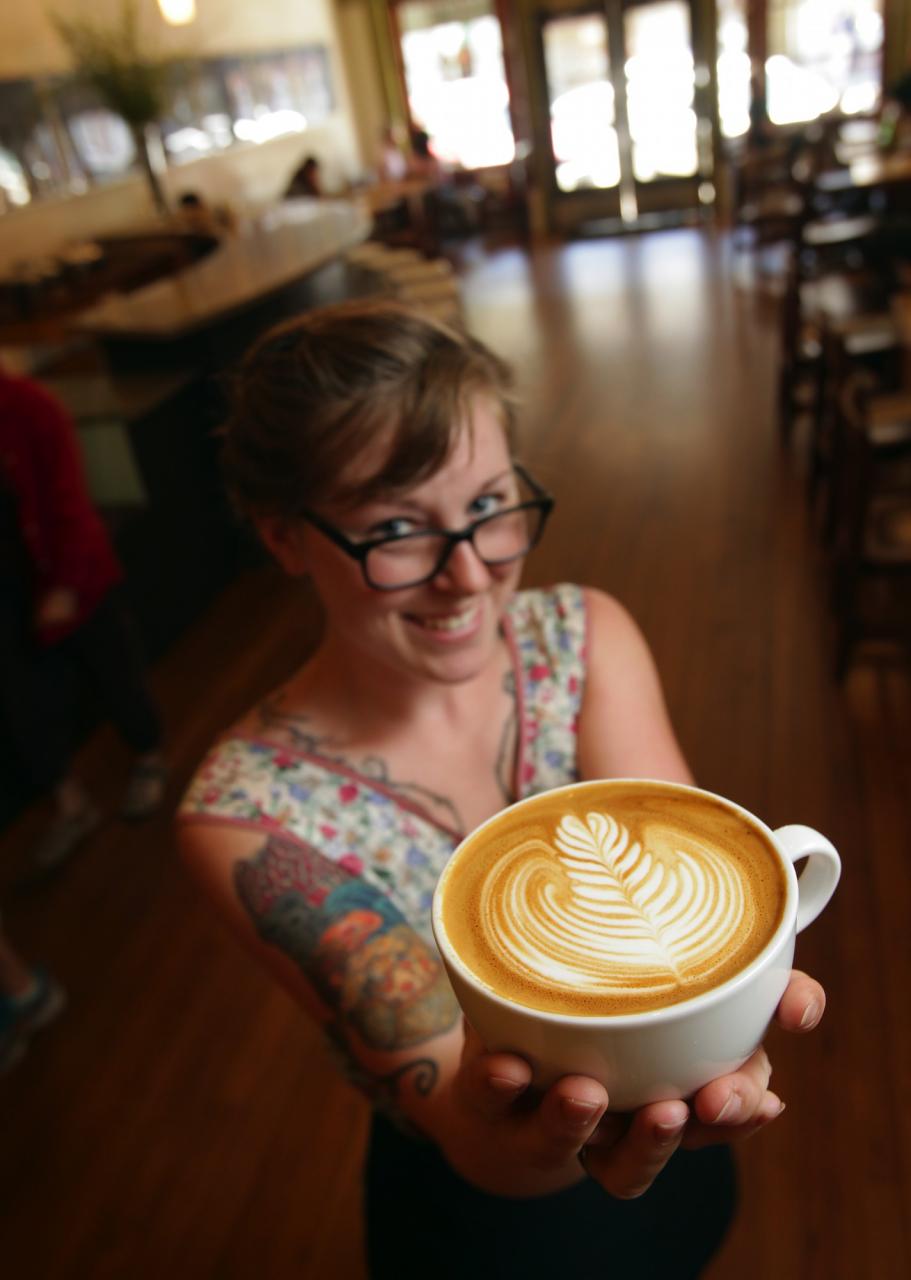
Coffee and pastry from Flying Goat Coffee. (Jenna Fisher)
Stumped on what to do when it gets damp and gray outside? Here are our 10 suggestions on how to make even a rainy day in Sonoma County a little brighter.
A cozy cafe escape
Order a cozy cup of joe and lounge at your local coffee shop. We recommend the Aztec Mocha with double espresso, Valrhona chocolate, chiles, spices, vanilla, organic cane sugar, rose water and steamed milk from Flying Goat Coffee in Healdsburg (300 Center St. and 419 Center St.). Or the seasonal pumpkin spice chai from Avid Coffee (formerly Acre Coffee) with locations in Santa Rosa (2365 Midway Drive) and Petaluma (21 Fourth St.).
Flying Goat Coffee in Healdsburg isn’t for the grab-and-go types; it’s for coffee lovers looking for a relaxed morning. (John Burgess / The Press Democrat, file)Morning light bathes clothbound books at Treehorn Books in downtown Santa Rosa, Tuesday, Oct. 31, 2023. (Kent Porter / The Press Democrat)
Get lost in a good book
Sonoma County has some incredible independent bookstores for your book-browsing adventures, including Levin & Company in downtown Healdsburg (306 Center St.) and Treehorn Books in downtown Santa Rosa (625 Fourth St.). Or stop by your local Sonoma County Library branch. Sonoma County Library cardholders can access e-books, audiobooks, thousands of magazines and movies from the comfort of their couch through the library’s online resources.
Retail therapy
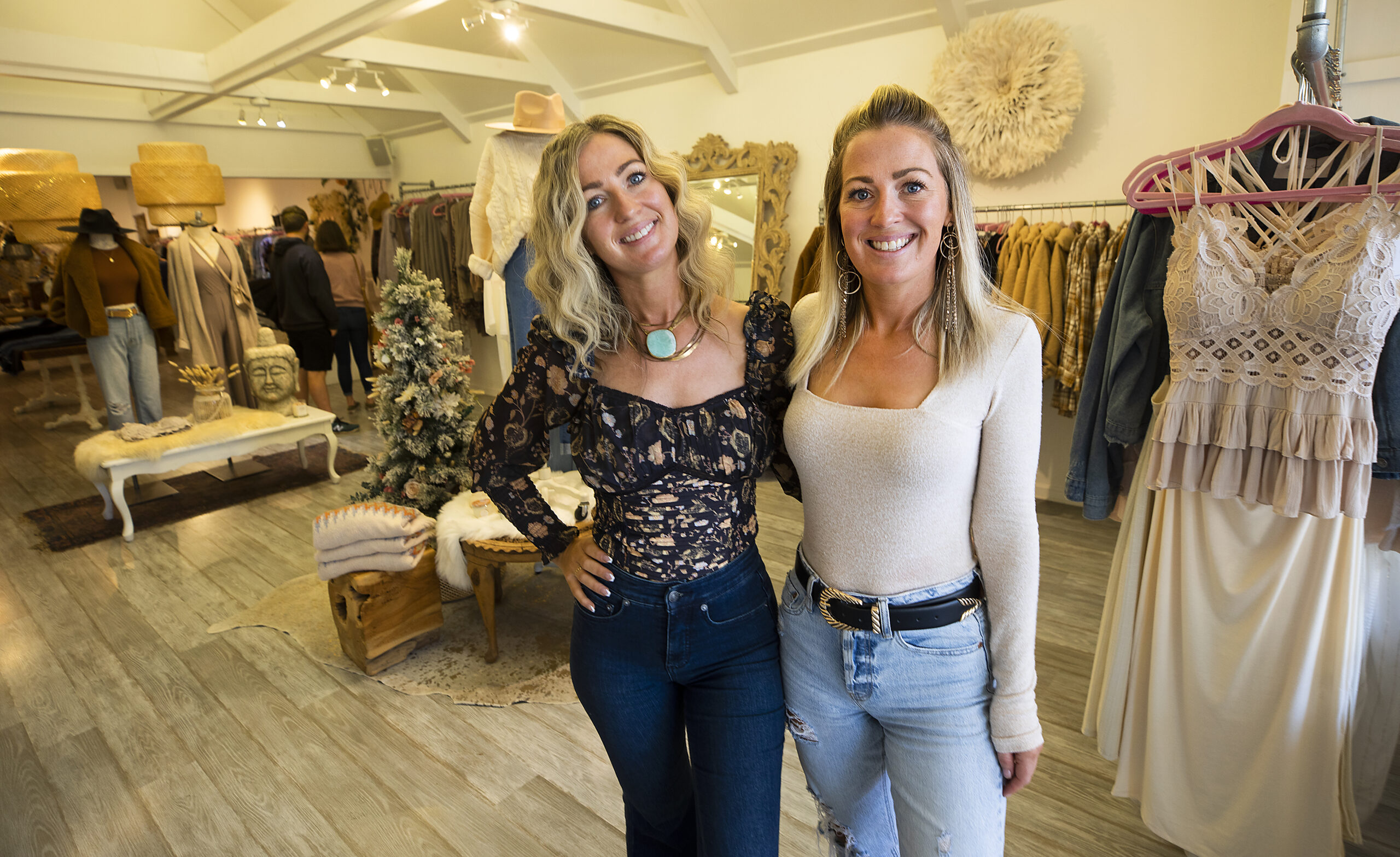
Go cozy sweater shopping at one of Sonoma County’s boutiques. Boho chic Ooh La Luxe with shops in Santa Rosa and Petaluma, Robindira Unsworth in Petaluma (115 Petaluma Blvd. N.) and The Loop in Sonoma (461 First St. W.) make stylish layering easy. For more local retail therapy, check here.
Twin sisters Michelle, left, and Cristina Wilson own Ooh La Luxe, a women’s clothing store with two locations in Sonoma County. Photographed in their downtown Petaluma store on Tuesday, Nov. 23, 2021. (John Burgess / The Press Democrat)Fred H. helps his daughter Vivian, 5, learn to skate during the Parent and Puppy session at Snoopy’s Home Ice at the Redwood Empire Ice Area in Santa Rosa on Tuesday, Dec. 20, 2022. (Beth Schlanker / The Press Democrat)
Strap on your skates
Go ice skating at Snoopy’s Home Ice, the Redwood Empire Ice Arena in Santa Rosa. Then have a cozy drink at the Warm Puppy Cafe. Regular public skating sessions are available middays, evenings and weekends, along with “Parent and Puppy Practice” sessions and “Toddlers On Ice.” 1667 W. Steele Lane, Santa Rosa, 707-546-7147, snoopyshomeice.com
For a limited time, the city of Petaluma opens its Luma Ice skating rink at the Petaluma Fairgrounds. Now in its second year, Luma Ice is offering tractor rides and a holiday jump zone in partnership with Mickelson Christmas Trees (located nearby). Open Dec. 10, 2025, through Jan. 6, 2026. 175 Fairgrounds Drive, Petaluma, 707-778-4380, lumaice.com
Soup’s on
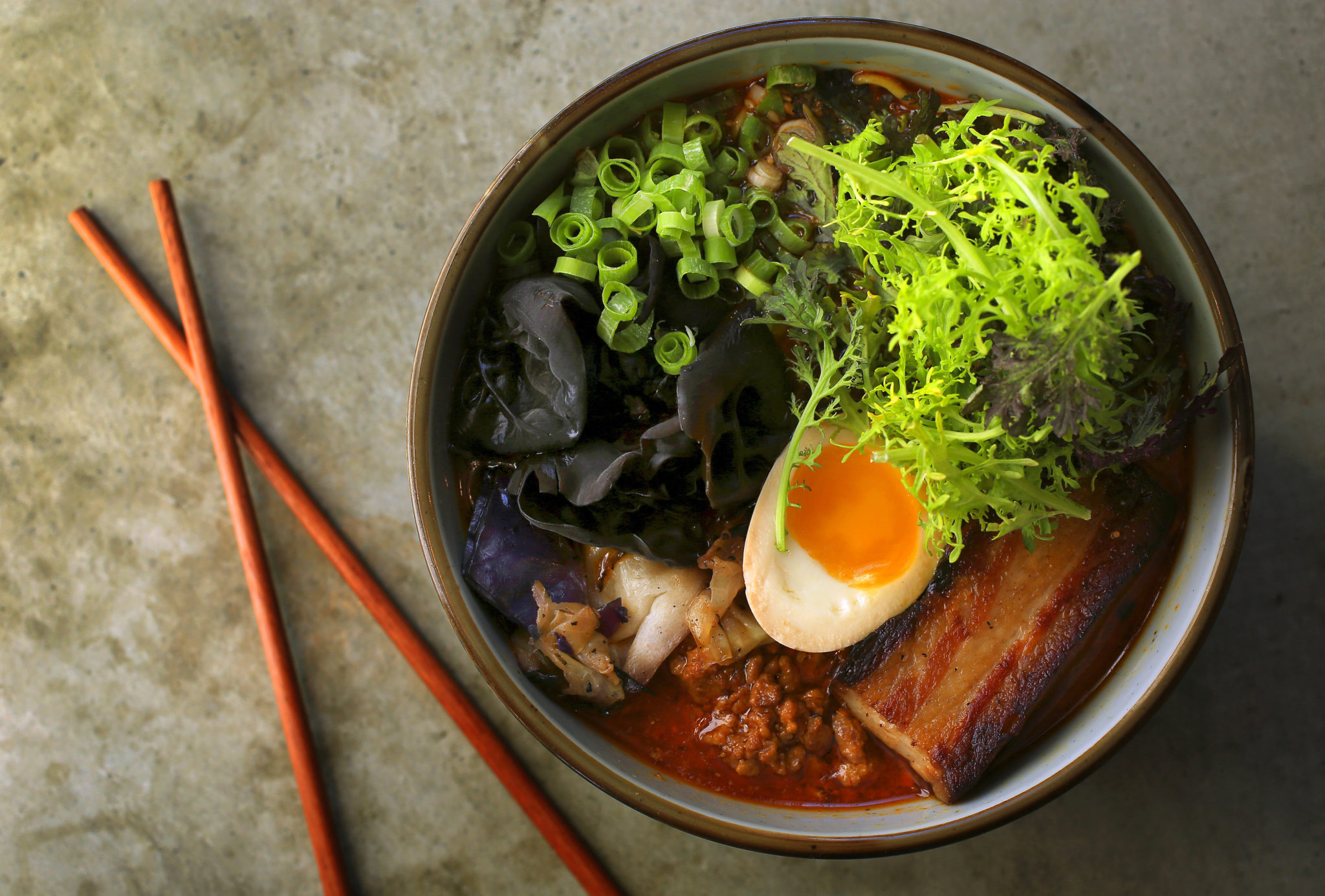
Order a warm bowl of delicious soup at one of Sonoma County’s restaurants. Favorites include the matzah ball soup with barbecue chicken thigh and ramen broth from Bird & The Bottle in Santa Rosa, and the Spicy Tan-Tanmen ramen with Sapporo noodle, pork belly chashu, spicy ground pork, six-minute egg, charred cabbage, woodear mushrooms, mustard frills and scallions from Ramen Gaijin in Sebastopol. Find more top soups here.
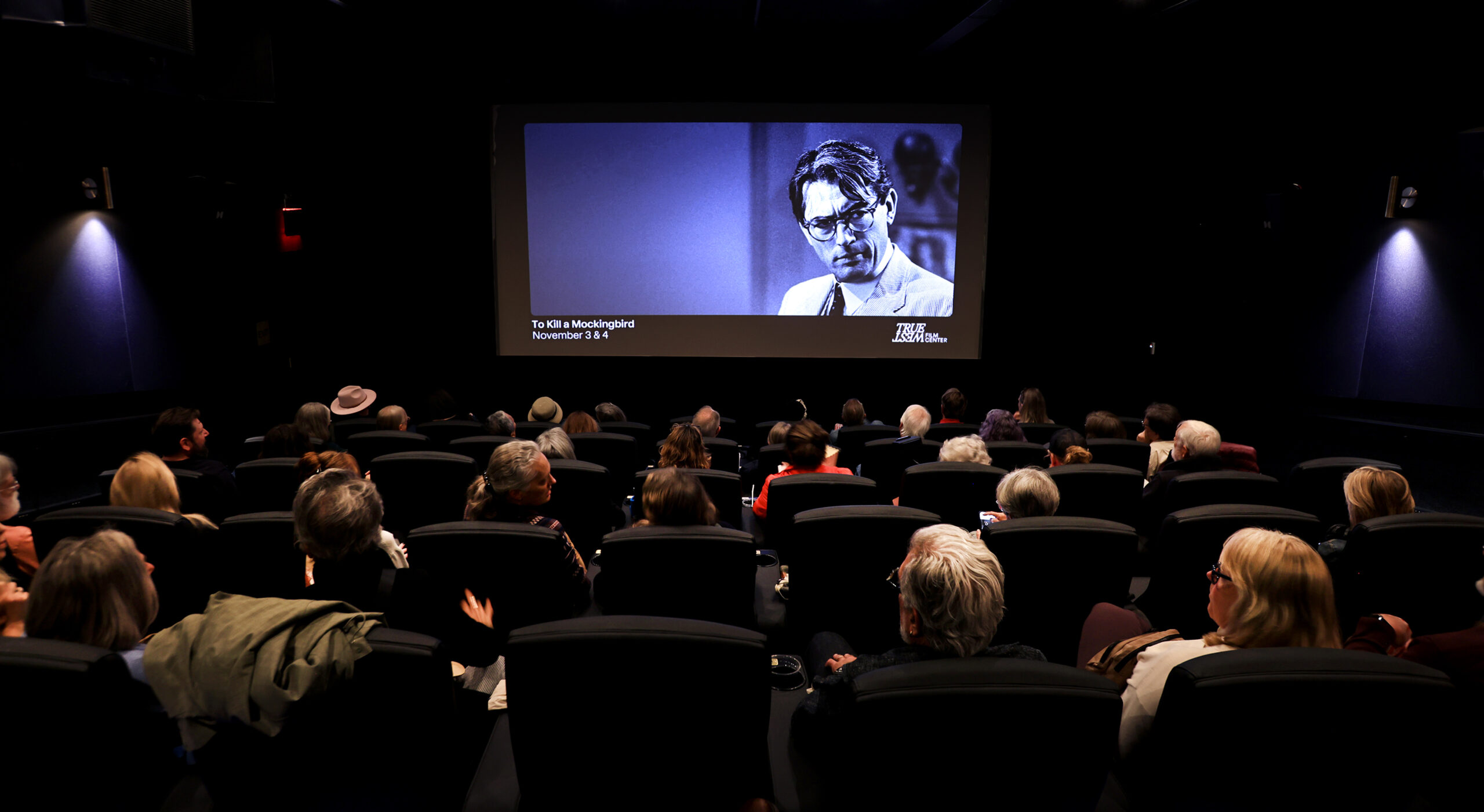
Spicy Tan Tan Ramen with Sapporo noodles, sesame, scallion, pork belly chashu, spicy ground pork, charred cabbage, wood ear mushrooms and a six-minute egg from Ramen Gaijin in Sebastopol. (John Burgess / The Press Democrat, file)During the True West Film Center grand opening, patrons wait for a short film to premier in the main theater, Saturday, Oct. 25, 2025, in Healdsburg. (Kent Porter / The Press Democrat)
Indie darlings
Catch a film at Rialto Cinemas in Sebastopol (6868 McKinley St.), Sebastiani Theatre in Sonoma (476 First St. E.) or the new True West Film Center in Healdsburg (371 Healdsburg Ave.). In addition to traditional movie concessions like popcorn and fountain drinks, True West offers moviegoers a curated list of local wines and select menu items from neighboring partner restaurants, such as Acorn Cafe, El Milagro, Lo & Behold and Troubadour.
Warm up with hot yoga
Take a hot yoga class at Energize Hot Yoga in Santa Rosa (522 Wilson St.), Sonoma Like It Hot in the town of Sonoma (721 West Napa St.), Yoga Hell in Petaluma (1484 Petaluma Blvd. N.), or one of the many other local yoga studios that offer Bikram yoga and other hot classes.
Energize Hot Yoga owner Rebecca Pennington leads a hot yoga class at her studio in Santa Rosa. (John Burgess / The Press Democrat, file)Russian River Brewing Company taproom in Windsor. (Wildly Simple / Sonoma County Tourism)
Cold brews, warm pubs
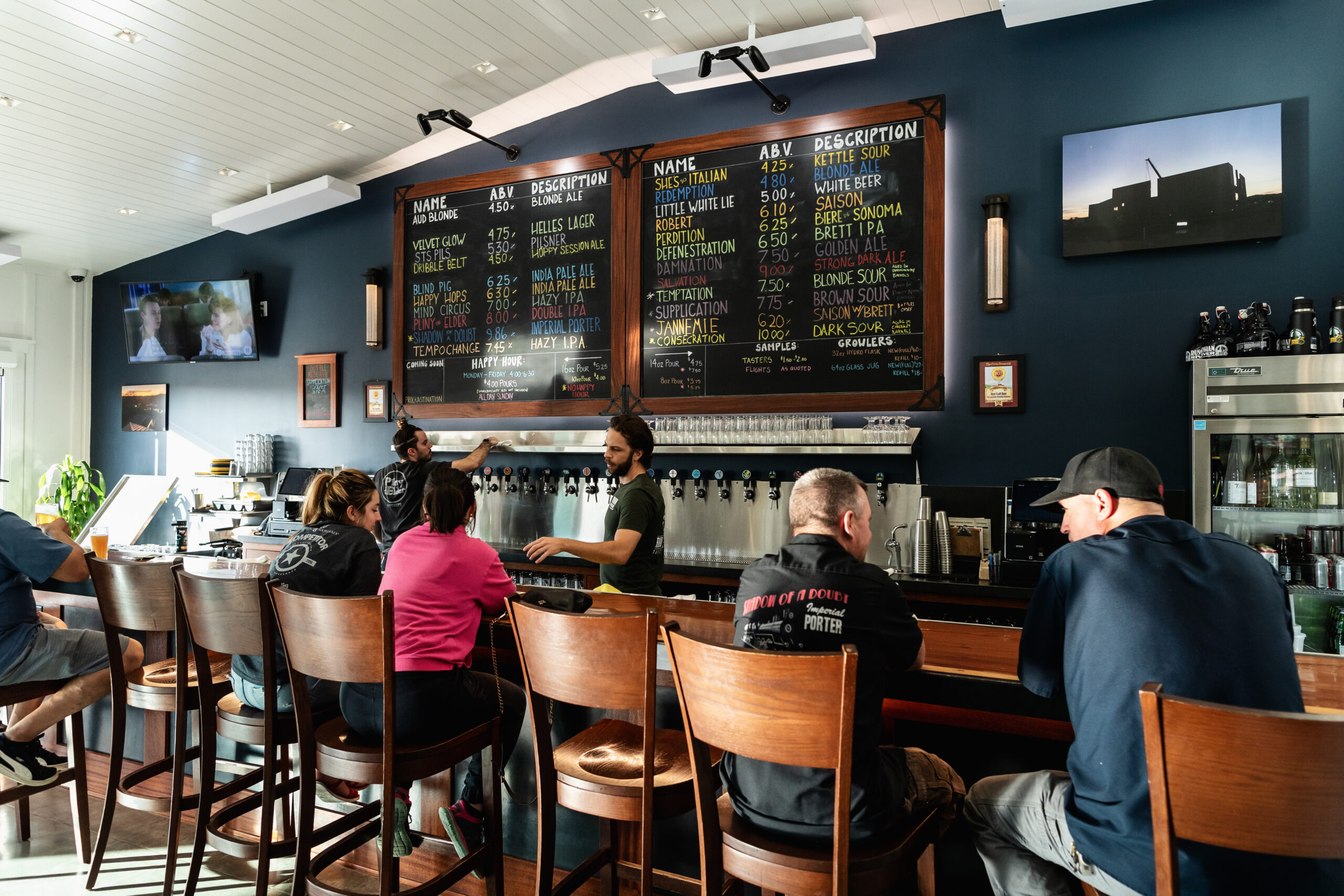
For a cool IPA and a warm environment, head over to one of the many breweries in Sonoma County. All of the Lagunitas staples are available on tap at the Petaluma brewpub, as well as harder to find styles. Flagship classics include Little Sumpin’, Lagunitas Pils, Hazy IPA and Brown Shugga. While you’re waiting for the annual release of Russian River Brewing Company’s Pliny the Younger, imbibe in the Elder IPA that remains on tap year-round at the Windsor and Santa Rosa brewpubs.
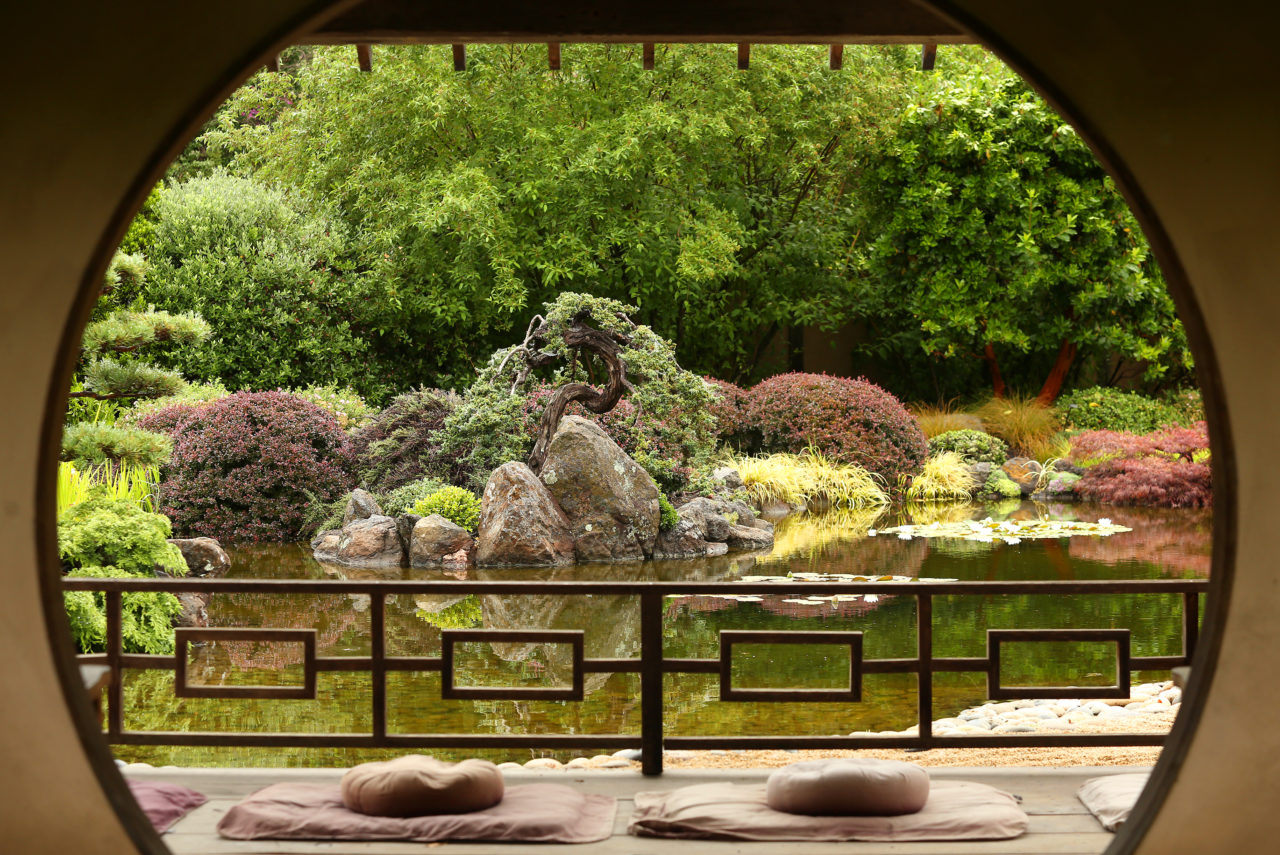
The meditation garden at Osmosis Day Spa in Freestone. (Christopher Chung / The Press Democrat, file)
Listen to classical music at Weill Hall or Schroeder Hall at Sonoma State University’s Green Music Center in Rohnert Park. The state-of-the-art concert halls serve as a home for Sonoma Bach and the Santa Rosa Symphony. The Sonoma County Philharmonic, an all-volunteer orchestra, presents free and low-cost concerts throughout Sonoma County.
Jenna Fischer and Maci Martell contributed to this article.
Marietta Cellars tasting room in Healdsburg. (Bryan Meltz)
There’s a good chance you’ve seen bottles of the California appellation Marietta Cellars Old Vine Red at local markets for well under 20 bucks. But there’s a more artisanal side to this 47-year-old Geyserville-based winery, showcased at Marietta’s first-ever tasting room in downtown Healdsburg.
The story
Marietta Cellars got its start in 1978, when Chris Bilbro founded the Dry Creek Valley winery and named it for his favorite aunt. Initially buying fruit from local growers, he built a reputation for making solid, affordable wines with integrity — including Marietta’s famous $19 red. Bilbro’s sons, Scot, Jake and Sam, grew up in the family business, so it was no surprise that all three found careers in the wine world. In 2012, Scot and Jake bought Marietta Cellars from their dad, and Sam founded Idlewild Wines. Now, as Marietta’s sole owner and winemaker, Scot Bilbro is adding exciting new dimensions to the business.
Farming 200 acres of vineyards in Sonoma and Mendocino counties, the winery makes about 35,000 cases per year, with small-lot wines reserved for the tasting room. Wines feature an intriguing array of varieties, including Zinfandel, Riesling and Trousseau.
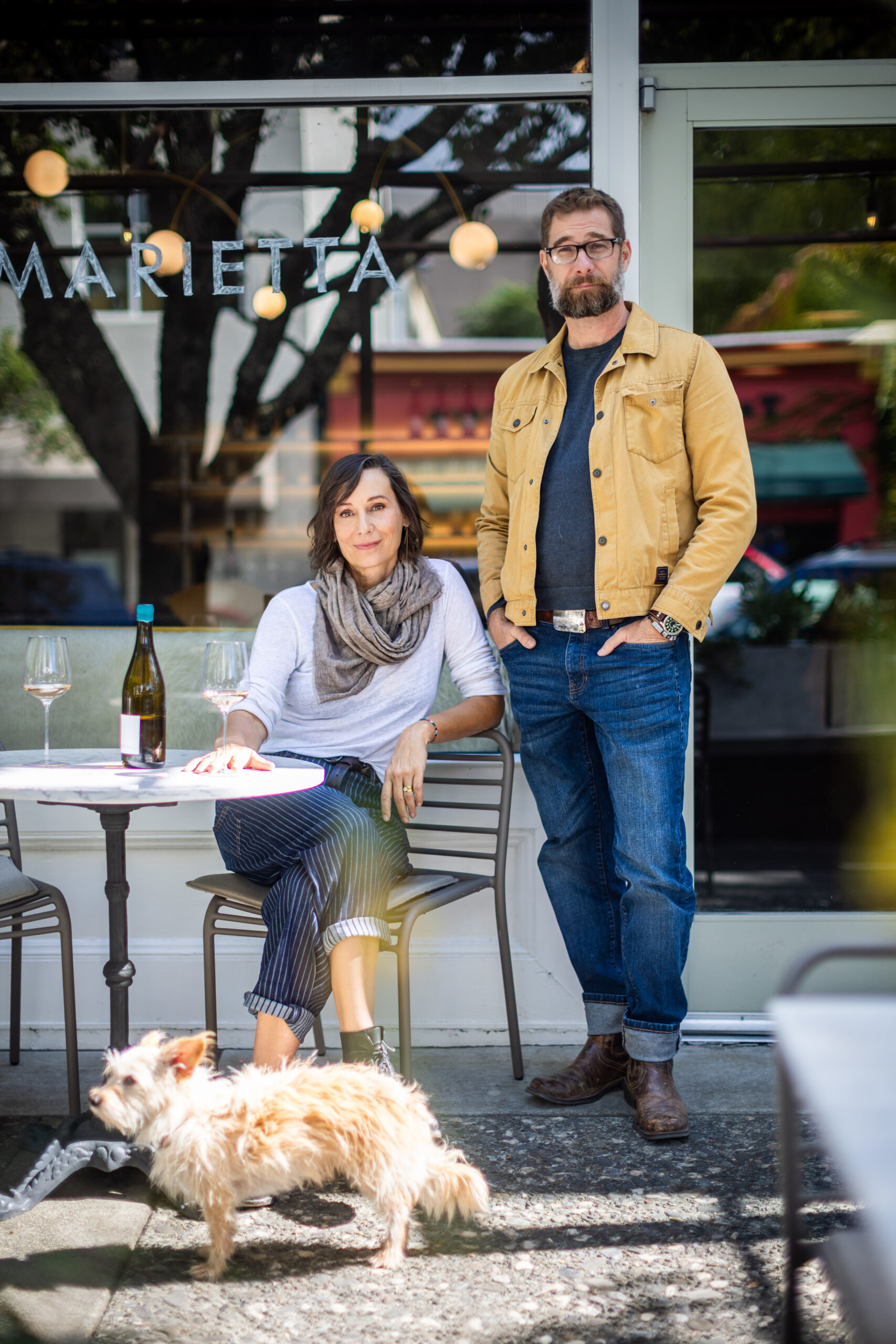
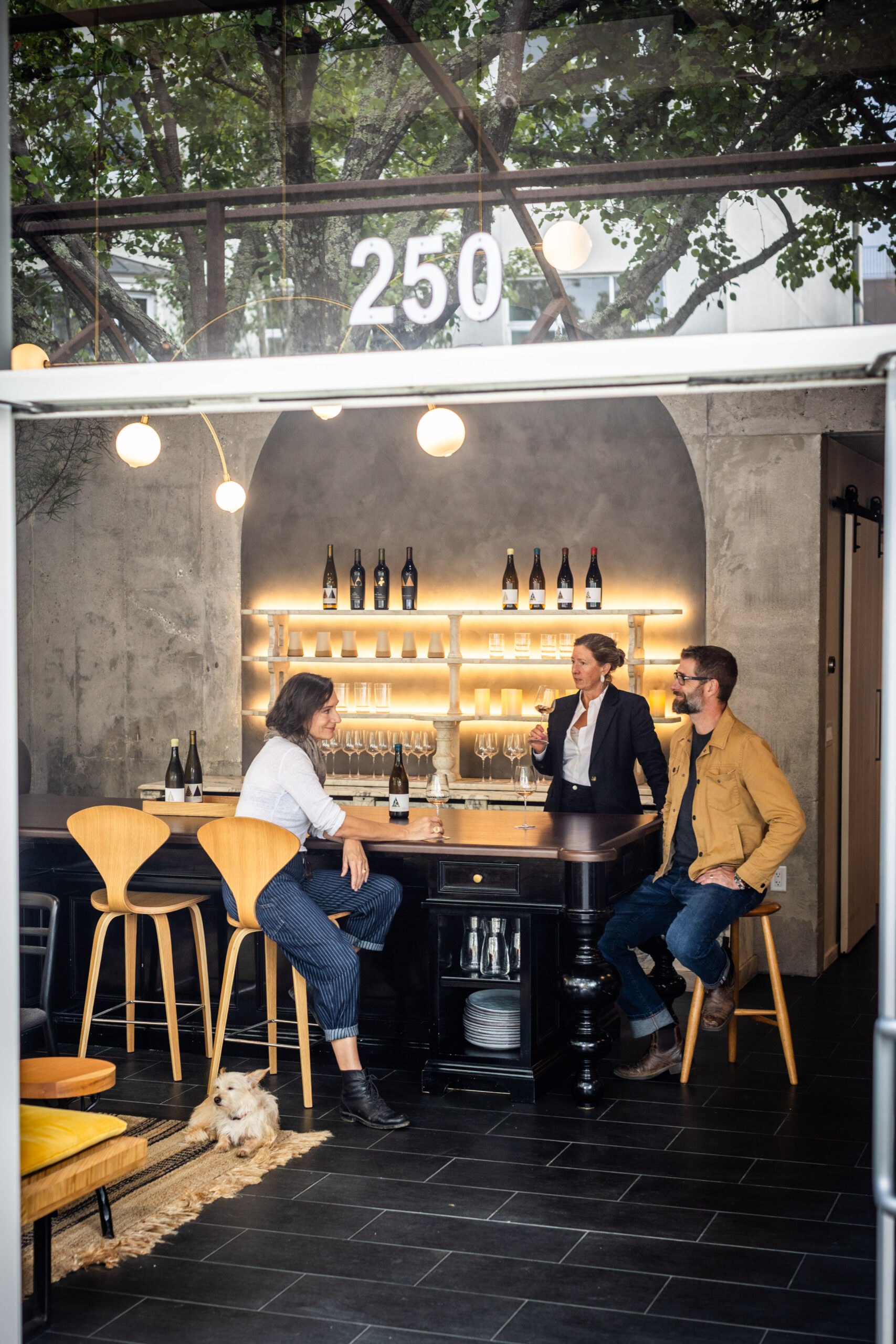
Lisa Steinkamp and Scot Bilbro at their Marietta Cellars tasting room in Healdsburg. (Bryan Meltz)
The vibe
Scot Bilbro and his wife, Lisa Steinkamp, opened the tasting room in late October just off the Healdsburg Plaza. The site was formerly a police station — the old holding cell is now Marietta’s bathroom — and, more recently, the tasting room for Roadhouse Winery.
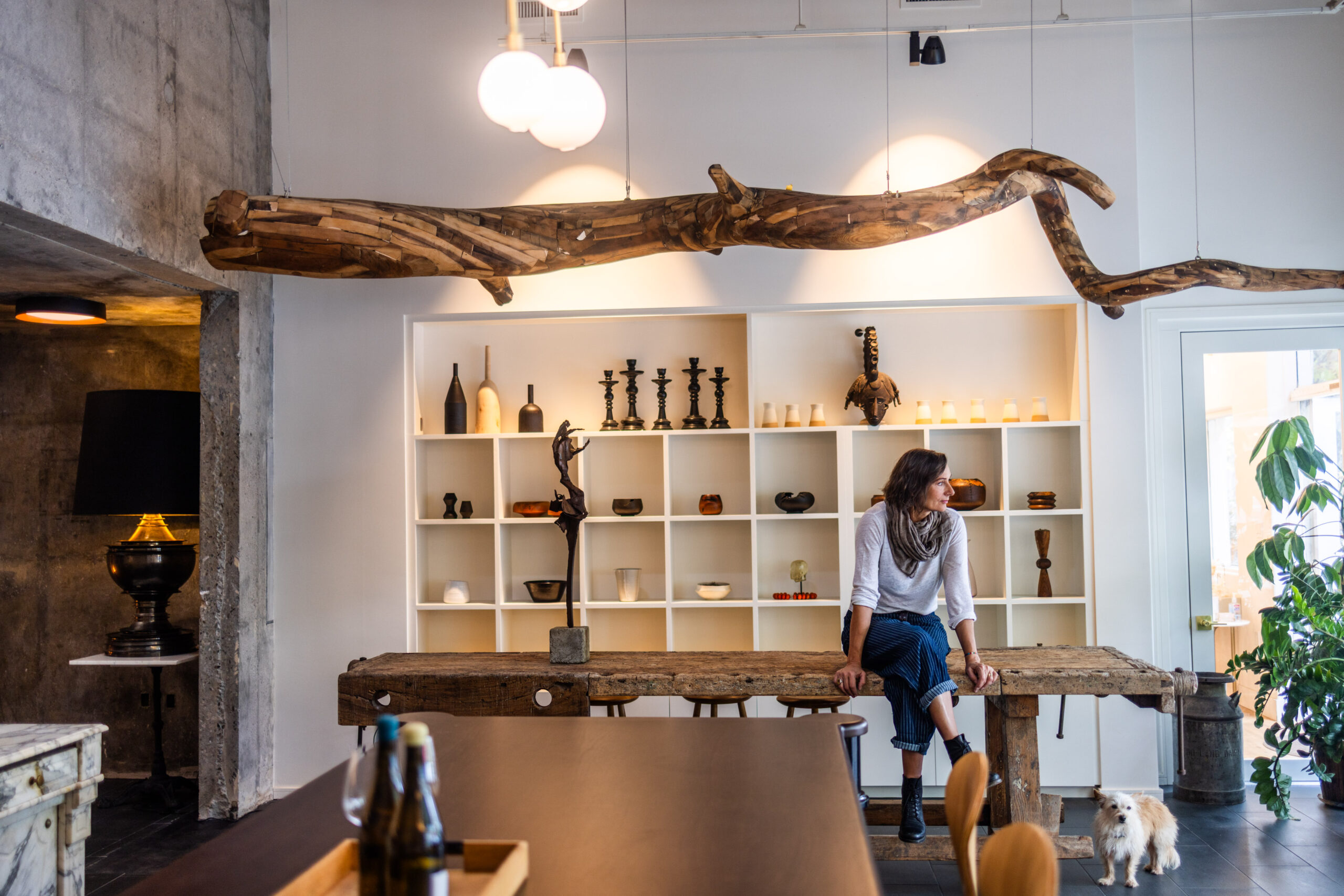
Steinkamp is an architectural designer and it shows in the bright, contemporary space. (One of her sketches hangs on the wall and her lovely watercolor paintings appear on Marietta’s wine labels.) All of the design choices are thoughtful and intentional, from the French marble hutch behind the bar to the wooden branch sculpture that hangs from the ceiling. Even the spittoons are custom-made by a local ceramicist — a former Buddhist monk.
Lisa Steinkamp inside the Marietta Cellars tasting room she designed in Healdsburg. (Bryan Meltz)Marietta Cellars tasting room in Healdsburg. (Bryan Meltz)
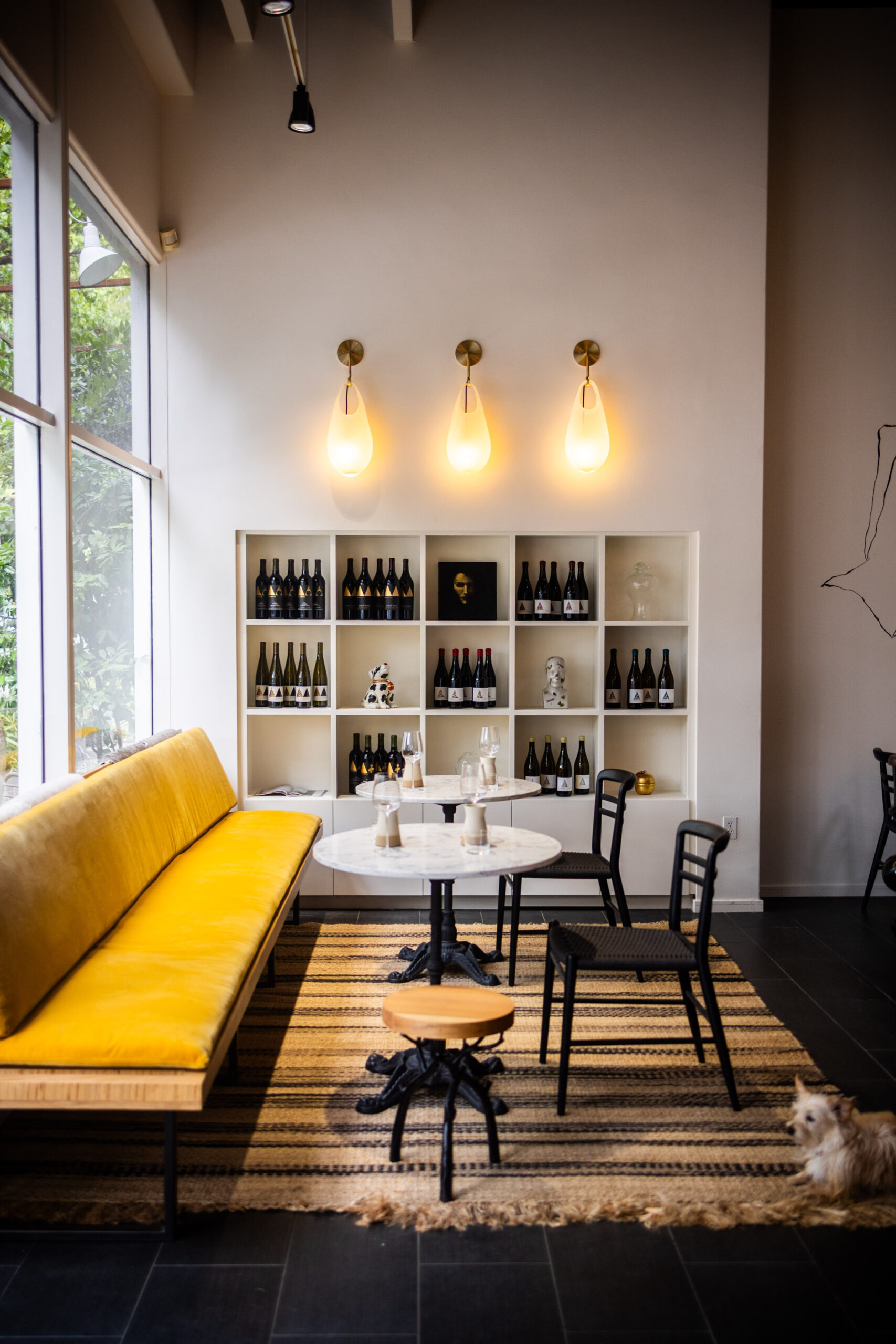
Seating includes a velvet banquette with marble-topped tables and a couple of bar seats. There’s also a sweet patio out front, with tables set under some leafy trees. The winery doesn’t currently offer food, but you can order from Acorn Café and have it brought over (Marietta shares a back door with the restaurant). Wines are available by the flight, glass and bottle, so visitors are welcome to stick around and relax. If you’re a dog person, as I am, you’ll enjoy meeting the couple’s bouncy pup, Harry.
On the palate
Although Marietta has some higher-production wines in distribution across the country, you won’t find them here. This is a chance to taste Bilbro’s small-lot wines, which he describes as both personal and emotional.
Marietta Cellars tasting room in Healdsburg. (Bryan Meltz)
The tasting room offers two different flights for $35 each. The Place sampling features single-estate wines made in a more traditional style. The Presence tasting highlights Marietta’s “Etta” series of playful, esoteric wines. All selections are made with neutral oak, which highlights the purity of the fruit and adds texture.
The Etta 2023 Gris ($42) immediately hooked me with its pale, coppery color. A blend of Grenache and Trousseau, the wine has peachy hints and a nice balance of acidity and body. I loved the Nadi 2022 Wirz Vineyard Dry Riesling from Cienega Valley ($38) for its golden color, stone-fruit aroma and racy energy. The 2022 Gibson Block Red from McDowell Valley ($58) is made from Syrah vines planted in 1918, along with Grenache, Petite Sirah and Alicante. Its deep color, structure and dark fruit flavors call out for a pan-seared steak.
Beyond the bottle
To keep the laid-back, artsy vibe going, catch a movie at the new True West Film Center. The three-screen theater showcases “art house” flicks and new releases, offering big, comfy seats and — in true Healdsburg fashion — a sommelier-designed selection of wines from the Alexander, Dry Creek and Russian River valleys. Moviegoers can also preorder food from Acorn Café, El Milagro, Journeyman Meat Co., Lo & Behold and Troubadour.
Marietta Cellars is open 11 a.m. to 5 p.m. daily. 250 Center St., Healdsburg. 707-433-2747, mariettacellars.com
Tina Caputo is a wine, food, and travel journalist who contributes to Sonoma magazine, SevenFifty Daily, Visit California, Northern California Public Media, KQED, and more. Follow her on Bluesky at @winebroad.bsky.social, view her website at tinacaputo.com, and email her story ideas at tina@caputocontent.com.
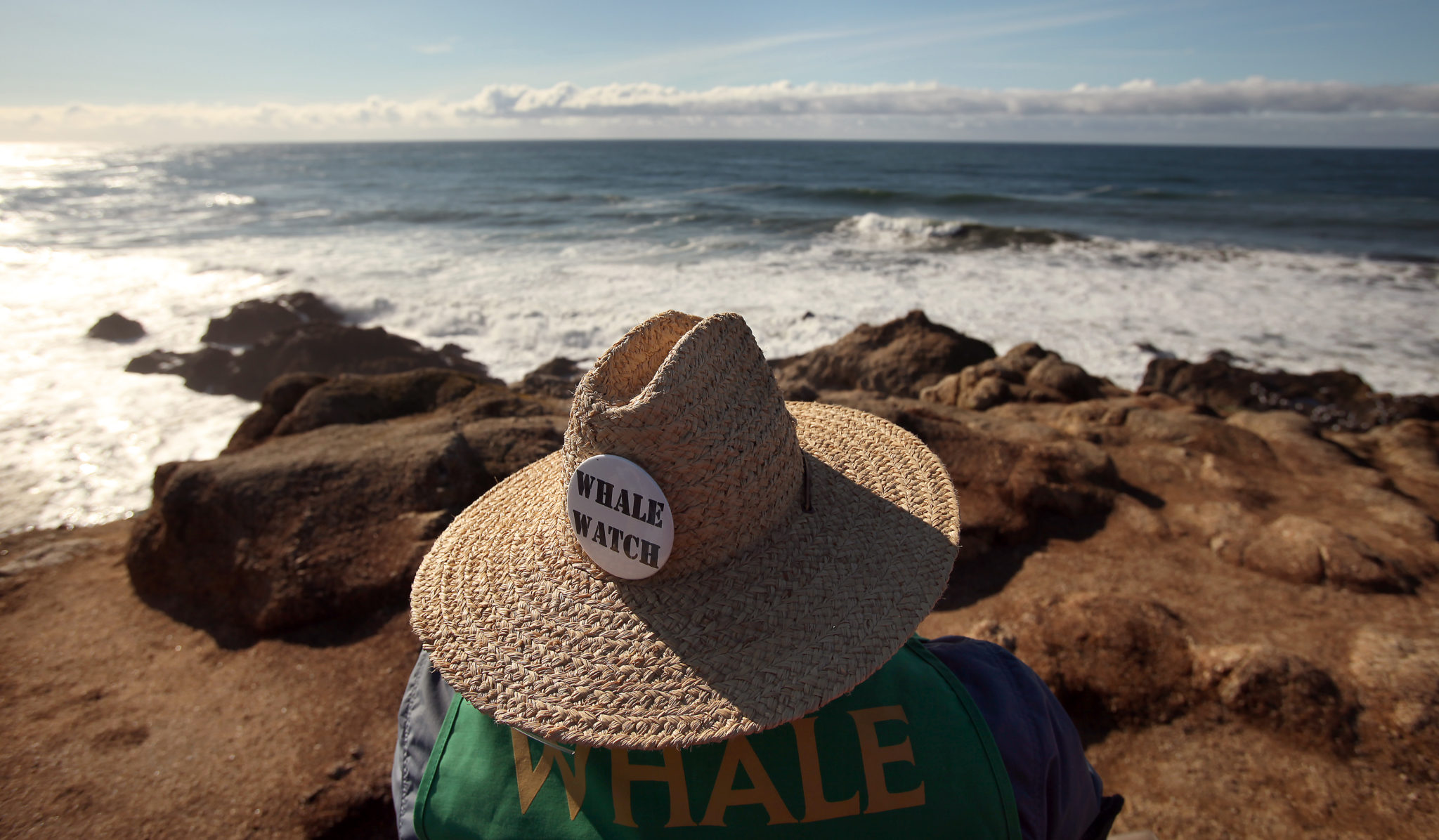
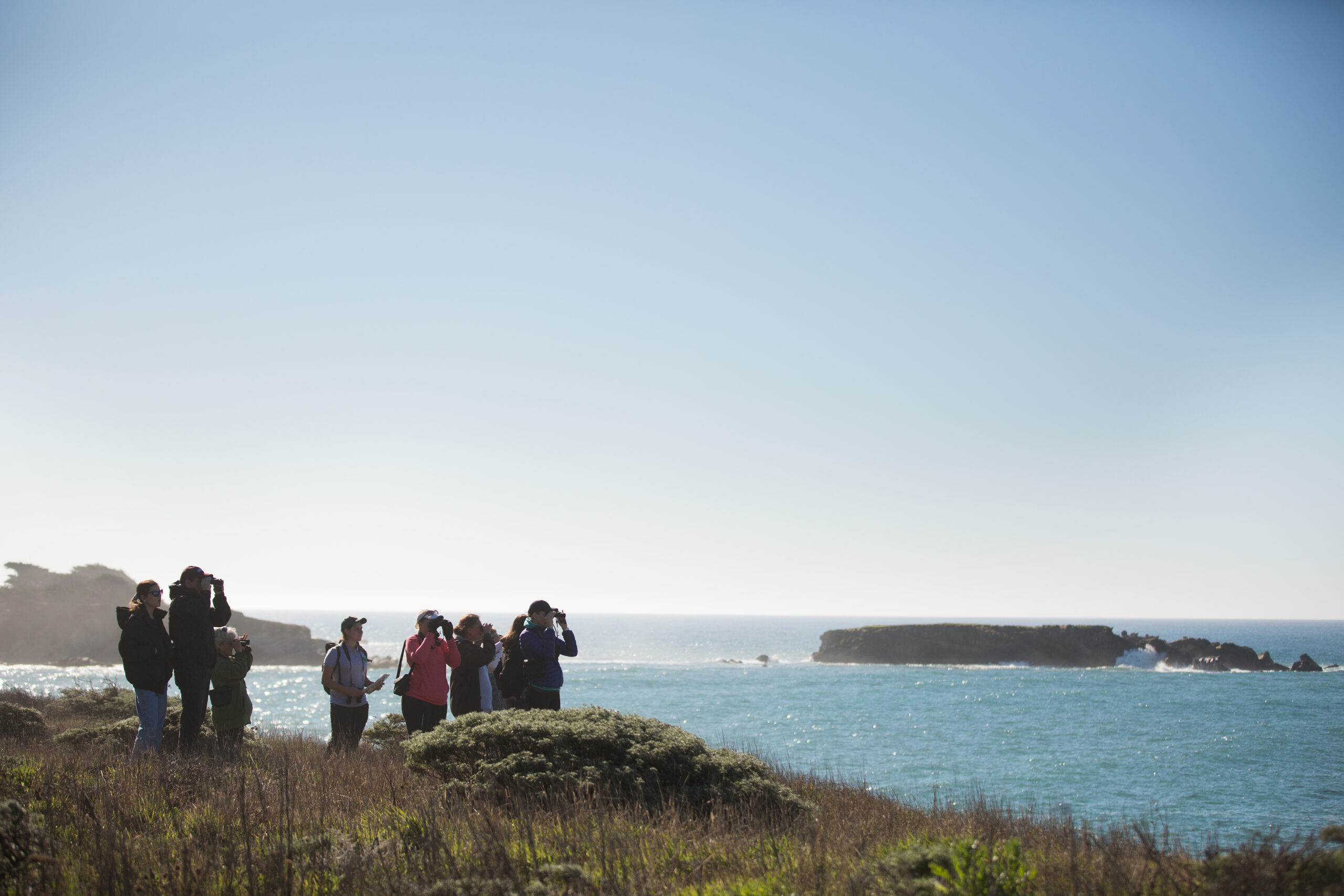
Whale Watch volunteer Larry Tiller, of Healdsburg, watches the horizon for spouts from Bodega Head on Sunday, Jan. 6, 2013. (Christopher Chung / The Press Democrat, file)
Twice each year, thousands of gray whales pass along the California coast as they swim south to breeding lagoons on the west coast of Baja California during winter months, then back to their summer feeding grounds in the Arctic’s Bering Sea in spring. The round trip for these sea giants is roughly 12,000 miles and is considered one of the longest among mammals.
In 2016, NOAA estimated the eastern North Pacific gray whale population to be nearly 27,000, one of the highest recorded estimates since 1967. However, the population has been steadily decreasing in recent years — the estimate for 2024-25 was between 11,700 to 14,450 whales, according to NOAA. The agency suggests “recent and continued environmental changes in the Arctic and sub-Arctic feeding grounds could be impacting population resilience.”
As NOAA continues to monitor the Pacific whale population, Sonoma County residents can do their part, too. Docents from the Stewards of the Coast and Redwoods’ Whale Watch Program recently started a Facebook group, Sonoma Coast Whale Watch, to share educational information about whales and for the public to post current sightings. The Facebook page is dedicated to Larry Tiller, a volunteer docent for over 20 years who died in July 2025.
Late Whale Watch volunteer Larry Tiller, of Healdsburg, watches the horizon for spouts from Bodega Head on Sunday, Jan. 6, 2013. (Christopher Chung / The Press Democrat)
If you’d like to witness the whales’ inspiring journey, the peak months for whale watching are January through May. If the weather is good, whales can be seen within a few hundred yards of coastal headlands. During spring migration, even little whales are a big deal, as the recently born calves cavort with their mothers on their way back to colder waters.
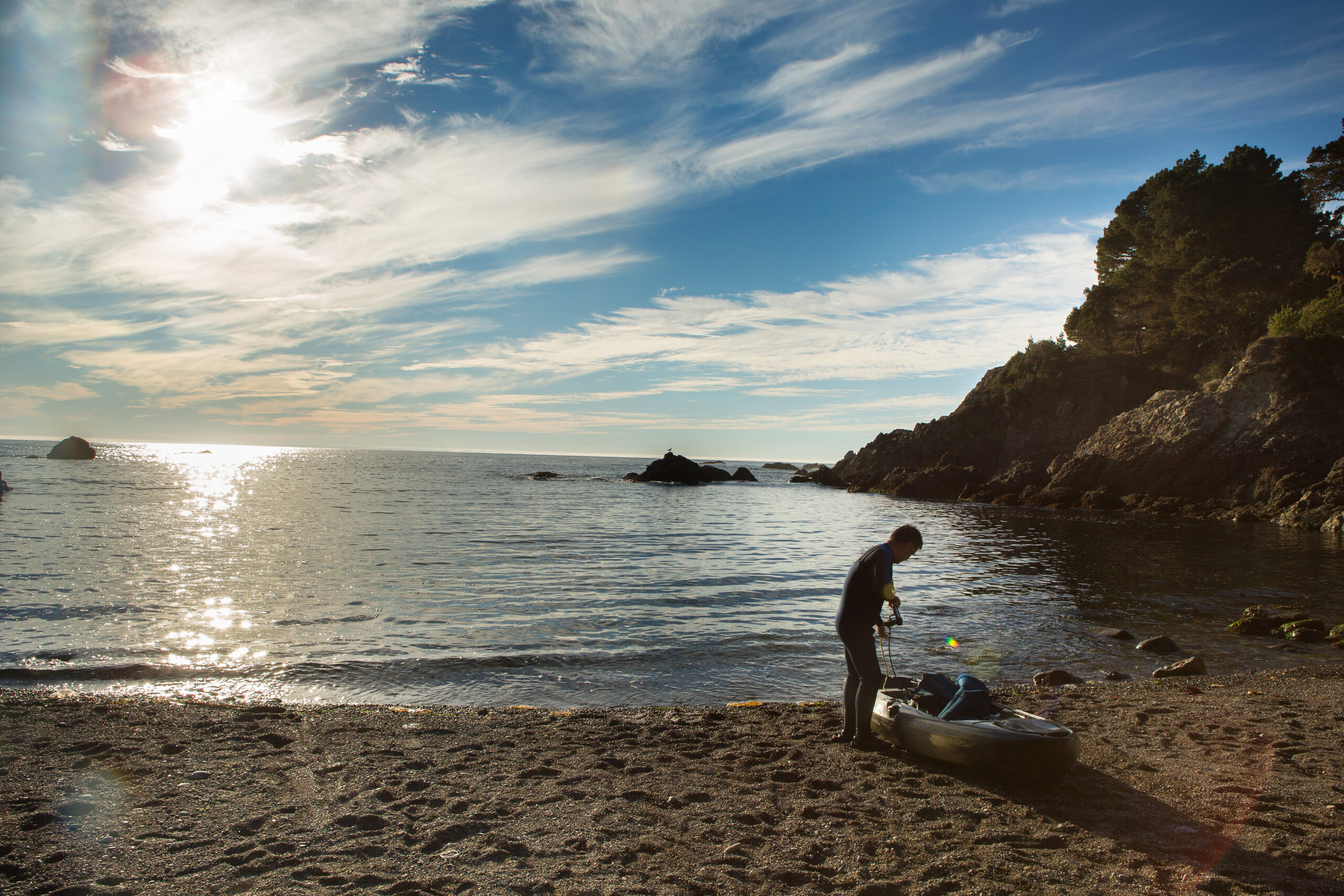
Here are our favorite spots for prime whale viewing along the Sonoma Coast.
PLEASE NOTE: Always read and obey warning signs along the coast. Ocean conditions can change quickly, and the absence of a particular sign does not mean there is no threat of hazardous conditions. Always keep a safe distance to the ocean and be careful when looking through binoculars and taking photos while near steep bluffs.
Gualala Point Regional Park
Bordering the Gualala River and Mendocino County, this oceanfront park marks the northernmost point on the Sonoma Coast. During whale migration season, many visitors will head to Whale Watch Point, which offers excellent views of the ocean, weather permitting. Parking is $8; free for regional park members. 42401 Highway 1, Gualala, parks.sonomacounty.ca.gov
Whale watching at Gualala Point Regional Park on the Sonoma Coast. (Sonoma County Tourism)The Sea Ranch Coastal Access Trails on the Sonoma Coast offer a chance to see migrating whales. (Sonoma County Tourism)
Sea Ranch Coastal Access Trails
Just south of Gualala, The Sea Ranch extends for 10 miles along the Sonoma Coast. The headlands here offer views of the sea, the rugged coastline, and — if you’re lucky — migrating whales. The Sea Ranch is a private community but six public access trails, managed by Sonoma County Regional Parks, give visitors a chance to experience this area and catch a glimpse of its wildlife. Parking is free. The Sea Ranch, off Highway 1 south of Gualala, parks.sonomacounty.ca.gov
Stillwater Cove Regional Park in Jenner offers views of the Pacific and a vista point for whale watching. (Sonoma County Tourism)
Stillwater Cove Regional Park
About 15 miles south of the Sea Ranch, Stillwater Cove features hiking trails through redwood forests and along ocean bluffs. Just north of the cove, the Stillwater Bluff Trail curves above the rocky coastline and offers views of the Pacific and a vista point for whale watching. Parking is $8; free for regional park members. 22455 Highway 1, Jenner, parks.sonomacounty.ca.gov
Bodega Head
One of the prime whale-watching spots in Sonoma County, the steep and rocky bluffs of this peninsula offer sweeping views of the ocean. January through May, volunteers from the Whale Watch public education program are stationed in this part of the Sonoma Coast State Park on weekends (10 a.m. to 2 p.m.) to answer questions and share their knowledge about whales. By early summer of 2026, the Stewards of the Coast and Redwoods plan to expand the program to include humpbacks, which migrate to the Sonoma Coast area to feed from about July to October, according to Whale Watch docent program coordinator Jenifer Piccinini. Parking is free. Off Highway 1, Bodega Bay, parks.ca.gov
A pair of gray whales make their way north during their migration past Bodega Head on Thursday, May 1, 2014. (Christopher Chung / The Press Democrat)A pair of gray whales make their way north during their migration past Bodega Head on Thursday, May 1, 2014. (Christopher Chung / The Press Democrat)
Whale watch from a boat, Bodega Bay
For a chance to get closer to the whales, while remaining at a safe distance, book a whale watching tour with a local fishing charter company. Companies like Bodega Bay Sportfishing and Miss Vic Sportfishing offer tours departing from Bodega Bay. Rates for Miss Vic’s whale watching charters are $600 for four to six people.
Snow clings to dormant trees, Tuesday, Feb. 5, 2019, off Geysers Road. (Kent Porter / The Press Democrat)
Inside every sleeping apple or pear tree is an internal clock, ticking down the darkest days of winter. Each hour of cold below about 45 degrees Fahrenheit is marked until the timer hits zero and the tree awakens, primed for the warmth of spring.
Not really, but that’s as good a way as any to think about winter dormancy in fruit trees — and many other plants, too. If you’ve ever scratched your head about chill hours while shopping for the latest addition to your home orchard, you’re not alone. Sunlight, preferred soil type, and watering requirements are straightforward and easy to understand.
But winter chill is more abstract. We don’t have an easy way to measure it, and we’re not nearly as attuned to this requirement as the trees are. Plus, the whole concept is almost counterintuitive: We’re more accustomed to considering heat requirements for sweeter fruit.
“Chill hours are pretty important, because if plants don’t get enough, they may not have a successful flowering and fruiting the following spring,” says Jerry Wilson, a nursery manager with Harmony Farm in Sebastopol.
At the risk of glossing over some fascinating science, the gist of it is this: Winter chill requirements are an evolutionary adaptation plants use to determine when the worst is over and it’s safe to break dormancy before the longer, warmer days of spring.
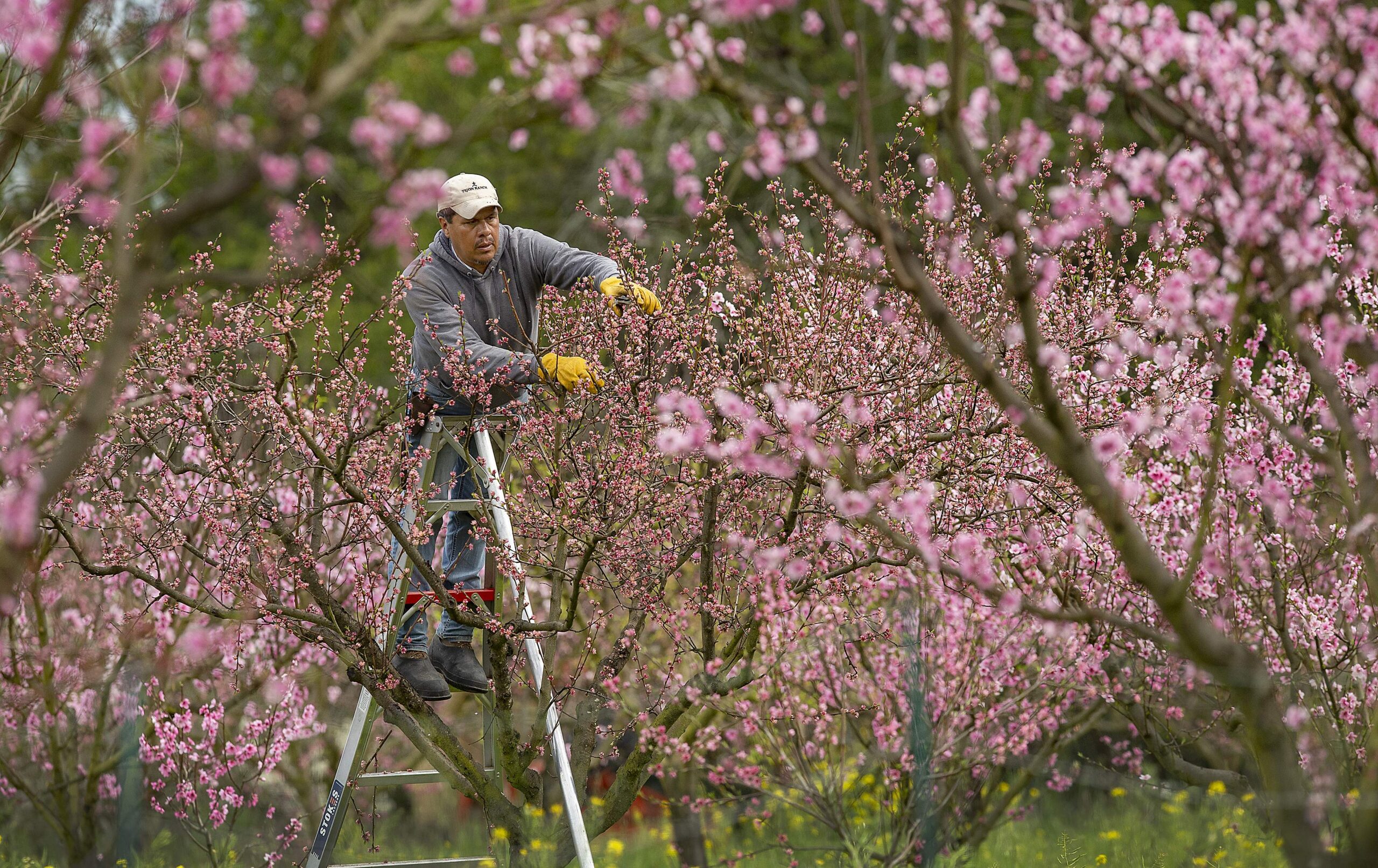
Luis Alcaraz prunes peach trees on the last day of winter in the Dry Creek Valley. (John Burgess / The Press Democrat, file)
Chill needs are most commonly discussed in reference to fruit and nut trees, but they’re a feature of almost all perennial plants originating in the temperate latitudes, including most of North America, Europe, and the far reaches of South America.
Within this group there’s incredible variation, Wilson says, from the pomegranate, originating in the mountains of the Middle East (200 hours or less), to Northern highbush blueberries, native to the northeastern U.S. (up to 1,000 hours).
Among ornamentals, European lilacs, herbaceous peonies, and witch hazel all have significant chill requirements. So do tulips and other bulbs, notes Harmony Farms sales manager Patty Hamilton. “A lot of times we’ll tell people to put them in the refrigerator for a couple weeks before they plant them,” she says. That’s not to preserve them; it’s to add more hours to the chill ledger.
An easy workaround with ornamentals is to plant natives — such as California lilac, or ceanothus. Beyond being friendly to native pollinators and other wildlife, they’re also genetically adapted to our weather, not someone else’s.
Unharvested apples on remaining apple trees at the Twin Hill Ranch near Sebastopol, Thursday Dec. 19, 2013. (Kent Porter / Press Democrat, file)
That said, Wilson and Hamilton stress, Sonoma County is a land of microclimates, from the low-chill, moderate-winter environs of Bodega Bay and Jenner (as little as 700 hours, enough for perfect Burbank plums) to the high-chill, cold-winter valleys of Santa Rosa and Sonoma (more than 1,500 hours, plus sufficient heat for oranges and tangerines). So whether we’re talking fruit trees, California natives, or non-native ornamentals, it’s crucial to consider our own unique weather patterns.
“Chill hours are a factor, but I wouldn’t say they’re the deciding factor,” Wilson says. “Every garden is its own climate.”
Boeuf Bourguignon at Walter Hansel Wine Bistro in Santa Rosa. (Chris Hardy/For Sonoma Magazine)
Despite ongoing challenges for the restaurant industry — rising food costs, staffing shortages, slower foot traffic and diners pushing back on creeping prices — many restaurateurs are still hanging on.
While Sonoma County saw a significant number of closures this year, more than in 2024, there was also encouraging movement in the other direction. Several restaurants reopened under new ownership, and others quickly found new tenants poised to take their place in 2026.
Restaurant ownership remains a tough game, even for the hardiest souls, but in 2025 openings ultimately outpaced closures. Rosso returned just months after closing, as did Bazaar Sonoma and Downtown BBQ. There were also big, successful swings, including Charlie Palmer’s Folia at Appellation Healdsburg and Waterhawk Lake Club in Rohnert Park, alongside smaller wins from pop-up standouts like Bob Costarella of Red Eye Barbecue.
Still, the losses sting. It’s heartbreaking to see longtime favorites disappear and just as painful to watch promising newcomers that never quite found their footing. Behind every closure are restaurateurs who poured blood, sweat and savings into a dream that didn’t survive.
Here are the Sonoma County restaurants we lost in 2025.
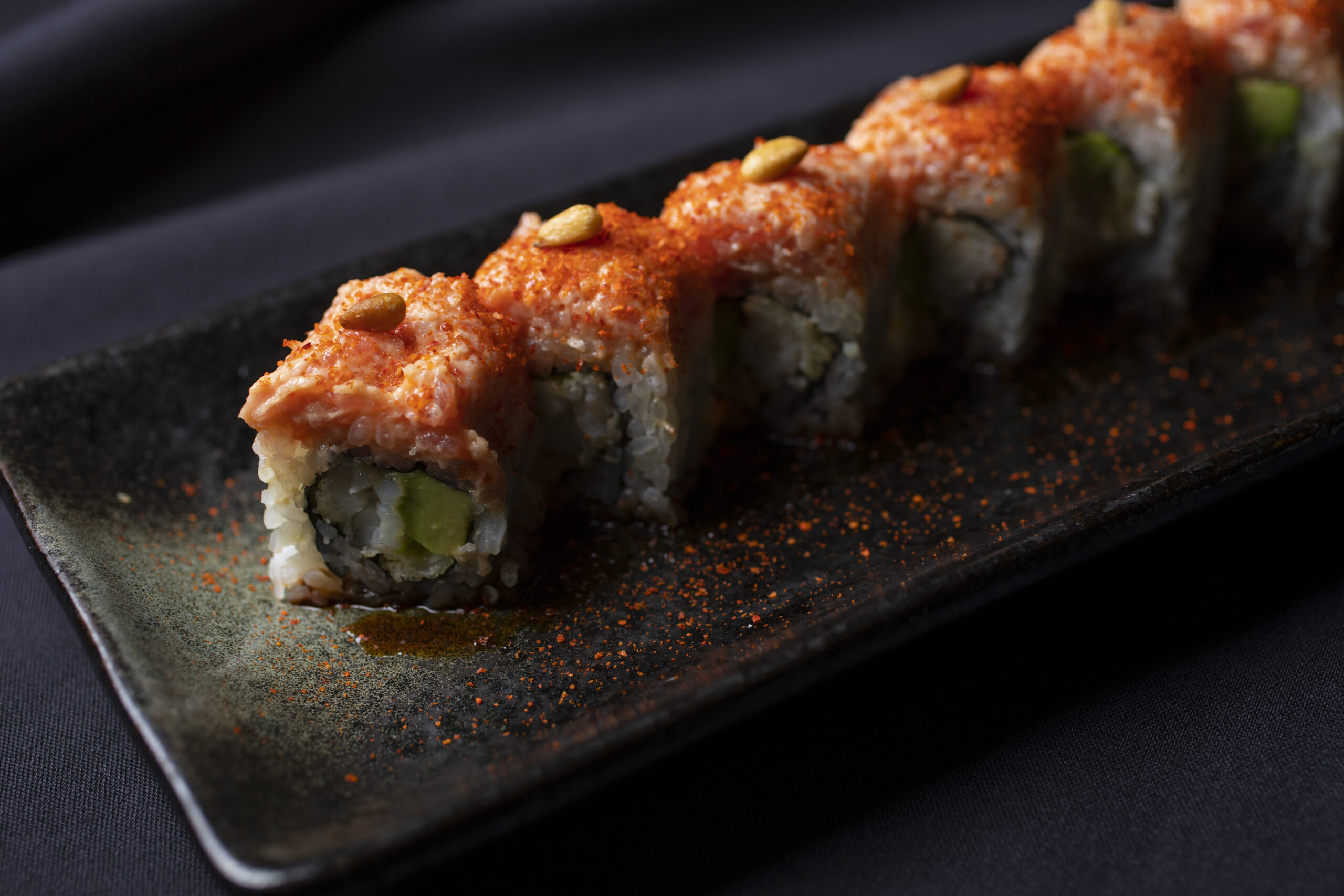
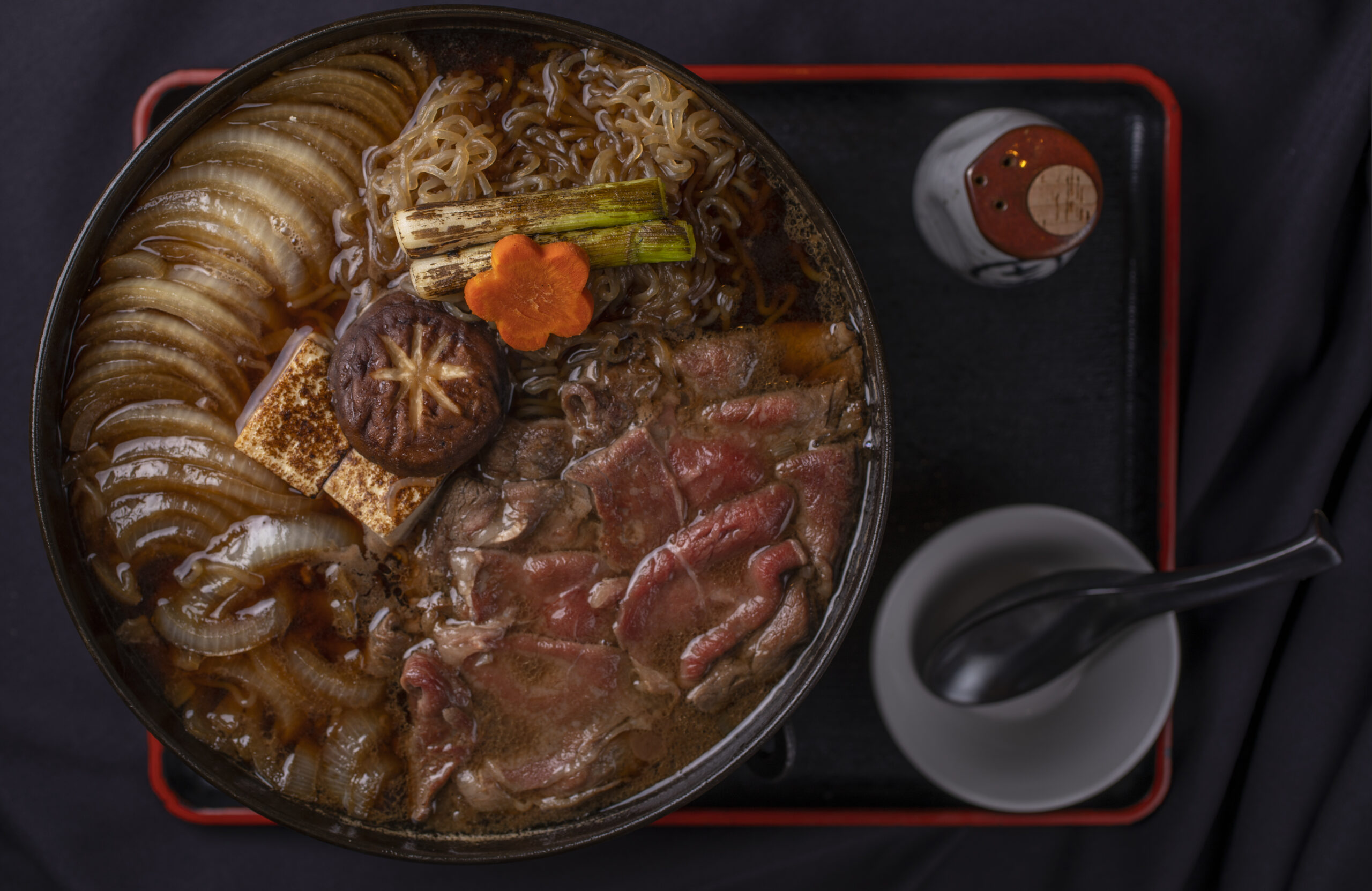
Ken’s Roll at Hana Japanese Restaurant in Rohnert Park Sept. 21, 2022. Hana closed in January of 2025. (Chad Surmick / The Press Democrat)Sukiyaki at Hana Japanese Restaurant in Rohnert Park Sept. 21, 2022. (Chad Surmick / The Press Democrat)
Hana Japanese (January): Known for its affable founding chef Ken Tominaga and authentic cuisine, the Japanese restaurant unofficially closed in January. It wasn’t until August that Tominaga’s widow, Emiko, announced the official closure, saying the family worked for three years to keep the restaurant open following Ken’s death before making the difficult decision to close. The Hana legacy carried on with a ramen pop-up with Bazaar Sonoma in August and promises of future collaborations. 101 Golf Course Drive, Rohnert Park
Tipsy Taco (March): The former Acapulco Restaurant & Cantina has seen a handful of restaurant concepts come and go at its downtown Santa Rosa location with the taqueria being its latest tenant. No replacement has been announced. 505 Mendocino Ave., Santa Rosa
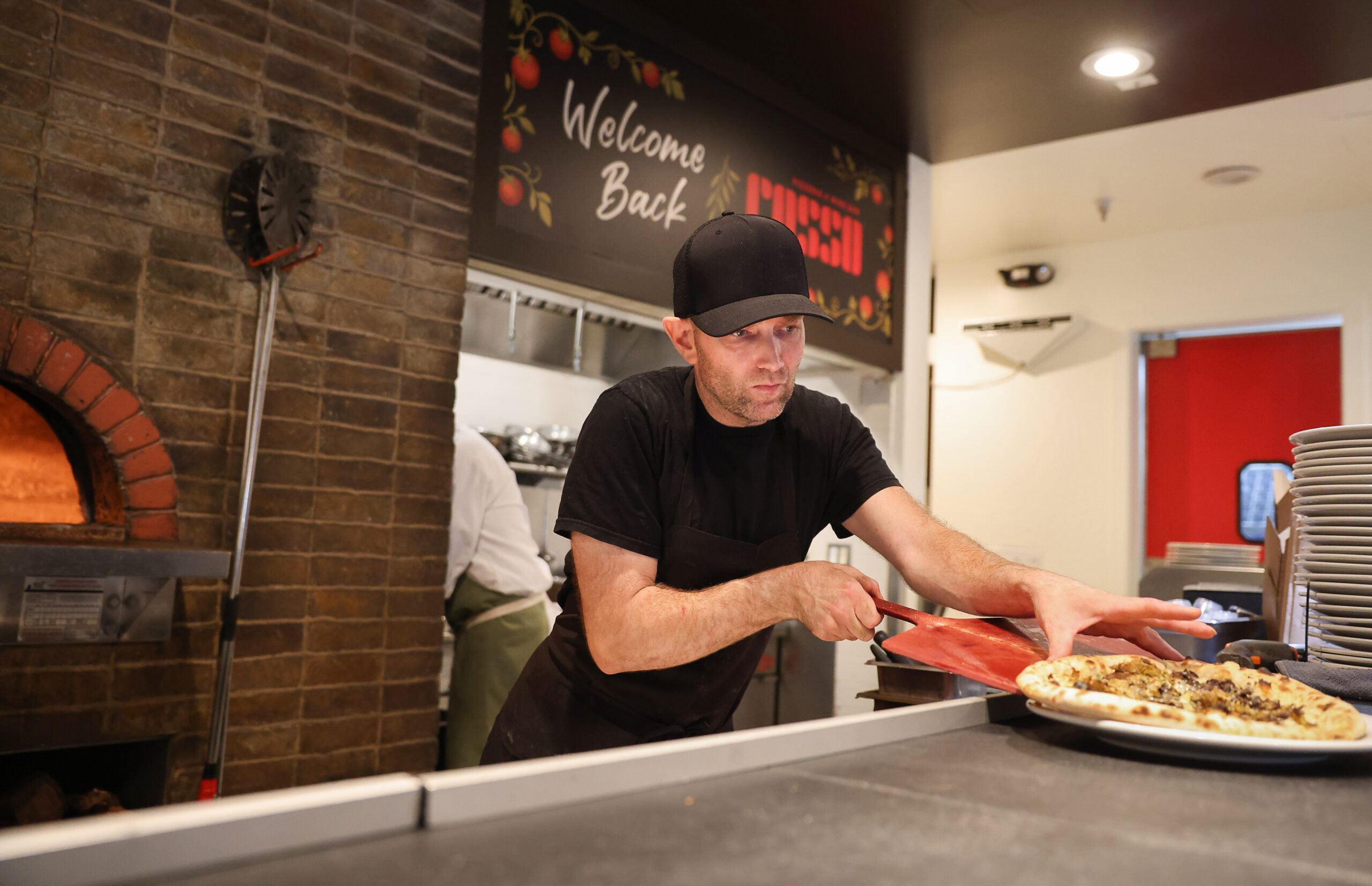
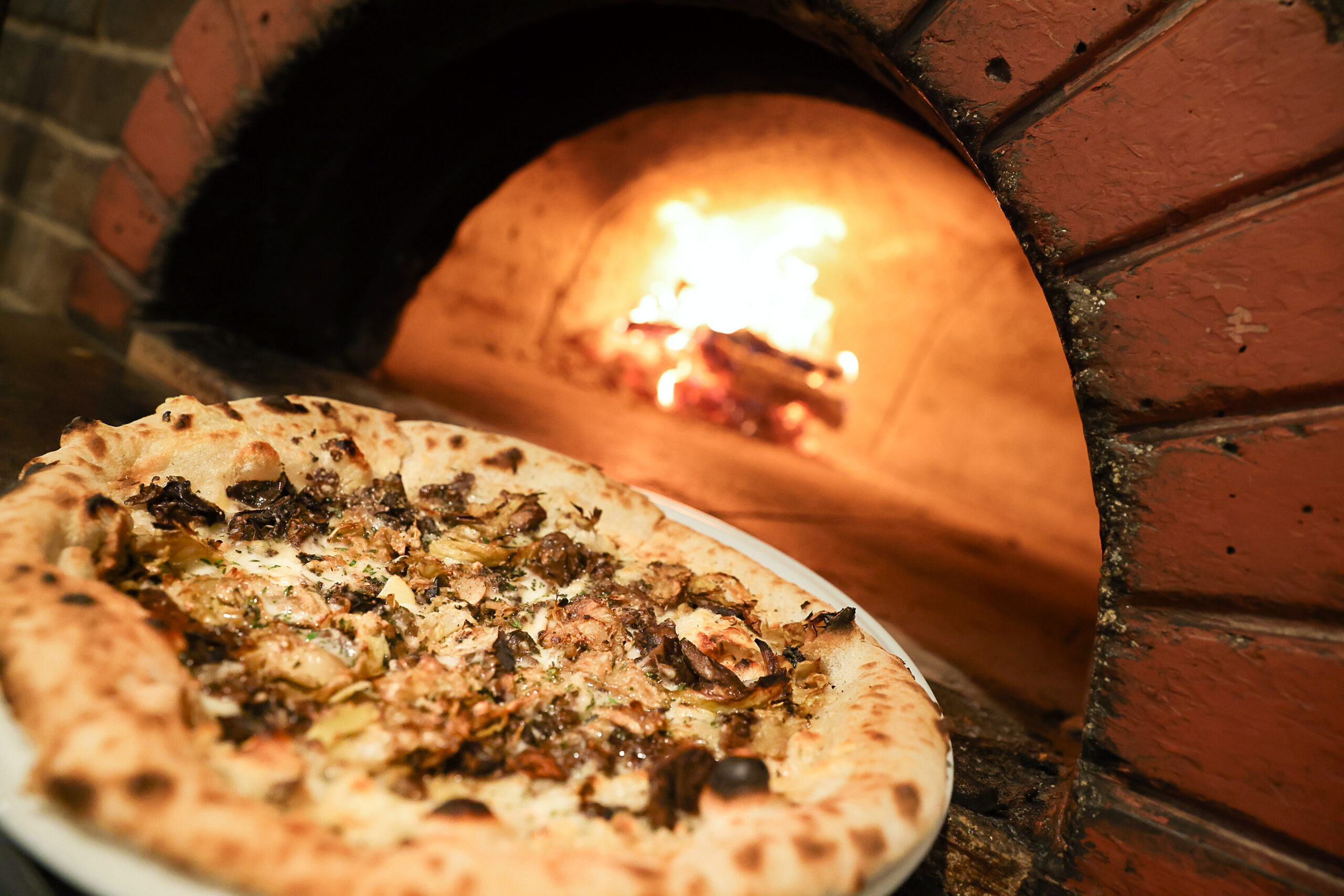
Basu Slade slides a pizza onto a plate at Rosso Pizzeria & Wine Bar in Santa Rosa on Tuesday, Sept. 30, 2025. Rosso closed in March and reopened in September. (Christopher Chung / The Press Democrat)Fungi limone pizza at Rosso Pizzeria & Wine Bar in Santa Rosa on Tuesday, Sept. 30, 2025. (Christopher Chung / The Press Democrat)
Rosso (March, reopened September): When Santa Rosa’s Rosso Pizzeria and Wine Bar closed its doors in March, it felt like the end of an era. Opened in 2009 by chef John Franchetti, formerly of Tra Vigne, and Kevin Cronin, the wood-fired pizza shop had built a loyal following with its focus on simple Italian cooking and seasonal, local ingredients. Franchetti insisted that everything — from dough to burrata — be made in-house. But Rosso was too inimitable to go gently into that good night.
Less than seven months later, the restaurant reopened under the ownership of John and Linda Ahmadi, a husband-and-wife team who previously ran Sandy’s Take and Bake Pizza (which they sold to Kristen and Kenny Bringhurst in 2023). The space and menu remain mostly unchanged, many staff members have returned, and the food, for the most part, is just as good as you remember. 53 Montgomery Drive, Santa Rosa, 707-615-7893, rossopizzeria.com
Trattoria Cattaneo (April): The Bennett Valley trattoria closed after 22 years, citing rising costs for ingredients, labor and utilities, along with a post-COVID slowdown. The family-run restaurant, known for classic comfort dishes like chicken cannelloni, ravioli and gnocchi, had been on the market for three years without a viable buyer. 2700 Yulupa Ave., Santa Rosa
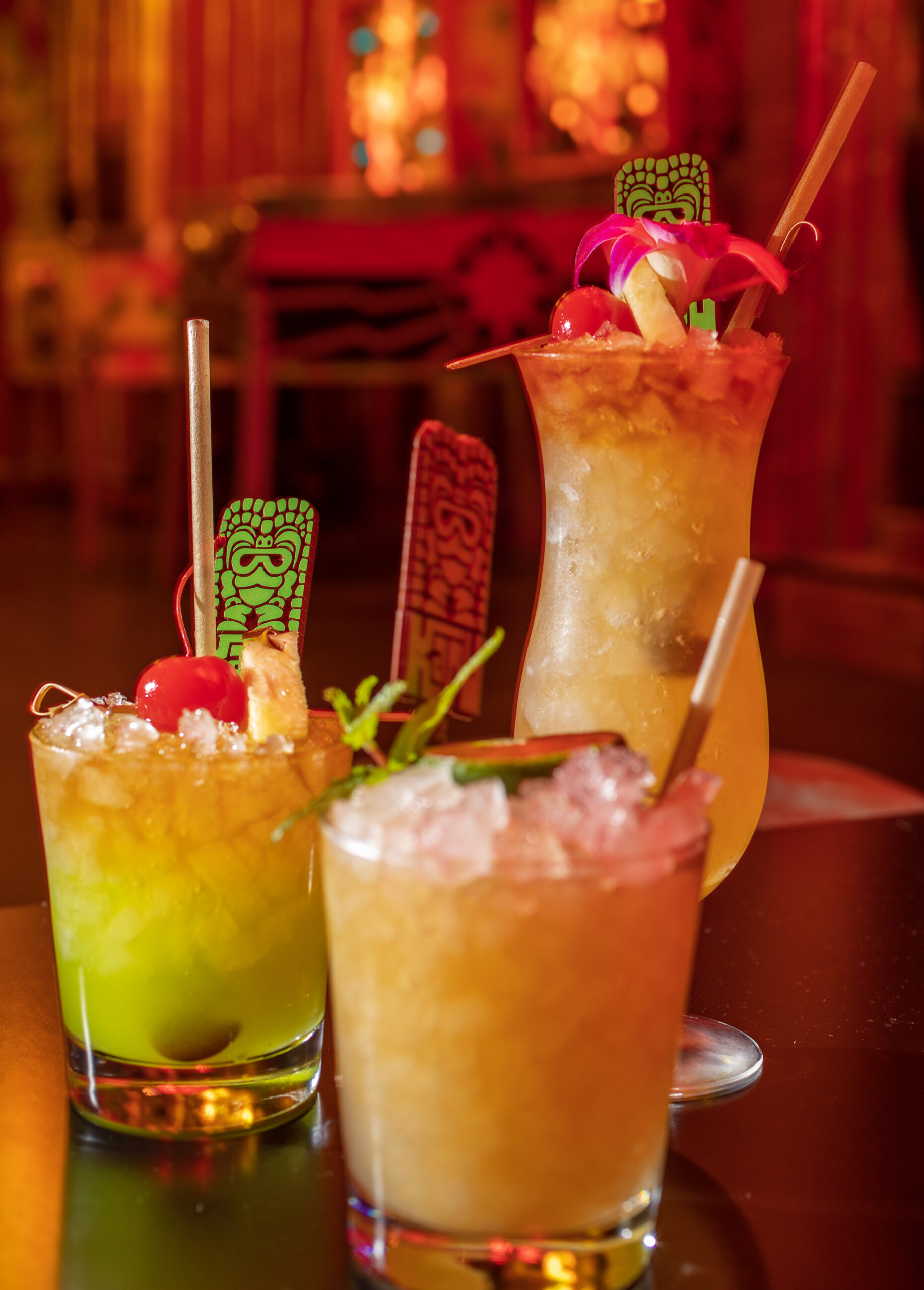
Kapu (April): The rum-forward, tiki-themed bar in Petaluma closed in late April due to ongoing financial challenges, according to owner David Ducommun. The bar opened in early 2023 with immersive design by tiki bar specialist Ben Bassham. 132 Keller St., Petaluma
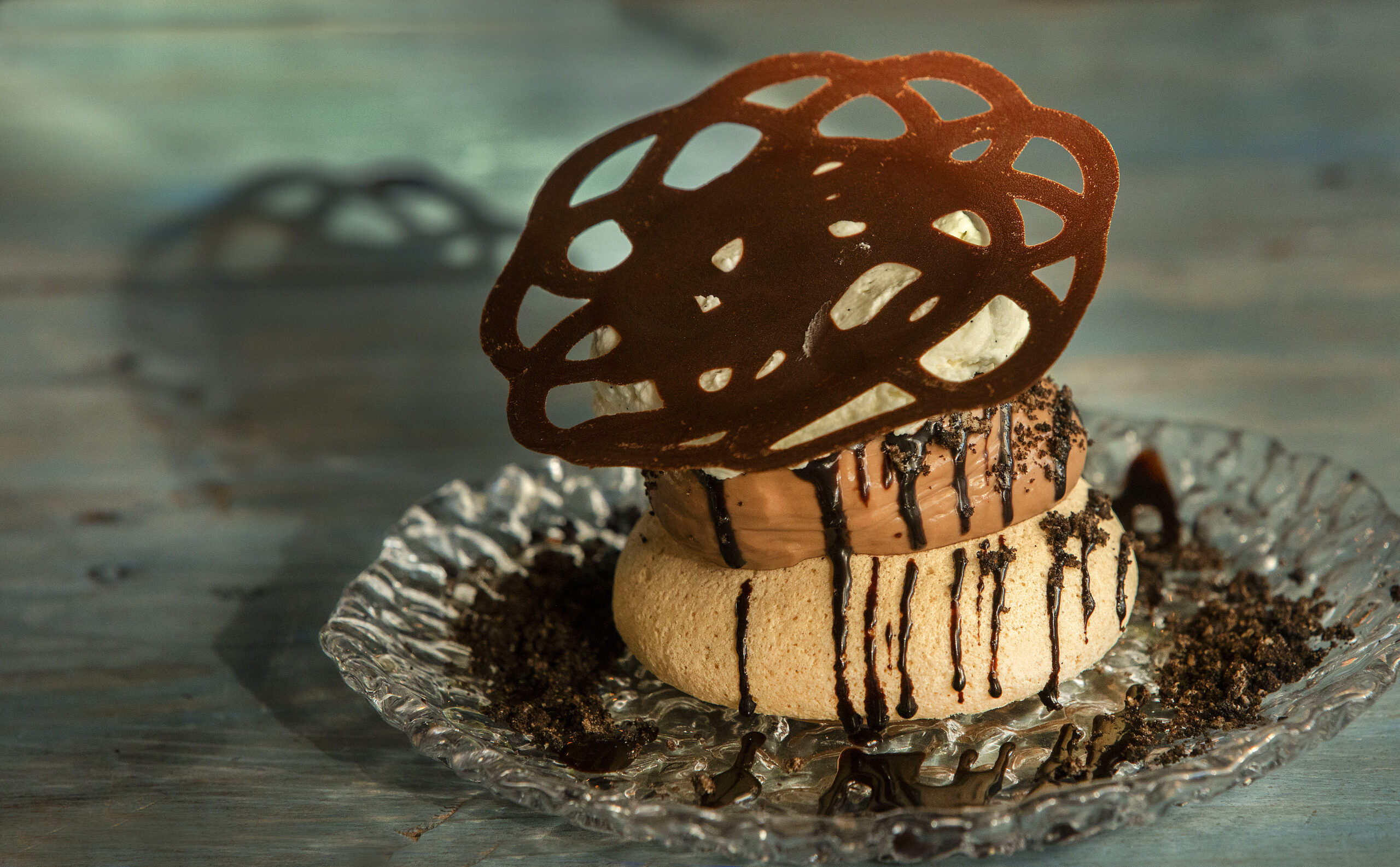
Tropical cocktails at Kapu Bar, a tiki bar and restaurant in the heart of downtown Petaluma on Keller Street. Photo taken Feb. 1, 2023. (Chad Surmick / The Press Democrat)Mississippi Mud Pie (Kinda’) with cocoa pavlova, milk chocolate pudding and vanilla cream from Blue Ridge Kitchen in Sebastopol. Photo taken Thursday, Sept. 24, 2020. (John Burgess / The Press Democrat)
Blue Ridge Kitchen (May): The Southern-inspired anchor restaurant at The Barlow was one of several closures and transitions at the Sebastopol market in 2025. Chef Matt D’Ambrosi, formerly of Spoonbar, Harmon Guest House and Pizzando, opened Blue Ridge Kitchen in 2020. No replacement has been announced. 6770 McKinley St., Sebastopol
Other Barlow transitions include:
• Farmer’s Wife, which closed in October, will be replaced by Genero’s Deli in early 2026.
• Salt & Sea, from Sushi Kosho owner Jake Rand, replaced the former Purple Acai juice and smoothie bar in August, serving Hawaiian-style poke bowls with seasoned rice and marinated raw fish.
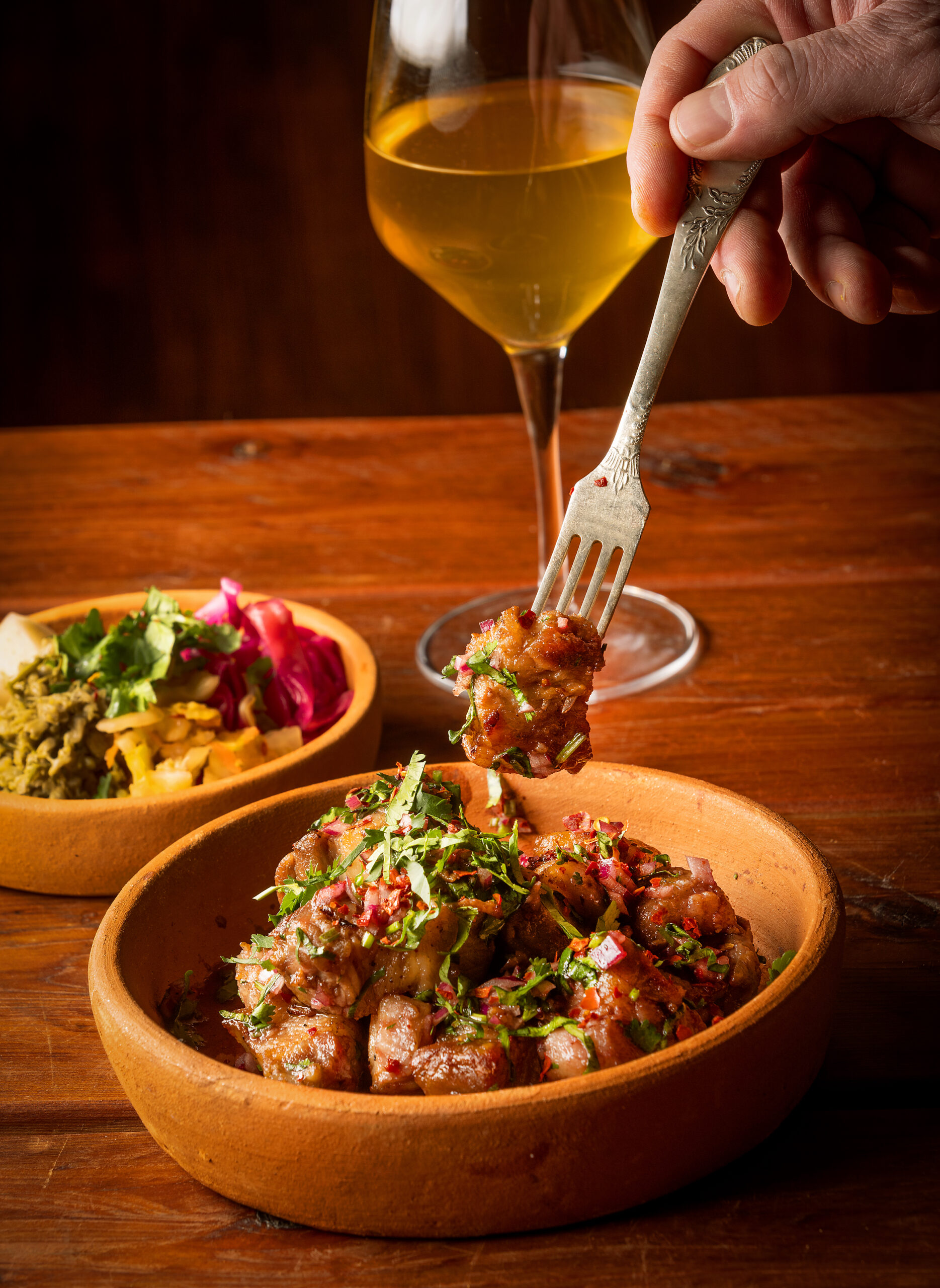
Mtsvadi, grilled pork belly tossed with cilantro, red onion and chile flake from Piala Restaurant and Wine Bar in Sebastopol. Photo taken Thursday, March 2, 2023. (John Burgess / The Press Democrat)
Piala (August): Despite glowing reviews, the Georgian-style restaurant cited the “economic climate” for its closure. But even before its 2022 opening, the Sebastopol restaurant faced challenges after city leaders barred co-owner Lowell Sheldon from working at or entering the kitchen as a condition of its alcohol permit. The restriction followed public outcry after Sheldon was accused of sexual harassment. He denies the allegations, and no criminal charges were filed. 7233 Healdsburg Ave., Sebastopol
Walter Hansel Wine & Bistro (August): The rural bistro affiliated with Walter Hansel Winery served its last meal in mid-August after 12 years in business. Owner Stephen Hansel cited rising food costs and declining foot traffic. 3535 Guerneville Road, Santa Rosa
Road Trip Kitchen (September): Restaurateur Crista Luedtke sold her eclectic Guerneville cafe to chefs Carlos Mendez and Rosy Ortega, who had worked for her at Boon Cafe for more than a decade. The duo reopened it as Three Cultures Kitchen, serving American dishes infused with flavors from Ortega’s Salvadoran roots and Mendez’s Mexican heritage. 16218 Main St., Guerneville
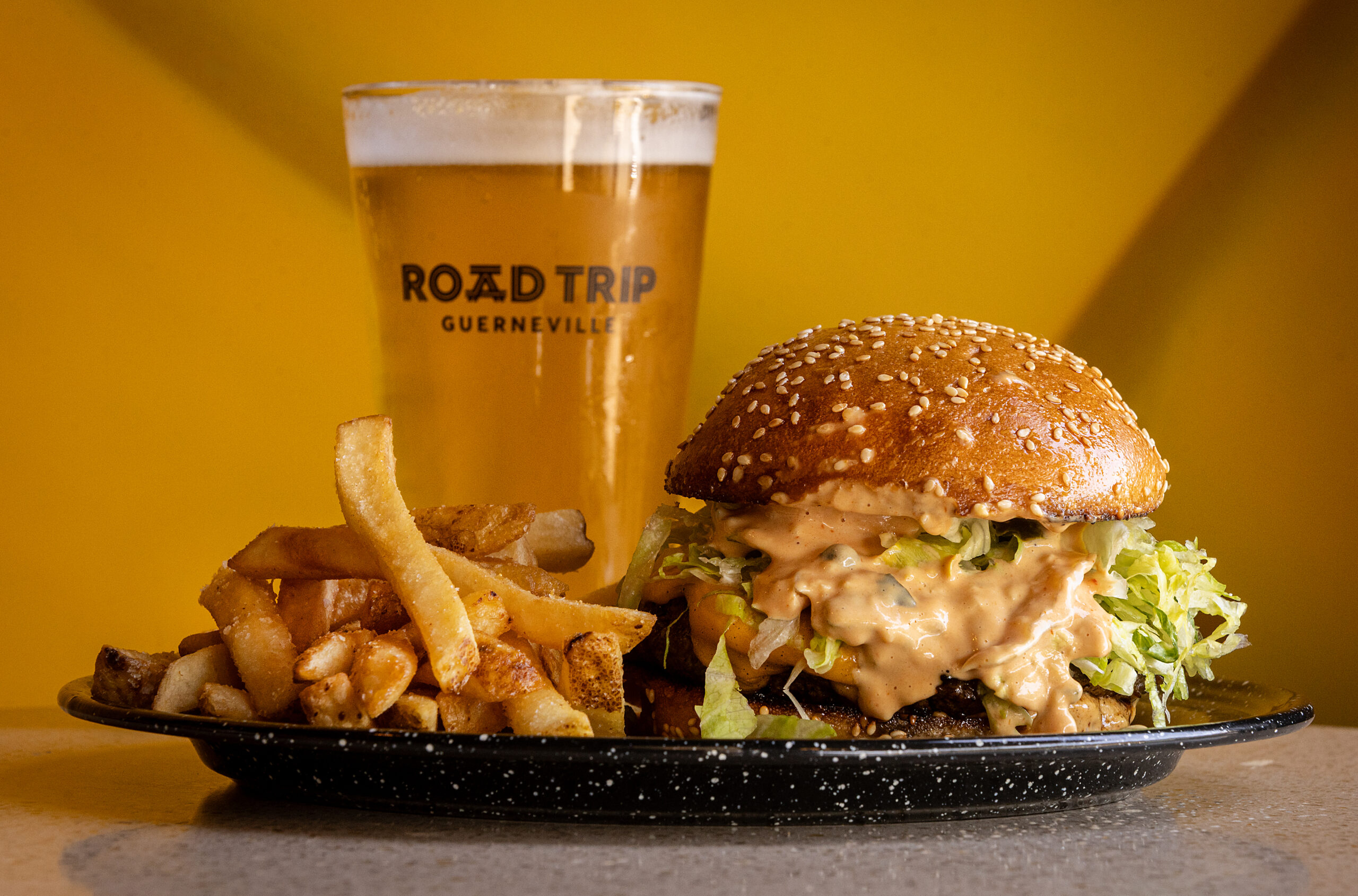
The Mac Daddy burger with secret sauce from Road Trip Monday, May 20, 2024, in Guerneville. (John Burgess / The Press Democrat)
Maya Restaurant (September): The longtime Mexican favorite on Sonoma’s plaza closed after the owners announced their retirement. The Girl & The Fig team plans to take over the space for a new restaurant opening in 2026. 101 E. Napa St., Sonoma
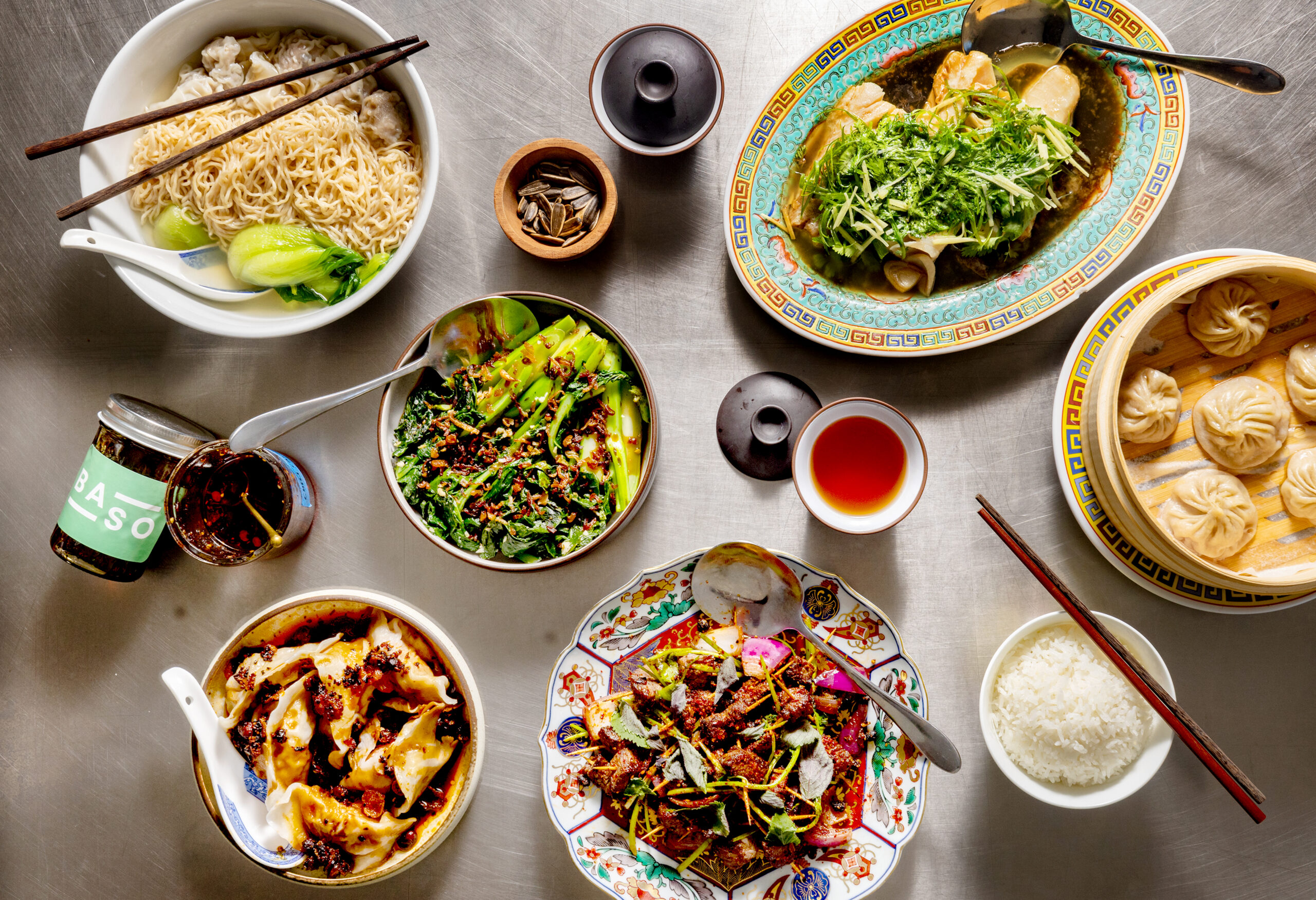
Forestville’s new restaurant Bazaar Sonoma on Oct. 17, 2024. (John Burgess / The Press Democrat)Bazaar Sonoma restaurant owners Jenny Phan and Sean Quan are grateful for the community support Thursday, Oct. 16, 2025, after a fire closed their Forestville restaurant. BaSo now operates in a temporary location offered by friend Gerard Nebesky of Gerard’s Paella Catering. (John Burgess / The Press Democrat)
Bazaar Sonoma (September, reopened October): After an early morning fire destroyed Bazaar Sonoma’s Forestville location in September, owners Sean Quan and Jenny Phan didn’t miss a beat. Just weeks later, they were back in cooking action at nearby BaSo Annex at 6536 Front St., offering a streamlined menu of fan favorites, including Zhong dumplings, Taiwanese beef noodle soup and tofu pudding with five-spice caramel. The Annex is open from 5-8 p.m. Wednesday through Sunday. They’ve also added Sunday lunch service from 10:30 a.m. to 2 p.m. for clay pot rice, dumplings and congee. In December, the couple had a preview of a new project, Anju Club, featuring Korean drinking food at Acre Pasta in Sebastopol.
Downtown BBQ (November, reopened late November): After a brief closure, restaurateur Lowell Sheldon announced that the sprawling downtown Santa Rosa restaurant would reopen under new ownership with some menu changes. Sheldon declined to identify the group replacing him, but said a new chef and new menu items were included with the change. 610 Third St., Santa Rosa
Stonework Pizza (November): The Petaluma pizzeria closed in late November. Pig in a Pickle plans to open at the site in 2026. 615 E. Washington St., Petaluma
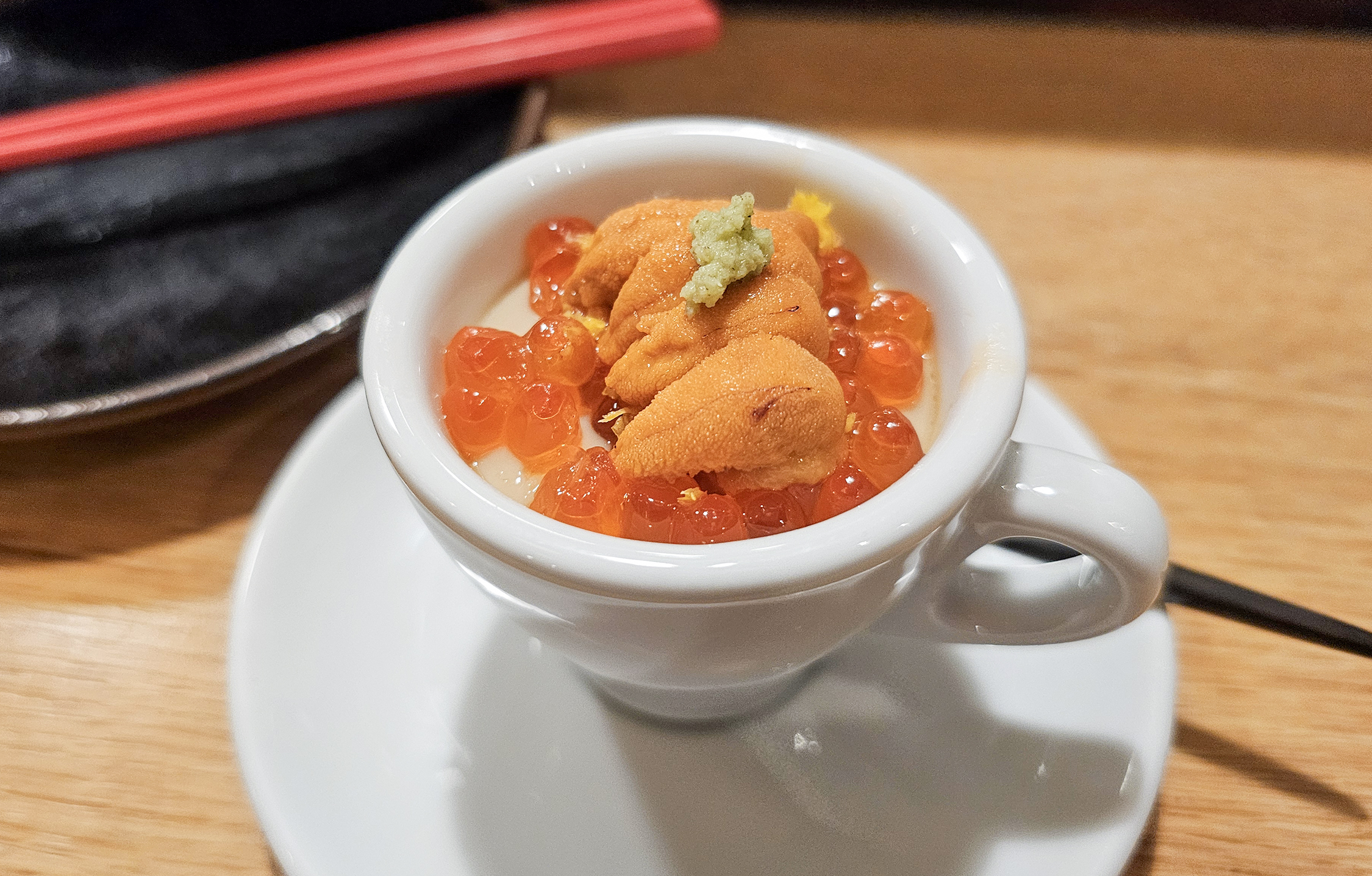
Uni chawanmushi (egg custard with Hokkaido uni and roe) at Sushi Kosho’s nine-piece nigiri tasting. (Heather Irwin / The Press Democrat)
Watching sushi chef Ben Gerelkhuu form shari in his palm is a thing of wonder. With a few impossibly quick wrist flicks and delicate squeezes, the vinegared sushi rice becomes a neat oblong pillow in his palm. Deft fingers flutter over the rice like a sleight-of-hand magic act, a thin slice of fish set gently on top — and voilà, nigiri appears before your eyes.
Gerelkhuu has recently joined the Sushi Kosho team at the Sebastopol restaurant, rolling out a progressive nine-piece omakase nigiri experience he created with Kosho owner Jake Rand. It’s a two-whiskey adventure at the sushi bar, where you can get up close and personal with your food.
I’ve long been a fan of Sushi Kosho, especially after losing the iconic Hana Japanese Restaurant earlier this year. It’s one of the only spots left with high-end fish, properly seasoned rice and well-trained chefs (Gerelkhuu recently worked at the Michelin-rated Sushi by Scratch) behind the counter.
After experiencing a preview version of the $89 experience, I’m impressed. It has all the quality of Sushi by Scratch (which I was ambivalent about) without the theatrics.
Here’s why I’m sold
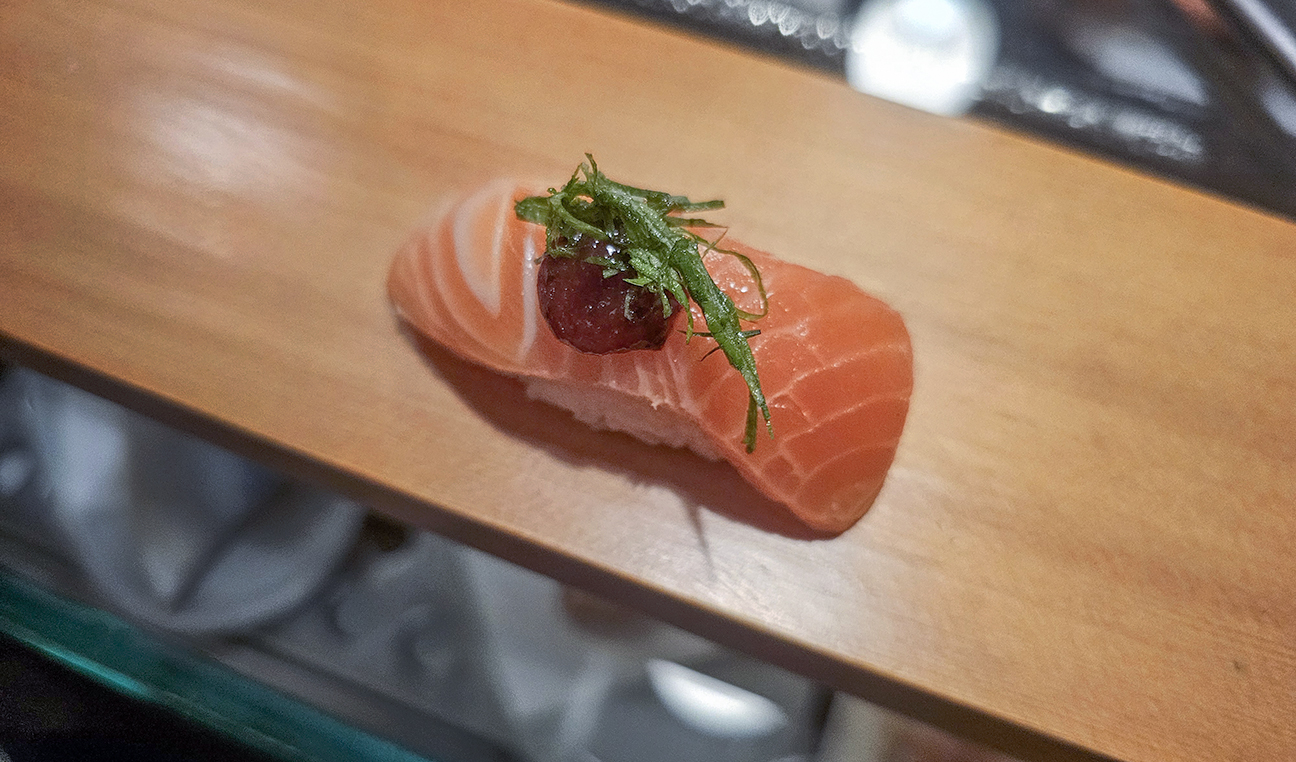
Salmon with plum and shiso at Sushi Kosho’s nine-piece nigiri tasting. (Heather Irwin / The Press Democrat)
The omakase experience has an easy, intentional rhythm rather than a pile of sushi landing on your plate at once. Each piece of nigiri is presented like a work of art — which it is. Gerelkhuu places tiny dots of kosho (an aromatic fermented chile paste) with needle-like chopsticks or sprays a pearl of blue cheese foam atop the fish with a flourish.
The nigiri are more than just fish and rice, but they aren’t ridiculous. I’m a purist, and I like the fish and rice to do the talking. Though Gerelkhuu and Rand aren’t afraid of a little embellishment, there’s nothing silly about the experience (OK, the blue cheese foam was a little silly, but entertaining).
The fish is pristine. And cut properly. I hate thick slabs of cheap fish that lesser sushi shops pass off as “generous.” Kosho has always impressed me with intentionally cut nigiri and sashimi.
Uni chawanmushi (egg custard with Hokkaido uni and roe) at Sushi Kosho’s nine-piece nigiri tasting. (Heather Irwin / The Press Democrat)
The chef’s choice intermezzos are outstanding. My experience included uni chawanmushi, a steamed bowl of egg custard with strips of creamy Hokkaido uni, and Wagyu beef chazuke, a bowl of rice with barbecued beef and tea-infused broth.
Clam, Prawn & Sausage Sauté served with grilled sourdough from Catelli’s Restaurant Sunday, Dec. 21, 2025 in Geyserville. (John Burgess / The Press Democrat)
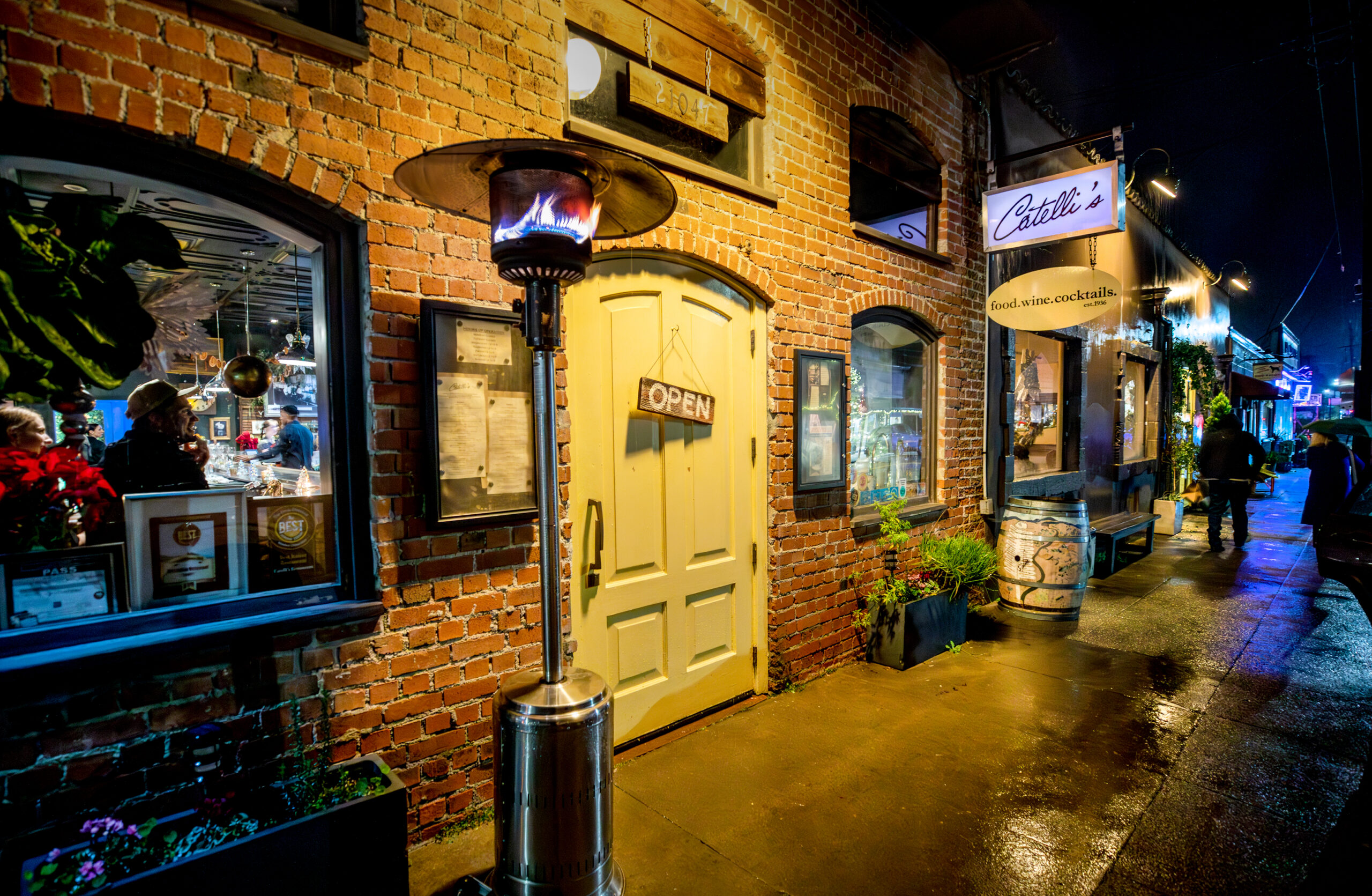
Everything about Catelli’s, from the exposed brick walls and timeworn wood floors to the smooth stone hearth, feels lived in. Walking through the door is like a hug from a favorite great-aunt: warm, familiar and faintly perfumed with garlic and red wine.
The homey Geyserville restaurant leans into Italian-American classics like 10-layer lasagna, spaghetti with marinara, chicken Parmesan, minestrone and garlic bread. But its soul is pure Sonoma County.
Nearly 90 years have passed since Santi and Virginia Catelli opened their first restaurant in town. They called it the Rex, after a free sign bearing a mysterious name whose origins remain unclear. The Rex endured for more than half a century, later becoming Catelli’s The Rex, before closing in 1991. It was revived in 2010 by the Catellis’ grandchildren, Domenica and Nick.
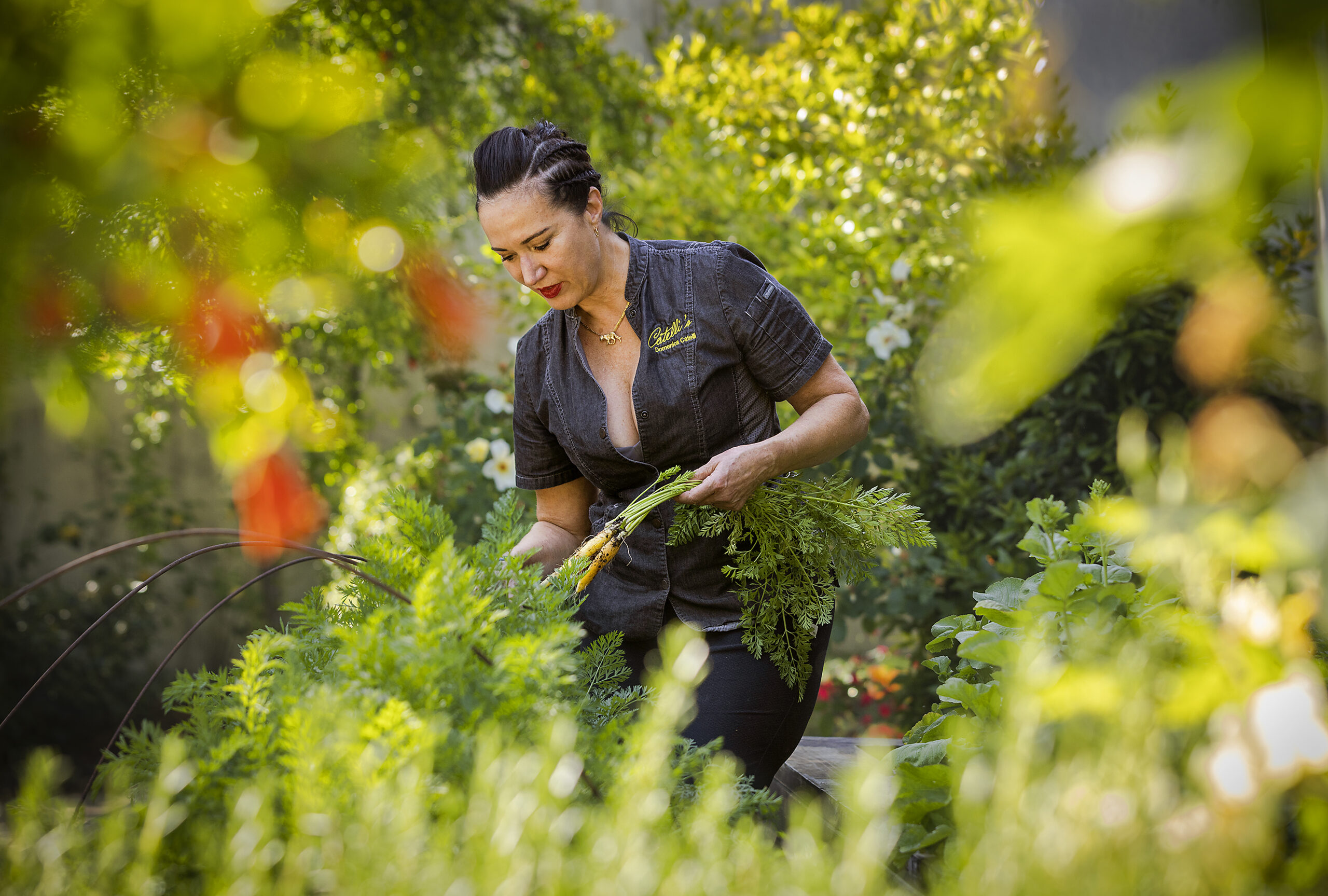
Domenica Catelli, chef and owner of Catelli’s in Geyserville, continues serving great Italian food started by her grandfather in 1936 when he opened “The Rex” with a used sign from another business. Photo taken Sunday, Dec. 21, 2025. (John Burgess / The Press Democrat)Chef Domenica Catelli, owner of Catelli’s restaurant, harvests fresh produce from her Geyserville restaurant garden. (John Burgess / The Press Democrat, file)
Chef Domenica Catelli is the restaurant’s public face, and her recipes anchor much of the menu. A private chef to several celebrities, she has appeared on numerous television cooking shows and is a frequent guest on programs hosted by Guy Fieri.
Catelli’s has reasserted itself as a cornerstone of rural Geyserville, a town without a stoplight and with only a handful of shops and restaurants. It is an irresistible draw for out-of-towners seeking an authentic Sonoma County experience.
Behind her broad smile and signature chestnut braid, Catelli is as comfortable working the line as she is in front of the camera. She is often found in the kitchen or out forging relationships with local farmers and producers.
Food, however, is only part of the equation. Family togetherness is baked into Catelli’s, with big booths and long tables that make it a natural gathering place for groups, whether bound by blood or affection.
“We want it to have a familial vibe — warm, comforting and fun,” Catelli said.
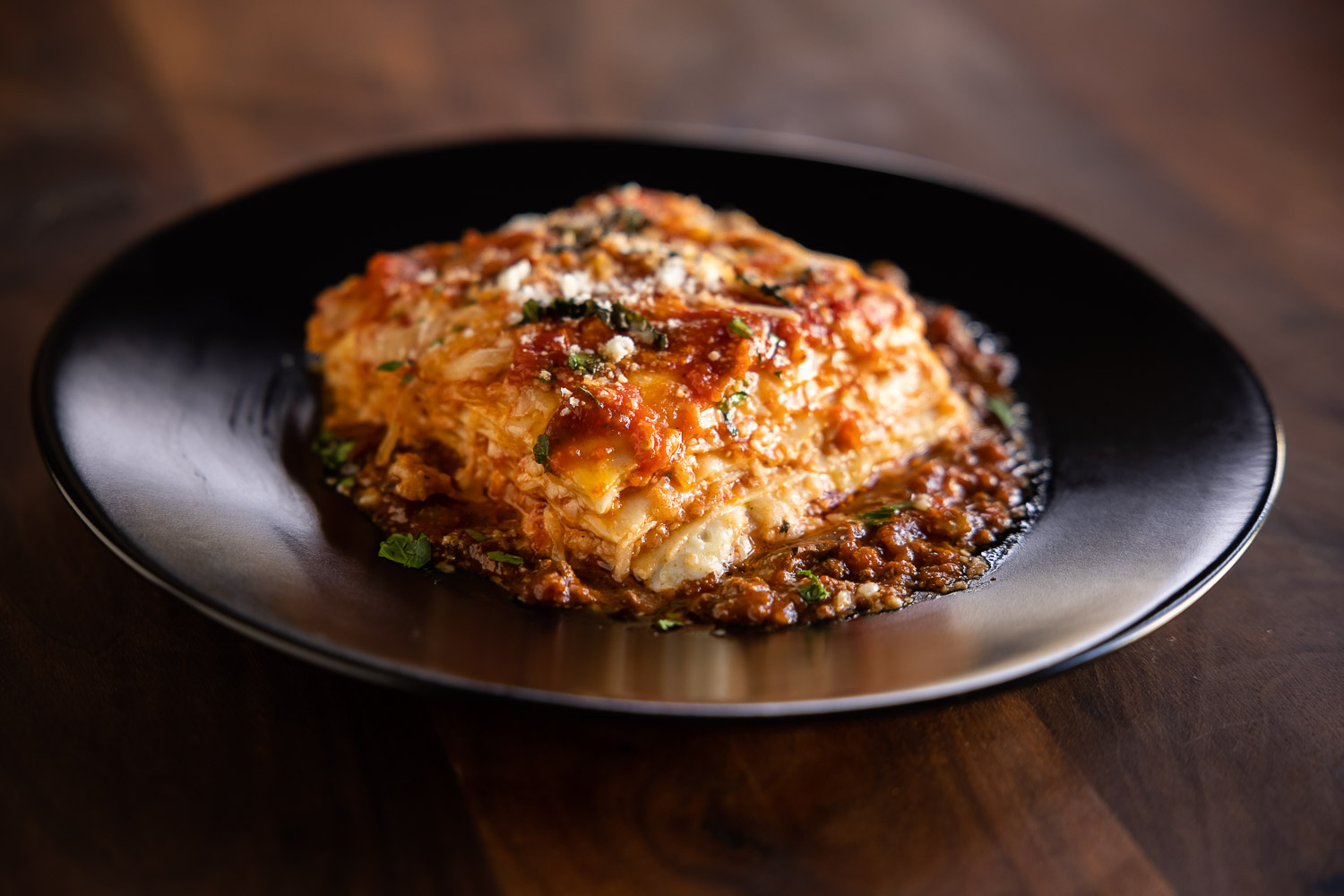
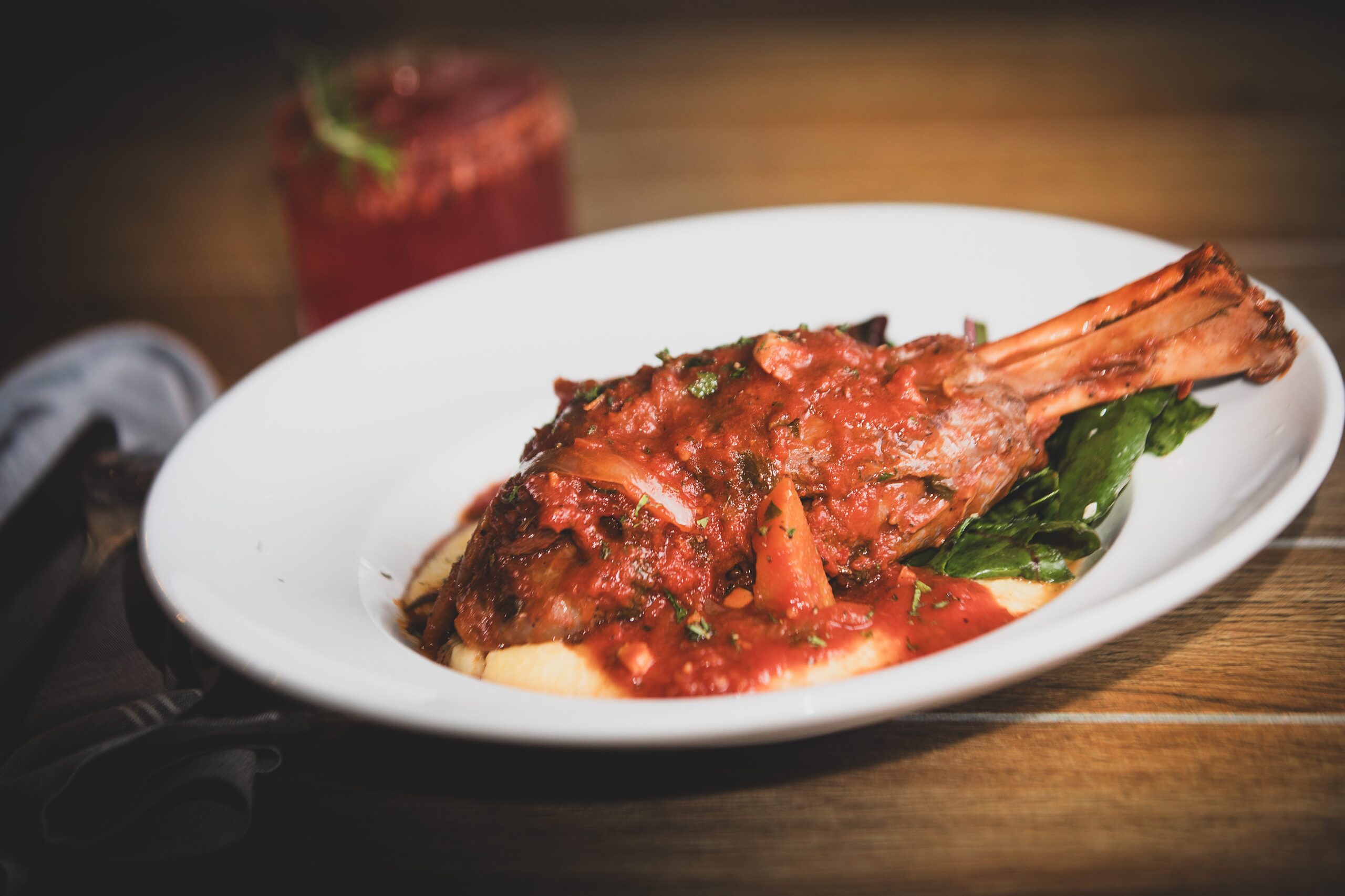
Ten-layer lasagna at Catelli’s in Geyserville. (Chris Hardy/for Sonoma Magazine, file)Zinfandel-braised lamb shank with polenta and greens and a Wintergreen Margarita from Catelli’s Restaurant Sunday, Dec. 21, 2025, in Geyserville. (John Burgess / The Press Democrat)
Fun fact
Catelli cooked for Oprah Winfrey for nearly a decade as a private chef and food stylist. She is the author of “Mom-a-Licious” and has appeared on Food Network as both a competitor and a judge.
Go-to spot
Catelli is a regular at Lo & Behold in Healdsburg. “It’s this warm, welcoming place that feels like home,” she said. “It’s my ‘Cheers.'” Catelli, who grew up in her family’s restaurant, spent many hours in a bouncy swing behind the bar — it was a different time.
The star factor
A-list diners have included Justin and Hailey Bieber, Lady Gaga and “Saturday Night Live” alumni Maya Rudolph, Ana Gasteyer and Amy Poehler.
The vibe
Food, family and fun — with family defined broadly and generously.
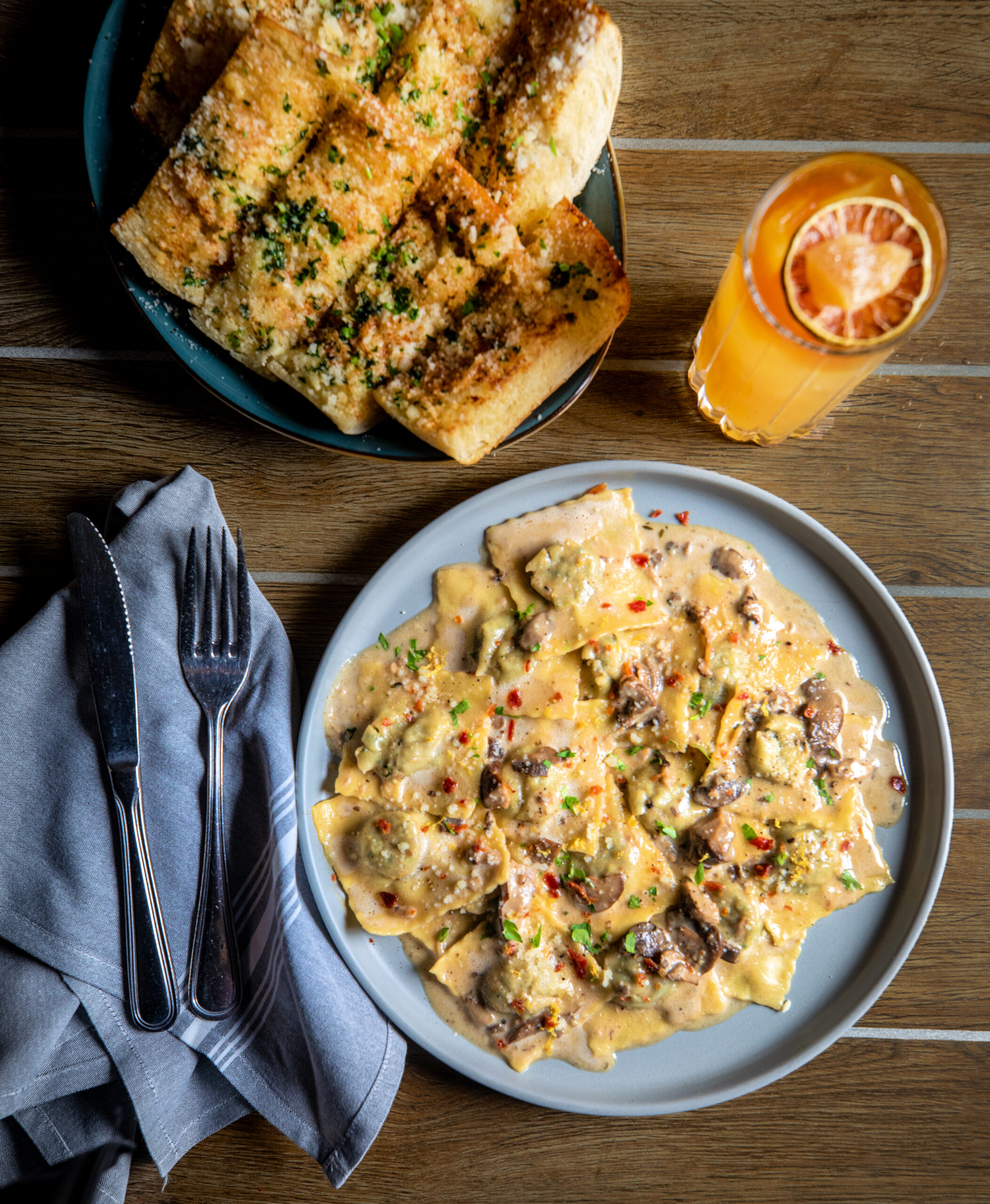
Catelli’s homemade meat ravioli with a mushroom cream sauce, cremini and porcini mushrooms, and finished with crispy prosciutto and Parmesan with a side of garlic bread and a Chai Mule cocktail from Catelli’s Restaurant Sunday, Dec. 21, 2025, in Geyserville. (John Burgess / The Press Democrat)
What to eat
Portions are generous, often large enough for leftovers, particularly pastas and main courses.
Most popular dish – Garlic bread ($11.50): “Every table has it,” Catelli said. Also popular: chicken Parmesan ($29) and spaghetti with Richard’s meat sauce ($25), made with beef, chicken, wine and vegetables.
Burrata and prosciutto ($22): Creamy burrata, ribbons of aged prosciutto, grilled bread and a heap of peppery arugula. Required.
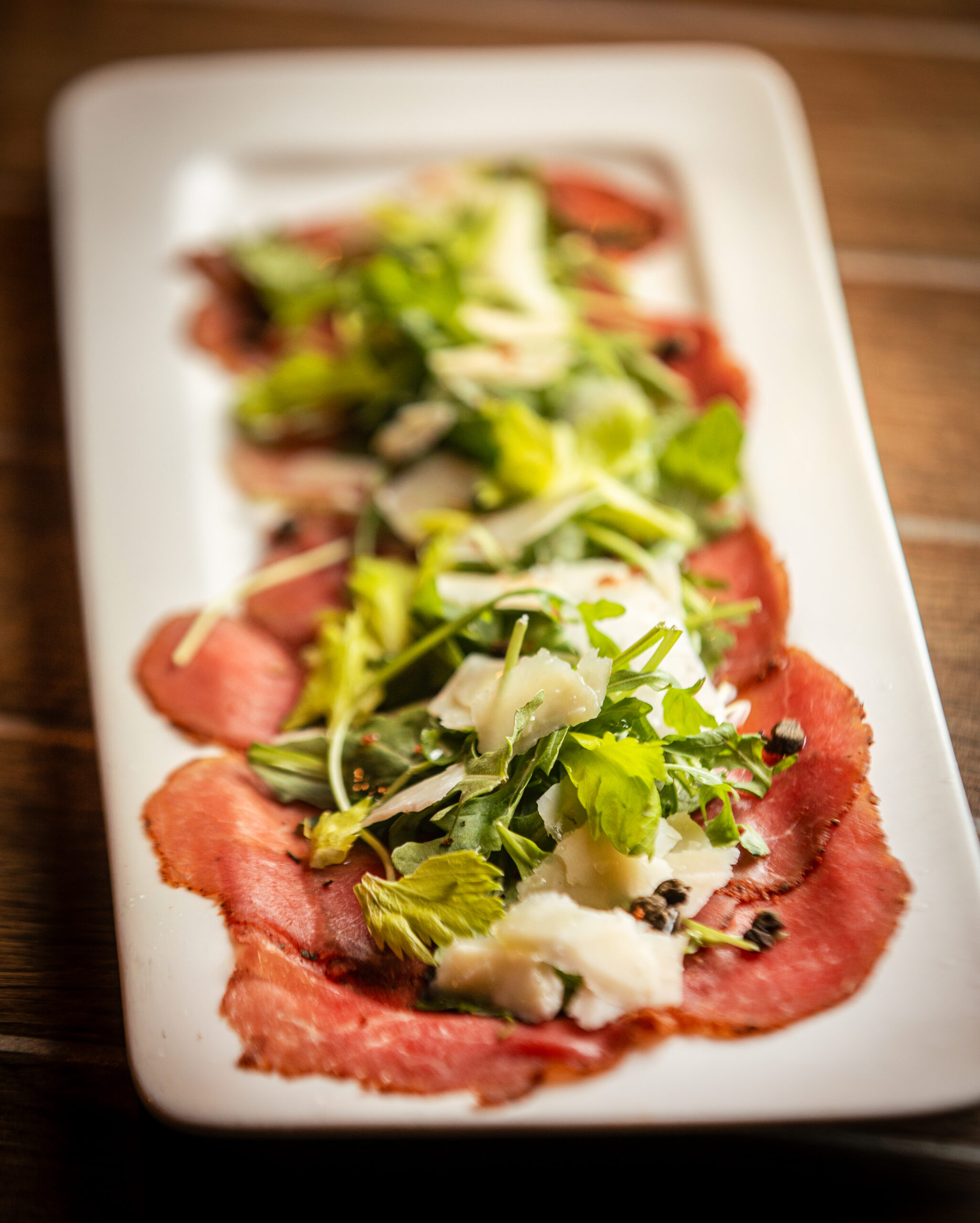
Beef carpaccio ($16): Paper-thin raw beef with shaved Parmesan and fried capers.
Beef Carpaccio with a house spice blend, sliced paper-thin and finished with arugula, Parmesan and fried capers from Catelli’s Restaurant Sunday, Dec. 21, 2025, in Geyserville. (John Burgess / The Press Democrat)
Basil Caesar ($10/$17): A classic interpretation with torn basil, Parmesan and lemony dressing.
Domenica’s sauce and spaghetti ($22): A deceptively simple tomato, garlic and olive oil sauce (plus a few secret ingredients), equally good with ravioli or the airy 10-layer lasagna made with ricotta, goat cheese and herbs. The mushroom cream sauce ($26) is rich and indulgent, with lemon zest, three kinds of mushrooms and prosciutto.
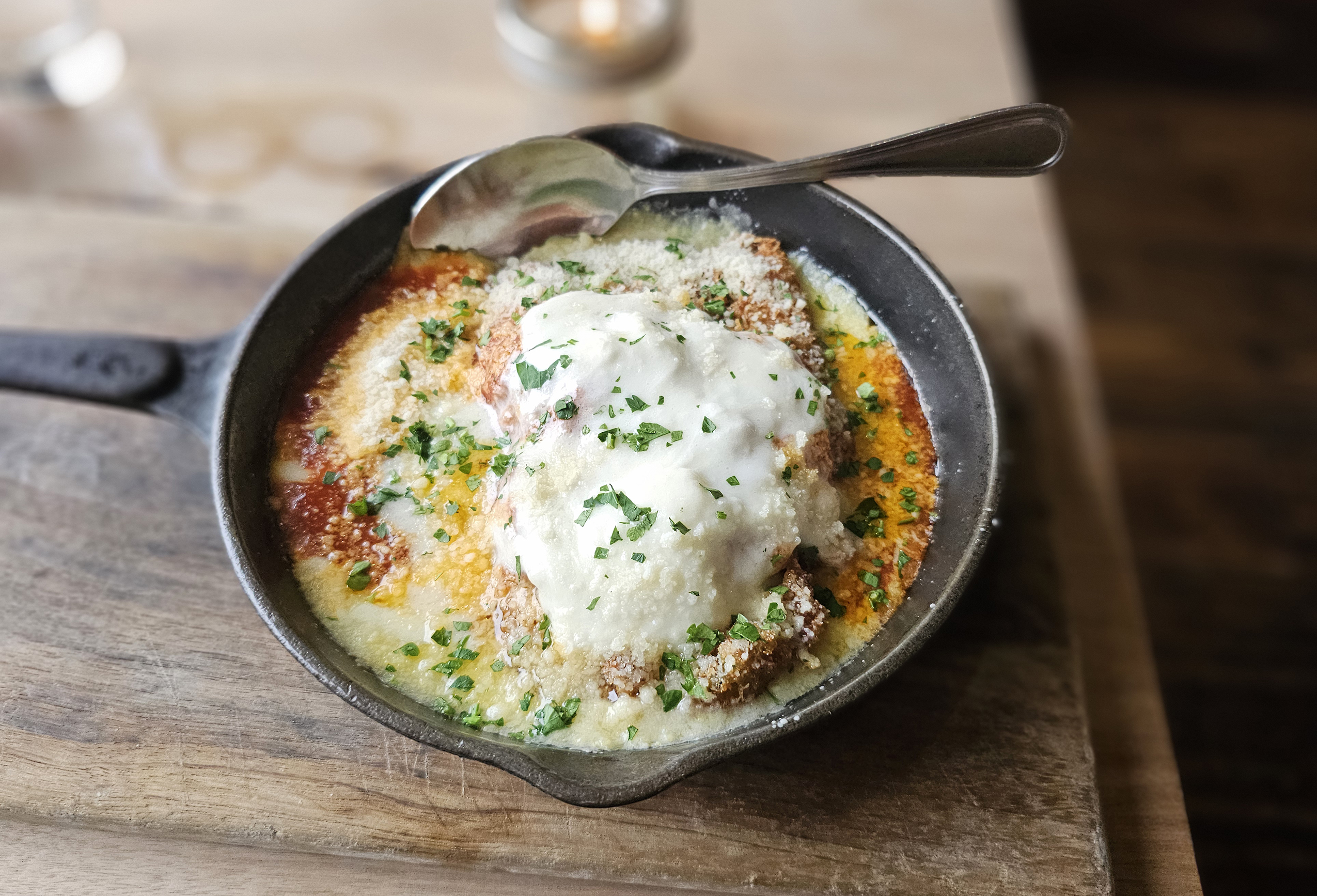
Chicken Parmesan ($29): I’m a chicken Parm enthusiast, and I’ve tried the gamut — from Michael Angelo’s frozen entrees to Mary’s Pizza Shack (both solid). This is the ultimate Chicken Parm: Juicy chicken, crisp breading, a pool of sassy tomato sauce, burrata and a bed of smoky, buttery polenta. I may have wept a little.
Chicken Parmesan at Catelli’s Restaurant in Geyserville. (Heather Irwin / The Press Democrat)
The rest
A full bar offers specialty cocktails, including the spicy Garden Jalapeño Margarita ($15) with pepper-infused tequila and a chile-salted rim. Gluten-free pasta and several gluten-free dishes are available.
The price
Starters $8-$22; salads $10-$18; pasta $22-$28; mains $29-$34.
A modern home on 10 secluded acres in Guerneville is currently listed for sale. The two-bedroom, two-bathroom dwelling set among redwoods is seeking$1,295,000.
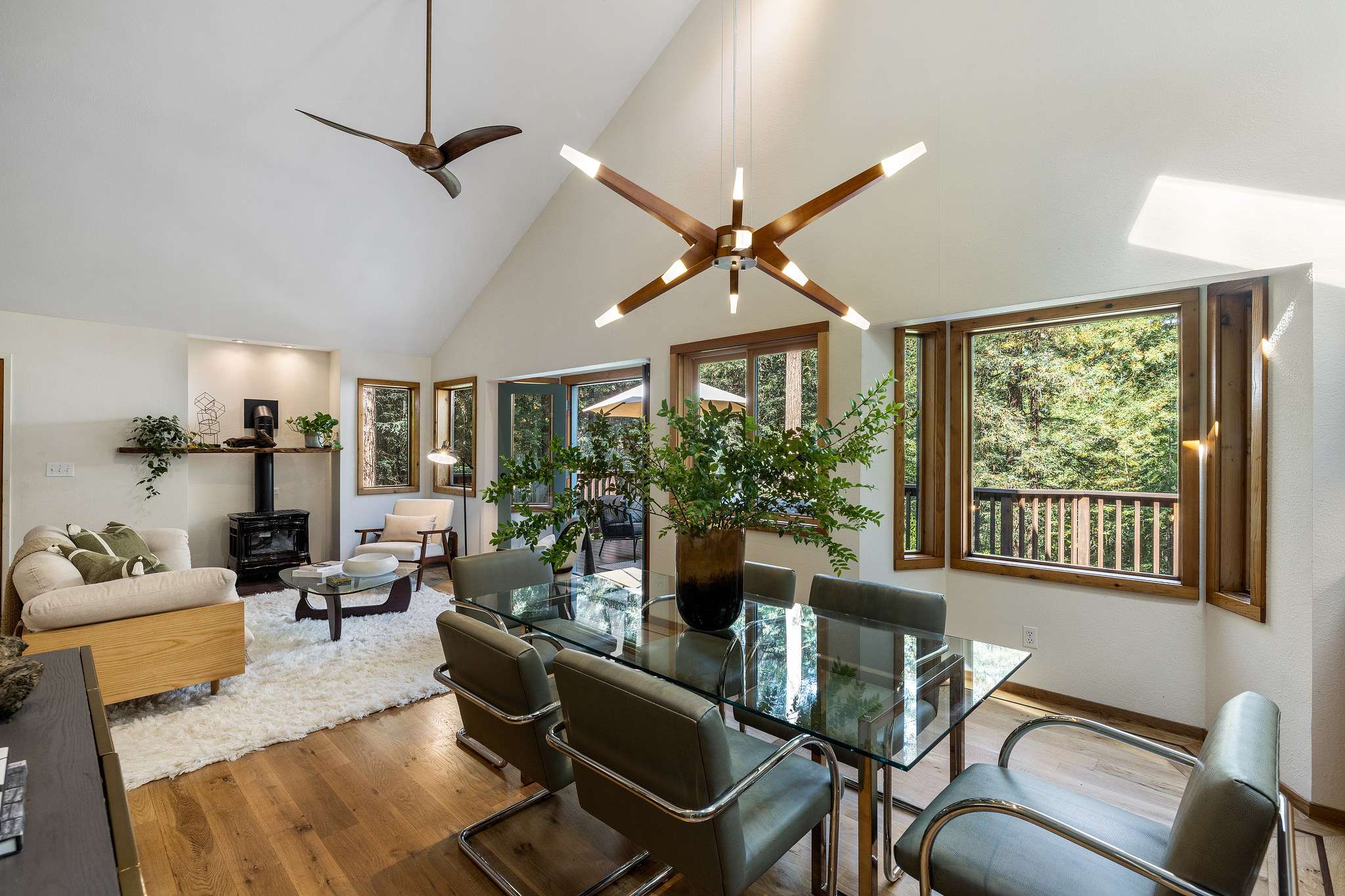
The interior of the 1,700-square-foot home, built in 1992, reiterates the woodsy surround through stained-wood millwork. Generous windows — including bifold patio doors — provide lots of light and allow forest views to take center stage.
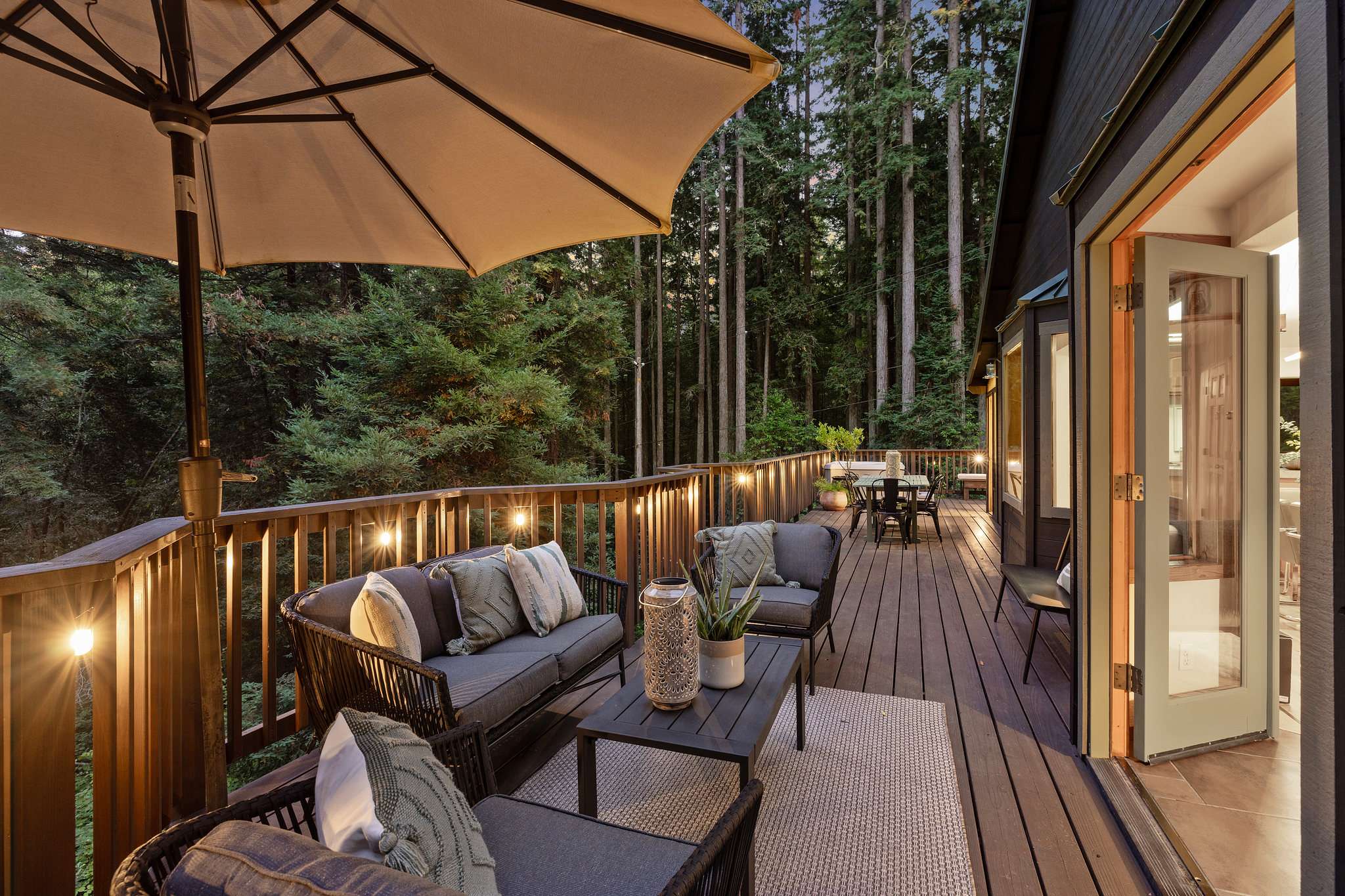
The wraparound deck is a spacious perch among the trees. Seating, dining and a spa offer a pleasing means of soaking it all in.
Great room. (Open Homes Photography)Seating area of deck. (Open Homes Photography)Outdoor sauna and seating area. (Open Homes Photography)
Sunny grounds include raised vegetable beds, fruit trees, a small barn, chicken coop and dry sauna. The garage is outfitted with Wi-Fi, and the property has an EV charging station and RV hookup. A metal roof offers fire mitigation.
For more information on the property at 17970 Duncan Road in Guerneville, contact listing agent Pat Patricelli, 415-516-0875, Vanguard Properties,redwoodescape.com
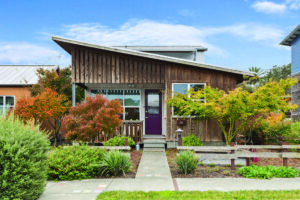
This two-bedroom, three-bathroom Petaluma home with access to a community garden and shared outdoor spaces is currently listed for $1,275,000. (Digital Twinners)
A contemporary home in Petaluma with clean lines and rich detail is on the market. The two-bedroom, three-bathroom dwelling with access to a community garden and shared outdoor spaces is currently listed for $1,275,000.
The work of Petaluma-based MAD Architecture, the circa-2018 home is situated for convenience and community. It’s part of the Keller Court Commons with shared green spaces, and it’s a walkable distance to Petaluma’s quaint and happening downtown. Recreation in and along the Petaluma River is nearby, too — from restaurants and paddleboarding to river walks dotted with art installations.
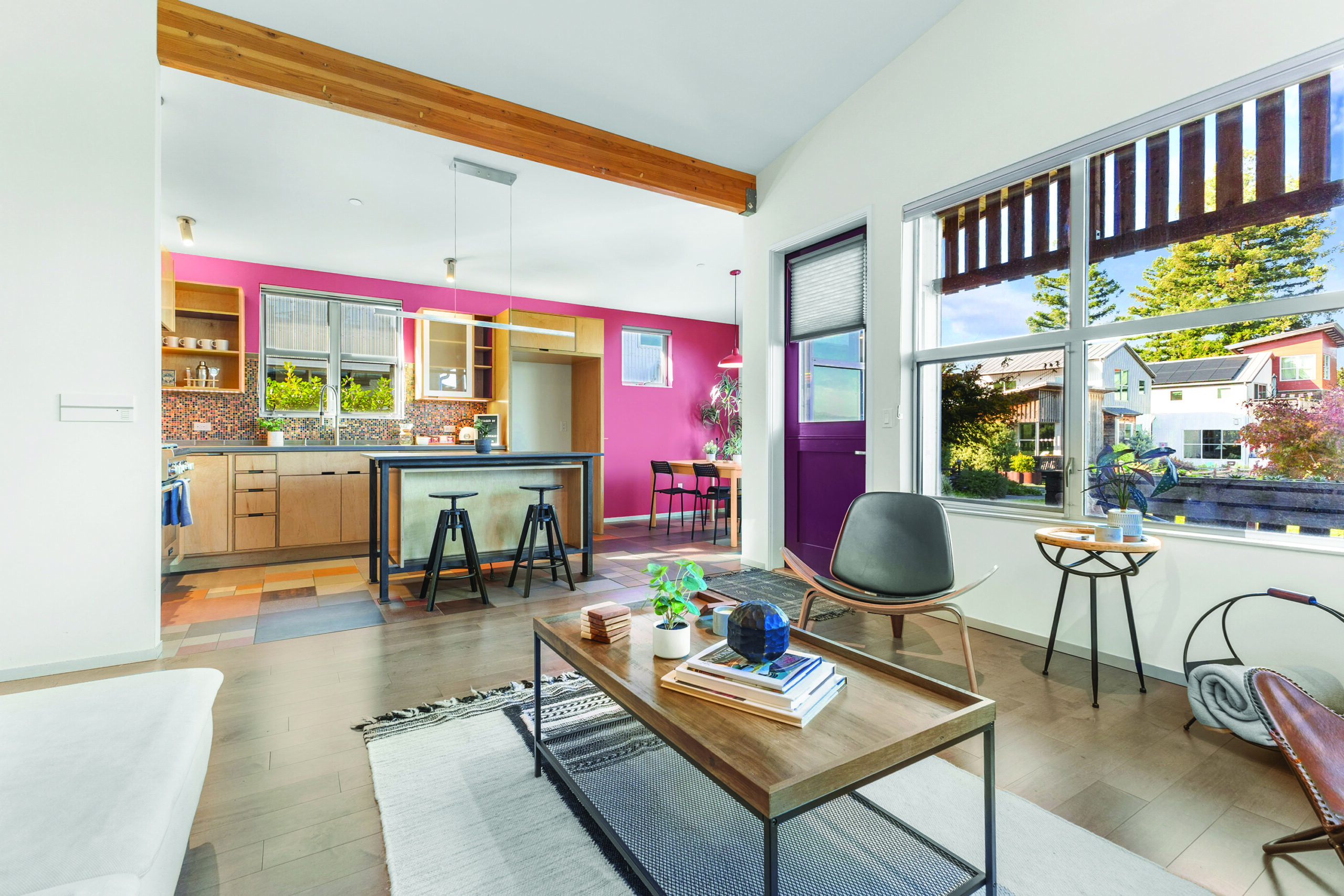
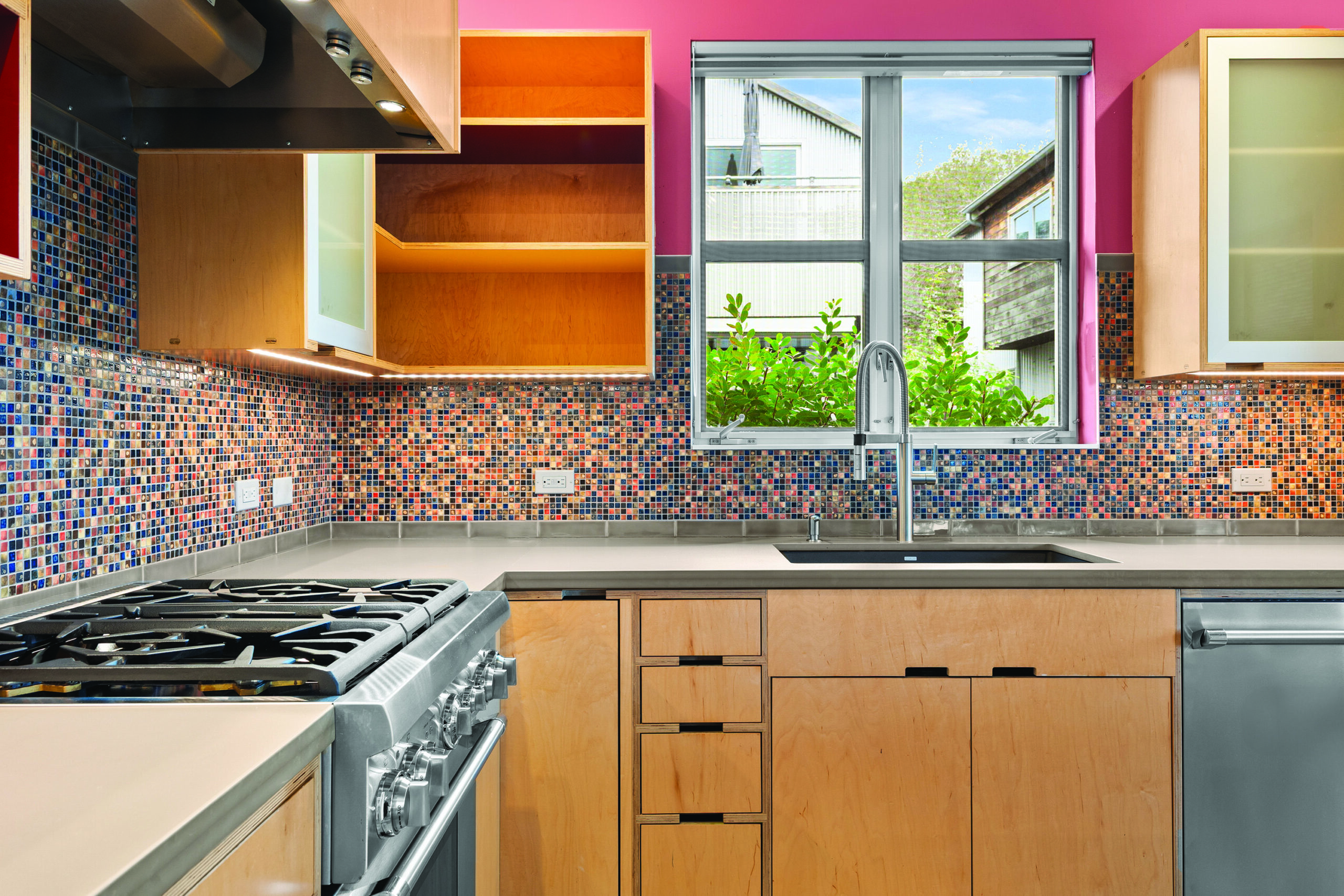
The home is cleanly modern with pleasing design details. Rugged-wood vertical siding provides a rustic and homey contrast to metal siding. High ceilings and repeating windows allow plenty of light, while patches of wood-cladding and inspired use of colorblocking warms the space. Accented areas with pink, plum and more enliven the dwelling. These tints are pulled from the mosaic backsplash in the kitchen, which anchors the great room.
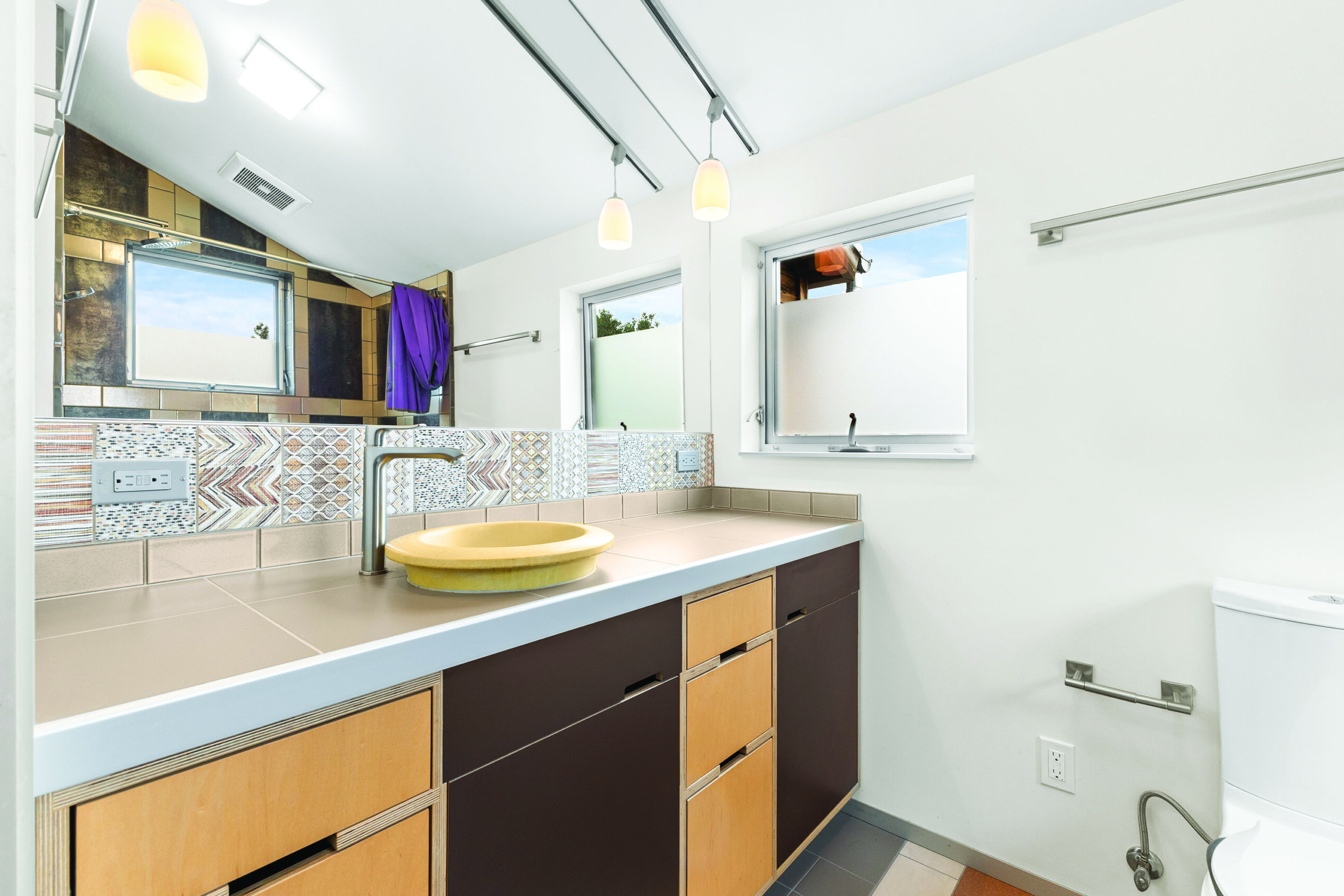
Great room. (Digital Twinners)Kitchen. (Digital Twinners)Bathroom. (Digital Twinners)
The color patchwork is repeated, more subtly so, in the bathroom with alternating dark and light wood cabinetry and on the radiant-heat floors with varying tones of tile. A built-in bench at the stairway landingwith a bright red wall adds visual interest and a cozy resting spot. The dwelling is an impossibly successful mix of lively and tranquil.
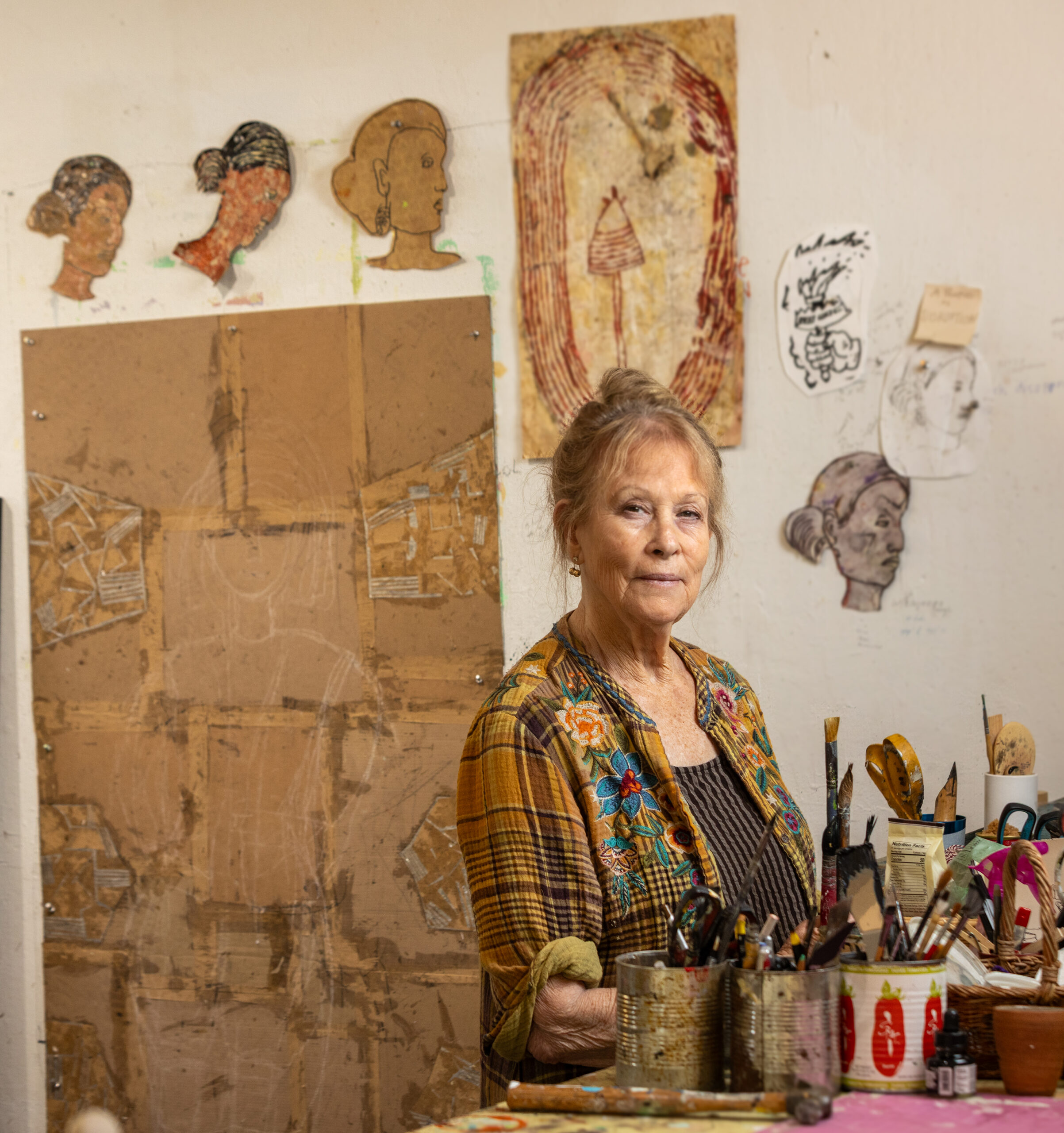
Susan Preston in her studio near her home of 50 years in the Dry Creek Valley. (John Burgess / The Press Democrat)
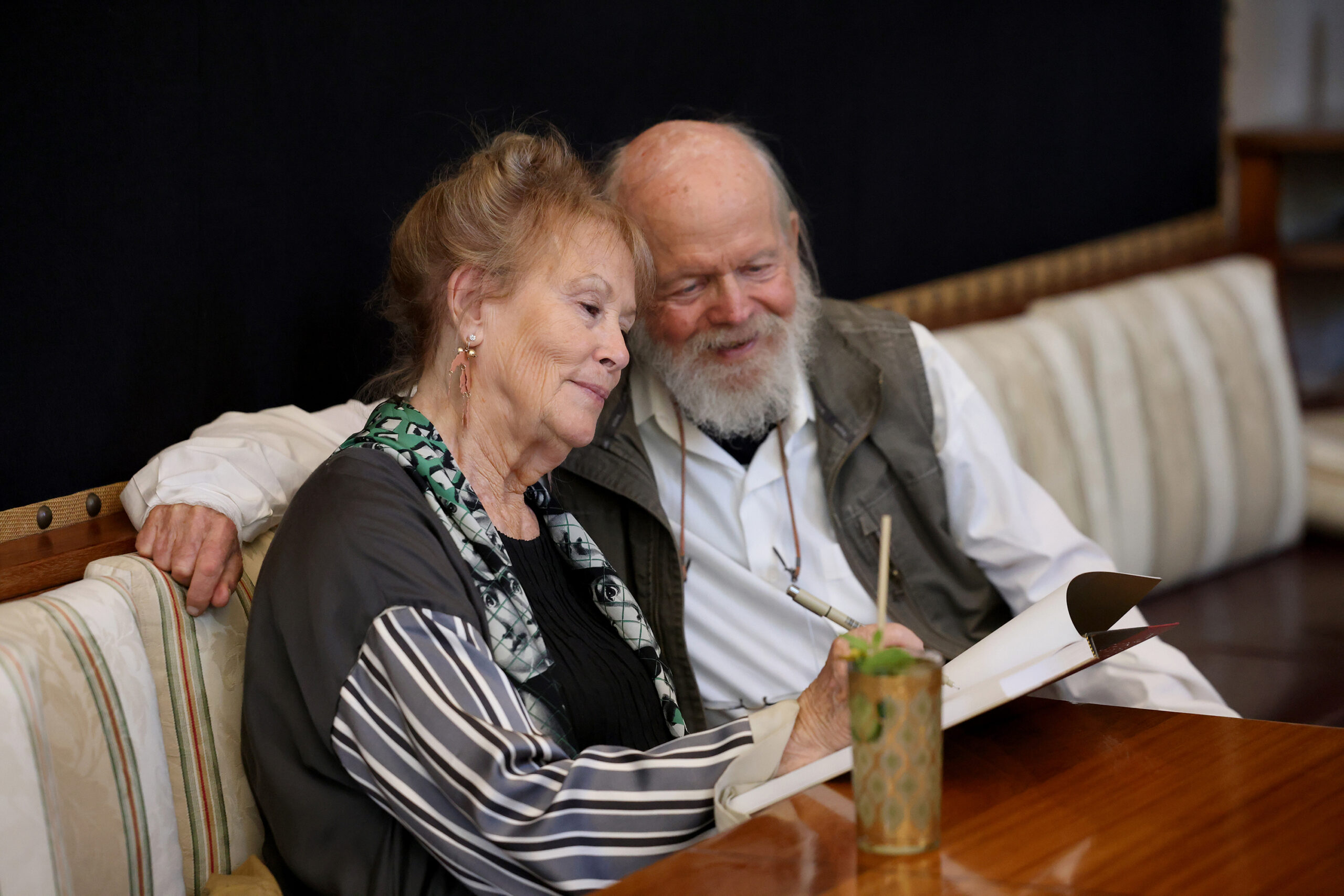
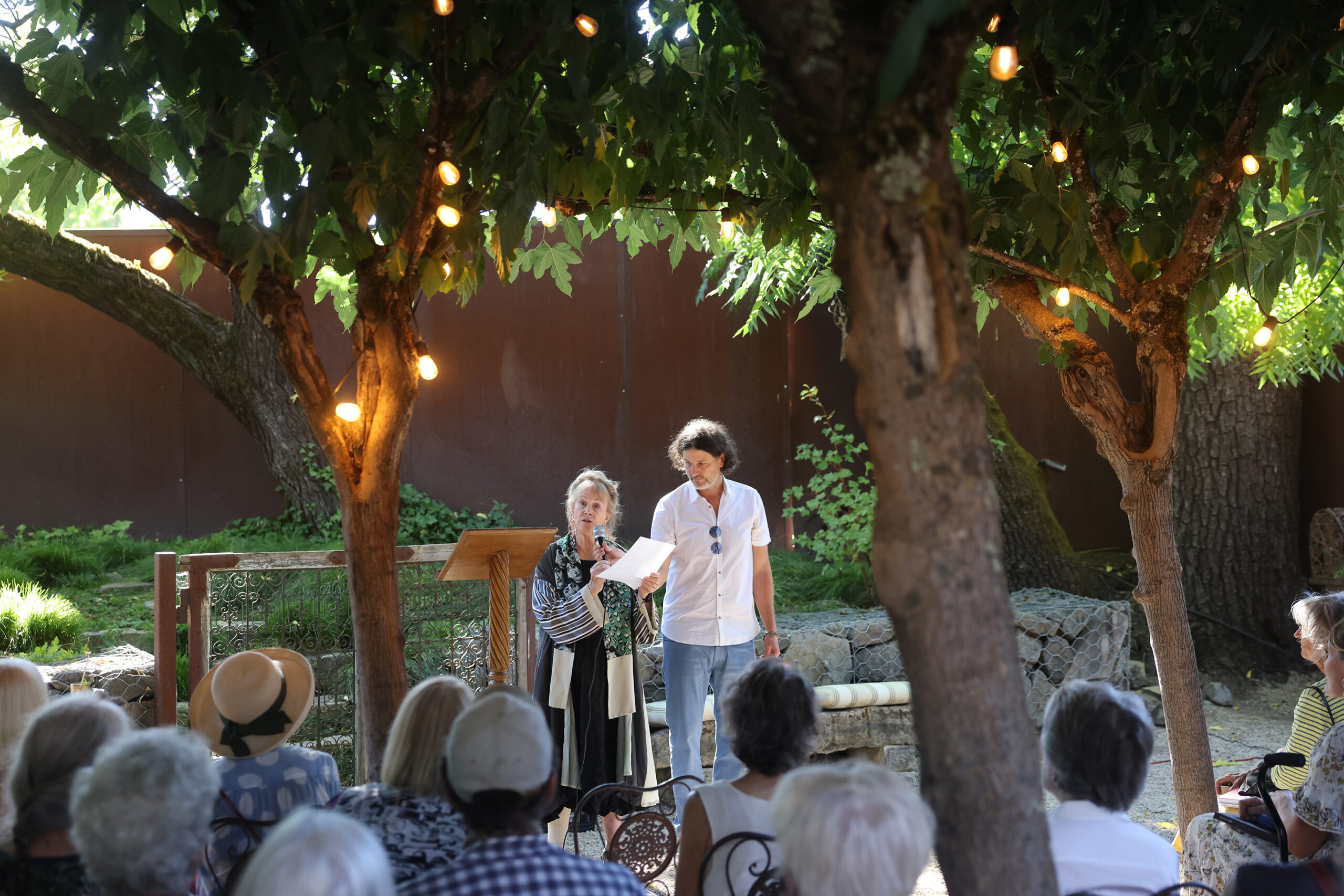
The woman signing books at Barndiva in Healdsburg seemed genteel and refined as she smiled and chatted with a long line of friends and admirers.
Susan Preston had, for the time being, set her spikes aside.
That is, she’d chosen to conceal certain of her wild and sharp-edged aspects — the “spikiness,” as she recently described it to her daughter Francesca — that emerge in her art.
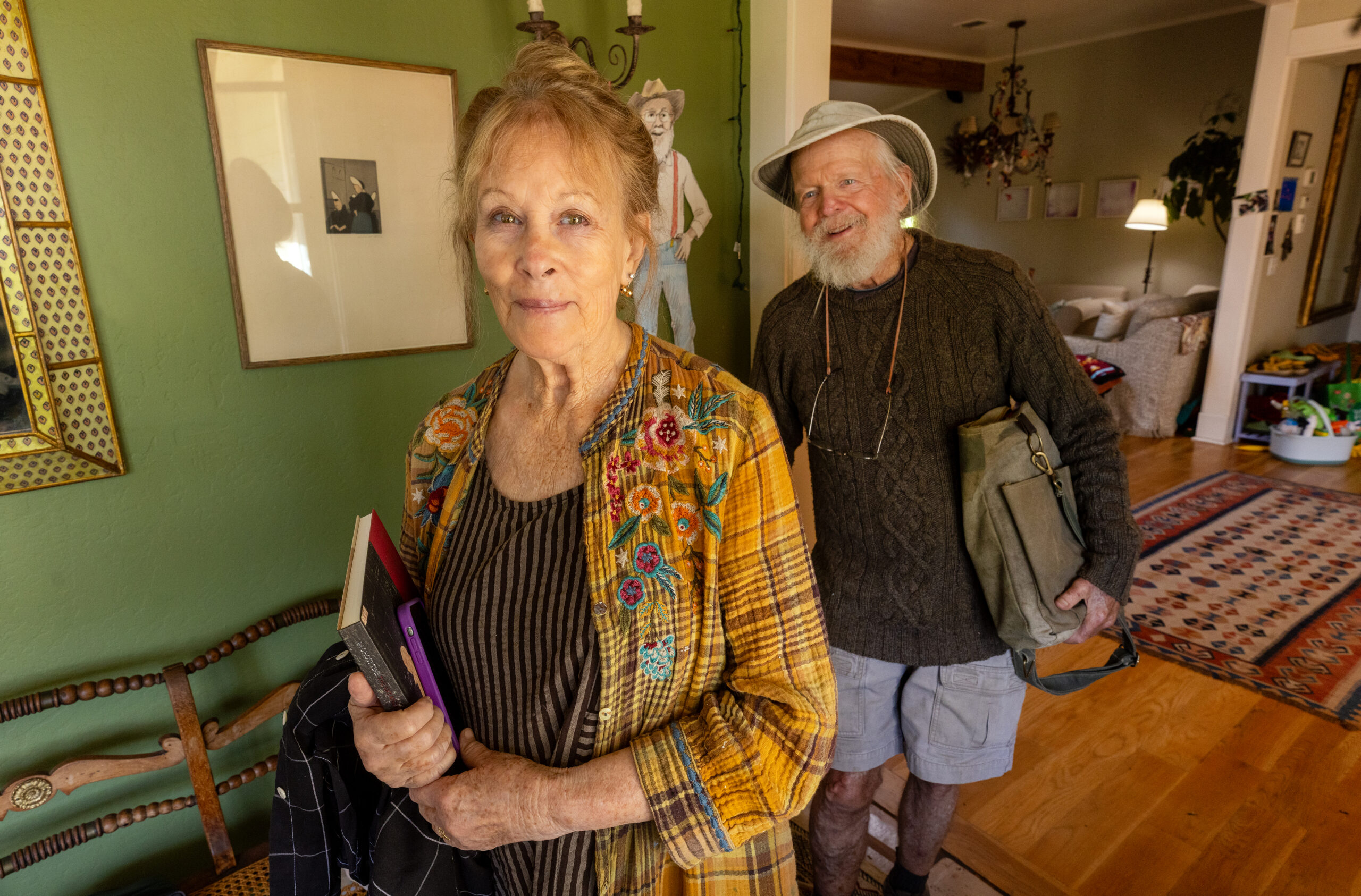
Since the mid-1970s, Susan and her husband, Lou Preston, have run a farm and winery in Dry Creek Valley widely beloved for its Old World feel and relaxed family vibe. Preston Farm and Winery sells superb wine, olive oil, organic produce, and artisanal food products like sourdough bread.
Less well known, but no less remarkable, are the talents and oeuvre of Susan Preston, who for decades “kind of split three ways,” in her words, dividing her energies “between children, business, and the art.”
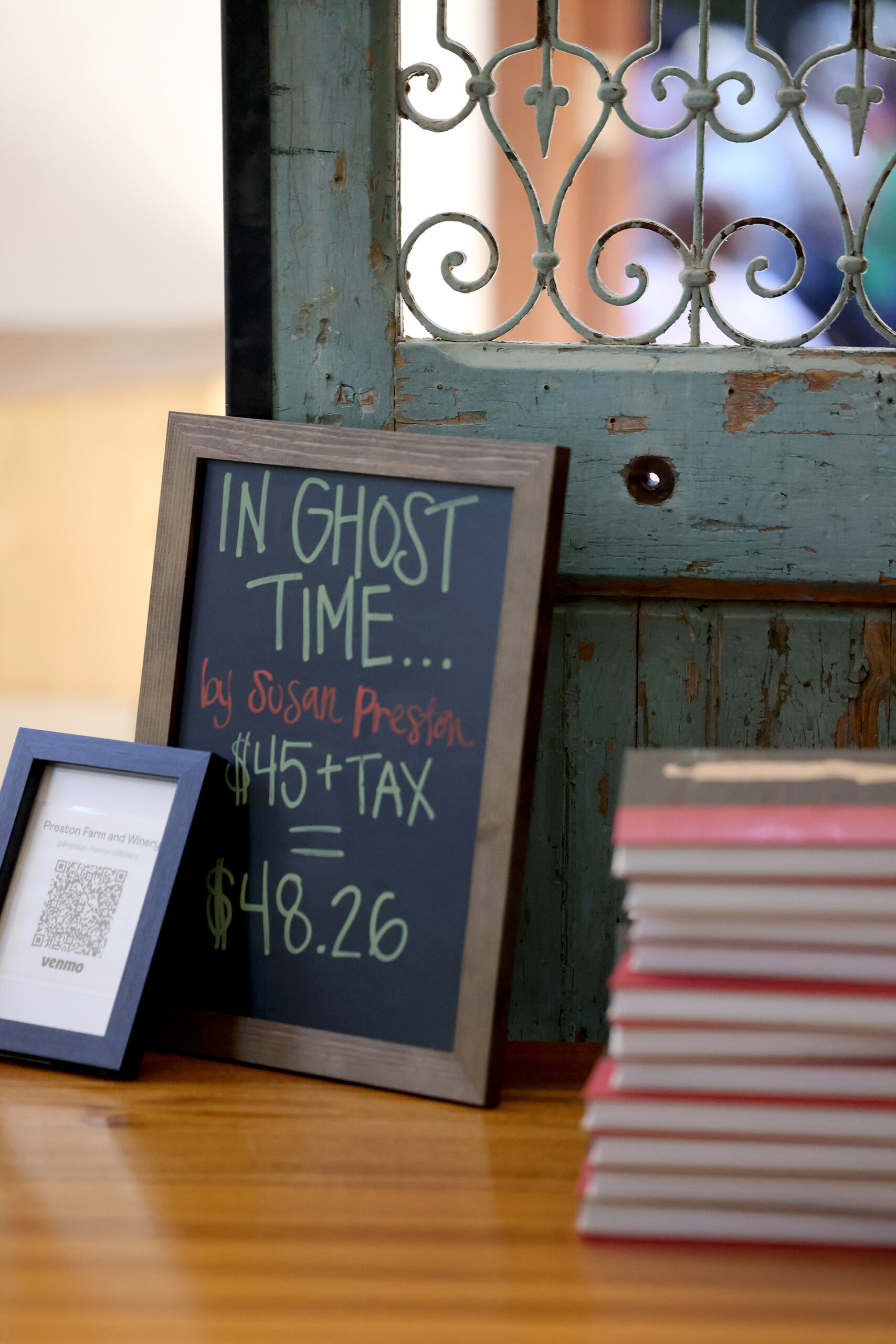
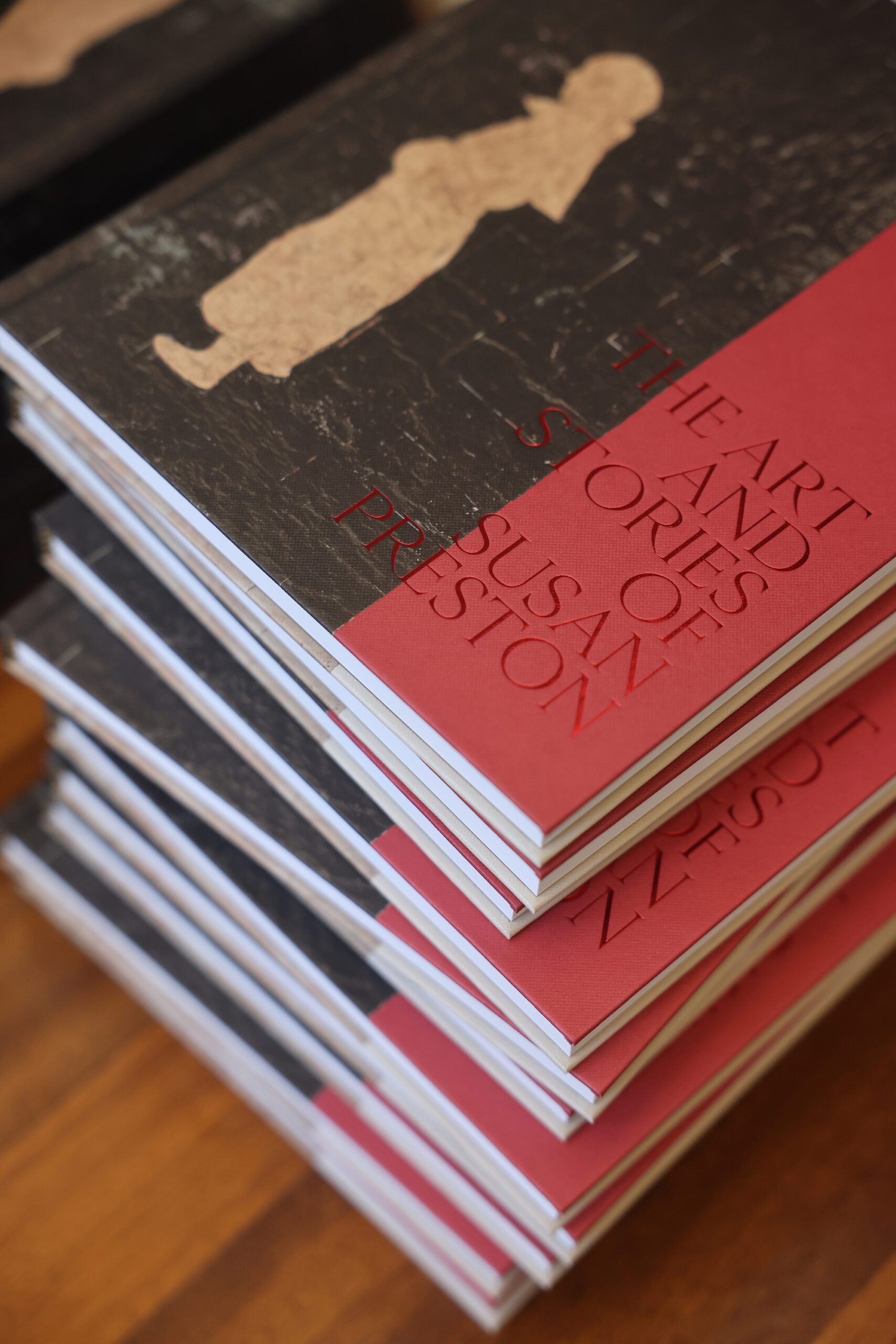
Copies of the book “In Ghost Time: The Art and Stories of Susan Preston” are available for purchase and signing during Preston’s book launch party at Barndiva in Healdsburg Sunday, Sept. 14, 2025. (Beth Schlanker / The Press Democrat)
With the September release of “In Ghost Time: The Art and Stories of Susan Preston,” her profile as a creative is on the rise. While helping grow the family business and raising daughters Maggie and Francesca — both now established artists in their own right — Susan was devouring courses at Santa Rosa Junior College, then Sonoma State University, then Mills College in Oakland, where she earned her Master of Fine Arts degree in 1996.
During that time she was honing the distinctive style on display in her new monograph.
“All the teachers told me I had my own way,” Preston recalls with a smile. “They said, ‘You’re an original.’”
“She’s always been very much her own person,” said Maggie, a photo-based artist who lives and works in Berkeley, “a little unusual, a little eccentric, and not necessarily following the traditional path.”
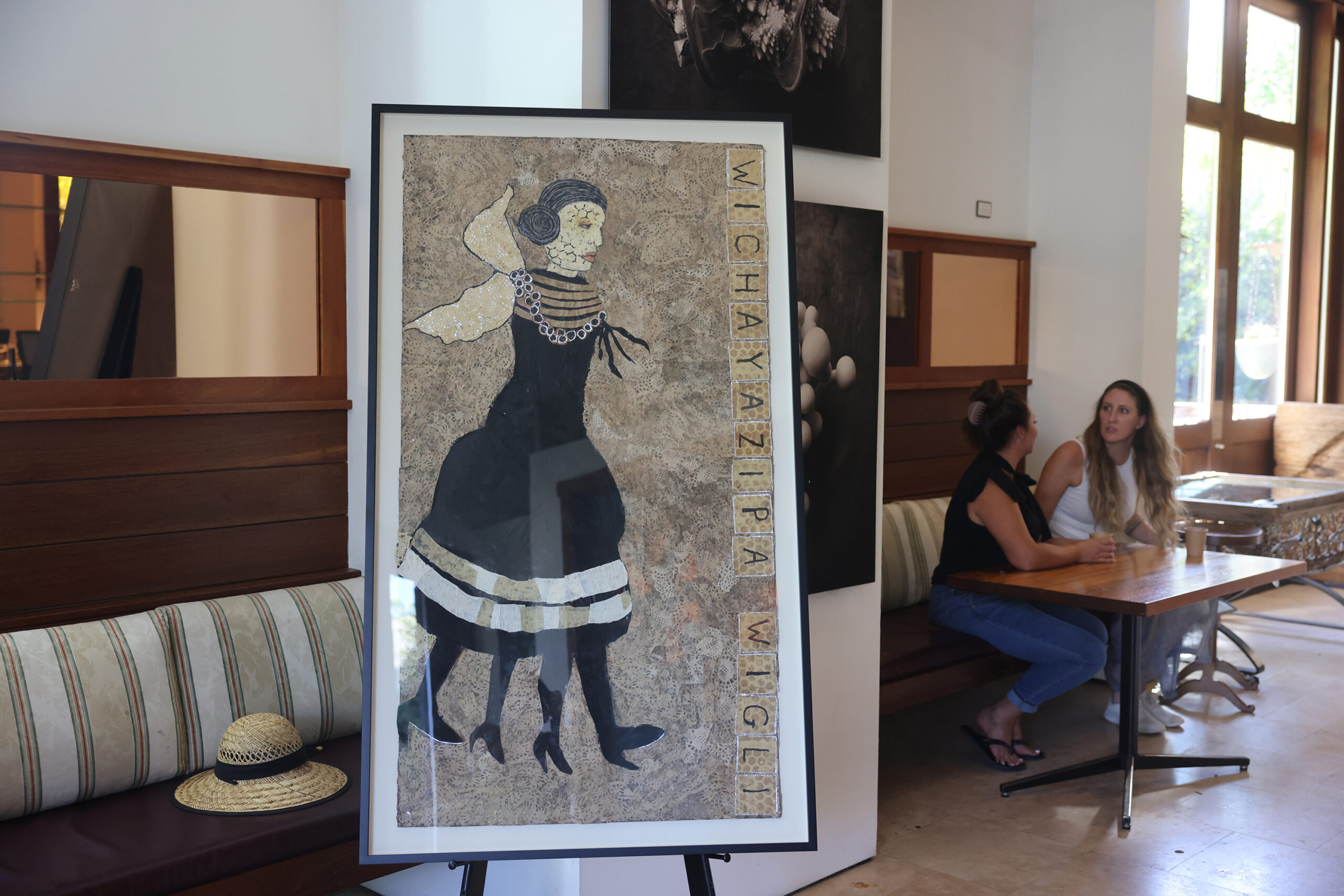
Artwork by Susan Preston is on display during a launch party for her book “In Ghost Time: The Art and Stories of Susan Preston” at Barndiva in Healdsburg Sunday, Sept. 14, 2025. (Beth Schlanker / The Press Democrat)
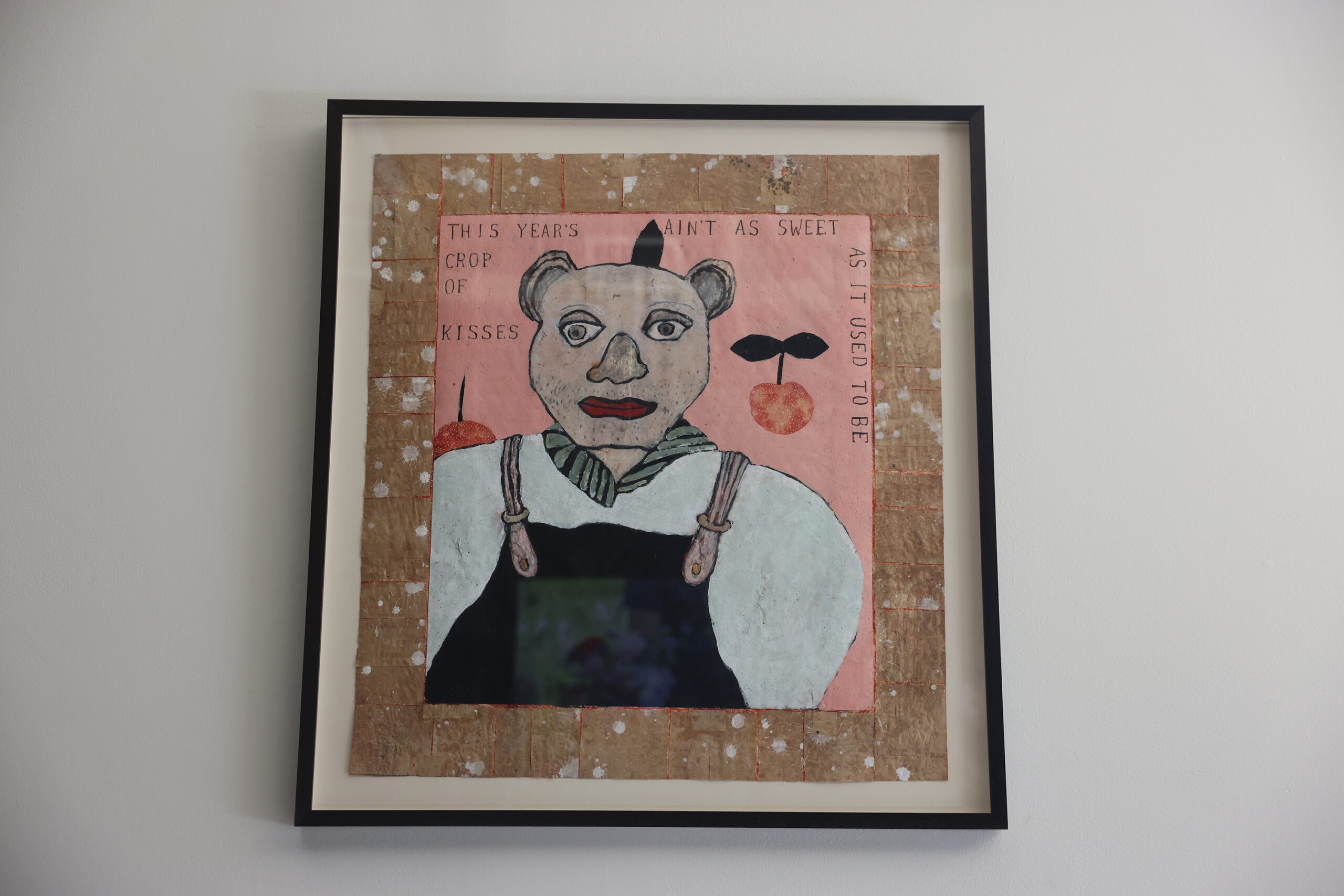
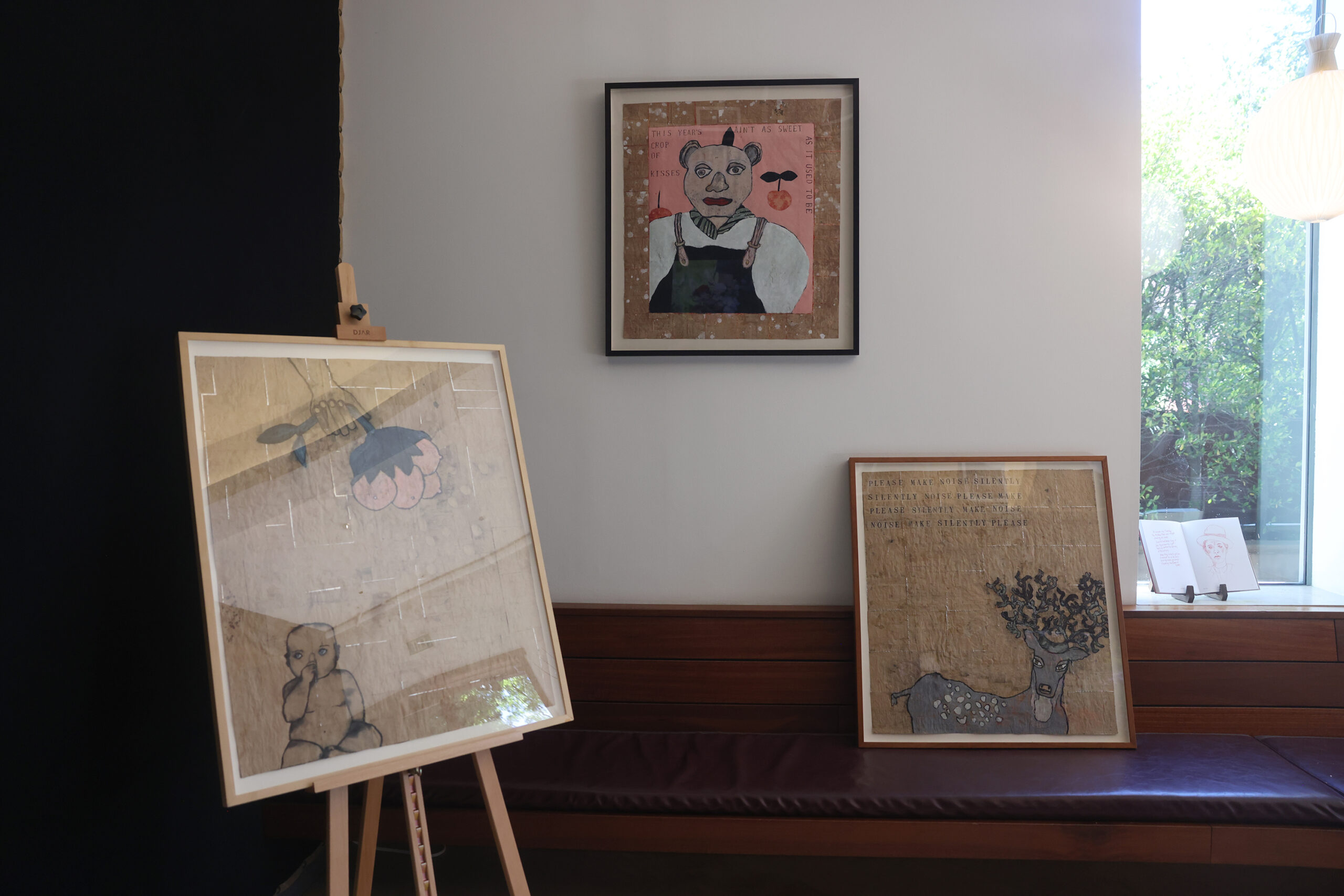
The less traveled, often fantastical path trod by Susan Preston resulted in paintings with whimsical and occasionally sinister titles, such as “Make Noise Silently,” “Oh Noodles Please Don’t Leave Me,” “A Pimp’s Tattoo,” and “We Killed the Wrong Twin.” Preston’s collage-style works feature “mysterious and idiosyncratic images” that are “a form of visual poetry and storytelling,” wrote Stephanie Hanor, Art Museum director at Mills College.
As unconventional as Preston’s art are the materials from which it’s made: brown paper bags — the kind you get in a grocery store — bees wax, black tea, rabbit skin glue, chewing gum, olive oil, and foil.
That alchemy takes place in her stand-alone, 20-by-30-foot studio just beyond the farmhouse on their verdant 125-acre spread between Dry Creek and Pena Creek. Covering the studio’s walls are drawings cut from her notebooks. No longer strong enough to push tacks into the walls to hang those sketches, she keeps a small hammer at the ready, for that purpose.
The studio is a place of “creative chaos,” says Lou, who speaks with wonderment of his wife’s process, and “all these wild and weird things in her work.”
Susan Preston in her studio near her home of 50 years in the Dry Creek Valley. (John Burgess / The Press Democrat)
While she used to bury larger pieces of that brown paper in the river, Susan now covers smaller squares with earth she’s loosened in front of her studio. She checks them every so often “like you would stirring a good soup,” she explains. “When the pieces are ready, I take them inside and wash them off. Subtlety is what I’m looking for. Sometimes, I pour small streams of olive oil or tea on them.”
Thus does she summon “characters and anthropomorphic animals that challenge our perceptions about what it really means to be alive,” writes Jil Hales in an essay that appears in the book.
Hales, a close friend of Preston’s, is the founder and co-owner of Barndiva, a Michelin-recommended restaurant that doubles, by day, as an art gallery and played a prominent role in the genesis of the women’s friendship.
On the day it opened in 2004, a crowd gathered outside Barndiva for an exhibit Hales had painstakingly planned. A select group of makers had been invited to showcase their wares: wine, chocolate, cured meats, and other delectables — each complemented by a piece of art that “interpreted” the edible art.
Artist Susan Preston, joined by her husband Lou, signs a copy of her book “In Ghost Time: The Art and Stories of Susan Preston” during a launch party for her book “In Ghost Time: The Art and Stories of Susan Preston” at Barndiva in Healdsburg Sunday, Sept. 14, 2025. (Beth Schlanker / The Press Democrat)
Each, that is, except the wood-fired, heritage grain loaf baked by Lou Preston, which, 10 minutes before Barndiva’s grand opening, still had no art to accompany it.
That’s when an attractive woman with “an off-kilter swagger strode in through the main door,” Hales recalls in the Barndiva blog, “carrying a full bag of flour on her shoulder.”
Susan “proceeded to bend, slash, and pour the entire sack onto the new stone floor, just below the plinth where Lou’s ‘art’ sat beneath a spotlight.”
The flour dust had yet to settle before she left, then returned with a faded blue, spindle-backed chair she placed into the flour. It was a performance piece, Hales writes, that “fully caught the zeitgeist of the exhibit and spoke eloquently of the direction we hoped to take Barndiva.” It was also a moment that left Hales convinced: “I needed to know this woman.”
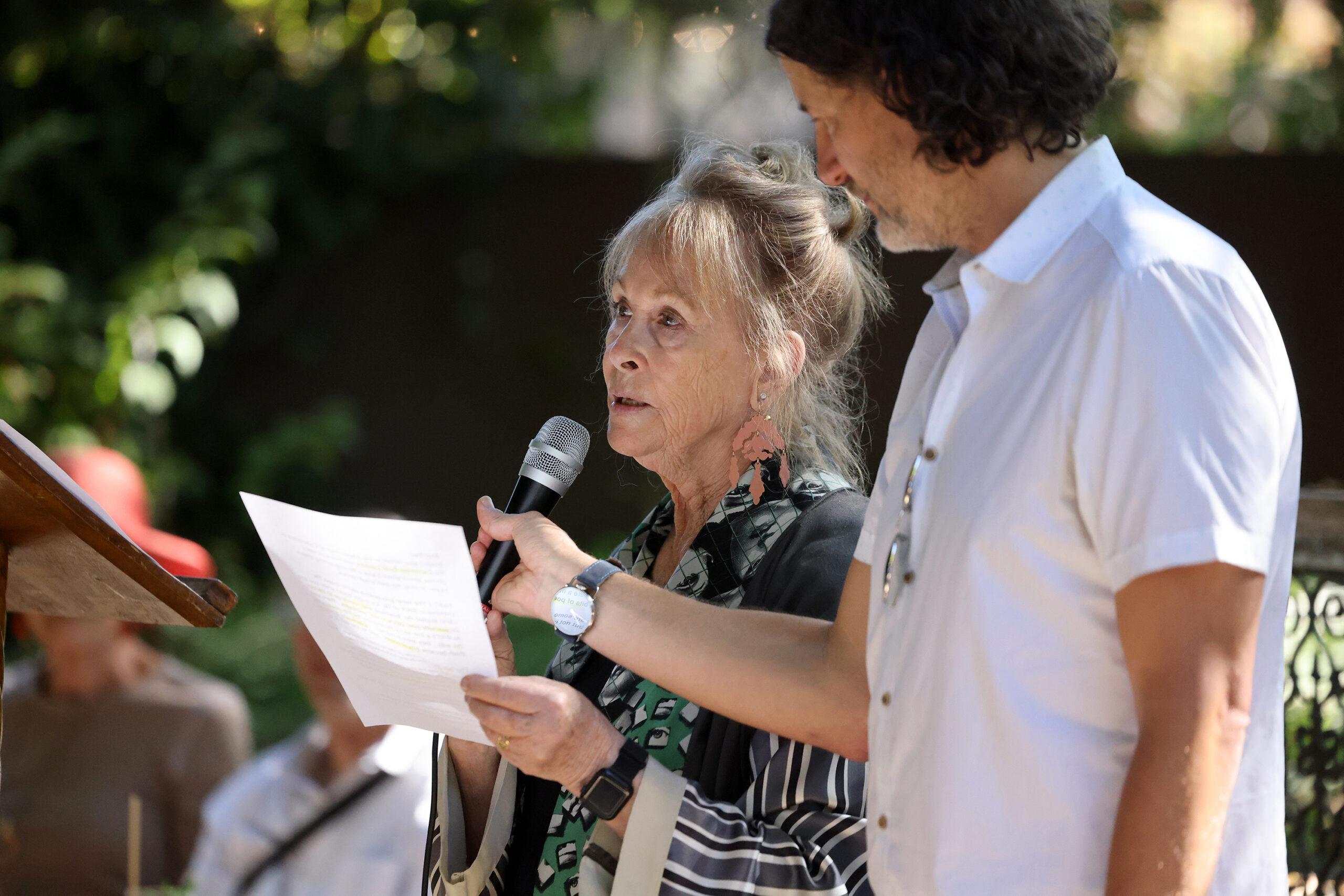
Artist Susan Preston speaks before a crowd during a launch party for her book “In Ghost Time: The Art and Stories of Susan Preston” at Barndiva in Healdsburg Sunday, Sept. 14, 2025. (Beth Schlanker / The Press Democrat)
The friendship that blossomed, says Hales, has “intensified the last few years.” Preston Farm works closely with Barndiva. Susan has shown her work in its studio. In addition to being wonderful and kind, Hales notes, Preston is “forthright,” and “has an honesty about her that’s rare these days.”
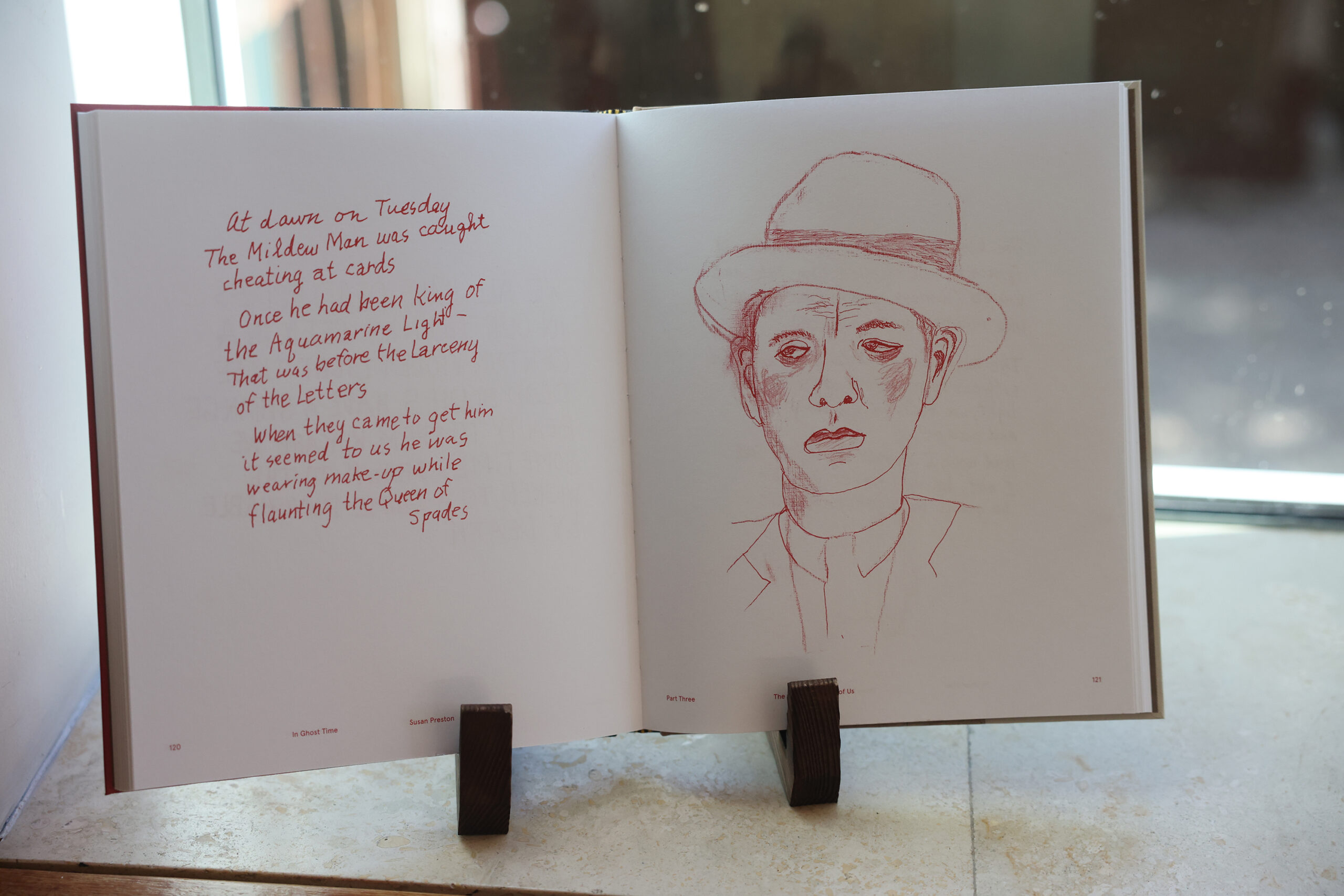
It was at Hales’ urging, and with her considerable help, that Preston produced “In Ghost Time,” a collection of her paintings and sketches, along with a handful of indelible stories that shed light on her artistic process and recall her free-range, almost feral upbringing in Calaveritas, California, an abandoned Gold Rush town, which gives the book its title.
I grew up in a ghost town
And played in the remains of an old Fandango house.
Two large junk heaps and a forgotten blacksmith shop.
Sections of the town were separated by barbed wire fences.
The lines in my paintings and drawings remind me of that ragged fence.
I crave a strange and crooked simplicity.
That’s an excerpt from the prologue introducing the book’s “Stories,” which recount in Preston’s spare, evocative prose what it was like to grow up in Calaveritas without her father, who moved away when she was 3, but with an extended family that provided “both freedom and protection.”
Copies of the book “In Ghost Time: The Art and Stories of Susan Preston” are available for purchase and signing during Preston’s book launch party at Barndiva in Healdsburg Sunday, Sept. 14, 2025. (Beth Schlanker / The Press Democrat)
You can take the girl out of the ghost town, but as Preston recounts in the book, the characters, shapes, and materials from Calaveritas, including “an old squeaky chair, a gold mining pan, iron trivets,” and the coiled baskets of the Miwok tribe just up the road, have long insinuated themselves into her artwork, embedded themselves in her being.
From the first day they met, said Lou Preston, whose upbringing on a dairy farm outside Healdsburg was more conventional, “I’ve been envious of her growing up with this incredible, magical independence.”
Artist Susan Preston draws birds for her latest piece while sitting in her studio sketching chair a quick walk from her home of 50 years in the Dry Creek Valley. (John Burgess / The Press Democrat)
“In Ghost Time” was conceived and set in motion during the Covid-19 pandemic, a frightening, uncertain period of Preston’s life.
In chronic pain while recovering from a difficult surgery, “and with the added dimensions of Covid, the political environment, and the general unknowing,” she recalled, “something disoriented me severely.”
“I became unmoored, half in this world, half in another. No one knew quite what to do about it.”
This “time of madness,” she said, was worse for her loved ones than herself.
Hales, who described Preston’s condition as “a perfect physical and psychological storm that jumbled her signposts and signals,” came up with the idea that helped Preston find her way back to lucidity.
She encouraged her friend to assemble a monograph of her art and stories. “And for some reason,” Preston recounted, “that was the first idea that stuck, and gave me purpose.”
It took two years, but she regained her health and started painting again.
Susan Cuneo and Lou Preston went on their first date in 1973, having been introduced by Barden Stevenot, a visionary grapegrower who would later be credited with bringing the wine industry to Calaveras County. On this day, he was showing Lou a piece of land in Dry Creek Valley that held promise as a vineyard.
Stevenot brought along his friend from the Gold Rush region, Susan, who at the time was teaching at a tiny Graton elementary school.
Susan Preston and her husband Lou have spent 50 years together in their Dry Creek Valley home. (John Burgess / The Press Democrat)
Lou remembers Stevenot showing up “with this gorgeous and smart lady who arrived to walk around the property in the shortest skirt I’d seen in a long time.” She was also barefoot.
He was also taken with Susan’s intellectual range. “She was very literate in a way that I wasn’t.”
And so she remains, says Lou, who now finds himself wondering, “If we live long enough, can I catch up? And I’ve kind of decided I probably won’t.”
Not long after that first date, Susan brought her new beau to Calaveritas, about 5 miles east of San Andreas, “to stomp grapes in the stonewalled winery under my family home.”
On long walks to the barn late at night, she recounts in the book, “I turned cartwheels for him in the moonlight.”
A year after that first date, they were married in Calaveritas. Stevenot was Lou’s best man.
After the couple launched their business, Susan would make frequent trips to the vest-pocket post office in Geyserville, where there was always a line, she remembers.
The book “In Ghost Time: The Art and Stories of Susan Preston” sits on display during Preston’s book launch party at Barndiva in Healdsburg Sunday, Sept. 14, 2025. (Beth Schlanker / The Press Democrat)
While waiting, she would turn her attention to the posters of the FBI’s “Most Wanted” fugitives. “They were a marvel,” she says. Studying their photos, admiring the cleverness of their aliases — she was especially taken with one Dwight Orlando Birdsong — Susan conjured fictitious backstories for them. Before long, she recalls, she was writing “poems and tiny stories” about them.
“In a sense some of these outlaws became my people.”
The tales of those outlaws, accompanied by her sketches, grew into a series of pieces she showed at the Southern Exposure Art Gallery in San Francisco in the early 2000s.
They also comprise “Part Three” of “In Ghost Time,” titled “The Criminal in Each of Us,” which begins with a kind of free-verse statement of her purpose:
I want to make real things, primitive, direct and concrete — like statues
Who live outside the Law.
I want to make a roomful of anarchists, who live below the earth, with
No remorse.
Artist Susan Preston speaks before a crowd during a launch party for her book “In Ghost Time: The Art and Stories of Susan Preston” at Barndiva in Healdsburg Sunday, Sept. 14, 2025. (Beth Schlanker / The Press Democrat)
While raising her daughters, Preston put her life as an artist on hold. She waited until Maggie, her youngest, was in kindergarten before enrolling in art classes at the junior college.
“I would take one or two courses each semester,” recalls Susan, who was constantly checking art history books out of various libraries. Strewn about the house, those tomes were picked up and perused by Maggie and Francesca, who themselves gravitated, not surprisingly, to the arts.
So obsessed was Susan with painting, she says, that she had occasional pangs of guilt “that I wasn’t giving them enough attention” — a notion Maggie dismissed by telling her mother, “If you’d given us too much attention, we wouldn’t have been able to find our own way.”
Francesca, a poet, essayist, artist, and editor based in Petaluma, contributed “Lean In Closer,” an essay accompanying the fourth and final section of “In Ghost Time,” a crazy quilt of drawings and musings collected and curated from the dozens of journals her mother kept over nearly 40 years.
Artwork by Susan Preston hangs on the wall during a launch party for her book “In Ghost Time: The Art and Stories of Susan Preston” at Barndiva in Healdsburg Sunday, Sept. 14, 2025. (Beth Schlanker / The Press Democrat)
Those journals and notebooks contained “words, patterns, unanswerable questions, cross-outs, lines from poems — all dancing around and within those fabulous faces,” Francesca recalls in her essay.
The notebooks could be found throughout the Preston household, “all over the place, like turkey feathers after a dust-up. Sometimes they were left open. If I came across one, I would gaze at it like a lost sibling.”
The drawings in those notebooks, which evoke the illustrations of New Yorker cartoonist Maira Kalman, were often rough drafts, precursors of the mature works that came later. Susan’s hope is that other artists might look at the sketches “and understand how my mind works when I’m figuring out what art to do.”
To look carefully at some of those drawings, she said, is to see “exactly where my thinking was.”
Artwork by Susan Preston is on display during a launch party for her book “In Ghost Time: The Art and Stories of Susan Preston” at Barndiva in Healdsburg Sunday, Sept. 14, 2025. (Beth Schlanker / The Press Democrat)
In a Q&A with her mother that appeared on the website Fuji Hub in February 2025, Francesca wrote that although Susan “did normal things like pack lunches and look for ticks in our hair, she was also growing into her real life as an artist, a painter, an inward-outward thinker. By the time I was 20 she had made her way to the prestigious MFA program in painting at Mills College, under the mentorship of master Hung Liu.”
Liu, one of the first Chinese artists to establish a successful career in the United States, died in 2021 of pancreatic cancer, two months before the opening of a major exhibition of her work at the National Portrait Gallery in Washington, D.C.
A few months before her death, Liu had been planning an exhibit honoring women artists she’d mentored during her two decades at Mills. Thirteen of those former students were chosen to have their work showcased at the exhibit, Susan Preston among them.
One of the questions Francesca posed to her mother concerned a sketch gleaned from one of those journals. Beside a drawing of a gazing woman is the sentence “Put a little anger in your sugar bowl.”
Artist Susan Preston attends a launch party for her book “In Ghost Time: The Art and Stories of Susan Preston” at Barndiva in Healdsburg Sunday, Sept. 14, 2025. (Beth Schlanker / The Press Democrat)
Asked to explain, Susan replied, “Well, I think that as a woman I don’t want to be walked over. One of the ways we can keep that from happening is to be a little spiky. Pretend you’ve got spikes all over you. I mean, you don’t have to be that way all of the time. But like how animals can change form when they need to? Like that.”
Or like the spiked plant she mentions early in her book:
I live in a place called dry creek
Where stinging nettle grows unbidden
Along the ruffian water
Before a rain I might bury a drawing down
Under the black dirt
Near my studio door or take a painting to the river
To bury it by placing rocks on its face
When I return to collect the pieces I feel like a mother rescuing her child.