For many wine lovers, the holiday season is the perfect time to share stories and favorite wines with family and friends. And what better way to find both of those things than to visit Sonoma County’s wineries?
This month, Julie Fadda Powers focuses on select wineries with intimate spaces, fireplaces and caves as well as those offering sparkling selections. Multi-winery events this season include Wine Road’s Wine & Food Affair on November 4 and 5, with wine and food pairings throughout the Russian River, Alexander and Dry Creek valleys (visit wineroad.com for tickets and details) and the Heart of Sonoma Valley Winery Association’s Holiday Open House on November 25 and 26, which includes 20 participating wineries throughout the valley (visit heartofsonomavalley.com for tickets and details). If you’re venturing out on your own, be sure to check websites or call ahead for hours and reservations.
In early October, a series of devastating fires ripped through Northern California. Now, with the fires at 100 percent containment, the region faces a new challenge: recovery.
For restaurant owners, who rely on Sonoma County’s tourism to sustain themselves and their employees, the fires threw things previously guaranteed–a steady stream of tourists during harvest season as well as a place to live–into upheaval.
We talked to Sonoma County restaurateurs who helped others as they grappled with uncertainty and their own personal losses during the fire, about their experiences and plans for the future.
Terri and Mark Stark
Willi’s Wine Bar was Mark and Terri Stark’s first restaurant. It was inspired by their second date, where they sat at the bar instead of a table, happily chatting with the staff and each other over a collection of smaller dishes. Their dream of opening a place like that was realized in 2002, when they had finally saved enough money to open Willi’s in an old Santa Rosa roadhouse. The Starks would eventually go on to open five more restaurants, but there was always something special about Willi’s. It was one of the first places to offer a now-popular selection of small plates, and more importantly, it had a distinctly local, comfortable feeling. You could enjoy a glass of local wine with friends, with no snobbery and no dress code. Dogs were welcome, as were small children.
Willi’s burned down in the early hours of Monday, October 9. That morning, Terri Stark was woken up by a call from their director of operations. She was fleeing from her home in the burning Coffey Park neighborhood and arrived at the Stark’s house with just her pajamas and purse. Soon, the Starks received another call. The manager who shut down Willi’s that night had heard about the fire, and raced back to turn off the restaurant’s gas. He then climbed on the roof to hose it down. He decided it was time to leave when he started noticing that the cars speeding down Old Redwood Highway were on fire.
The Starks didn’t know for certain if Willi’s had burned until around three in the morning, when local newspaper the Press Democrat posted a picture of the burning restaurant on their website. Their next days were spent in what Stark calls, “true survival mode,” as they hosted a house full of evacuated friends and were ready to evacuate themselves at any moment. On Thursday, they opened their other five restaurants (they had tried to open Wednesday, but the smoke was too thick.)
“It was really to get people back to work,” Terri Stark said of the decision to reopen. Her staff–the Starks employ over 400 people across their restaurants–was grappling with the same trauma and loss as everyone in the county, but as service industry workers, any time to the restaurant was closed meant a dip in their paycheck. “Our community needed a place to go again to have that meal or some semblance of normalcy,” she said. “I just felt like it was our duty to get the restaurants open as soon as possible.”
From Thursday to Sunday, the Starks provided free meals to evacuees and first responders at their remaining restaurants. Stark also started the daunting task of finding jobs for all 52 displaced Willi’s Wine Bar employees at their other restaurants. (As of our interview, she had succeeded.)
“The restaurants are our employees’ second home. And within each restaurant, they make up a family of their own,” she said. “For them to be around each other, it was really powerful and important.”
The Starks are still trying to find out if they can rebuild Willi’s–the historic nature of the property means it requires a host of improvements before it can operate as a commercial space–and in the meantime, they’re doing everything they can to ensure their guests have a great experience, so that Sonoma County remains a destination for tourists.
“Much of what Sonoma has to offer as far as wine country experience is still here and beautiful,” Stark said. “It would be even a bigger tragedy if businesses couldn’t survive in the aftermath of this and people lost their jobs. The trickle down from that is just going to add to the devastation.”
Dustin Valette
Dustin Valette grew up around airports. His mom flew for for REACH Air Medical Services, his dad for Cal Fire, so he’d end up waiting for them at the airport, washing planes and doing other chores. Sometimes during those trips, the airport would receive news of an airplane crash. Valette would be quickly shuffled away to his grandfather’s house, where he’d spend hours worrying, not knowing if the plane that had gone down had been carrying his parents, or one of their coworkers that had been over for dinner the previous Sunday.
Valette didn’t follow his parents’ path. He became a chef instead and opened Valette in Healdsburg in 2015. But his experiences growing up gave him an intimate knowledge of not just the uncertainty that comes with loving a first responder, but the logistics of their deployment. So when he was woken up early Monday by his young daughters, and started to hear about the fire’s horror from his friends, he knew that all firefighters would be deployed to fight it–except for one, who would required to stay back and cook for the rest of the team. What if, Valette thought, he did what he does best–cooking–so as many firefighters as possible could do what they do best?
That Monday, Valette went to his closed restaurant, took stock of what he had, and started cooking meals for the first responders like his dad, still a Cal Fire pilot. “Monday, those first responders had Kobe steaks, lobster and caviar, because that’s what we had in our walk-in,” Valette said. They made 150 meals that first day, and by the end of the week, with the help of friends, they were making about 400 dinners a night for the first responders, a pattern they continued for about a week and a half. At one point, a crew in Geyserville loaded up one of their trucks with the food, and brought it up to the middle of the fire so the crew could take a break.
The meals didn’t just provide sustenance but an injection of morale, Valette said. “When we showed up on Wednesday afternoon, they were eating government-issued peanut butter, and government-issued bread. So basically, hell,” he said. “To see them go from [a] piece of peanut butter and cold bread to eating roasted pork and braised chicken…[we gave] them a sense of something to look forward to at the end of the day, fuel that wasn’t just calories, but a sense of enjoyment.”
“The morale changed instantaneously. It was like…kids at Christmas,” he continued. “Everybody came running out of the tents, everyone’s clapping, and these are people who are risking their lives. Jumping out of helicopters into burn zones to put out a fire, with nothing but a rake. And here they are, coming right up like little kids clapping, because it was such a huge thing for them.”
The fires are now contained, but Valette still has plans to help the first responders. He’s working at Chefsgiving, a chef-driven fundraiser, and he’s also the chair of Rise Up Sonoma, a December fundraiser featuring food, wine and a silent auction.
And while his restaurant is safe, as is his home, he’s still recovering in other ways.
“We’re definitely nervous. I mean, in the first two weeks our restaurant lost $60,000. And that was just because we were putting a lot of money out for first responders, but also because the sales, the revenue, wasn’t there. And I think everybody, in the industry, is nervous,” he said. And It’s not just the obvious–hotels and restaurants–that will be affected by a drop in tourism, he added.
“Our cheese lady. Simple and funny as that is, our cheese lady, who we buy cheese from…We didn’t order cheese for a week, because we didn’t have people buying the cheese,” he said. “So, all of a sudden, she’s not selling the cheese, she has to cut back her staff, and then, the delivery driver who usually gets paid 100 bucks to go drive here and drop it off, well, they don’t need him, so he doesn’t need to work, so his hours [are] cut. It’s just a huge trickle-down effect.”
The Ochoa Family
On the night of Sunday, October 8, the Ochoa family, owners of popular downtown Santa Rosa taqueria El Patio #2, watched a movie together at their Fountaingrove home. The daughter, Maria Ochoa, fell asleep during the movie, and afterwards, when the rest of the family headed to bed, she wasn’t tired. So she stayed up, watching YouTube videos late into the night. As it grew later, she started noticing things. The people talking outside her window still hadn’t left. People were starting their cars. The smell of smoke her family had noted earlier still lingered.
“I couldn’t go to sleep,” she said. So she stepped outside. “Once I went out to see, I felt this heat wave.” That’s when she went back in and woke up her mom.
Maria Ochoa, daughter of the owner of El Patio in Santa Rosa. (Wendy Goodfriend)
The Ochoas decided to leave for another property they owned that they usually rent out, but was currently empty, They gathered their cats and dogs, but Maria’s mother was forced to leave her beloved pet birds behind as they fled. The next morning, her mother returned to the neighborhood for them, but the road was blocked off. A police officer took pity on her, and escorted her back to their house.
“She was the first one to notice that our house was gone,” Maria said. “She came back crying and she told us all that our house was gone.”
The Ochoas didn’t open El Patio on Monday or Tuesday. But on Wednesday, Maria and her father, Sergio Ochoa, El Patio’s owner, were back with their employees, making tacos and burritos for their customers as they adjusted to their new life. A friend of the family noticed their dedication, and posted about Sergio’s return to work on Facebook in a post that quickly amassed more than a hundred supportive comments.
“It was really amazing,” Maria Ochoa said, of the post. “I didn’t know people showed that much love for us, especially [for] my dad. I couldn’t believe it. I couldn’t stop smiling.”
As word spread, the Ochoas have been inundated with gifts of clothing and gift cards. The support surprised Sergio, who didn’t expect people to be thinking about him. It’s a role reversal for Sergio, who is usually the one helping others–in particular, the homeless people who occupy the park across from the restaurant, who Ochoa regularly feeds, passing out burritos to those who seem hungry. “I had a little change five years ago,” Ochoa said. All of a sudden, he started “worry[ing] about other people on the streets. And I started giving some meals, and I’m feeling good.”
Like a lot of people, the Ochoas aren’t sure if they’ll rebuild their home. They’re slowly returning to normalcy, one order at a time, adjusting to their new routines, new housing situations, and–for Sergio–the new feeling of someone worrying about him. “A lot of people are helping people right now. I am so surprised…[it’s] very nice.”
Erik Johnson
Marissa Alden was in China on a business trip when she found out about the fires. A neighbor sent her a message: the fires were getting closer. Was her family evacuating? Frantic, she called her husband, Erik Johnson. He didn’t get the message, thanks to their Cloverdale home’s spotty cell reception. She finally got through to his parents, who were staying with Johnson to help out with childcare while she was away. After being woken up by his stepdad, Johnson sprung out of bed, and gathered their twin daughters, explaining to them as calmly as he could manage that there was a fire, and they needed to leave immediately. The family evacuated to his mom’s house in downtown Cloverdale, where they remained for the next few days.
Alden and Johnson own the Trading Post in Cloverdale, and that Monday, Johnson started cooking. The Pocket Fire that affected Cloverdale didn’t cause as much damage as the Tubbs fire in Santa Rosa, so evacuees turned away from the overfilled Santa Rosa shelters soon headed north to Cloverdale to find refuge. For two days, Johnson prepared meals for evacuees staying at the Citrus Fairgrounds evacuation shelter, down the street from the Trading Post.
People quickly joined in. The baker at his restaurant contributed some loaves of focaccia to go with the lasagna he made. His neighbor, a farmer who provides much of the produce for his restaurant, donated greens he turned into a salad. A local market donated some dairy and dry goods.
“We just wanted to cook some home-cooked, sort of comfort food for folks down there. Just to give them a warm meal that hopefully they would enjoy,” he said. “The first instinct that I had was how can I help, what can I do to help? And the obvious way to help was I have a commercial kitchen, and [I could] rally some people in the community around to help donate a little bit of food. It just felt good to do that.”
Johnson and his family were able to return home on Wednesday, but were then forced to evacuate again after the winds shifted. His house was ultimately fine, and he reopened his restaurant on Thursday. “We opened back up because we just knew that there’s a lot of people in town that kind of want normalcy, and wanted to be able to gather somewhere and eat,” he said.
Johnson is participating in the Rise Up Sonoma event with Valette in December, and like Valette, he’s anxiously waiting to see what the long-term economic effects will happen as a result of the fire.
“I wouldn’t say it’s dire, but it’s a little bit slower than usual,” he said. He wants people to know that, “Sonoma County didn’t burn to a crisp, it’s still here. It’s beautiful.”
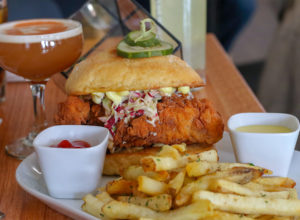
Grassfed burger at The Golden Pig in Hopland. (Heather Irwin/PD)
With all the holiday celebrations and feasts, November and December can feel like gastro-overload. Heather Irwin says skip the cookies and candy and save the calories for some of the new spots she’s found around Sonoma County (and beyond). It’s a great way to escape the seasonal mayhem and nourish both body and soul.
THE GOLDEN PIG, Hopland
Julie Golden’s dance card was full long before she opened The Golden Pig restaurant in Hopland last summer. There was the massive fire that wiped out acres of grazing land for the animals Mendocino Meats’ Adam Gaske raises on her 2000-acre ranch near Ukiah. Then there are the winery and vineyards she manages with her husband Joe, four school-age children and a menagerie of animals. And her wine shop.
But it was her ongoing frustration about how restaurants source their food that made her a newly-minted restaurateur as well.
After years of selling her grass-fed beef, pork, and chicken to high-end chefs, then watching them cancel orders when she claims her prices were undercut by larger food suppliers, she figured she’d put her money where her meat was.
In late June, Golden opened The Golden Pig as an outlet for her beef, pork, chicken, eggs and produce—with that of nearby farmers—and as a sort of experiment in bringing true farm-to-table food to more people.
“I didn’t do this to just to be a restaurateur,” she said. “I did it because I love farmers and I want people to be able to thank me for bringing them great food.”
Calling her restaurant farm-driven, rather than farm-to-table, Golden’s mission with The Golden Pig is to grow honest food in healthy soil with clean water, lots of sunshine and minimal intervention – “to keep you healthy”, according to Golden. Her menu bears the following credo: “We’re investing in the land and the farmer, creating a culture that strengthens goodwill among local businesses and delivers fine food to each of our customers. It feels good to cook with honest ingredients. And it feels even better knowing we’re nurturing the land for future generations.”
Golden hasn’t hired a chef, but she trains her cooks to execute simple dishes she’s helped to create, frequently based on what’s available rather than what can be delivered by a food service company.
“Farmers need somewhere for their food to go,” she said, adding that the claim of farm-to-table sometimes far exceeds the reality of what restaurants are actually serving.
Golden says that, as a producer, she frequently encounters top San Francisco chefs who would feature her products for a while until food service suppliers were able to offer substantially lower prices than those being offered by her farm and other small producers.
Since restaurants frequently have slim margins on food costs, Golden said it’s understandable, but frustrating to lose those accounts.
“This wasn’t something I was just doing in my spare time,” she said. “I’m making good food, using the entire animal, and being sustainable. I thought it would be easy to make people understand. But until I opened a restaurant I didn’t understand.”
“Now I understand why restaurants can’t easily work with small farmers. It’s complicated, and there are market forces that incentivize restaurants not to. Yes, there are chef-driven restaurants like Thomas Keller’s that are truly farm-to-table but that’s just not affordable to the average person.”
By using her own products, and those of her friends, she hopes to both keep costs low and showcase the food of the region.
Hopland has long suffered from drive-by syndrome. Fifteen miles north of Cloverdale, the thousand-resident hamlet is bisected by Highway 101 — only two slow-moving lanes here — with cars and trucks mostly passing through. But the Piazza de Campovida inn and tavern, along with the Emerald Pharms cannabis dispensary at the Solar Living Center, and other new wineries and restaurants like Golden’s are catching the attention of travelers.
Beautifully remodeled with recycled materials and clean lines, The Golden Pig is actually housed in one of the oldest buildings in Hopland — a 19th-century saloon called the Cottonwood. The centerpiece of the dining room is the original bar from the Yuengling Brewery in Pottsville, Pennsylvania, the nation’s oldest brewery. Her mother, says Golden, bought the piece at an auction, and used it for years in her Ukiah dress shop, Esther’s, with it later sitting in Golden’s barn, and now restored to its original glory. The full bar serves cocktails made with fresh local berries, muddled herbs and infused liquors, along with local beers on tap, a wine list with mostly nearby wineries (including their own Golden Winery), and house-made shrubs using seasonal produce from Heart Arrow Ranch.
More than just libations, they’re tasty symbols of Golden’s crusade toward delicious sustainability.
“Opening this restaurant is giving me insight into the system, and I can affect change more easily. I want to have this conversation about food, I want farmers to continue farming. Otherwise, what’s my legacy?”
Charcuterie at Journeyman Meat Co. in Healdsburg. (Photo by Heather Irwin)
JOURNEYMAN MEAT CO., Healdsburg
Eighteen inches nearly cost Pete Seghesio his longtime dream of becoming a salumist.
The two-story building he’d constructed at the site of the former Healdsburg post office was just a foot-and-a-half shy of fitting a custom- built meat-processing room he’d specially commissioned. OK, there was that, and the concern about loading whole animal carcasses into the building just steps from the downtown square.
So, Seghesio punted. He leased out most of the space in the building to Single Thread Restaurant and Farm, which had one of the most high-profile restaurant launches of the year. Single Thread also manages several guest rooms above the restaurant.
That left a small nook in the building for Seghesio to put in a retail butcher shop, salumeria and tasting bar, which has now opened as Journeyman Meat Co. His meat-processing facility, called a salumificio in Italian, has been relocated to Cloverdale, where engineers are putting the final touches on the multimillion- dollar salumi fermentation, sausage and hot-dog making, and estate beef-packaging space. Soon, all of Journeyman’s products will go directly from farm to table straight through Seghesio’s company.
Suffice to say, Seghesio now has his soppressata and can eat it, too.
The newly opened salumeria is every bit as luxurious as its nearby restaurant and tasting-room comrades that line Healdsburg’s streets — a warm, yet minimalist space that showcases several hand-operated Berkel meat slicers, hanging salumi, extensive wine racks, a wood-fire pizza oven and casual seating for sharing plates of charcuterie, pizzas, sausages, sandwiches and a glass of wine. As a butcher shop, it holds a carefully curated case of estate beef and heritage breed pork, along with bacon, smoked and fresh sausages, and assorted salumi.
The simple opening menu is worth snacking through, with best bets including: Butcher’s Steak, perfectly cooked market steak served with Parmigiano-Reggiano, a roasted tomato, compound butter and grilled bread ($18); salumi boards of five ($25) or eight ($34) salumi varieties; and sausage skewers ($10). There are also wine and salumi flights offering two wines with four salumi selections ($15) — a great way to try Seghesio’s Journeyman and San Lorenzo wines.
Why did the chicken cross the road? To pair its nuggets with a tasty Chardonnay in Wine Country’s newest tasting room.
Sebastopol’s Hip Chicks, whose organic chicken fingers are now sold in more than 5,000 stores, have opened The Kitchen, a chicken-nugget tasting room and lunch counter featuring “flights” of their original, ketchup and maple chicken fingers, fried buttermilk chicken sandos, a chicken meatball sub, turkey burger, egg sandwich with sweet potato hash, apple cider corn dogs and local beer and wine.
Chef and co-owner Jennifer Johnson, a Chez Panisse alum, founded the company with her wife, Serafina Palandech, to provide healthful, sustainable, family-friendly foods, starting with their nuggets, and expanding to other products like breakfast sausage, meatballs and grilled chicken strips.
In an instant, a drunk driver changed the trajectory of chef Travis Day’s life.
Though he was nowhere near Petaluma when an impaired motorist plowed into the storefront of Thistle Meats in early 2016 — all but destroying it — little more than a year later, he would officially reopen it to the public.
In mid-May, Day took over the downtown artisan butcher shop from founder Molly Best. It had been a rough year for the business.
The drunk driver had done so much structural damage to the building that it had been “red-tagged” as uninhabitable. Best was forced to sell her bone broth and meats to loyal customers from behind their Petaluma Boulevard shop for months.
When Day’s childhood friend and former Thistle butcher Aaron Gilliam said the shop was for sale, Day pounced. After a two-week shutter, Thistle was reborn.
“People were breaking down the door for bone broth,” says Day. “We couldn’t stay closed.”
More than just a butchery, the space has been opened up to include a small seating area serving sandwiches, soups and charcuterie plates that go far beyond deli fare.
The open butcher table remains, and a charming brick patio has become the setting for Day’s monthly Sunday suppers with some of San Francisco’s top toques. Day has kept on the former staff.
“I wanted to buy Thistle because I just love the product. I want this to be the best butcher shop in the Bay Area,” Day says. Continuing to focus on ethically raised meats from local ranches, Day knows his purveyors personally, describing everything from their animals’ feed program to how they are processed.
With years of study as a salumist and butcher, Day is a chef’s chef — working his way up the kitchen ladder with the kind of intense focus and passion that results in 25 journals filled with business plans and recipes, traveling to 20 countries with his chef’s knives and developing a résumé that includes some of the best restaurants in the world. Not that he’d really tell you that. Day and his staff are usually too busy learning Argentinian butchering techniques or describing “secreto” or “secret” cuts of pork.
“I used to cure duck prosciutto in the rafters and stay up until 3 a.m. translating old French cookbooks,” Day says. “I feel like this is the natural progression.” Part of what Day hopes to improve at Thistle are its prepared dishes like the simple-yet-not-simple Jambon Royal sandwich with Humboldt Fog cheese, wild arugula and mustard aioli; heirloom melon with guanciale, cucumber and Italian burrata; or gazpacho with herbs and pan-fried bread. Each showcases the meat and the techniques of the chef.
Tokyo Shoyu Chasu pork ramen at Miso Good Ramen in Santa Rosa. (Photo by Heather Irwin)
MISO GOOD RAMEN, Santa Rosa
If you want to know what chefs eat on their days off, it’s usually one of two things: tacos or ramen. Not Top Ramen, but serious Japanese ramen made with real miso, six-minute eggs, char siu pork belly and, most importantly, good noodles. Otherwise, you might was well eat Top Ramen, or better yet, a taco. And, chefs will tell you that the salty, fatty umami bowls taking the food scene by storm are an ultimate comfort/hangover food that are still pretty good even when they’re not great.
Miso Good Ramen, in downtown Santa Rosa, is exactly that: really good, exceedingly slurp-able, ramen bowls we’ve tried on several occasions — and continue to crave. Of course, a serious discussion of the many styles, virtues and classifications of ramen (it’s sort of like regional barbecue in that everyone has an opinion) is outside the scope of this column, but the surprise best bet is the Miso Butter Veggie ($12)! Though we’re pork lovers through and through, the veggie-centric ramen made with fermented soybean broth and piled with okra, corn, sprouts, mushrooms and garlic seaweed gets a bit o’ butter that makes it over-the-top delicious.
We also loved the Hamachi Carpaccio ($15), with slices of Japanese yellowtail, tart ponzu sauce and a hint of truffle oil — enough to balance the dish, not punch it in the face.
The Tokyo Shoyu Chasu Pork ramen ($12) has great pieces of soy-braised pork in pork broth, a far more flavorful broth than chicken could ever hope to be. Six-minute egg was custardy and just soft enough — just like a sixminute egg should be.
Sonoma County residents received some good news on October 31: the fires that had ravaged the region for three weeks were fully contained. This marked the beginning of the rebuilding process, with local businesses taking resolute steps toward recovery and declaring “Sonoma County is open for business!”
That declaration is not only being made by longtime brick and mortar businesses in our communities, but also new businesses that look forward to welcoming locals and visitors alike. From a revamped retro hotel to a bright and airy yoga studio, a handful of restaurants, wineries and even a brewpub, you’ll have no shortage of new places to explore in Sonoma County this fall. Click through the gallery above for all the details.
Here’s an easy way to support the community — eat and drink your heart out.
By now many of you know that I’ve spent the last three weeks running Sonoma Family Meal, offering free chef-made, to-go meals to anyone in need. We’ve received so much support from the restaurant community, and I’m proud of all the amazing volunteers, chefs, food purveyors and supporters who’ve helped us serve more than 70,000 meals.
Vegetable curry at John Ash and Co. event Center one of the meals for Sonoma Family Meal. We got thousands of pounds of squash donated, and the pumpkin seeds were roasted as a garnish. Fancy!
I plan to continue this project as long as we are financially able, as well as continue my day job as a restaurant writer. You can still expect the same kind behind-the-scenes restaurant news and food stories that you’ve come to expect from me over the last 11 years. In addition, I’ll be highlighting the many fundraisers and food heroes that have come to the aid of the county with everything from pans of lasagna to thousands of pounds of donated meat. (Don’t worry, I’ll sleep later.)
We’re all in this together, and the success of farmers, restaurants, and non-profits is the key to keeping our Sonoma County food system strong. No one wants to be eating out of cans anytime soon, so the best thing any of us can do right now is to fill our bellies with the local bounty.
Workers in the kitchen at John Ash and Co. event Center creating meals for Sonoma Family Meal
There are two fundraisers, however, that will impact Sonoma Family Meal directly and help us to continue operations, both run by organizations who have been integral to our operations from early on: One from Mark and Terri Stark, who lost Willi’s Wine Bar, and one from KJ, who have been supplying SFM with thousands of pre-made entrees from their commercial kitchen — specifically under Chef Tracey Shepos — since day one.
Fundraisers Supporting Sonoma Family Meal
Mark and Terri Stark in the dining room at Starks Steak & Seafood in Santa Rosa. (File photo)
Willi’s Classics: Favorite menu items from Willi’s Wine Bar will be served at the five remaining Stark’s restaurants through Dec. 31. That means you can get your curried crab tacos, pork belly potstickers, Tunisian roasted carrots, filet mignon sliders and more, with $2 from each item donated directly to our non-profit.
Willi’s Seafood and Raw Bar (403 Healdsburg Ave, Healdsburg)
Curried Crab Tacos With Apple, Cucumber & Mint
Spanish Octopus A La Plancha, Mole Amarillo, Pickled Hearts Of Palm
Pork Belly Potstickers With Five Spice & Shiitake Mushrooms
Foie Gras Poppers, Orange Marmalade, Vanilla Bean Fleur De Sel
Kendall-Jackson
Sonoma Family Meal and the Redwood Empire Food Bank will split donations from the Kendall-Jackson Wine Estate and Gardens through Dec. 31. The folks at KJ are donating $5 for every bottle purchased and $20 for a wine club membership. Napa and Sonoma residents enjoy a complimentary tasting.5007 Fulton Rd, Fulton.
Thousands of first responders and military reservist came to Sonoma County to help fight the wildfires that ravaged the region last month. As the fires are now contained, many remain and continue to support the local community in its efforts to rebuild, including in Sonoma Valley, where fires destroyed many Glen Ellen, Sonoma and Kenwood homes and businesses.
To honor these first responders and military reservists – and all active military and veterans, and their immediate families – Sonoma Valley is hosting its 4th annual Freedom Week, November 8-12. During this week, local wineries, restaurants, and other businesses will open up their doors with special offerings as a display of gratitude.
Click through the gallery above to discover free services offered by local businesses in Sonoma Valley to first responders, veterans, active and reserve military, and their immediate families, November 8-12.
The list of restaurants re-opening after the wildfires that ravaged Wine Country continues to grow – and soon the Glen Ellen Inn Oyster Grill & Martini Bar will be added to that list – after renovations.
“Our restaurant and inn survived,” share owners Karen & Chris Bertrand, who have owned the bistro for over 25 years, “as did our house, barely.”
Luckily, most of the restaurants in downtown Glen Ellen escaped major damage, thanks to hard working fire crews.
The Glen Ellen Inn serves up more than just local oysters and strong martinis, it has seven cottages nestled along a creek behind the restaurant. “Three of our buildings were yellow tagged due to roof damage,” says the Bertrand’s, “but we will have that fixed as soon as we can.”
The electricity was off in Glen Ellen for 14 days, leading the Bertrand’s to replace a refrigerator and freezer. They’re also taking advantage of the repair time for a winter renovation, which will feature an update to the martini bar, flooring and kitchen. They’ll reopen as soon as permitting allows.
“Meanwhile, we ask all of our guests to visit our friends in our Glen Ellen neighborhood restaurants,” say the couple, “Glen Ellen is a beautiful place filled with beautiful people – and we will come back strong!”
We here at Bite Club will let you know when they reopen.
The Luther Burbank Center is set to re-open Thursday, Nov. 9.
The Charles M. Schulz Museum and The Luther Burbank Center for the Arts are re-opening to the public after a nearly month-long closure due to the North Bay wildfires.
“The arts are a vital part of Santa Rosa’s DNA,” said Brad Calkins, executive director of Visit Santa Rosa. “Even our chefs and winemakers are artists. That ‘maker’ spirit thrives here, so we weren’t surprised by how quickly our community worked to start welcoming visitors back to experience our creative culture.”
The Charles M. Schulz Museum opened Sunday, November 5, after a thorough clean-up by the collection staff and conservators. Visitors can view the new “AAUGH! The Language of Peanuts” strip rotation gallery, in addition to permanent exhibitions such as the Snoopy Labyrinth and Sparky’s Studio.
“We will open our doors with a renewed faith in the importance of preserving Charles Schulz’s legacy for all of us to find joy, laughter, whimsy, wisdom, and wonder in his characters, giving meaning to our daily lives and becoming a source of great memories for years to come,” said museum director Karen Johnson, in a statement released by the museum.
The Luther Burbank Center for the Arts will re-open this Thursday, November 9, welcoming visitors back with “Shopkins Live! Shop It Up!” – a musical based on the popular children’s toy.
The Luther Burbank Center for the Arts sustained damage from the Tubbs Fire, losing a group of classrooms at one end of its 140,000-square-foot campus. The main stage was unaffected and is now ready to open thanks to a 50-person cleanup- and landscaping crew. (See before and after photos of Sonoma County landmarks damaged or destroyed by the fires here)
During the month of November, the Center will offer a “Pay What You Can” ticket program to those affected by the early October fires and to first responders.
“During these challenging times, we believe the Center provides a place for the community to come together, connect, find solace and experience the restorative power of a live performance, and we want that opportunity to be available to everyone,” said Rick Nowlin, president and CEO of Luther Burbank Center, in a statement released by the center.
The “Pay What You Can” program includes Shopkins Live! Shop it Up,” Austrailian soft rock duo Air Supply, “La Belle” performed by Imago Theatre, country singer Dwight Yoakam, stage show “PJ Masks Live! Time to Be a Hero,” and new age electronic and classical ensemble Mannheim Steamroller. Other upcoming performances at the Luther Burbank Center for the Arts include Tony Bennett and Trevor Noah (not included in the “Pay What You Can” program).
Charles M. Schulz Museum and Research Center, 2301 Hardies Lane, Santa Rosa 95403, 707-579-4452, schulzmuseum.org
The Luther Burbank Center for the Arts, 50 Mark West Springs Road, Santa Rosa 95403, 707-546-3600, lutherburbankcenter.org
Salmon with carrot puree at Tisza Bistro in Windsor. (Heather Irwin/Sonoma Magazine)
Chef Krisztian Karkus isn’t sure if he wants everyone to know how good his wiener schnitzel is. He has a special recipe, sure, and it’s pan-fried in butter and pork lard with fresh lingonberry jam and homemade cucumber salad, but he isn’t a German chef, he says in a heavy Hungarian accent–and he doesn’t want his new restaurant, Tisza Bistro in Windsor, to be pigeon-holed as an ethnic dining experience. Trouble is, he already has fans coming in weekly for a plate of the breadcrumb-topped veal. You may also notice its the only photo I took after having several bites because it is that good, which anything cooked in pork lard tends to be.
Housed inside the new Windsor Holiday Inn, Tisza opened its doors during the week of the wildfires. “Bad timing,” said Karkus, though he turned a hotel full of fire refugees and a burner-less kitchen into a welcomed gathering around food—even if it was a few hundred panini sandwiches made with a waffle iron he bought at Kohls. The displaced residents volunteered to wash dishes, came into the kitchen to give him a hug and help out the restaurant any way they could. “What could they do all day, watch tv?” he said of the friends he made in those tough first days.
Beet salad with pears, whipped chevre and beet yogurt at Tisza Bistro in Windsor. Heather Irwin/PD
These days, however, the restaurant has gained quick momentum as repeat customers and neighbors discover that Karkus can do a whole lot more than cook paninis. His mix of Old World comfort food (with lots of roasting) and fresh, California-inspired ingredients make for an intriguing menu ranging from brown butter artichokes with tarragon and lemon aioli (not lemon and mayonnaise, he specifies), duck confit with brandied cherries, spaetzle mac and cheese, and smoked bratwurst and braised sauerkraut.
Not a single dish missed the mark. Not one.
A former chef at Napa’s Meritage Resort, along with other high-end hotels and resorts, Karkus has experience with luxe Wine Country dining. He’s forthcoming, however, about the time he ran a Hungarian restaurant in Japan, something he describes as “too ethnic”, and careful not to label himself as the goulash guy. Or the wiener schnitzel and bratwurst guy.
Instead, Karkus is the chef who is taking a much-welcomed right turn away from olive oil and heavy French sauces toward flavors that have been hard to find in Sonoma lately, pairing salmon with a Hungarian-style potato pancake or braised lamb with a yeasty Bohemian dumpling.
“Food has to taste good first,” he said, “and look good second.” He’s achieved both, with perfectly cooked greens and beans; clever touches like balsamic “pearls” (a molecular gastronomy technique) that aren’t overly precious, deeply flavorful infusions of spices and herbs and perfectly crisp salmon and duck skin.
On a personal note, my husband as deemed the little brown boxes I’ve left in the fridge after dinner “the best leftovers of my life.” We tussled over the last bits of duck in the kitchen.
Tisza may have been born from fire, but named after a meandering Hungarian river, its menu is awash in a love for the flavors of Sonoma County and Eastern Europe. Plus, the schnitzel ain’t bad.
Best Bets at Tisza Bistro:
Artichokes with brown butter and tarragon with lemon aioli at Tisza Bistro in Windsor. Heather Irwin/PD
– Roasted Castroville artichoke with tarragon brown butter and preserved lemon, $10: Huge artichokes bathed in nutty butter with creamy lemon aioli. We’re never quite sure about the proper way to eat an artichoke, but you’ll find the meatiest bits on the bigger petals, though we’d rather just spoon the aioli in our mouths when it comes right down to it. There’s no getting around the calories here, but intensely worth sharing around the table.
– Russian kale salad, $10: Another kale salad, yay. Here’s the truth, though, this one is so pretty it seems almost cruel not to eat it. One bite of the wine-soaked currants studded throughout the chopped kale, however, and you’re hooked. Mixed in are quinoa (yay, healthy!), shaved Parmesan topped with a honey walnut vinaigrette. Not a bad choice after the artichoke.
– Roasted beets, $11: I’ve become the roasted beet queen, because they seem to be on just about every menu and darn it I like beets. This version, though, is extra special, with a mix of sweet and earthy beets, whipped Redwood Hill Farm chevre (along with a few chunks on top), balsamic pearls (made by dropping hot vinegar mixed with agar agar into cold oil, a flavor burst) and Karkus’ “beet yoghurt”, his own recipe for the tart cream mixed with beets and 7 spice blend.
Kale salad with pomegranates, Parmesan and wine soaked currants Salmon with carrot puree at Tisza Bistro in Windsor. Heather Irwin/PD
– Roasted Skuna Bay salmon, $24: Roasted salmon is a lot like roasted chicken—it’s just not that interesting. But with skin as crisp as a new dollar bill (but tastier), lighter-tasting, flaky salmon and a humble potato pancake atop carrot puree, it’s almost date-worthy. Karkus’ latke-style pancake is a recipe from his mother, who he says was a wonderful cook. Hers were slathered in sour cream, while Karkus takes a gentler approach, leaving them as a perfect sauce-mop for any leftover puree or spinach.
– Wiener schnitzel, $23: Veal, rolled in bread crumbs, fried in butter and pork fat. A squeeze of lemon and life suddenly seems a lot better. This version has no relationship to a sad piece of dry pork dropped in a deep fat fryer, which the sibling of chicken fried steak, something no one should eat willingly.
– Braised lamb shoulder, $26: Lamb can be a tough sell, but this long-cooked cut is tender and beefy. Bohemian yeast dumplings are a bit like steamed bao, a sticky sort of dough ball whose only purpose is to soak up au jus.
Duck confit with brandy-soaked cherries at Tisza Bistro in Windsor. Heather Irwin/PD
– Roasted Liberty Farm duck confit, $18: There are so many ways this preserved duck leg can go wrong, and I’ve tasted most of them. They’re either greasy or fatty, often a bit grey inside, and with a rubbery skin. Karkus again gets a super crispy skin (“I love it to be crispy,” he says) by searing off the deep red meat. Brandied cherries are the, well, cherry on the confit.
– Rolled crepe with walnut cream, $6: This is the undersell of the menu, because it’s a treasured Hungarian dessert called palatschinke, and one I know well from my childhood. I got a little teary, in fact, when Karkus began explaining the soft, papery crepe that puts any French buckwheat imposteur to shame. “You should be able to eat it like this,” Karkus mimes, pressing his lips together. No teeth needed. Rolled instead of folded into a triangle, palatschinke is filled with a walnut cream surrounded by rum raisins (boozy fruit is a popular theme) and swooshes of real chocolate ganache. Nutella be damned.
Tisza Bistro is open for breakfast, lunch and dinner. 8757 Old Redwood Hwy, Windsor, 707-838-5100, tiszabistro.com.
+++
Heather Irwin is the founder of BiteClub and has been heading a meal relief program in Sonoma County called Sonoma Family Meal, offering free chef-made meals to those affected by the fires at sonomafamilymeal.org.
A fan reaches up to A Sun That Never Sets lead singer Mike McCubbin during a heavy metal concert at The Phoenix Theater in Petaluma, Calif., on April 19, 2013. (Alvin Jornada / The Press Democrat) Live Music at the Phoenix Theater for Santa Rosa Magazine
Alvin Jornada
The Big Easy in historic downtown Petaluma. (Photo by Estefany Gonzalez)
Petaluma is a tale of two towns: by day, it is the cute corner of Sonoma County with quaint buildings, bakeries, bookstores and boutiques. But when the sun sinks and shadows lengthen, Petaluma gets edgy with dimly lit speakeasies and fringe music venues. We’ve found five moonlit must-stops for your next nocturnal visit to Petaluma:
The Big Easy
The Big Easy, with its no nonsense speakeasy vibe, has been jazzing up Petaluma’s live-music scene since 2014. Located in historic downtown Petaluma, this hidden gem is not easy to spot: its neon sign is nearly invisible, its facade dark and almost dungeon-like. The dim and dusky theme continues inside the venue; this is not a place for people watching, instead, the music takes center stage – along with a 1957 Hammond B3 organ.
Wayne De La Cruz preforms with his band at The Big Easy bar and night club in Petaluma. (Photo by Jeremy Portje)
Big Easy owner Roger Tschann’s music background is rock solid: he founded Petaluma’s Grizzly Studios in the 1990’s and has since recorded a large variety of albums for North Bay bands. Together with his girlfriend, Amber Driscoll, Tschann also operates Speakeasy, a restaurant across American Alley from The Big Easy.
The Big Easy provides a rollicking dance floor where blues, soul, jazz, Americana, folk, gipsy jazz and rock n’ roll preside. It serves Bay Area brews on tap, local wines, and a menu of tapas and small-plates from Speakeasy. Stand-up comedy reigns on first and third Mondays of each month. Close your eyes, soak up the sound, and you might find yourself on Bourbon Street, or in subterranean Georgetown… Contact: The Big Easy, 128 American Alley, Petaluma, CA 94952, (707) 776-4631, bigeasypetaluma.com
A couple dances as Pamela Rose preforms with Wayne De La Cruz at The Big Easy bar and night club in Petaluma. (Photo by Jeremy Portje)
Andresen’s Tavern
Andresen’s Tavern, in business since 1934, is Petaluma’s oldest bar. This time-warp watering hole is run by third-generation proprietor Kathie Andresen and comes with a variety of paraphernalia: antique pistols and rifles, trophies from Andresen’s hunting trips on the African savanna, rusty old signs and faded photographs.
While a jukebox plays low in one corner, Helga, the bartender, slings the drinks – if she takes a liking to you, she’ll challenge you to a game of Cribbage. This Western Avenue bar has a bit of a “David Lynch” quality to it, but it’s “theme” is honestly come by through years of service. After all, this is the real McCoy, not some Johnny-come-lately. Contact: 19 Western Ave, Petaluma, CA 94952, (707) 762-6647, visit on Facebook.
The Phoenix Theatre
The Phoenix Theatre has survived two fires and gone through several transmogrifications in its 111 years of existence. Today, this venerable venue welcomes a variety of musical acts, its walls are lined with graffiti and art, and two skateboard ramps run the length of the room.
A fan reaches up to A Sun That Never Sets lead singer Mike McCubbin during a heavy metal concert at The Phoenix Theater in Petaluma. (Photo by Alvin Jornada)
The theater began as the Hill Opera House in 1905 and was once graced with performances by Harry Houdini, Enrico Caruso and Lily Langtree. In the early 1920s, the opera house was nearly destroyed by fire and the venue shut down. A few years later, it was revived for the first time, as a movie theater. In 1957, a second fire damaged the building. The theater was then bought by the Tocchini family (the Tocchinis opened the first movie theater in Santa Rosa, The Strand, in 1924 and the family has since operated numerous Sonoma County movie theaters).
The Tocchinis restored the storied downtown building, renamed it the Showcase Theater and turned it into a movie house with late night music shows. In 1982, the Showcase Theater was purchased by Ken Frankel and named “The Phoenix,” for its ability to “rise from the ashes.” The theater continued to host live music performances by bands like the Ramones, the Red Hot Chili Peppers, Metallica, Primus, Green Day and Mr. Bungle.Contact: 201 Washington St, Petaluma, CA 94952, (707) 762-3565, thephoenixtheater.com
Aarne Bielefeldt of Willits wears his “octo-beard” with his wife Rita wearing her Whiskerina beard made of gears during the 58th annual Bill Soberanes Memorial Petaluma Whiskerino, at the Phoenix Theater in Petaluma. (Photo by Alvin Jornada)
Jamison’s Roaring Donkey
Looking for some friendly folks and mean drinks? Jamison’s Roaring Donkey on Kentucky Street serves up wine, brews, ten different styles of vodka based mules and a whole lot of happenings. There’s Triva Night on Tuesdays, Open Mic Night on Wednesdays (spoken word, hip hop, comedy, music and magic acts), DIY Bloody Mary Buffet on Sundays, and regular Paint Nites (mixing cocktails and creativity).
The Roaring Donkey has an old-fashioned whiskey bar feel and a separate performance area, “The Blue Room,” where Bay Area bands take the stage. There’s also pool and shuffleboard tables, and sports on big screen TVs. Contact: 146 Kentucky St, Petaluma, CA 94952, (707) 772-5478, roaring-donkey.com
Jamison’s Roaring Donkey in Petaluma. (Photo by Estefany Gonzalez)
Buffalo Billiards
The Buffalo Billiards pool hall in Petaluma is located in one of the oldest brick buildings in Sonoma County, dating to the 1860’s. The rustic building and custom-made furnishings (made from recycled pool and shuffleboard tables) cinematically set the scene for some night pool shooting to the sounds of jukebox tunes, paired with pub grub and pints.
Buffalo Billiards has been featured in Billiards Digest as one of the top 10 pool halls worldwide and has an extensive inventory of billiards equipment for sale in the pro-shop, including cues, cases and cloth. Owner Lee Simon spent his adolescent years working and hanging out at his father’s pool hall Novato Billiards (opened in 1953). Simon learned every detail of the game, and could soon play like a pro and gained the ability to deftly restore both antique pool tables and cues. He managed his fathers pool hall until opening a hall of his own in Petaluma. Contact: 246 Petaluma Blvd N, Petaluma, CA 94952, (707) 585-8992, buffalo-billiards-gameroom.com
Looking for more things to do in Sonoma County? Click here.