10/28/2012: T2:
PC: Susan Graf straightens up merchandise in her shop Susan Graf Limited in Healdsburg, California on Tuesday, October 23, 2012. (BETH SCHLANKER/ The Press Democrat)
It’s Sunday Nov. 3 in downtown Healdsburg, one of Sonoma County’s premier food, wine and retail destinations.
Just days earlier, the wind-whipped Kincade fire was spreading fear and disruption in this area as it threatened the town itself as well as the surrounding landscape, causing mass-evacuations and extended power outages. But on this sunny Sunday afternoon, there’s no sign of disaster: not a burned building or scorched patch of land in sight — you can’t even smell the smoke. If it wasn’t for the news van parked on a quiet block and a large piece of paper and a couple of sharpies on a sidewalk — an opportunity to scrawl thank you notes to first responders — you would never guess what had just transpired here. Still, the usually busy shopping and sipping district around the downtown plaza is desolate. Aside from a few bar goers and shopkeepers seated inside their stores, hoping to win back customers after a week of being closed, Healdsburg is eerily empty.
Susan Graf, of Susan Graf Limited, has enjoyed 22 years of retail success in her Healdsburg store, but says her business is now in its third year of losing critical sales during the typically bustling harvest season. The 2017 fires, last year’s Camp fire, and now the Kincade fire have kept away wine buyers, who normally would shop her European clothing lines. Graf—whose design credits include a successful partnership with a German designer to create exclusive and popular “techno pants”—says small businesses like hers “don’t have the deep pockets” to withstand these kinds of losses.
Grace and Oliver Estrada of Scout West County. (Photo: Michelle Pattee Photography)
A few doors down from Susan Graf Limited, at Copperfield’s Books, bookseller Mary Lou Smith thanks shoppers for their purchases and shares a hopeful story: a San Francisco couple and their two young children came in and purchased over $200 worth of books. “We don’t normally purchase hardcover books, but we wanted to support you,” Smith recounts the couple saying.
Grace and Oliver Estrada of Scout West County, located just north of the Healdsburg plaza, have seen a downturn in sales for the second time in just a few months. The past week’s closure due to mandatory evacuation orders was preceded by the February floods, which damaged numerous stores in Guerneville and Sebastopol’s The Barlow, where the couple’s second store is located. While the flooding didn’t damage their Sebastopol store, the way it did neighboring businesses such as Tamarind and Adele Stoll, it nevertheless made business dwindle to a trickle as shoppers avoided the area weeks and months thereafter.
The Estradas, like other storeowners, have turned to Instagram to encourage people to shop local: “At a time like this…even the smallest purchase helps your local businesses recover and thrive,” they said in a recent post.
While the road to recovery may be long and complex, and there are a variety of ways in which the public can help, it’s clear that the simple act of “shopping local” can have an immediate impact on businesses in Healdsburg, Geyserville, and Windsor, as well as other local areas affected by the Kincade fire and power shutoffs. Check our shopping section for tips on places to visit.
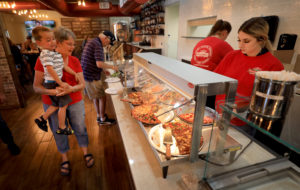
Diantha Okrepkie and her grandson Tillman Okrepkie, 3, look over the pizza buffet at the newly reopened Mountain Mike’s Pizza, Friday, July 5, 2019. During the 2017 Tubbs fire, the restaurant was damaged forcing the owners to close. On Friday they reopened at a new location on Cleveland Ave., one half-mile from the old location. (Kent Porter / The Press Democrat) 2019
Just four months after reopening its Santa Rosa location that closed due to damage in the 2017 Tubbs fire, Mountain Mike’s Pizza is serving free meals to Kincade fire evacuees and first responders on Nov. 1 and 2, between 5 p.m. and 8 p.m.
The Santa Rosa restaurant, located at 3125 Cleveland Ave., closed under mandatory evacuation orders earlier this week and was just authorized to reopen. It has partnered with the Redwood Credit Union to host the event, which includes an all-you-can-eat buffet.
“As our community is reliving a nightmare that’s all too recent, we want to do everything in our power to support the families that have been displaced and the brave men and women who are going above and beyond to keep us safe,” said Sonu Chandi, Mountain Mike’s Pizza area developer and president of Chandi Hospitality.
The restaurant has also donated pizzas to local fire stations, emergency centers and evacuation shelters during the Kincade fire “in hopes that food is just one less thing those affected by the fires need to worry about.”
“When rebuilding our location that was lost in the Tubbs fire, it was the support of the community that kept us going,” added Chandi.
This promotion is only valid at the Mountain Mike’s Pizza on Cleveland Ave. in Santa Rosa.
Worth Our Weight Executive Director Evelyn Cheatham worked with Paradise Ridge Winery to create the “Pizza in Paradise” lunch on Saturdays. (JOHN BURGESS/The Press Democrat) staffing
John Burgess
Evelyn Cheatham, who founded Santa Rosa’s Worth Our Weight culinary training program, has died. According to Chef Duskie Estes, who was a close friend of Cheatham’s, the visionary chef and non-profit director, passed Thursday night.
“Evelyn was a person who was truly good,” said Estes. “She was a role model on how to be. She always picked me up and pulled me forward.”
It’s a huge blow for the culinary community. Cheatham was a mentor both to the at-risk youth who she patiently taught cooking skills at WOW, as well as a touchstone for chefs like Estes and many others.
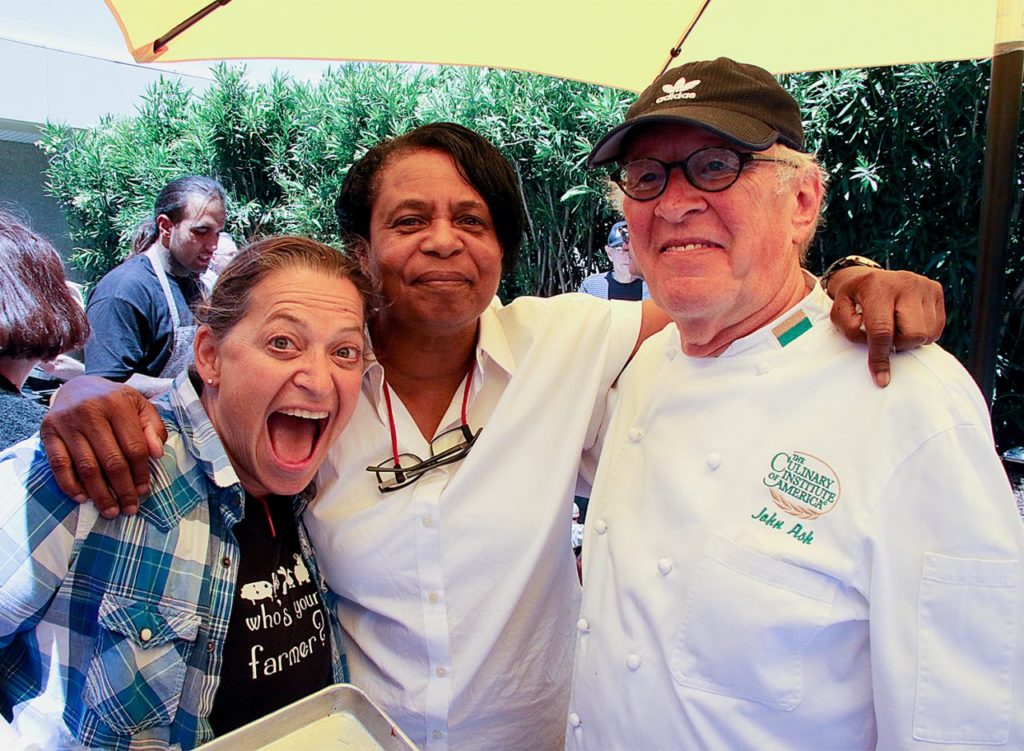
Chefs Duskie Estes, Evelyn Cheatham and John Ash. Heather Irwin/PD
“She was such an angel,” said Chef John Ash. “She was such an iconoclast, because she had her own vision, and luckily for us, it was about helping young people. She was ahead of her time.”
“She was one of our heroes. I’m just devastated,” said Josh Silvers, of Jackson’s Bar and Oven in Santa Rosa.
Silvers said he met Cheatham at a youth probation camp, where she was a chef. Even then, she was working with youth at the camp to teach them cooking skills.
“She was teaching them to be good people, not just cooks,” said Silvers. “She was teaching them to be kind and generous.”
Silvers also said that many chefs cooked dinners at WOW as fundraisers, and were eager to help whenever they got a call from her.
“Anytime she needed help, we wanted to be there,” he said.
Cheatham and I had a personal relationship as well. She loved it when I wrote about her students, and in turn, she was a mentor and inspiration. Though she could be direct, she also always had a hug and a smile. She didn’t suffer fools, but she was patient when I acted like one. In the first days of the Tubbs fire, as I ran around Franchetti’s restaurant trying to figure out how to organize chefs and feed disaster survivors, she sat quietly at the table next to me offering up help and advice on how to handle the emergency.
A little bit of Evelyn lives in so many that continue her work. We will miss her dearly.
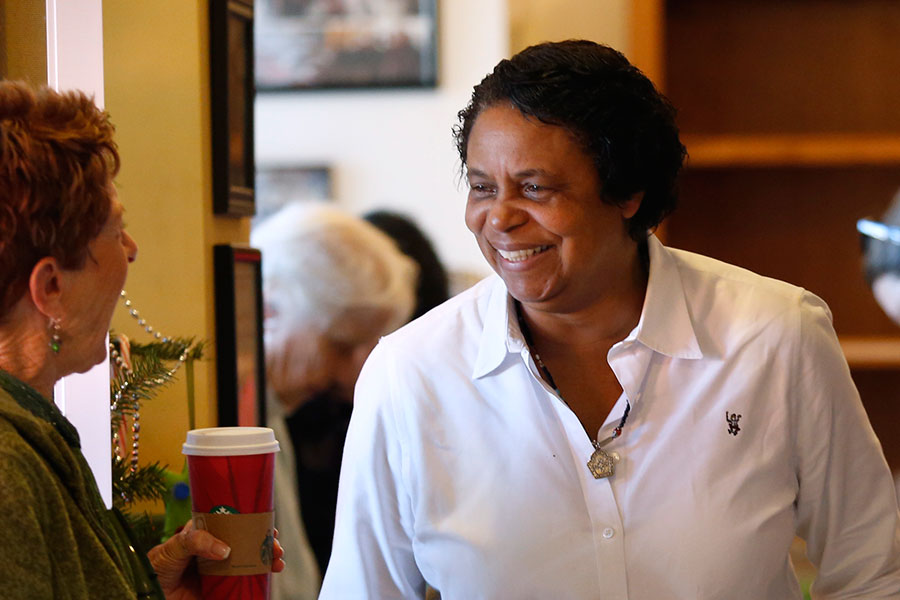
Evelyn Cheatham talks with friend Penny Ferry, at Worth Our Weight Cafe in Santa Rosa. It was Cheatham’s 25th and final year leading the effort. Beth Schlanker / The Press Democrat
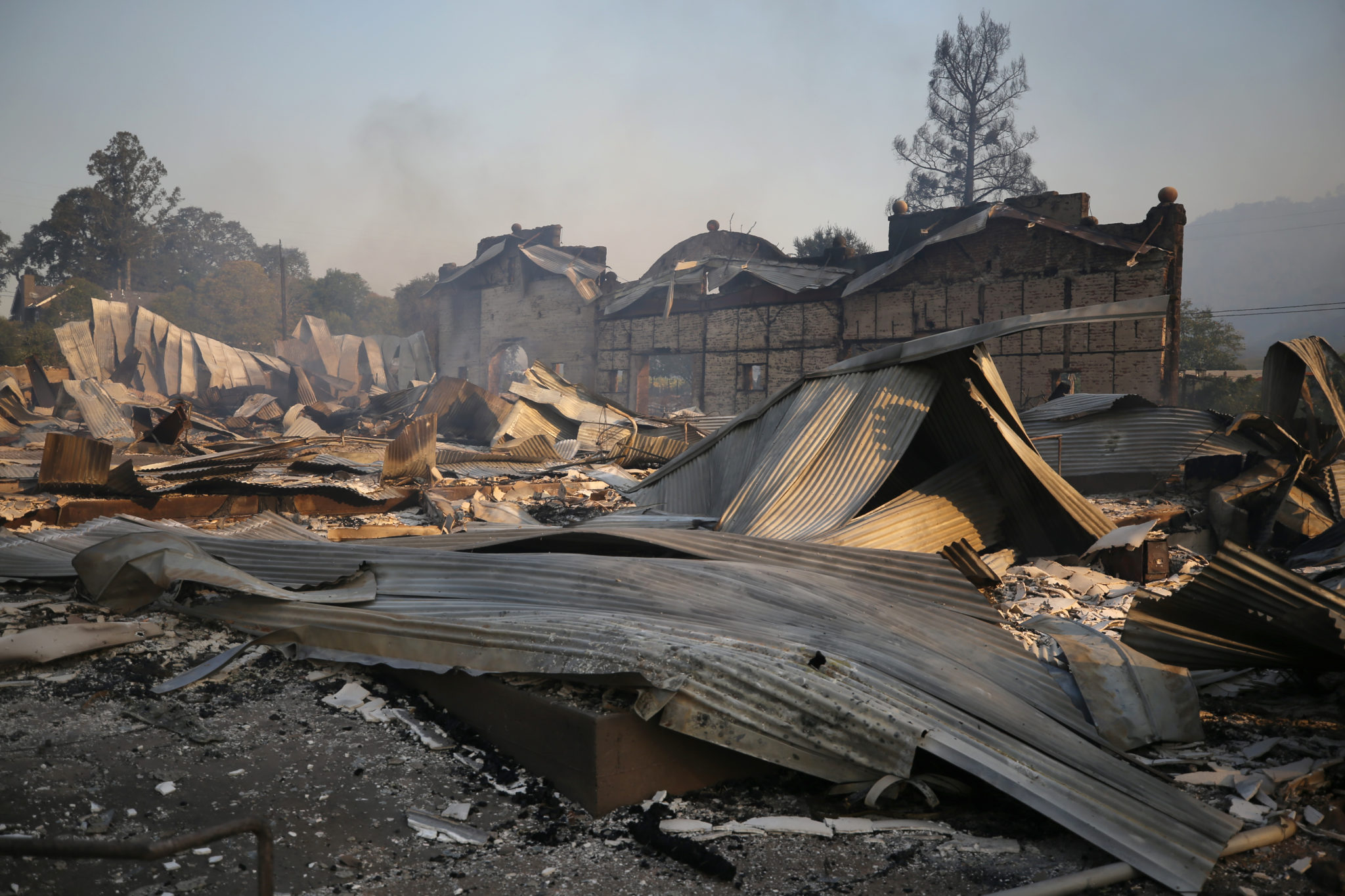
A sculpture of a wild boar called “Lord Snort” stands in front of the charred facade of Soda Rock Winery, which burned during the Kincade fire in Healdsburg on Sunday, October 27, 2019. (Beth Schlanker / The Press Democrat)
With one winery destroyed, another severely damaged, burned landscaping and outbuildings, and many unknowns facing winemakers, both threats of fire and the Kincade fire itself have brought disruption and destruction to local wineries.
First came the PG&E power shutoffs, intended to reduce wildfire risk but stalling winemaking operations in the late stages of harvest in the Alexander Valley and Chalk Hill regions. Then there were the pre-emptive evacuations in and around Geyserville, Healdsburg and Windsor, should record-high winds in the mountains topple trees into power lines, sparking fires and pushing flames toward homes and businesses. And finally, the Kincade fire, which erupted the night of Oct. 23.
The most notable losses in Alexander Valley were Ken and Diane Wilson’s Soda Rock Winery, located on Highway 128 between Pine Flat Road and Chalk Hill Road, and Jackson Family Wines’ The Spire Collection at Field Stone Vineyard. Soda Rock, destroyed except for its 1869 stone façade and Bryan Tedrick’s Lord Snout metal sculpture (which debuted at Burning Man and was later purchased by the Wilsons), is just up the road from The Spire Collection site, where many of Jackson family’s finest wines are poured.
“Based on multiple reports that we have received, we have sustained damage to the barn and winery at the Field Stone Vineyard property,” said Kristin Reitzell, vice president of public relations for Jackson Family Wines. “But the Vérité estate off Chalk Hill Road and Stonestreet winery in Alexander Valley remain structurally unharmed. While the area around all three properties was threatened by fire, we remain hopeful that there was no long-term damage to the vineyards.”
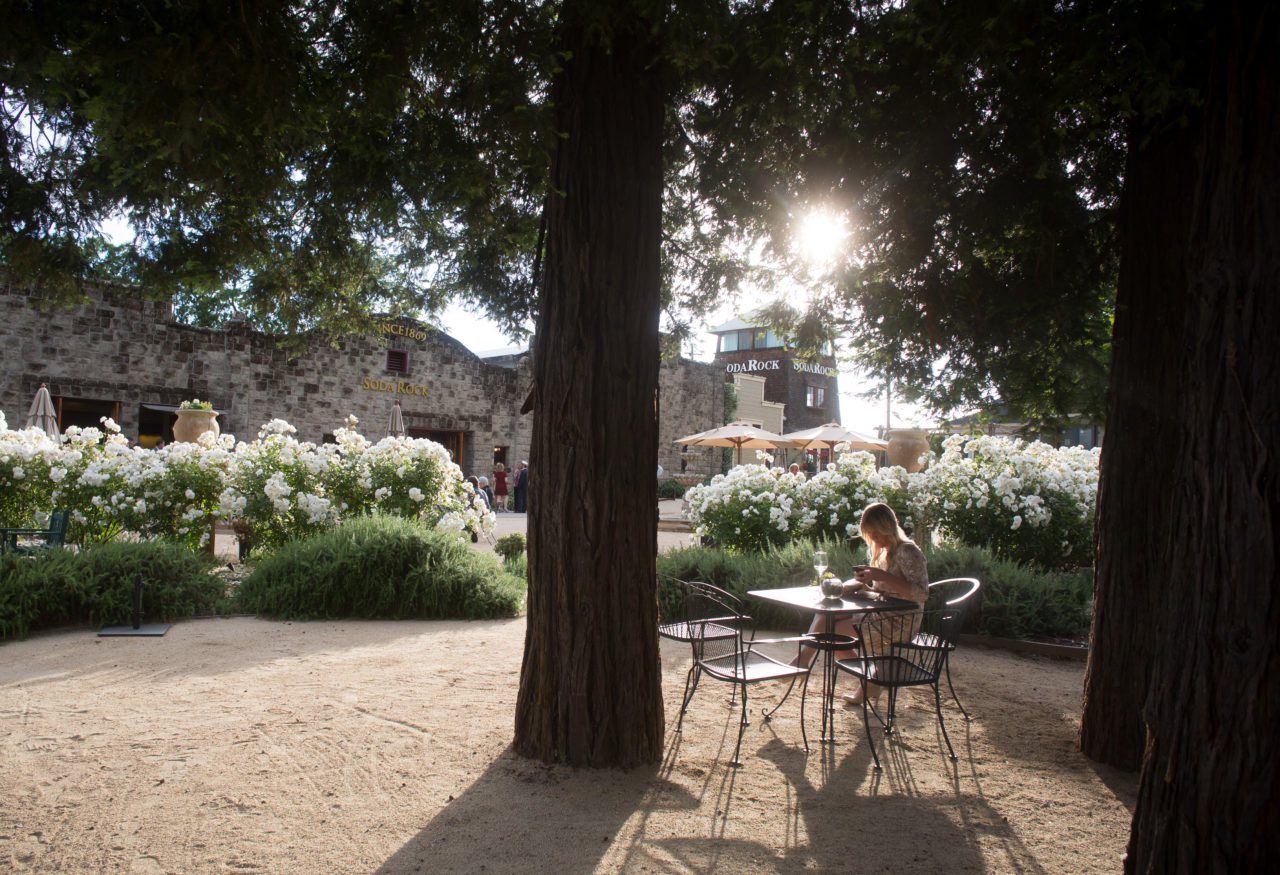
October 27, 2019: The charred debris of Soda Rock Winery after it burned in the Kincade fire in Healdsburg. (Beth Schlanker / The Press Democrat)May 14, 2016: Alison Pfaff finds a quiet moment during the gala celebration of Wine Road’s 40th Ruby Anniversary held at Soda Rock Winery near Healdsburg. (Jeremy Portje / For The Press Democrat)
Even wineries that were unscathed by flames were hampered in their efforts to bring in the remaining, late-ripening wine grapes such as Cabernet Sauvignon and Petit Verdot, crush them and begin fermentations. More mandatory evacuations, loss of power, road closures and toxic, smoke-filled air, kept workers out of the vineyards and wineries.
At the time of this article, some wineries in the area had not yet regained power and had not reopened to visitors. Some had spotty or no phone service and could not be reached. In the coming days, weeks and even months, wineries and vineyard owners in Alexander Valley and throughout Sonoma County will know more about the post-fire quality and quantity of their wines and the condition of their vineyards.
For now, here is an evolving list of area wineries affected in some way by the Kincade fire.
Alexander Valley Vineyards: According to Katie Wetzel Murphy, whose parents, Harry and Maggie Wetzel, purchased the former Cyrus Alexander homestead in the early 1960s and began to plant vineyards, the Kincade fire burned around the edges of the property, claiming a few sheds, small buildings and a greenhouse, yet the winery and tasting room were saved by firefighters. The family residences and the original 1840s Cyrus Alexander home were also spared. As of Oct. 31, the winery had no power, though Murphy’s brother, Hank, and his son, Harry, continued to tend to the remaining wine fermentations. “We’ll likely be closed until next week,” Murphy said of the tasting room, “when we have power, have been able to clean up, and air quality improves.”
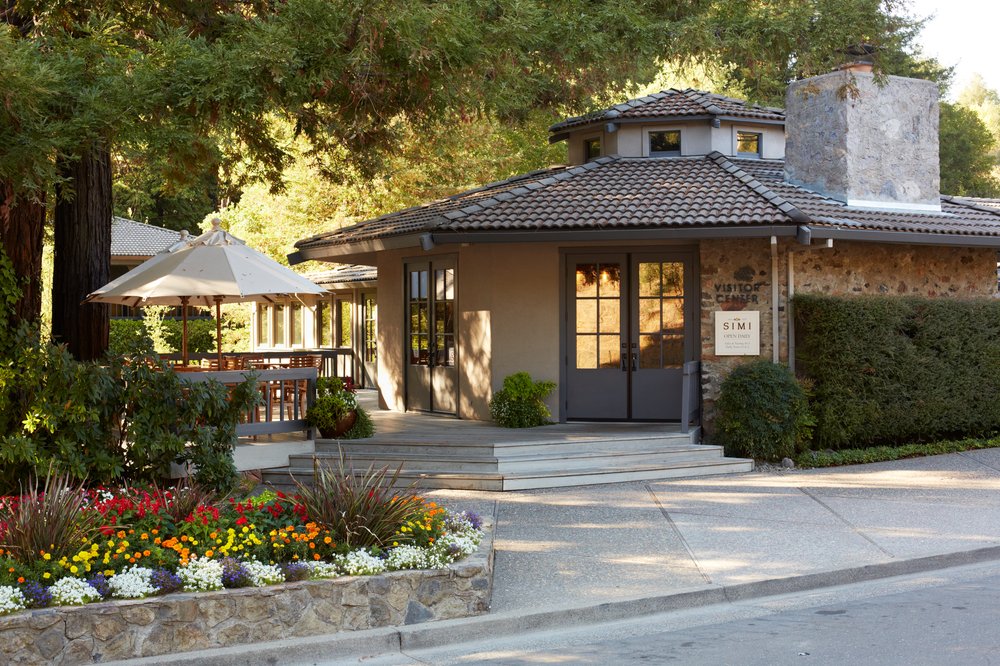
Clos du Bois and Simi Winery: These Constellation Brands properties, in Geyserville and Healdsburg, respectively, suffered no fire damage, according to spokesperson Alexandra Wagner, but are closed to visitors at this time. “We continue to monitor the Kincade fire closely and are taking all necessary measures to ensure the safety of our employees as our top priority,” Wagner stated. “Our Sonoma County properties — including Simi and Clos du Bois — will remain closed to the public until the area is confirmed safe by local authorities. The majority of our Sonoma County harvest is complete, and we anticipate no material impact to our 2019 vintage.”
Clos du Bois and Simi Winery, in Geyserville and Healdsburg, respectively, suffered no fire damage but are closed to visitors at this time. (Courtesy photo)
Hafner Vineyard: In an Oct. 29 Facebook post, the small, family winery thanked the Jackson Family for their help during the fire: “One neighborhood family and business (Field Stone) did something extraordinary and unimaginable for us /…/ In an unprecedented act of kindness and selflessness, the Jackson Family (of Jackson Family Wines) without a second thought told us to go get their generator and use it at our winery so we could save our fermentations and pick the rest of our Cabernet Sauvignon grapes. No words will be able to express our gratitude to them.”
Hanna Winery Alexander Valley. President Christine Hanna said a propane tank at the Alexander Valley Road winery southeast of Healdsburg – and just down the road from Alexander Valley Vineyards and Field Stone – burned but did not explode, and some landscaping was singed. Otherwise, the winery and tasting room were undamaged. “Some vines look a little crispy,” she said, “as does a beautiful old-growth oak. We were very, very lucky.” As of 2 p.m. on Oct. 30, Hanna was still under evacuation orders and had no power. “We don’t know when we can return,” she said.
Hanna and her family were double evacuees, as their Hanna Winery Russian River Valley, on the outskirts of Santa Rosa, received departure orders. “We were evacuated at 3 Sunday morning (Oct. 27), “Hanna explained. “My son, husband and I were staying in a house on the Santa Rosa property after being evacuated from our Healdsburg home on Saturday. We have a generator that is allowing us to continue winemaking operations. The tasting room is closed, though we are hopeful that power will resume soon, and then we’ll open the tasting room immediately.”
Ferrari-Carano Winery. The tourist-loving Geyserville gem has its estate winery in Dry Creek Valley and another in Alexander Valley for red wines. “We still have no power in Dry Creek Valley,” said executive winemaker Sarah Quider. “Our red-winery facility on Highway 128 was surrounded by fire, but luckily it is still standing with no damage (and) running with our generators.” When power is restored, the estate-based visitor center will re-open.
Foley Sonoma, Lancaster Estate, Roth Estate Winery and Chalk Hill Winery. Owned by Foley Family Wines, these four wineries – the first in Geyserville, the other three in the Alexander Valley and Chalk Hill AVAs east of Healdsburg – avoided significant damage in the Kincade fire. Gerard Thoukis, chief marketing officer for the company, issued a statement reading: “From all of Foley Family Wines, we would like to extend a sentiment of extreme gratitude for the heroic efforts of all First Responders in fighting the Kincade fire. We are relieved and grateful to report that, although a few of our properties suffered damage to non-essential buildings and equipment, all employees are accounted for and safe while our wineries escaped major damage. Having been admitted back on to our properties to take stock of what remains, one thing is abundantly clear – there was a courageous and consuming fight to save what we hold dear.”
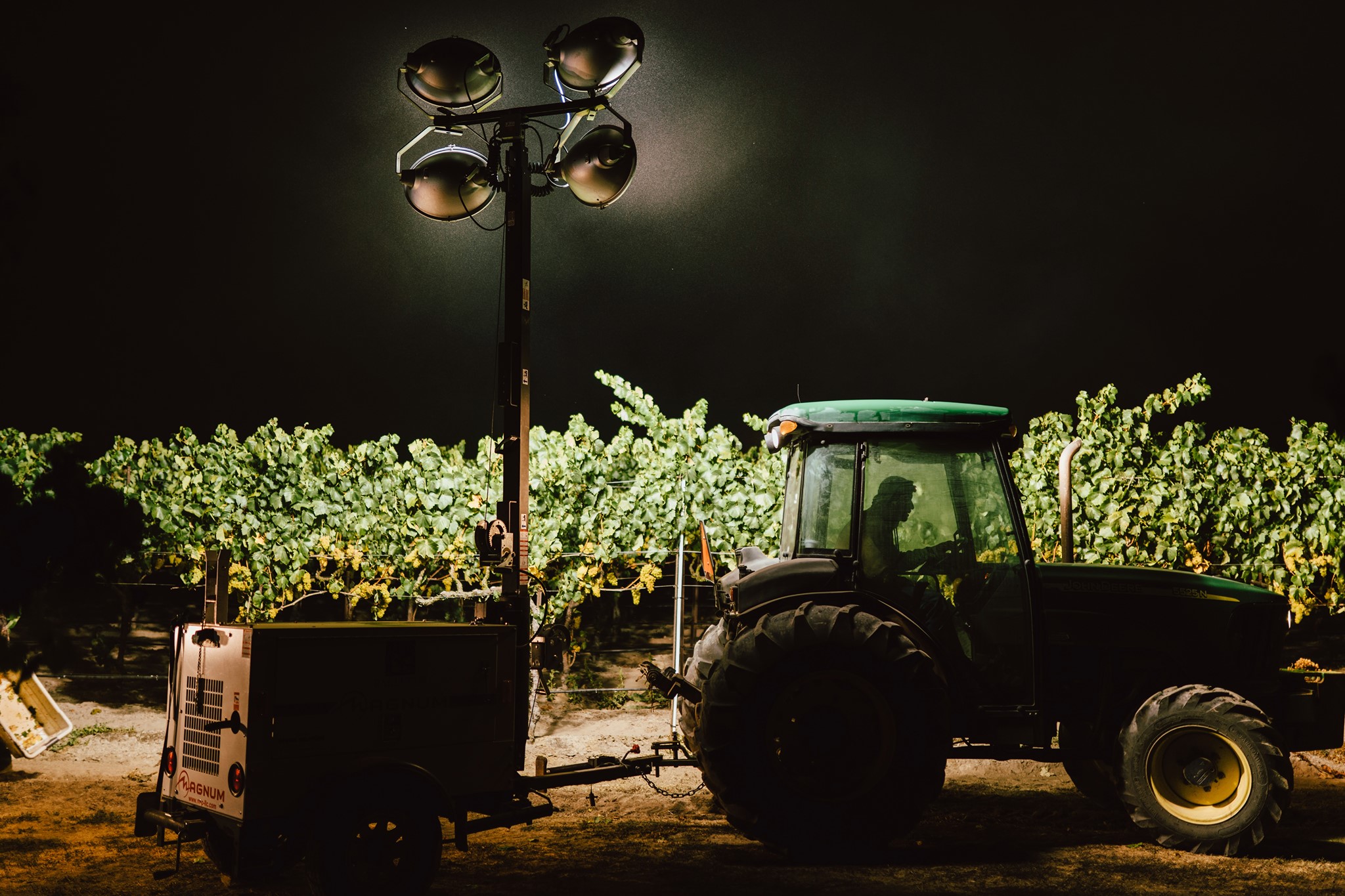
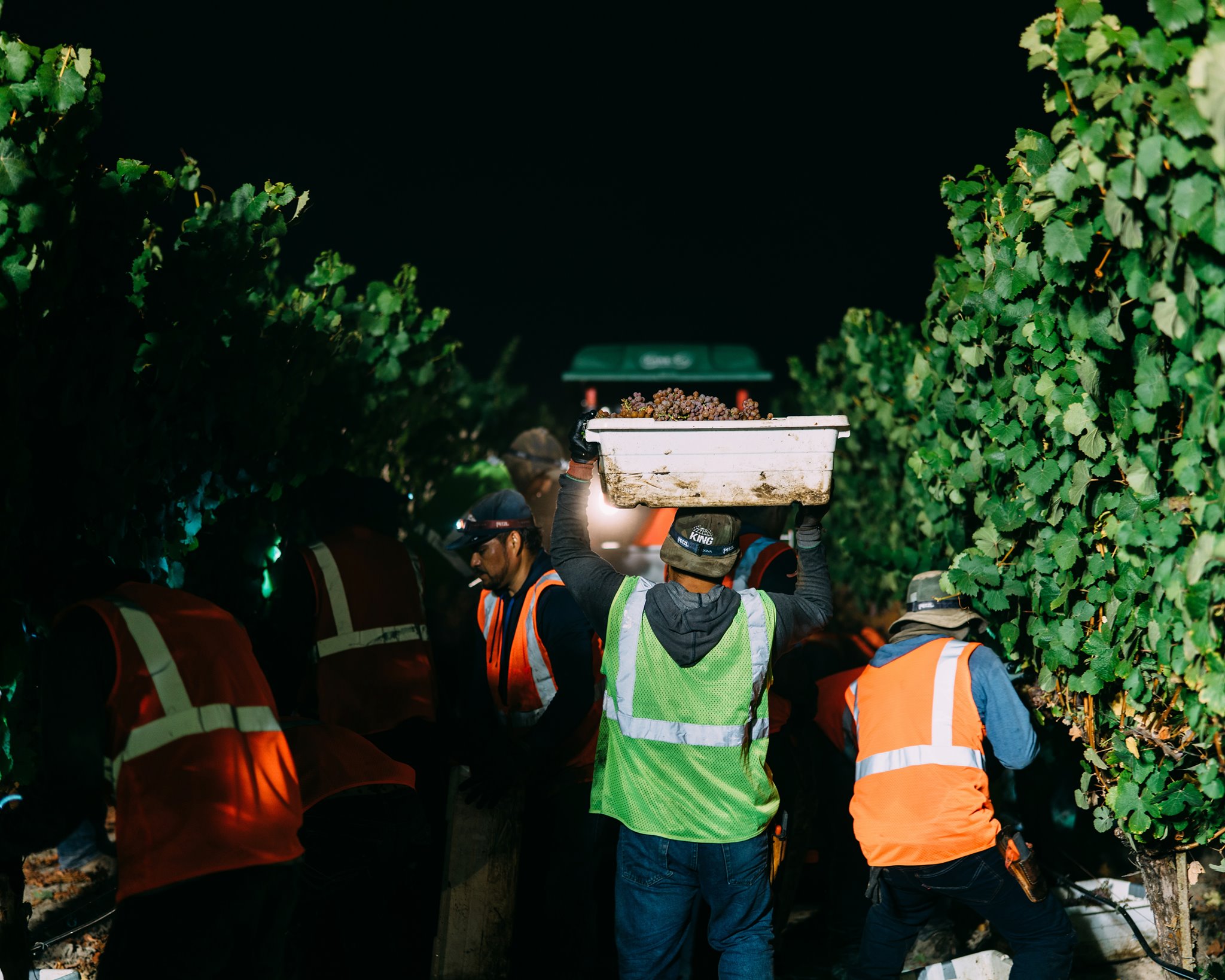
October 23, 2019: Francis Ford Coppola Winery in Geyserville posts a series of photos on Facebook depicting the ongoing harvest. (Courtesy photo)October 22, 2019: Harvesters picking berries at their peak ripeness at Francis Ford Coppola Winery in Geyserville. (Courtesy photo)October 30, 2019: Francis Ford Coppola winery posts this image on Facebook. The winery, along with sister property Virginia Dare Winery, were unharmed by the Kincade fire. (Courtesy photo)
Francis Ford Coppola Winery and Virginia Dare Winery. Sister wineries owned by film legend Francis Ford Coppola, both west of Highway 101 in Geyserville, were unharmed by the fire. Generators kept winery operations going, though the tasting rooms were closed. CEO and Winemaking Chief Corey Beck said the tasting room and restaurant at Francis Ford Coppola Winery was expected to open when power returned, likely in time for weekend visitors. Virginia Dare will open its doors to visitors soon thereafter. “Our priority, from when we closed at 2 p.m. on Saturday (Oct. 26), was to get our people home and safe. Now we’re working for a return to normalcy. At harvest time, the two wineries employ 300 people.
Garden Creek Vineyards. Owners and co-winemakers Justin and Karin Miller lost six structures to flames on their property northwest of Robert Young Estate Winery, including worker housing. Displaced workers were sent to housing the Miller family owns in Cloverdale for the time being. Fire also consumed a section of their Cabernet Sauvignon vineyard, the part they use for their own Tesserae brand. The majority of their annual crop is sold to other wineries, lessening the financial blow, yet the Millers’ favorite blocks go into their own wines.
Jordan Vineyard & Winery. The Healdsburg winery and visitor center tapped its generator to supply continuous power to the winery. The facility, residences, garden, vista point and pastures went unscathed by fire. Jordan director of marketing and communications Lisa Mattson said that pasture, and its 60 cows, helped shield the property from flames.
“A firefighter who was part of the strike team that went to West Soda Rock Road on Saturday night/Sunday morning to take a stand against the spot fire that was about to encroach on the southeast corner of the property used to work for Tim Spence in our operations department,” Mattson explained. “He sent (owner) John Jordan a text message on Sunday, telling him they were determined to hold that line and not let the fire get to Jordan. He also told John that having 60 cows grazing on the southeast corner of our ranch really helped because there was no ground fuel for the fire. But John already knew that. That’s one of the main reasons why he has so many cows. They are integral to our fire protection plan.” Mattson said Jordan will resume tours and tastings on Nov. 4.
J. Rickards Winery. On Oct. 30, the Geyserville winery’s website reported: “We are deeply saddened by the devastation of our neighbors’ properties across the valley. Our thanks to everyone who has reached out with good thoughts, and to the first responders defending the county. We are fine and will continue the work to finish our wines. But the offices and tasting room remain closed until further notice. Stay safe!”
Medlock Ames. The winery and organically farmed vineyards are situated on the border of the Alexander and Knights valleys. Owners Chris Medlock James and Ames Morison said through social media, “The Kincade fire swept quickly through our vineyards at Bell Mountain Ranch and touched almost 75% of our property. With the amazing efforts of the first responders, none of the buildings — including our winery, barns and offices — burned. A few vines out of our 55 acres were singed. Our wines were safe in our winery and the remaining 30 tons we harvested quickly were brought to our friends at Saintsbury in Carneros as soon as the evacuation order was given.”
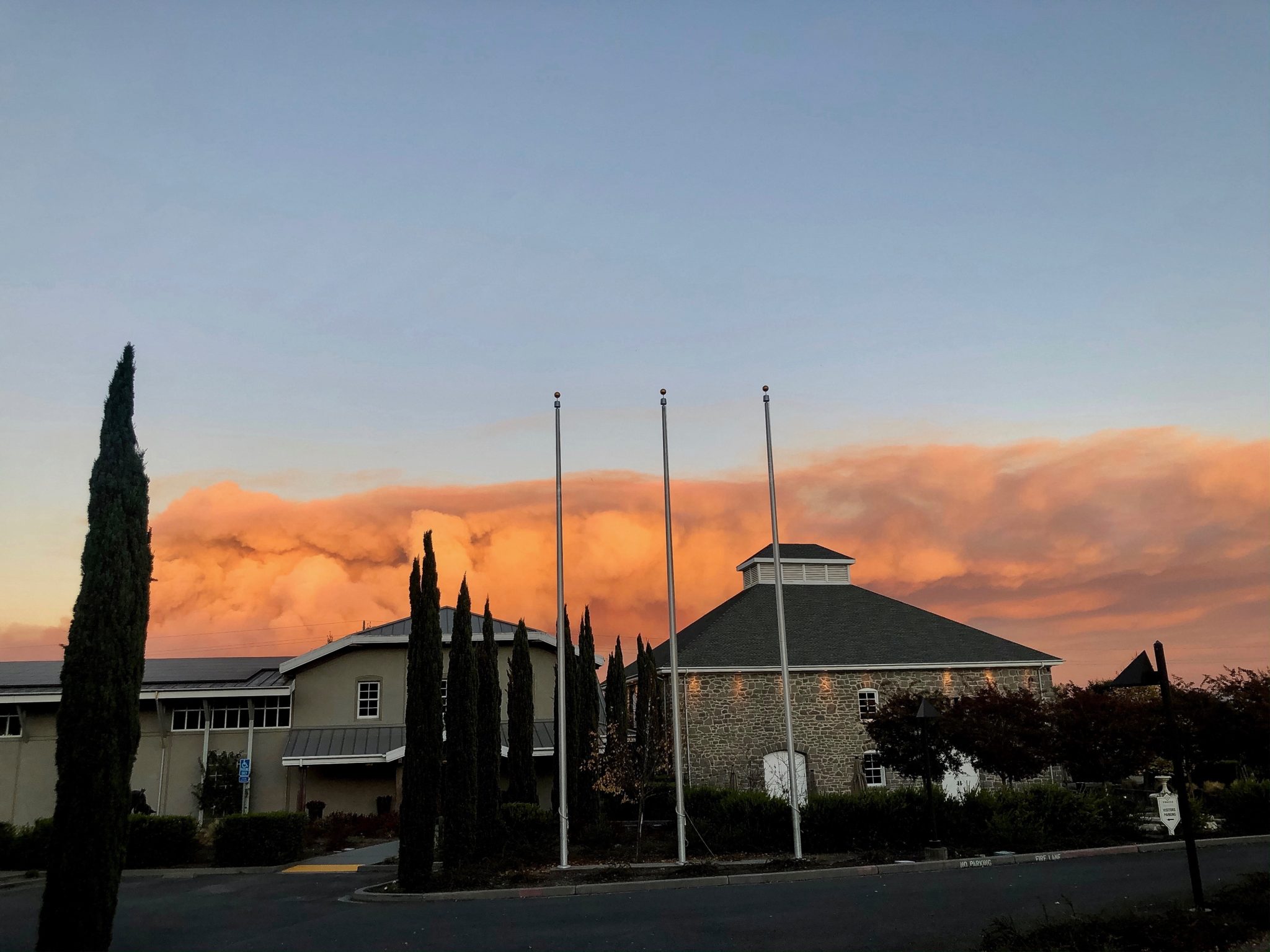
October 21, 2019: View from Robert Young Estate Winery in Healdsburg. (Courtesy photo)
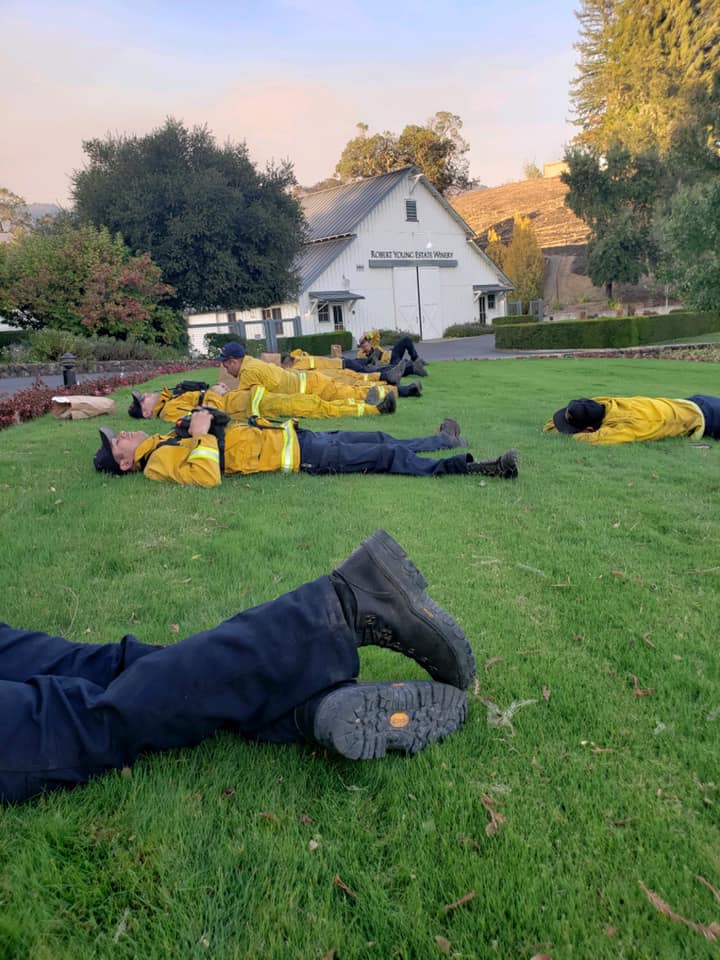
October 25, 2019: A crew from Petaluma Firefighters Local 1415 takes a break on the lawn at Robert Young Estate Winery after 36 hours on the fire line, October 25, 2019. (Courtesy photo)
Robert Young Estate Winery. General Manager Karen Maley did a masterful job of using social media to keep customers and media apprised of the eventually successful fight to save the winery, tasting room and residence from the flames. The Young family did lose an outbuilding, some equipment and a hay field for the family’s 50 head of cattle. “The fire couldn’t have been any closer” to the structures that count, Maley said. “(Brothers) Fred and Jim Young, and Fred’s son, Robbie, stayed on the property since Wednesday night, as roadblocks would prevent them from coming back. Firefighters saved the estate, and there’s going to be one heck of a party for them.” The tasting facility, the Scion House, will open as soon as roads are open, Maley said.
Silver Oak Alexander Valley. Vice President of Winemaking Nate Weis reported on Facebook that “Silver Oak Alexander Valley had a scare but is perfectly fine. We have a generator and hundreds of thousands of gallons of water to feed the fire pump, so there’s no place I’d rather be in a fire (except, maybe, somewhere that there isn’t a fire). It’s inside the evacuation zone, so please don’t try to visit. But we’re pumping tanks over and so on until we can get the cellar crew back to the winery in force.”
Skipstone Ranch. The winery reported that the fire swept through its estate grounds in Geyserville, destroying several structures; the main residence was saved. “Portions of our vineyard and olive groves also suffered some damage, but we will repair and replant as necessary in the affected areas to fully recover, the by-appointment-only winery posted. “Our wine and olive oil program will continue uninterrupted. The 2019 wine lots are safely fermenting and the recent vintages are aging in barrels in our remote winery, so there is no impact to any of our Skipstone wine in the very near term.”
Sutro Wine Co. Flames came close to Its Warnecke Ranch & Vineyard on Chalk Hill Road but did not damage vines or structures. Alice Sutro, who owns the brand with her husband, Eliot Sutro, remains available for tastings, by appointment, in downtown Healdsburg; vineyard hikes (with tastings) are postponed for the time being.
Trentadue Winery. With a hurrah, the Geyserville winery’s Facebook page announced: “The smoke has cleared, the skies are blue and we miss you! We are open for business so stop by the Tasting Room and join us for a tasting of our award-winning wines.”
Photo courtesy of Trione Vineyards and Winery.
Trione Vineyards and Winery. Located just east of Highway 101, south of Geyserville, Trione reopened its tasting room to wine club members on Nov. 2 and the public on Nov. 3. It’s easy to access, unaffected by fire-related road closures.
Zialena Winery. As they did in the 2017 Pocket Fire, flames came close to the Geyserville winery but did no damage to the buildings or vineyards. “One fence at the far end of the property caught fire, but that was it, said Lisa Mazzoni, who owns Zialena with her winemaker brother, Mark Mazzoni. “Matt has been able to complete pump-overs and is pleased with how the wines are fermenting.” Zialena lost power on Oct. 23, and the tasting room will remain closed until electricity is restored and the evacuation order lifted. Added Lisa Mazzoni: “I received this text from PG&E at 2:10 p.m. Wednesday, Oct 23: ‘PG&E Safety Update: Forecasted weather conditions have improved & we are not planning to turn off power for public safety.’ And 10 minutes later, I was in the dark.”
Many Healdsburg downtown tasting rooms have already re-opened and more are certain to be doing business by the weekend, now that the city has power and the evacuation order has been lifted. If you have updated information about a local winery or tasting room impacted by the Kincade fire, please send us an email.
Thick smoke from the Kincade fire obscures the setting sun as seen from the Middletown side of the Mayacamas Mountains, Friday, Oct. 25, 2019. (Kent Porter / The Press Democrat)
Only two years after the devastating wildfires of October 2017 and eight months following the February floods, Sonoma County is again dealing with the impacts of natural catastrophe.
After sparking late Wednesday night, October 23, the Kincade fire has engulfed 282 structures, 141 of which were homes. It has burned 76,825 acres and forced more than a third of Sonoma County residents to flee their homes. Others have been separated from employment by damage or destruction to workplaces or closures due to power outages. Thousands have been in the dark, many for days on end, without electricity, hot water, fresh food and warm houses. The poor air quality continues to affect all of us; those with respiratory problems impacted the most.
The good news this morning, Thursday, October 31, is that containment of the Kincade fire has reached 60 percent and most evacuees have been permitted to return to their homes. The fire, however, remains at 76,825 acres — making it the largest wildfire in Sonoma County history.
Wildfires constitute a particularly stressful experience, according to the American Psychological Association (APA), “because the factors that influence their strength and direction can change at any moment.” Strong emotions — like feelings of hopelessness, depression, anxiety and anger — are common among people who have lived through these circumstances. Even those not directly impacted by the fires may experience “a sense of distress or vulnerability by living close by or watching the destruction unfold in news reports,” adds the APA.
If you or someone you know are experiencing distress due to the fire, or reemergence of PTSD symptoms, there are a number of free mental health services that can offer support — from helplines to online resources to therapy sessions. Please find below a list of resources.
The American Psychological Association also offers advice on their website on how to identify emotional responses to traumatic events, such as a wildfire, and how to recover from this experience: For those immediately affected: www.apa.org/helpcenter/wildfire, and general advice: https://www.apa.org/helpcenter/wildfire-tips.
Phone Support
National Alliance on Mental Health (NAMI) Sonoma County’s Warm Line is a non-crisis helpline that operates Monday to Friday from 10:00 a.m. to 7:00 p.m. Knowledgeable and compassionate NAMI staff members and volunteers provide information, resources, caring attention and non-judgmental support. Some staff and volunteers speak Spanish. Call or text 1-866-960-6264 or email warmline@namisoco.org.
Rebuilding Our Community (ROC) Sonoma County was established after the 2017 fires. Because disasters have long-lasting emotional effects, they are committed to providing long-lasting support. On the second anniversary of the Tubbs fire, they wrote, “If you or someone you know is still in need of help, please do not hesitate to reach out to ROC Sonoma County at 707-535-3349 or visit rocsonomacounty.org.”
Sonoma Rises is a cellphone application designed in response to the 2017 fires. Available on Android and iOS, it provides a mood tracker and support tools for healing and coping with stress. RiseTeens is a specialized section for ages 13-18. It is available in English and Spanish. Look for it in your cellphone’s app store.
Substance Abuse and Mental Health Services Administration’s (SAMSHA) Disaster Distress Helpline is a 24/7 national hotline dedicated to providing immediate crisis counseling for people experiencing emotional distress related to any natural or human-caused disaster. It offers toll-free, multilingual, confidential crisis support. Call 1-800-985-5990 or text TalkWithUs to 66746 to connect with a trained crisis counselor. Spanish speakers call 1(800) 985-5990 and press “2” or text Hablanos to 66746. For more information, visit DisasterDistress.samhsa.gov
Magellan Health has opened a free 24-hour crisis line for anyone impacted by California wildfires. Magellan will provide free, confidential consulting services and other resources, such as referrals to local non-profit organizations, shelters and additional community-based support to assist individuals in California. Call 1-800-327-7451
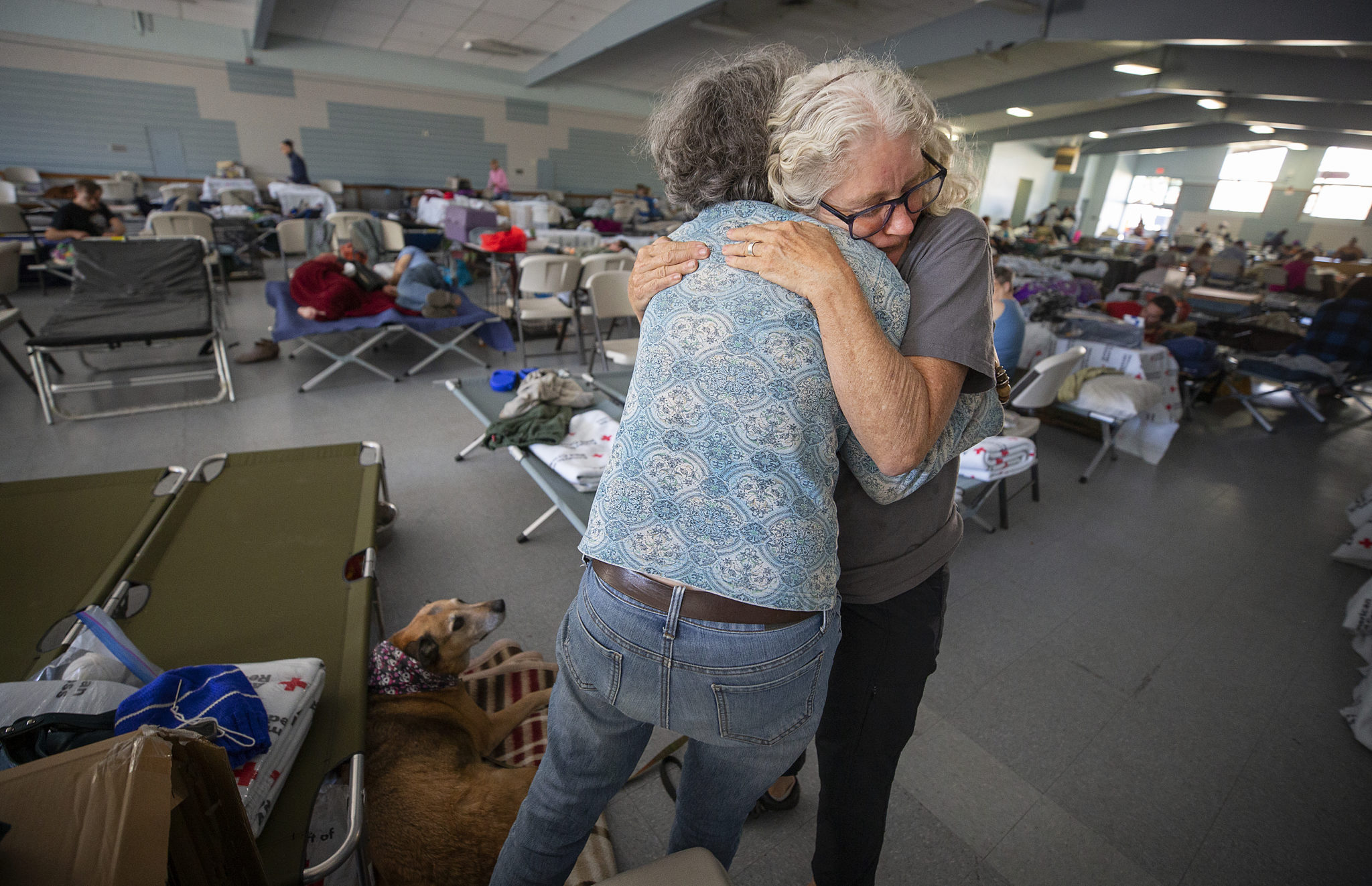
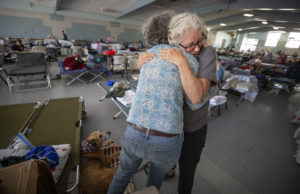
Red Cross volunteer Barbara Wood gives a hug to a Kincade fire evacuee who seemed in distress at the Red Cross Shelter at the Sonoma County Fairgrounds on Sunday, October 27, 2019. (John Burgess/The Press Democrat)
Online Resources
My Sonoma Strong is a Sonoma-specific web resource created by experts in trauma psychology. It aims to help recent survivors of disaster understand and identify common stress reactions that may occur after such an experience and help survivors develop healthy ways to cope with these reactions. It is free and self-guided, so you can explore it at your own pace. The site is available in English and Spanish. https://www.mysonomastrong.com/
Supportiv is a Berkeley-based online service that provides anonymous peer support groups in real-time. Users click a Chat Now button on the website, enter a sentence about what they want to discuss, and are routed into a chat room where they can vent and feel supported. The site requires no personal information. Normally there’s a small fee after 24-hours, but fire survivors can use the code SAFETY to receive free access for 30 days. https://www.supportiv.com/
Capacitar provides an “Emergency Kit” of simple body-based practices for immediate use to help people deal with challenging situations, including natural disasters. It teaches a few basic breathing practices, Tai Chi exercises, acupressure points and more. It is available in 20 languages. You can download it here: https://capacitar.org/capacitar-emergency-kit/
Healthy Children is a site created by the American Academy of Pediatrics. It provides a guide for parents and caregivers called “Responding to Children’s Emotional Needs During Times of Crisis.” It is available online in English and Spanish.
The Red Cross provides useful information online, including tips on emotional recovery from disasters. Like Healthy Children, they also provide guides on helping children cope with disaster. Most resources are available in English and Spanish, with some also available in Chinese, Korean, Vietnamese and Tagalog. Click here to visit their site.
Therapy and Group Support
The Redwood Empire Chapter of California Association of Marriage and Family Therapists (RECAMFT) has created a list of providers who have expressed willingness to offer three to five sessions of free therapy to fire survivors. RECAMFT does not guarantee the counseling services of any provider. https://www.recamft.org/freecounseling
Santa Rosa City Schools’ Integrated Wellness Center provides free services in English and Spanish to parents and students based anywhere in Sonoma County; in any school district. The Integrated Wellness Center is open Tuesday through Thursday from 3:00 p.m. – 6:00 p.m. They have counselors to provide support and referrals for students and parents, basic nurse services, and academic support. Transportation can be arranged. Please note: Power outages may impact hours. Call 707-890-3827 or visit srcschools.org/domain/2112
The Sonoma Community Resilience Collaborative, spearheaded by Santa Rosa Community Health, is working in partnership across the local community and with The Center for Mind-Body Medicine, whose curriculum is the foundation for the program. There are opportunities to experience evidence-based self-care tools for effectively addressing personal and professional stress after the fires, network with peers, and learn an evidence-based model to self-healing and coping skills. For more information and a calendar of workshops, visit srhealth.org/about-us/resilience-collaborative
The Jewish Community Free Clinic in Santa Rosa offers free medical and mental health services. There are no eligibility requirements. Visit the clinic’s website for more information about services: jewishfreeclinic.org/about/services. 50 Montgomery Drive, Santa Rosa, 707-585-7780.
Weather permitting, Susan Karle will offer A Walk Honoring Loss and Resilience on November 21 at 10:00 a.m. in Sugarloaf State Park. (Photo by Adrienne Shubin)
Get Physical
Trauma-informed yoga for fire survivors throughout the county is sponsored by Healthcare Foundation Northern Sonoma County, with at least one class offered almost every day of the week. La Luz in the town of Sonoma offers classes in Spanish on Mondays. Specific classes may be temporarily unavailable depending on evacuation status and availability of power. Click here to view the schedule.
Weather permitting, Susan Karle will offer A Walk Honoring Loss and Resilience on November 21 at 10:00 a.m. in Sugarloaf State Park. This gentle Forest Bathing Walk is under a mile on a well-maintained trail. Karle will guide those recovering from the traumatic impact of the natural disaster in sharing circles. Click here for free tickets and more information.
An ember wash, pushed by high winds during the Kincade fire in the Geysers, spreads over the landscape on Thursday, Oct. 24, 2019 in Sonoma County. (Kent Porter / The Press Democrat)
As the Kincade fire rages in Sonoma County, The Press Democrat photographers John Burgess, Christopher Chung, Alvin Jornada, Kent Porter and Beth Schlanker work overtime to document the destruction and the courageous efforts to contain the conflagration. In one moment, just behind the fire line, they capture the dreadful, yet insidiously haunting flames and the firefighters’ valiant efforts to protect us from them — in another, they turn their lenses to the flight of the evacuees. More intimate scenes show sheltered people and animals, and prepared community members. Finally, there are glimpses of hope — a neighborhood saved, a thankful smile, warm embraces and words of encouragement between family, friends and strangers. Click through the gallery to see some of the images.
The presence of wildfires and resulting evacuations can take a toll on everyone in a household. Just as adults yearn for a sense of normalcy and routines, children need to get back to the important business of playing. Providing some welcome distraction, a number of local museums and activity centers are offering free admission to evacuees and those affected by the fire. Click through the gallery for more details. Remember to bring proof of address.
Red Cross volunteer Barbara Wood gives a hug to a Kincade fire evacuee who seemed in distress at the Red Cross Shelter at the Sonoma County Fairgrounds on Sunday, October 27, 2019. (John Burgess/The Press Democrat)
Latest update: Nov. 5, 2019, 3:00 p.m.
If you would like to help those affected by the Kincade fire, mandatory evacuations and PG&E power shutoffs, here’s how you can volunteer and make donations. Please note that needs will change in the days and weeks to come. Please check back for updates.
Do you know of a volunteer opportunity or fundraising initiative not listed here? Send an email to sofia.englund@pressdemocrat.com.
DONATIONS & VOLUNTEERING
The Redwood Empire Food Bank (REFB)
The Redwood Empire Food Bank has deployed its emergency response program, Station 3990. These distributions are open to anyone in need of food. Find food distribution sites here.
Donate food: The Redwood Empire Food Bank is currently accepting food donations at their main facility at 3990 Brickway Blvd in Santa Rosa. They also have donation sites throughout Sonoma County, listed here.
Guidelines for food donations: No glass. No perishable items. No open items. No homemade items.
Most needed items include:
• Tuna and Canned Meat
• Peanut Butter
• Canned Soups, Stews, and Chili
• Rice and Dry Beans
• Cereal
• Canned Fruits and Vegetables
• High Protein Granola Bars
• Trail Mix or Nuts
To volunteer with the REFB — includes helping out in the kitchen and with food distribution — sign up for a shift here.
Founded by SMI dining editor Heather Irwin, Sonoma Family Meal has served more than 200,000 meals to fire survivors since 2017. The nonprofit is also an emergency disaster response kitchen and is now serving Kincade fire victims and evacuees.
The World Central Kitchen’s “Chef Relief Team” provides meals to those in need in disaster areas. WCK will continue to provide meals to first responders, and expect to remain in Sonoma County through early next week. More information here.
Those interested in volunteering should register on wck.org. (Click on the link at the top of the homepage to sign up for a shift.)
Center for Volunteer & Nonprofit Leadership (CVNL) and The Volunteer Center of Sonoma County (VCSC)
The Center for Volunteer & Nonprofit Leadership (CVNL) and The Volunteer Center of Sonoma County (VCSC) coordinate volunteer efforts during a disaster.
To volunteer during this disasterand for long-term recovery efforts, register online at cvnl.org/volunteer-marin. Once registered, individuals will be deployed or contacted directly if and when they are needed for this disaster and for future events.
To make a financial donation, visit cvnl.org/donate (under “additional information,” make sure to select “disaster-related work”). Donations will be distributed directly to local charities supporting evacuees in Sonoma, Marin, and Napa counties. Gift cards can also be delivered to CVNL + VCSC office locations. The organizations kindly ask that people refrain from donating goods/items to their Emergency Volunteer Centers at this time.
Find more information about CVNL + VCSC wildfire relief work here.
Petaluma Peoples Services Center
Petaluma Peoples Services Center is a collection of human services programs. The nonprofit is now serving Kincade fire victims.
Those interested in making a donation serving Kincade fire victims can do this online at petalumapeople.org/donateand the organization will make “targeted purchases.”
You can also bring a check made out to the Petaluma People Services Center or items from this listto Kenilworth Teen Center, 150 Fairgrounds Drive, Petaluma.
Those wanting to volunteer with the Petaluma Peoples Services Center can fill out an online application here: tinyurl.com/PPSC-volunteer.
The Jewish Community Free Clinic
The Jewish Community Free Clinic in Santa Rosa offers completely free medical and mental health services. There are no eligibility requirements. Visit the clinic’s website for more information about services.
To volunteer at the Jewish Community Free Clinic, download and complete an application form. The clinic utilizes volunteers for medical receptionists, medical providers, nurses, interpreters, therapists, social service support, and acupuncturists. They also have special project volunteers and research internships.
To make a financial donation to the clinic, you can donate online, join a giving tree, sponsor an event or send a check to Jewish Community Free Clinic 50 Montgomery Drive, Santa Rosa, CA 95404.
COTS
COTS welcomes evacuees to visit their Mary Isaak Center (900 Hopper Street, Petaluma) for showers, laundry, meals and phone charging. All services are free. More information here.
The nonprofit is currently seeking the following donations for fire evacuees:
• Towels and wash cloths
• Shampoo, body wash
• Bedding/sleeping bags
• Laundry detergent
• Toilet paper
• N95 masks
Volunteer: Regular COTS volunteers are encouraged to help coordinate laundry and showers. Get in touch with the front desk: 707-765-6530 x120.
FINANCIAL DONATIONS
Community Foundation of Sonoma County
The Community Foundation of Sonoma County’s ongoing Resilience Fund continues to accept donations to support the mid- and long-term recovery needs of individuals and families, with particular focus on helping individuals impacted by the fires, healing the long-term effects of trauma, and addressing housing solutions within the county. Make a donation here.
Latino Community Foundation
The Latino Community Foundation has reactivated its NorCal Wildfire Relief Fund in response to the Kincade fire. The fund supports nonprofits that include Corazon Healdsburg and Nuestra Comunidad, which are providing essential sheltering and supportive services to Latino immigrants and farmworkers impacted by the fire. Make a donationhere.
Rebuild NorthBay Foundation
Rebuild NorthBay Foundation (RNBF) is committed to the long-term rebuilding of Sonoma, Napa, Lake and Mendocino counties in the wake of wildfires. The foundation was founded by Darius Anderson, CEO of Kenwood Investments and managing partner in Sonoma Media Investments, which owns Sonoma Magazine. According to the RNBF, all donations to Kincade fire survivors and evacuees will go directly toward fire relief without any administration fee taken out by the foundation. Make a donation here. (Put “KINCADE” in the memo.)
Russian River Alliance
The nonprofit Russian River Alliance is seeking donations to help fund small emergency cash grants to help cover lost wages and evacuation costs for people who live and work in the area between Forestville and Cazadero, including Occidental, and earn $15 an hour or less.
Organizer Jennifer Wertz notes that workers were displaced just as rents were coming due on the first of the month and residents who lost power already were facing unexpected grocery bills. Grants of up to $300 may be available beginning Monday, November 4, to qualified applicants, who must work at least 20 hours a week.
The effort is part of an ongoing workforce fund started as a homeless prevention effort that morphed to accommodate recovery needs in the wake of the February 2019 floods.
Donations may be made online at russianriveralliance.org/Donate.html.
The Red Cross
To make a financial donation to victims of the Kincade fire, visit redcross.org, call 1-800-733-2767, or text REDCROSS to 90999 to make a $10 donation. You can also send a check to American Red Cross, 5297 Aero Dr, Santa Rosa, CA 95403. The check should be made out to “American Red Cross” with “Kincade fire” noted on the check.
Find more information about The Red Cross’s wildfire response here and here.
The Salvation Army
The Salvation Army is serving three meals a day at five evacuation centers in Napa, San Rafael and Petaluma. 100 percent of donations will go toward Kincade fire relief efforts as the Salvation Army feeds and cares for evacuees and first responders. Make a donation here.
UndocuFund
The UndocuFund for Fire Relief in Sonoma County, managed by Graton Day Labor Center, North Bay Organizing Project, and North Bay Jobs with Justice, is currently raising funds to assist the victims of the Kincade fire. This fund is providing direct funding to undocumented immigrants and their families in Sonoma County to help with fire-related expenses. Make a donation here. Find more information about how to support undocumented victims of the Kincade fire here.
United Way of the Wine Country
United Way has opened the Kincade Fire Emergency Relief & Recovery Fund to help in the relief and recovery efforts post fire. Make a donation here.
Animal Shelters
Several North Bay animal shelters are accepting donations for pets displaced by the Kincade fire. The Humane Society of Sonoma County and Sonoma County Animal Services closed due to mandatory evacuation orders and remain closed due to the power shutoff — check their websites for more information.
To make a monetary donation or to volunteer, visit the animal shelter’s website:
Sonoma Magazine was honored Friday with an Eppy Award for Best Digital Magazine with under 1 million unique monthly visitors.
The annual awards, presented by Editor & Publisher, recognize excellence in online journalism, digital storytelling and design. Other 2019 Eppy Award winners this year include The Boston Globe for Best Daily Newspaper Website, CNN for Best Online News Website and ESPN for Best Mobile App. This is Sonoma Magazine’s first Eppy.
Since its founding in 2013, Sonoma Magazine has provided an insider’s guide to Sonoma Wine Country. Its digital presence has grown dramatically in the past three years to keep its ever-expanding audience on the pulse of local restaurants, wineries, arts, entertainment, culture and style.
Content created exclusively for sonomamag.com combines vivid photography and informative articles to provide useful guides to the stars and hidden gems of the area. Longtime favorite dining blog BiteClub, penned by dining editor Heather Irwin, has also found a new home on Sonoma Magazine’s recently redesigned website.
“It’s an honor to be awarded an Eppy,” said Sonoma Magazine’s Digital Editor Sofia Englund. “Thanks to the efforts of our small but dedicated team, sonomamag.com has become the little lifestyle website that could. And when you’re lucky enough to live and work in Sonoma County, there’s never a shortage of great stories to tell.”
This is the 24th year that Editor & Publisher—whose roots extend to the founding of its predecessor, The Journalist, in 1884—has awarded its prestigious Eppy Awards. The magazine covers the North American newspaper industry. This year, 300 entries were submitted in over 30 different competing categories.
Domenica Catelli hugs Osvaldo Jimenez of Moustache Baked Goods at the Healdsburg evacuation center. Heather Irwin/PD
The sound of parsley being chopped — a staccato of knives against a cutting board— rings in stereo as volunteer chefs prepare to add it to a simmer pot of marinara sauce. Dinner will be served at the evacuation center in an hour, and parsley is key to Domenica Catelli’s famous sauce.
Huddled in the kitchen of the Healdsburg Senior Center, a small squad of chefs from around Sonoma County works in sync, with few words, to prepare dinner for 200. On the menu is a simple spaghetti and marinara with garlic bread and salad. This isn’t commodity food from cans, but homemade tomato sauce, local butter, freshly chopped herbs and a mix of peppery greens with a light vinaigrette heading to Sonoma County’s northernmost evacuation center during the Kincade fire
Food, like wine, shapes the character of Sonoma County. We are farmers and we are foodies who appreciate water buffalo cheese and bespoke Asian herb gardens. It is in our DNA.
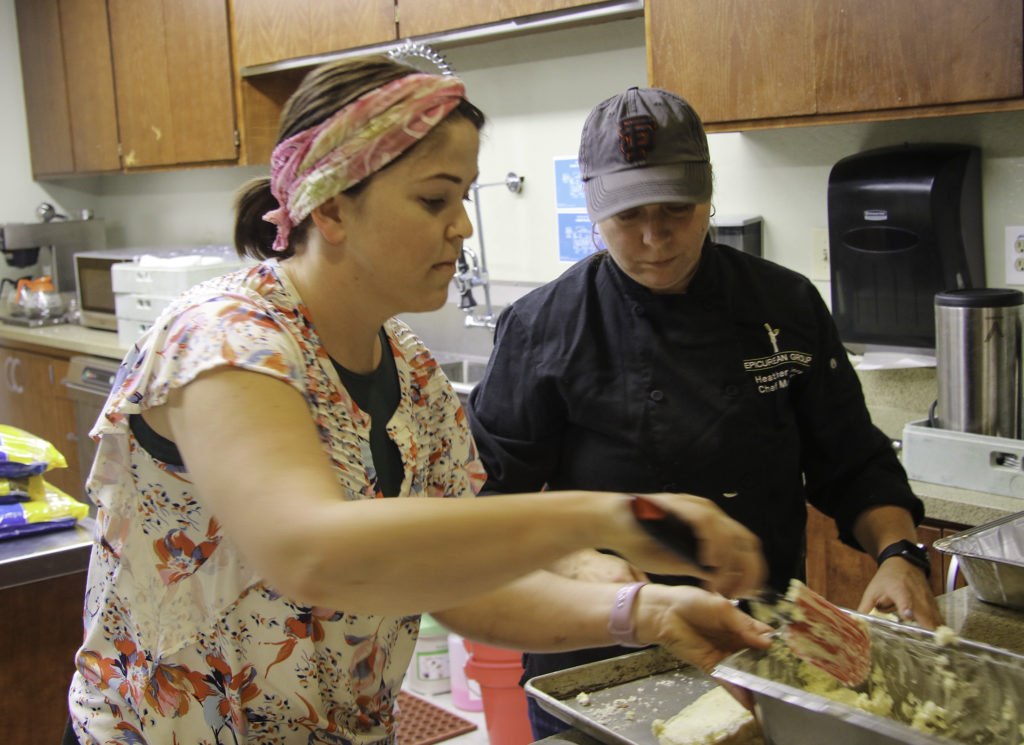
Chefs Katie Falese of KJ Wine Estates and Heather Ames of Sonoma Family Meal prepare garlic bread at the Healdsburg Senior Center on Thursday evening. Heather Irwin/PD
In moments of crisis, which have been in abundance over the last few years, we feed each other with arugula and tri-tip rather than canned ham and tater tots. In the days after the Tubbs fire devastated Santa Rosa in 2017 it was chef-prepared meals from Guy Fieri to top local chefs like Zazu’s John Stewart and Duskie Estes, three-Michelin starred Kyle and Katina Connaughton, John Franchetti, Miriam Donaldson, SF Chefs and hundreds of others that made more than calories — they made disaster cuisine.
At the Healdsburg shelter, which is a beehive of aid workers, news cameras, politicians and dazed evacuees, tables are piled with food. The smell of warm garlic bread wafts from a tiny community kitchen, the owners of Moustache Baked Goods, Osvaldo Jimenez and Christian Sullberg have laid out artisan cupcakes. A grain salad from three-Michelin star restaurant Single Thread has been prepared and throughout the day today, evacuees will have macaroni and cheese from celebrity chef Douglas Keane’s Healdsburg Bar and Grill, bread from Costeaux Bakery and meat from Pete Seghesio’s Journeyman Meats.
A line of hungry evacuees fills their plates, looking bewildered and tired. Most have no idea that the food they’re eating has come from top restaurants, highly trained chefs and local gardens. It doesn’t matter. These are chefs doing what chefs do: They feed people.
Ironically, some of these chefs have been displaced too. Domenica Catelli’s restaurant in Geyserville is in the evacuation zone, and while she’s making marinara, she’s also worried about her own family and the losses to her business that has come from two power outages. She has a worried bride whose wedding she’s supposed to cater this weekend, possibly without power.
The Sonoma County Tourism Bureau estimates that restaurants lose roughly $4,700 each time the power is cut as refrigeration goes down and food has to be thrown away. Most chefs are thriftier than that and cook up what they can and donate it. It doesn’t mitigate the financial loss, which is something few mom and pop restaurants can bear.
The food will continue to arrive wherever it’s needed, for as long as it’s needed from an army of Sonoma County chefs making amazing food for those who need it most.