
Restaurant P/30 closes

UPDATE: P/30 owners plan to honor gift certificates if/when the restaurant is sold to new owners…

A NOTE ABOUT GIFT CERTIFICATES: We are deeply sorry if you recently purchased a gift certificate-it was never our intention for this to happen. We will do everything in our power to make sure that the certificates are honored by the next owners, it will be written into the contract. Thank you for your patience and understanding, and know that we would never, ever take advantage of you.

++++++

With just a few day’s warning, West County comfort food eatery P/30 has shuttered. On Friday, owners Patrick and Christine Tafoya sent out upbeat notes to Facebook friends and fans offering dining discounts on food and wine with promises of a last group hurrah. But come Monday, the party would be over.

Oozing with charm, family-friendly, casual and mid-priced deals, everything seemed to point to P/30’s success early on. So what happened?

The couple say the decision to close the eighteen-month old restaurant was purely about family, or rather, the lack of it during their brief stint as first-time restaurant owners. Both were almost constant fixtures at the location, while juggling the demands of parenthood and Christine’s design business. Said Patrick on Sunday night from behind his computer: “I am closing the restaurant for the sake of my family.”

Reached on Monday morning, he said he’s feeling a mixed bag of emotions about the closure. “Some moments I feel nothing but relief and excitement about the future. Some moments I’m struck with sorrow and pain from what we’re walking away from,” the chef said. He plans to take some time off and most likely return to the restaurant scene. “It’s what I am and what I know how to do.”

But already a legacy is clear: Kudos for aggressive social networking (which I personally commend and which influenced me significantly), appealing to a diverse cross-section of diners (from young winetasters to families and older couples) and Patrick’s commitment walking the walk with small local producers and pushing the boundaries on creative comfort food. While not every dish always worked, there was clearly passion and love behind the cooking. And for that, P/30 will be remembered.

But the restaurant biz can be brutal, and despite the hard work and commitment of the Tafoyas, some mixed reviews about the menu, the location and the locals may have contributed to it’s ultimate demise…

The Location: Chef insiders had long shared concerns about the remote countryside location half-way between the town of Sebastopol and Bodega. Undoubtedly one of the most charming summer and fall getaways in Wine Country, pros know the road to the coast has less appeal during cold and rainy winter and spring months — especially for notoriously fickle Santa Rosans. The closure of numerous restaurants in the location — most recently Cafe Saint Rose — speaks to the challenge. Tafoya counters: “It’s full of potential. We were never to fully capitalize on that, but in no way is this a doomed location at all.” He plans to offer his services as chef consultant if he can find a buyer.

The Community: Though it’s often been a polarizing discussion, restaurateurs also know that West County success hinges on keeping Sebastapolians coming back on weeknights and through the slow season. Though P/30 seemed to have consistent support within the community, the ghosts of Restaurant Eloise and West County Grill serve as painful reminders to chefs who stumble in the eyes of locals — whether by price, service, attitude or consistency. “Look,” said Tafoya, “The locals have been nothing but kind and supportive. We’ve gotten to know a lot of people and we’ve had nothing but support.”

In the end, a restaurant with so much potential closing is a loss regardless of the reason. Many of us are still smarting over the departure of the Eloise crew and understand the almost insurmountable difficulty of owning a restaurant. So here’s to taking that chance, Patrick and Christine. And here’s to hoping we’ll see you again soon.

The Costco Report: Organic Chicken w/ Meyer Lemons & Rosemary from My Garden

Head to the Santa Rosa Plaza mall where you’ll find nearly everything on sale right now.
Marinated w/ rosemary and Meyer lemons from my garden, grilled, served over homemade lemon confit

The Costco Report: Episodic observations on where to port safely, and what to avoid like a pestilence, when navigating an ocean of consumer non-durables under a sheet metal sky… In today’s edition, a pretty good deal on organic chicken, and a nice way to use your seasonal garden while you cook it.

If you insist on eating strictly local products from small family businesses that hold themselves to the highest possible standards of ethics and quality, I certainly won’t be the one to talk you out of it, and this chicken will not be for you; instead, I’d refer you to the good folks at Gleason Ranch, and the related article by my friends over at BiteClub on the virtues of the $26 chicken (there are many). But if – like our family – you support local producers whenever and understand the imperative to feed your family consistently well without breaking the bank, then – also like our family – you supplement roadside farm stands and weekend markets with trips to big-box retailers. The trick, of course, is to tease out only the best of what the big-box stores have to offer from the underlying ocean of unadulterated crap. It’s with this in mind that I recently served my kids a nicely grilled Organic Boneless Chicken with Meyer Lemons, Rosemary, and Garlic, for which I paid less than $7/lb at Costco. Flavored with stuff I grew, cooked in one pan with virtually no prep, and a tasty, healthy meal, with the added bonus of economies-of-scale leftovers.

John Sebastiani and Jens Hoj
Look for the Organic Boneless, Skinless Thighs

The provenance of the bird itself is the Coleman Organics brand, specifically the boneless, skinless thighs (they also have breasts, if that’s your thing, but I’ve never really understood Americans’ predilection to pay more for something that tastes, well, less). Coleman claims that they farm sustainably, ethically, feed only vegetarian grain without the use of antibiotics, and are USDA-certified organic. I have no doubt that the USDA label covers a wide range of practices, some a lot less wholesome than I’d like, and – by virtue of their size alone – that Coleman is on the “industrial” end of the spectrum. And I’d be remiss if I didn’t at least mention the company’s role in a beef recall at Whole Foods, so I did some surfing this morning, tried to find out about Coleman’s other poultry brands, but unfortunately couldn’t find much, either pro- or con; if you know of any good animal welfare/food quality sites or research that talks about the Coleman brands, please post it in the comments. What I can tell you, at least, is that it tastes good.

Grilled Chicken with Garlic, Meyer Lemons, and Rosemary from My Garden

  1. Season 1-1.5lb of chicken meat (I used a pack of the organic boneless, skinless thighs from Costco mentioned above, but you could use any cut, really) liberally with salt and pepper and place in a heavy duty Zip Loc bag, along with a few sprigs of rosemary, 2-3 crushed garlic cloves, and a couple of sliced Meyer lemons (don’t even bother seeding them).
  2. Place the bag in a bowl (for sanitation, in case it leaks) and leave in the fridge for whatever time you have
    Marinate in a bag for sanitation, quality, and convenience

    (an hour, overnight, longer is better, but it will taste good regardless).

  3. Heat a grill pan or skillet on medium heat and cook until nicely colored on both sides and the juices run clear (use a kitchen thermometer if you have any question about done-ness; chicken is unsafe when undercooked, and inedible when overcooked).
  4. Serve on a bed of more sliced Meyers, or use more of that edible Meyer lemon confit I keep talking about, which adds a wonderful flavor when eaten with the chicken. (The chicken may want a bit more salt; I garnished mine with a little sprinkling of fleur de sel and some more freshly cracked pepper.)

A Seasonal Twist on the Tuna Sandwich

Of the many things not to like about a crappy job market, working longer hours for less money has to be near the top of the list; worse still, however, are the all-too-inevitable hours spent working for nothing, the hours spent trying to secure employment instead of actually doing something productive, like riding your bike or cooking. I say this because neither cooks, writers, nor economists of merely mortal stature obtain any special immunity to recessions, which means I’ve spent more time at the margin fretting about paychecks than I have perusing roadside farm stands. It also means that I’ve had to do some thinking about faster, easier ways to serve good food to my family, and what’s faster and easier than the humble tuna sandwich?

Personally, I love the classic deli-style preparation, with properly-chunked tuna and lots of finely chopped celery suspended in a bed of real mayonnaise. But it can get a bit boring – even oppressive to the palate – eating mayo by the bucketful, especially to my eldest daughter, who still regards the invention of mayonnaise as a greasy, evil plot to force otherwise attractive proteins into masquerading as “salads”. My favorite alternative is to make tuna salad in what I think of as the “Mediterranean style”, using olive oil in place of mayo, adorned simply with roughly chopped olives, some of those gorgeous Meyer lemons, still bursting from their branches this time of year, and maybe a little minced red onion. The salty cure of the olives makes a good friend to the mildly bitter and orange-y Meyers, whose citrus-y tang balances out the tuna flavors nicely; add your favorite green for color and texture. And, while I hate to waste bread, I have to admit that I like the crusts cut off…

Mediterranean Style Tuna Salad with Olives & Lemons

  1. Flake a 6oz can of tuna with a fork in a medium-sized mixing bowl (see the note on health & sustainability of canned tuna at bottom). If the tuna is water-packed, drain it well, and then add enough olive oil to make the texture coherent enough for a sandwich; if it’s packed in olive oil, just go with it, or adjust the amount of oil to taste.
  2. Coarsely chop a small handful of Kalamata or oil-cured Provencal olives (regular or oil cured, pits removed) and several slices of Meyer lemon confit. (I realize that you probably don’t have Meyer lemon confit lying around, but that’s only because I haven’t convinced you to make it yet. With Meyers exploding off the trees, I made a huge batch, and I’ve been cooking the stuff into soups, chopping it into Nicoise-esque salads, and serving it with roasted fish and grilled chicken at every turn. It’s a great way to preserve a seasonal crop, and it makes a kick-ass condiment for all sorts of things. In any case, absent the confit, just squeeze some fresh lemon juice into the tuna.) If you like – I’ve done it both ways, it just depends on your predilection for raw onion – finely mince a tablespoon or two of red onion as well.
  3. Mix all the ingredients together and serve on toasted whole wheat, preferably with a nice green, like wild arugula (very tasty and available right now, pre-washed, from Trader Joe’s). I’m quite sure the sandwich would be just as successful on your favorite sourdough bread, and/or with spinach. If you want to be cute, and why wouldn’t you, cut off the crusts before assembly, then spear both halves of the assembled sando with toothpicks, and slice it on the diagonal (see picture inset above).

Footnote: Issues w/ Canned Tuna

Mercury poisoning and sustainable fishing are critically important issues as they relate to tuna, but they’re also well beyond the scope of this post. For those that care, however, I can recommend the excellent website for sustainable seafood published by the Monterey Bay Aquarium, and the series of pieces by Consumer Reports discussing toxicity levels in tuna.

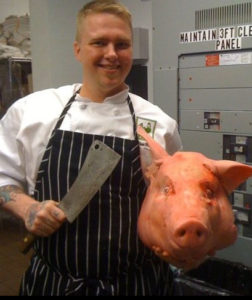
Santi welcomes Richey

As reported previously in BiteClub, sous chef Doug Richey is taking over the Santi kitchen in Santa Rosa. He’s been working with exec chef Liza Hinman, who’s heading off to maternity leave.

Should you be worried? Owner Doug Swett says he’s totally confident, especially since Richey trained under former exec chefs Franco Dunn and Dino Bugica in Geyserville.

And come on, look at the way he handles a pig head– a true measure of any great chef.

Congrats Chef!

Prix Fixe: Beginning January 17 Santi launches a Monday evening Prix fixe menu for friends and family.  As a way of introducing Chef Richey to the neighborhood, Santi will be offering a 3 course meal featuring both Santi favorites and new creations for $35 per person.

“Parker House” Dinner Rolls

Somewhere, in a squat little cardboard tube, lies a row of Pillsbury dinner rolls, mashed into one another as if caught in some evil baker’s version of airline seats, and each of those rolls, as it pays its Karmic debt to the gods of flour and water, thinks of one thing only: Please, please let me come back as a Parker House roll, baked from scratch in somebody’s kitchen, pulled apart by the chubby little fingers of happy little children. At least that’s what comes to mind as I pull these puffy, golden little pillows from the oven, our entire home smelling sweetly of toasty yeast and melted butter, my kids bouncing up and down like Chanukah and Christmas came early this year.

I distinctly remember eating dinner rolls as a child: The milky sweetness of a just-the-right-side-of-doughy, slightly flaky interior; the barely perceptible crackle of soft buttery crust; the slight resistance when I pull one free from its litter; they way a fine dinner roll can overshadow whatever it was meant to accompany. Still and all, I’m not even sure if these Proustian rolls from my youth were actually baked by my mother, served alongside the 1970s incarnation of the Smorgasboard buffet my brother and I always chose for special occasions, or merely intuited by way of the iconic dough-boy in the ads, a televised osmosis, a little dose of kiddie SOMA baked directly into the memory banks. Does it even matter? I remember them, all the same.

Whether these particular rolls qualify as true Parker House rolls – named for the Parker House Hotel in Boston, where they are still served – is an open question. If you like to bet on celebrity chefs, you can find versions by Martha Stewart, Bobby Flay, and Tom Colicchio; if historical accuracy is your thing, you can even find a credible printed recipe from 1896. Regardless, this is what I know, as of 6pm last night: I am not a baker, and even I can make a spectacular version of these rolls. And they are that thing of rare beauty, a little nugget of white-trash loveliness that will make you a hero to your children, transform grown men into little boys, and generally restore one’s faith in one’s oven. So please, make these rolls. And do let me know if you find a better version?

Parker House Rolls (Adapted from T Colicchio, as printed in Saveur)

Note: I’m pretty sure that the printed version is incorrect (read the comments or, worse, try it yourself; the main flaws are too cool an oven and too short a proof, although I’m not convinced about his precise quantities, either), so I’ve reprinted their version, crossing out the original wherever I’ve made changes, with my reasoning (in parentheses); another home cook’s take may be found here.

Chef Tom Colicchio’s fluffy, buttery dinner rolls may be the best we’ve ever eaten. The secret? Barley malt syrup, a molasses-thick liquid sweetener that adds a hint of malty flavor.

Source: Saveur Yours truly.
3/4 cup milk, heated to 115° 6oz milk (yes, I know it should be the same thing, but I had so much trouble with the original that I weighed it all on a scale instead of using measuring cups; and don’t fuss over the temperature, just warm to the touch is more than adequate)
1 tsp. 1 packet active dry yeast (preferably Red Star brand)
1 tsp. barley malt syrup or dark corn syrup 1 tablespoon honey (I’m sure the malt syrup would be great, but I don’t stock it; the teaspoon is not enough, regardless)
2 cups flour 10 oz A/P flour (the pictured version was made with bread flour, which makes a chewier version, but for this dough, you may want the fluffier dough from an A/P flour)
1 1/2 tsp. 1 tsp. kosher salt (it’s too much salt, given the garnish, and because I only had salted butter to hand; and 1t is the classic baker’s ratio, so I went with that)
2 1/2 tbsp. unsalted butter, cut into 1/2″cubes1/4 cup clarified butter, for greasing (you don’t actually need to clarify the butter, although it’s easy, and will give a slightly better look, as the milk solids won’t stick on top) and brushing
Fleur de sel, to garnish

1. Stir together milk, yeast, and malt syrup honey in a large bowl; let sit until foamy, 10 minutes. In a medium bowl, whisk together flour and salt; add to milk mixture along with butter and stir with a wooden spoon until a dough forms. Transfer to a lightly floured work surface and knead until smooth, 5–6 minutes. Transfer dough to a lightly greased bowl and cover with plastic wrap; let sit until nearly doubled in size, about at least 1 hour. Uncover and punch down dough; cover and let sit until puffed, about 45 minutes rest for 10-15 minutes (we’ll get all the rise from a much-longer proof).

This weekend, it's all about having fun. 2. Heat oven to 325°350F (check your oven temp – this is a little delicate). Portion dough into (about) fourteen 1 1/2″-diameter balls, about 1 1/4 oz. each, and transfer to a greased 8″ cast-iron skillet or 8″ x 8″ baking pan, nestling them side by side (you want a little space between them), and brush them with butter; cover loosely with plastic wrap a damp cloth and let sit until doubled in size, about 2 hours about 4-6 hours; you may have to slow it down by putting the pan in the fridge for the first 2-4 hours, but but sure to take it out at least 2 hours before baking to allow the dough and the metal to come to room temperature. Brush again with clarified butter, and bake until puffed and pale golden brown, 20–22 about 25 minutes (check at 20, and keep an eye on them). Transfer to a rack and brush with more clarified butter; sprinkle each roll with a small pinch of fleur de sel and serve warm.

MAKES ABOUT 14 ROLLS

Denny’s Slamburger

Breakfast, lunch and a day’s worth of calories all for the low low price of $8.95: The Denny’s Slamburger.

On the plate: A half pound burger with bacon, hash browns, a fried egg and cheese sauce on a sesame seed bun. With fries, natch.

Pair with: Four hours of exercise and a cardiogram.

Amount eaten: Less than half. McNibs forcefully removed it.

Nutrition: 1030 calories, 59 grams of fat (22 saturated), 350 mg cholesteral, 1850 mg sodium, 3 grams of fiber, 60 grams of protein.

Denny's Slamburger
Denny's Slamburger

Casino Bar & Grill | Bodega

It takes approximately five seconds to drive through the hamlet of Bodega — the town, not the Bay. There is no stoplight, but the posted speed limit of 25 miles per hour makes for a steady glow of brake lights as beach-goers and dairy trucks make their way somewhere else.

It also takes approximately five seconds to give a mostly-incorrect retelling of the town’s claim-to-fame as backdrop for Alfred Hitchcock’s The Birds. And though it’s true that the haunting spires of Saint Teresa of Avila church and the Potter School figured into the 1962 thriller most of the good stuff (like the fire) was filmed on a Hollywood set and no where near Bodega.

Enthralled by the story, however, you may ask about the funny old building with the neon sign leaning out into the road about two seconds into town. Chances are you’ll get a blank look and be told the building is a casino. The glowing neon 7-Up sign on the building says, “Casino”, as anyone can see. But that too would be incorrect.

“Casino” is actually Casino Bar and Grill. It’s a locals spot with creaky wooden floors, windows you can’t see into from the street, pool tables and a jukebox. It’s the kind of place you’d feel pretty silly asking for a glass of chardonnay, but if you did, they’d fix you right up. The crew from the Birds, so the story goes, used to hang out there and Hitchcock himself once ate there. Two stuffed bird “extras” still  hang out above the bar.

Amidst the avian ambiance, you’ll also find Chef Mark Malicki.

“I drove by probably hundreds of times and never went in,” said the grill’s new nighttime chef. You may remember Malicki from his days at Cafe Saint Rose, which closed several years ago. In the interim, the creative Wine Country chef has worked at The French Garden, as a caterer and in briefly in Benicia.

Acting as executive chef, griddle cook, waitstaff and busser, Malicki dreams up a new list of dishes each night that usually includes a couple of appetizers, an entree or two and dessert. Using mostly local, seasonal ingredients, he does his Mark thing. On the night we visited, that was a menu that included Dates with Manchego, Pistachios and Serrano ham; Griddled Brussels Sprouts with bacon and Goat Cheese Toast; Potato and Fennel Soup with Creme Fraiche, Oxtail Stuffed Piquillo Peppers, Fish Tacos, Caesar Salad and Flourless Chocolate Cake.

So how does a Malicki’s menu go over with the locals?

Oxtail stuff piquillo peppers with pomagranate seeds

“Never judge a book by it’s cover is what I’ve learned,” said Malicki. “I’ve learned that it’s impossible to sell fish to fishermen, though.”  Game goes over well, as does meatloaf. The other stuff he just tries out, like roast shoulder of pork with pig ear mushrooms, bbq pork shortribs or goat milk caramel flan. Few things are over $12, with most in the $6-$8 range. Our dinner cost $50 total.

In a town with this much history, its yet to be seen whether Malicki will stand the test of time at this rural outpost, or if this is merely brake light in his culinary career. Either way, this Bodega way station is worth more than a five second glance on your way somewhere else. Just watch out for the birds.

+++++++

Malicki is currently in the kitchen Thursday through Tuesday night and has recently extended the dining hours until 11pm. Casino Bar and Grill, 17000 Bodega Hwy, Bodega, 876-3185. Children are welcome until 10pm.

Lobster Bisque & Viognier @ J Winery: Two of a Perfect Pair

Nicole's Vineyard Pinot Noir

Forgive the hackneyed analog, but I’ve just eaten a Lennon-McCartney harmony of food and wine over at J Winery; OK, maybe that’s too much, but a solid Bee Gees, at least! Seriously, if we wore socks on our teeth, then Chef Mark Caldwell’s Lobster Bisque, together with winemaker George Bursick’s Hoot Owl Vineyard Viognier, would knock them clean off. And I don’t even like Viognier, as a rule.

Beet-Mushroom Crepe, Sesame Brittle-Yuzu Royale

Eight-Flavor Local Duck, Tamarind-Orange Glazed Pork Belly, and Yuzu Royale; a vertical of single-vineyard Pinot Noirs, a late-disgorged vintage sparkler. For breakfast, no less. Not that one necessarily needs a special occasion to have wine for breakfast when one lives in wine country, but it helps, especially if you’ve got school pick-up, or anything else marginally productive to do. Fortunately, I had neither, so I got to enjoy all of this at a “Chinese New Year”-inspired pairing of food and wine in J’s Bubble Room; the menu, and the wines, will be featured through February 6th, a great call if you’ve been looking for a something-special to do in Healdsburg.

As good as it all is – and it’s all very good – it’s that Lobster Bisque and Viognier that makes you forget about the door levy. To be sure, $65/head for a 7-course menu hardly qualifies for a budget-oriented visit to the tasting room, but to be fair, it’s  a meal more than a tasting (7 substantial plates of very tasty vittles), and ends up as much a miniature course in wine education as it does a tasting (including 8 different glasses of J’s top-shelf offerings); really, my only gripe is that I had to write this review, instead of taking a nap. But back to that bisque: Chef Mark serves it as a “cappuccino”, the “foam” delicately laced with coconut, an intriguing note of lime adding just the right balance to the  sweet-spicy decadence of the soup and coaxing a range of citrus flavors from the wine.

Vegetable Firecracker, That Impossibly Good Bisque

Now, I don’t know about you and Viognier – with the notable exception of a few of the better examples from the Condrieu region of France, I generally won’t touch the stuff – but I’ve just been converted. The honeyed texture, the white flowers and stone fruit, and, above all, that mysterious note of lime zest in the wine do a little tango with the soup, each getting more from its partner than either had alone, the ultimate goal of all wine-food pairings. I’m going to try to convince Mark to give me his recipe for that bisque, but in the meantime, I’m headed back to J for another bottle, and then to pick up some Thai food to-go, something with coconut and lemongrass, maybe…

Taco Bell: More bull than beef?

A lawsuit has been filed against Taco Bell stating that the fast food chain is using false advertising when it uses the term “ground beef” or “seasoned ground beef” to refer to its food.

In contention: The “taco meat filling” used by the restaurants only contain about 35% beef with binders, extenders, preservatives, additives and “other agents” making up the other 65%.

Frankly, we think any late night nibbler who has scarfed down a 20-pack could probably tell you that “beef” wasn’t the main reason for their border run. It’s the cheap thrill of using pocket change to pay for a meal.

What’s your take? Bull or beef…and are you really all that shocked and appalled?

My Favorite $5 Kitchen Gadget

Useless Kitchen Gadgets
My mezza luna, dough stippler, fish tongs…

I buy too many kitchen toys, and I suspect I’m not alone. Admit it: Anyone who watches Food TV, buys cookbooks, or owns an up-to-date Zagat’s, to say nothing of the hardcore amongst us who actually read blogs about food and cooking in our spare time, owns an extravagant number of culinary gadgets. That many of them go unused is a virtual certainty, relegated to that far-left drawer or too-low cupboard, buckets of strange, medieval-looking devices that seemed so indispensable in the Williams-Sonoma catalog, but which turned out to be hard to clean, rarely employed, or – worst of all – to require more work than the task they were originally meant to simplify (thekitchn.com provides a cute, if highly abridged, list of their top 10 offenders here).

Still and all, kitchen toys are wonderful things, and I happily employ them by the dozen: Chinoises, rolling pins, poultry shears, tongs, cast iron grill pans, my favorite spatula, even a salad spinner and all those nesting prep bowls… I can rationalize each and every one, given a enough meals to prep. On the basis of cost and functionality, however, few can compete with the humble dough scraper, for three simple reasons:

  1. It is cheap – really cheap. You could get a sexy, stainless steel version at Williams-Sonoma for $8, my Oxo version for $8.99, or – and this is what I would do – go to your nearest restaurant supply store (e.g., Meyers in Santa Rosa), and pick up a commercial version for less than half those prices.
  2. It takes up virtually no storage space. Small and essentially flat, standing upright or flat in a drawer, the thing will fit anywhere.
  3. It makes cleaning up faster, easier, and neater. While a dough scraper is essential for removing the crusty bids of dough that seem to bond chemically to your work surface, its true unheralded genius is its capacity to move piles of chopped stuff to pot or pan (simply scoop up the item to be moved with the blade), clear my workspace of debris as it accumulates (I always keep a large steel “scrap bowl” around, into which goes plastic wrap, onion skin, excess flour, whatever, all lifted cleanly from my board with the scraper), and then clean off my cutting boards and counters when I’m done, all without seeding our kitchen floor like some Johnny Appleseed of Trash and annoying my wife. And, surely, that’s enough?