
(Note: Recently, I reported on a recent study from the Cornucopia Institute that rated 70 egg producers, including two local producers. The ensuing comments raised a lot of questions about how customers can wade through the confusion. This is the unedited version of a story that will run in the Press Democrat in the coming weeks. Some of it rehashes the original piece, but there is a lot of new information as well. Enjoy.)
With the recent nationwide salmonella outbreak linked to factory-farmed egg production, legions of wary customers are trolling the grocery aisles and farm markets for organic or pasture-raised alternatives as a safer or more sustainable solution.
Not surprisingly, a wealth of promises await in the ever-growing refrigerated section devoted to eggs. Hormone-free, cage-free, antibiotic-free, free-range, Omega-three enriched, cholesterol-reduced, and of course in a rainbow of colors from white to brown, green, blue and tan. But buyer beware, because because homey cardboard packaging, smiling farmers and empty promises of happy chickens don’t always mean well-bred eggs.
Eggs, like so many other foods, have fallen victim to the green-washing trend, being labeled with the latest catch-phrases that consumers want to hear. So can you make the best choices when it comes to your morning scramble? It pays to do a little research.
First-off, a few definitions are handy when it comes to egg education. These definitions are distilled from a variety of sources including the USDA, producers, and various industry publications and third-party studies devoted to organic egg labeling.
– Organic: Laying hens must be fed an all-organic diet without byproducts or GMOs. To be organically certified- hens must have access to the outdoors and cage-free, according to the USDA. There have been exceptions to the outdoor-rule in California based on the risk of the birds contracting avian flu.
– Cage-free: Hens are not kept in cages, but allowed to move freely. The passage of Prop. 2 in 2008 mandated that all California egg-producers be cage-free, by 2015. Cage-free, however, can mean many things. Large factory farms can have thousands of birds packed into barns with limited or no access to the outdoors. Others allow for plenty of room and full or partial outdoor access.
– Hormone-free: This is a red herring. No hormones are approved by the FDA for poultry production.
– Free-range, Pasture-Raised: Hens are allowed to roam freely outdoors during the day, Studies indicate these eggs may be higher in nutrition, but detractors raise concerns about the spread of avian flu to wandering animals and the possibility of birds inadvertently eating toxin and passing those along to consumers.
– No-kill: When a hen no-longer produces eggs (usually about four years), they are often slaughtered. No-kill operations let the non-producers live out their natural lives.
– Brown eggs: Brown eggs are not nutritionally different than white eggs. They, along with green and blue eggs, come from different breeds of chickens.
– Vegetarian diet: This can be a bit confusing. Vegetarian chickens don’t exist in the wild — chickens enjoy insects and worms, so it means the birds probably don’t go outside. On the plus side, it also means their feed doesn’t include animal by-products like feathers, bone meal or beef tallow.
–Antibiotic-free: Heavy use of antibiotics on chickens is unusual and very expensive for egg producers. Ultimately, it doesn’t mean a lot, but it certainly doesn’t hurt to know your egg isn’t pumped up with medicine and the flock is kept healthy.
– Natural: A product that contains no artificial ingredients or added color and is minimally processed. Though regulated by the USDA, opponents argue that the term is too vague to be of much use.
– Fertile: If roosters are kept with the hens, eggs are considered fertile. Often a catch-word for un-caged.
– Humane, Animal Welfare, United Egg Producer Certified: There are a number of certifiers who audit living conditions. Animal Welfare Approved is the highest standard, but none of its certified producers sell to supermarkets. American Humane Certified allows for cage-confinement. UEPC certification allows for battery cages and beak-trimming, making it the least restrictive of the certifications.
– Omega-3 Enriched: To produce these nutritionally-enhanced eggs, hens are given flax seed, algae or fish oil in their feed. This has no effect on the treatment of the animals or their organic-status.
Now that you know the lingo, it’s time to do a little self-examination. Labels can tell you a lot, but your own conscience will have to be your guide.
– If animal welfare is your highest priority, expect to pay a premium (up to $7) for a dozen eggs. It takes a great deal of space and care to raise hens outdoors and larger producers — even conscientious ones — don’t usually offer pasture-raised birds. John Kearns of Healdsburg Farm Fresh Eggs, who has a small flock of about 150 birds, sells his pasture-raised eggs at local markets for about $6, and looks to two recent studies that give high marks to the increased nutritional profile of eggs produced by pasture-raised hens. “You have to eat 3 conventional factory farmed eggs to equal the same nutrition just 1 of my eggs contains,” said Kearns in an email. He is not, however, certified organic, which he claims is cost-prohibitive to a small operation. Local farm markets and farm stands typically sell non-organic certified eggs from pasture raised hens.
A recent study from The Cornucopia Institute recently released its Organic Egg Scorecard rating 70 egg producers around the country. The Institute looked for small-to-medium sized family farms raising pastured chickens sold under the farm’s name or to natural grocery stores. In Northern California, it’s highest ratings went to Alexandre Kids, Cresent City; Elkhorn Organics, Prunedale and St. John Family Farm, Orland. It gave “Very Good” marks to Clover-Stornetta Farms, which are American Humane certified.
– If organic is your highest priority: Midsized and large farms can certify that their eggs have met the criteria for organic. Petaluma Poultry, a mid-sized family farm, with about 250,000 birds, sells under a variety of brands, including Judy’s Family Farm, Uncle Eddies Cage-Free Eggs, Rock Island Fertile Brown Eggs and Gold Circle DHA Omega-3 Eggs. All of the family’s hens are cage-free and their organic eggs are certified by Oregon Tilth, one of the most stringent certifiers. Owner Steve Mahrt, a third generation chicken farmer, was a pioneer in the organic egg movement, and was the first to be certified more than a decade ago. Petaluma Poultry’s hens are not considered pasture-raised, because the birds are kept to screened-in porches and their barns due to the threat of avian flu. “They can go outside in a controlled safe manner,” said Marht. Cage-free organic eggs usually cost between $3 and $5.
– Go local: Something that nearly all Northern California producers agree on is buying eggs locally. Large factory farms can process millions of eggs per day, going to across the country under a variety of labels. Concerns about contamination, carbon-footprints and the welfare of hens packed into battery cages is a good reason to pay close attention to where your dozen hails from.
– If price is your highest priority: Not everyone can afford high-brow eggs, but you may want to consider looking at your eggs with a more critical eye. At minimum, look for cage-free eggs. Compare commercially-produced eggs with eggs that you buy from a farm market, and you may be surprised at the visual difference — yellower yolks, thicker whites.
Con*Fusion Pop Up Dinners

When Maria Vieages’ world turned upside down in the wake of Hurricane Katrina, the New Orleans resident headed westward with little more than her recipes and a her infectiously sunny disposition.
The two have served her well, leading to scores culinary ventures for her company, Maria’s Multi Regional Cuisine, including stints at wineries, cooking schools and on her own food broadcast, Maria’s Non-Pompous Food Talk on KGGV — which pretty much sums up her no-nonsense philosophy on eating.
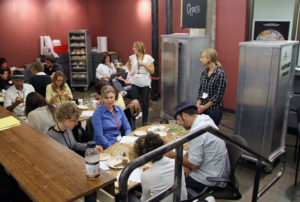
Now, Vieages and three friends (former restaurant owners Donna Seltzer and Sparky Thorne along with self-taught chef, Bethany Rose) are hosting a twice-monthly Friday pop-up restaurant called ConFusion at the Garden Court Cafe in Glen Ellen.
The menu roams around the world, picking up Creole, Cajun, Caribbean and South American flavors as well as dishes influenced by California and the Pacific Rim. The first menu (Oct. 22) includes Brazilian-style duck breast marinated in sugarcane served with plantain crema and duck cracklings; Louisiana chicken and sausage gumbo; Jamaican pork tenderloin stuffed with spinach, feta and mango; lasagna with hot Italian sausage, vanilla cream-cheese brownies with coconut and cheesecake-stuffed strawberries dipped in chocolate.
Four-course prix-fixe dinner, $50 per person. Seating begins at 6pm. No corkage fee. Reservations, which are strongly suggested, call 546-3293 or the restaurant at 935-1565. 13647 Arnold Dr., Glen Ellen, (707) 935-1565For additional dates, go to mariasmrc.com.
Tyler Florence’s Hot Dog Chili (Or, When Bad Recipes Happen To Good People)

In statistics, we often talk about “Type I vs. Type II Errors” – unimaginative geek-speak for “false positives” and “false negatives”, respectively – but one could just as properly label these concepts “errors of commission vs. errors of omission“. A conundrum endemic to parenting and modern life in general, and for which the home kitchen provides an object lesson: When preparing a recipe for the first time, particularly one from a celebrity chef like Tyler Florence, do I trust my instincts and override the recipe whenever something seems amiss? Or, do I remain humble, follow it to the letter, and hope for the best?
The inherent conflict between humility and judgment, whether in the laboratory or the kitchen, proffers no solutions, only trade-offs, because it is a mathematical certainty that one cannot have it both ways: The less likely you are to make one sort of error, the more likely you are to make the other. Think of it as a sort of no-free-lunch paradigm for stats monkeys, and a dilemma which all of us confront every day: To which school should we send the kids? Should our retirement account be in stocks or bonds? Will it be faster to take the highway or the back roads? Does this dish need more seasoning? I would even argue that this basic trade-off girds principles as wide-ranging as the Hippocratic Oath, the Libertarian Party’s economic platform, and most of the world’s approach to family planning, but then I’d get lots of snarky emails about my presumed politics, so perhaps better to let those particular dogs lie unperturbed.
The whole issue is on my mind today because I just made Hot Dog Chili – not a preparation I’m overly familiar with, unless we’re counting the many past instances of inebriated consumption – from a recipe provided by Tyler Florence. Being unfamiliar with the dish, I went with humility – that is, I accepted the risk of Type I errors in order to avoid Type IIs – and I paid for it, because I’d have been hard-pressed to make a mistake worse than the recipe itself.
Now, to be fair – both to Mr Florence and my decision to trust him – the thing about Hot Dog Chili is that it’s not meant to be chili per se: Hot Dog Chili derives from the kitchens of places like Pink’s and Tommy’s down in Hollywood, and shares little family resemblance with the competition-style chilis of Texas. Hot Dog Chili does not depend on tomatoes, peppers, or beans; includes neither cubes of brisket nor heaping handfuls of spice; and must always have a very particular texture – not one you’d want to eat very often, truth be told – of a shirt-and-tie-destroying, finger-nail-staining, heart-stopping mouthful of pasty, fatty, Elmers-esque loveliness, best enjoyed very late at night with a stomach full of hooch. As questionable as they may sound, the mild flavor and sludge-like consistency of Hot Dog Chili are absolutely essential for a proper chili dog, so I dutifully banked on humility and Mr Florence’s recipe to tow me in from a lonely reef of ignorance to a tropical paradise of chili dog perfection; unfortunately, I was wrong to do so, because the recipe is a shipwreck. But bitching solves nothing, and I still want my chili dog, so herewith my list of gripes and suggested corrections, assuming an overall preparation following his lines:
- The Problem: Lean ground beef is contra-indicated, because Hot Dog Chili is in many respects a ragu. Furthermore, the notion of using lean beef, and then cooking it in a whopping 1/4 cup of oil just strikes me as counter-productive. Too much onion. The fix: Get a pound of high quality, flavorful, freshly ground grass-fed beef at least 20% fat; I’ll use my go-to slider material, a blend of chuck, brisket and sirloin, all grass-fed and ground-to-order by Rian, my go-to butcher at my go-to butcher’s, Willowside Meats & Sausage Co. I would also cut the onion by half, and I’d cook it in 1-2 tablespoons of canola or peanut oil.
- The Problem: A full cup of ketchup is obscene, unless you want your chili sweet, sticky, and cloying, tasting of little more than a concentrated paste of Heinz. Further, neither a teaspoon of mustard nor a smattering of chili powder is nearly enough. The Fix: Use only 1/2 cup of Heinz ketchup, at least a tablespoon of French’s mustard, at;east a tablespoon of paprika and at least a teaspoon of ground cumin. The ranges are provided because I’ve only established the lower bound in my limited experiments thus far, but suspect more is required; I also suspect you really want to reserve some of the spices and add them toward the end, as you would a staged spice-dump for a more classic chili, because their flavors tend to cook out after all that time on the heat.
- The Problem: Without water or stock, the chili dries out too quickly and never has a chance to braise down into its proper ragu-like consistency, particularly in the suggested amount of time. The Fix: Add a cup of water (or, better, rich beef stock) and allow it to cook for at least another hour (two would be better), until almost dry and the fat begins to separate; if it dries out while cooking, just add more water/stock.
Post script:
Since I began this post, the obvious finally occurred to me, and the number of blogs purporting to have the “secret recipe” of either Pink’s or Tommy’s are is legion (for instance, here and here). Lots of small differences, and one big one: The use of a roux to bind the sauce, which I am almost certain must be part of the real deal. I actually like some of what Mr Florence is doing – including the use of ketchup and mustard and a very short list of spices – so I”m going to play around with some combination of his approach and the purported secrets from the kitchen’s of Hollywood’s most famous dives.
Zimmern & Cosentino: Offal street-eats in SF

Two of my adventurous eating heroes, Andrew Zimmern (Bizarre Foods) and Chris Cosentino (Incanto) will be doing an All Offal menu out of an SF street food truck ( Le Truc) this Saturday (Oct 16) from 11:30-3pm while taping an episode of Zimmern’s Travel Channel show. It’s open to the public at the Off The Grid: McCoppin Hub on McCoppin Street at Valencia (Between Market and Duboce on Valencia).
Word from the SF food crew is that nose-to-tail proponent Cosentino will be cooking up fried pig’s head with pork trotter meatballs served with brain mayonnaise (“brainnaise”) in a cone.
Can’t make it? Cosentino will be in Healdsburg on Novemeber 7 at Quivira Winery hosting a benefit dinner for Slow Food Russian River’s heritage turkey program. For details about the dinner go to slowfoodrr.org.
Foods for breast health
Eating has never seemed so complicated, especially when it comes to our health. Food wrappers and labels shout their supposed benefits: Low-fat, no trans-fats, anti-oxidant, heart-healthy. But in the end, as a nation we’re fatter than ever and continuing to suffer in record numbers from diabetes, cardiovascular disease and cancer. So what’s the answer?
Even among nutritionists, there’s debate, but what almost all agree on for everything from cancer prevention to losing weight: Lowering fat, limiting processed foods and eating more fruits and vegetables. Pretty much the same stuff we’ve been hearing for years and ignoring. Author Michael Pollan, whose books, “the Omnivore’s Dillemma” and “In Defense of Food” have helped to ignite a wider understanding of our current food crisis says simply, “Eat food. Not too much. Mostly plants.”
And when it comes to breast cancer, specifically, there are many theories about obesity, alcohol use, refined sugars and meat consumption. But the truth is that doctors still don’t know with any complete certainty what causes breast cancer. Nor is there any magic food that will cure or prevent cancer.
Strong evidence, however, is emerging that animal products and pesticides may be at least part of the problem.
“As far as the anti-cancer diets go in general-most advocates suggest people avoid pesticides and all animal products. The China Study, though not written by a doctor or nutritionist, has become a Bible for some. The authors advocate for a vegan diet as a way to suppress cancer,” said Nora Bulloch, a registered dietician and nutritionist who teaches at the Northern California Center for Well-Being. “Other anticancer diets encourage the anti-inflammatory diet which eliminates all refined foods, sugar and really anything that is high on the glycemic index. The theory is that high glycemic index foods raise insulin levels quickly and this leads to inflammation-the cause of all disease,” she added.
But for many, a diet without meat, flour, sugar, dairy or eggs is simply too restrictive. So what Bulloch and other nutritionists I spoke to advocate is boosting up “good foods” and cutting back on “culprit” foods that may have negative effects. Here are a few of their recommendations…
– Mushrooms: Medicinal mushrooms (such as shiitake, maitake, oyster and even white button or crimini or portabella) are high on the list of healthy helper foods for registered dietician and teacher Jill Nussinow, aka The Veggie Queen. Mushrooms are rich in selenium, an antioxidant. Nussinow also is a fan of fermented foods (pickles, sauerkraut) and home grown sprouts, especially in the cruciferous vegetable family.
– Seaweed: Nurse Practioner Elaine Weil of the Amitabha Medical Clinic and Healing Center in Sebastopol suggests incorporating small amounts of seaweed (sea vegetables into your diet) which contain trace minerals including iodine which are very important for breast health. “Try sprinkling dulse flakes on your salads and grains, or add vegetarian sushi to your diet,” she suggests.
– Turmeric: There’s increasing evidence that this yellow spice native to the ginger family may have some powerful health benefits. Considered an anti-oxidant and anti-inflamatory, turmeric is an integral ingredient in curry and gives regular mustard it’s bright yellow color.
– Alcohol: When it comes to breast cancer, limiting or eliminating alcohol is suggested, with no more than one small drink per day.
– Soy: Because soy contains estrogen-like isoflavones, there is concern that it may stimulate the estrogen receptors of breast cancer cells to grow, which is why many doctors warn breast cancer patients against eating soy products. The jury’s still out, however, as others point to the positive effects of soy on Asian diets and as a substitute for meat and dairy. Experts say to use in moderation and ask your doctor about avoiding soy supplements if you have breast cancer.
– Flax seed: Another phytoestrogen, flax seeds have long helped with menopausal symptoms. Nutritionists love this mega-seed for its health-giving alpha-linolenic acid (a plant form of Omega-3 fatty acids), but again, its worth talking to your doctor about if you already have breast cancer.
– Nuts and fish: Although fish at the high-end of the food chain can contain high levels of mercury, wild-caught salmon and sardines (which are at the low end of the chain) are top picks for their Omega-3 oil content. Walnuts also have high levels of Omega-3.
– Leafy Greens and Cruciferous Veggies: Kale, cabbage, Bok Choy, broccoli and cauliflower should become your new best friends if you’re worried about your breast health. High in natural cancer-fighting plant chemicals, it’s thought to help inhibit breast cancer cells from growing as quickly. They’re also rich in Vitamin C.
– Green Tea: As with many Asian foods, scientists are finding positive health effects from this powerful antioxidant. Studies show that it inhibits cancer and tumor growth.
– Olive Oil: Food needs fat for taste and cooking, but not all fats are created equal. Olive oil is the choice of nutritionists not only for its monounsaturated fats, but also for its high antioxidant content.
– Berry Good: Ripe berries in every color are good for the body and soul. Dark blue or black fruits (blueberries, blackberries) are thought to have the most antioxidants, but the vitamin C and fiber of all berries make them a top breast-cancer pick. Keep in mind, however, that berries often contain high amounts of pesticide, so opt for locally-grown organics whenever possible for all your fruits and veggies.
Wingstop, Penzey’s Spices coming

Is anyone else feeling like we’re being hit by a franchise tsunami, lately?
There’s the new In-N-Out (we hear it’s October and has the number 8 in the date), El Pollo Loco in RP, and now word of a Wingstop (chicken wings ‘n such) franchise hiring in Santa Rosa along with Penzey’s Spices (a Milwaukee-based spice and herb retailer well known to foodies) soon to take up residence at Montgomery Village.
And while it feels like a bonanza of pending culinary openings after a relative dry-spell in these parts, the news is bittersweet as many local businesses continue to struggle to make ends meet. While it’s nice to see storefronts come back to life, are we losing some of our homegrown Sonoma County personality?
What’s your take?
How far will Duskie make it on The Next Iron Chef?

She’s made it through two rounds, and it’s clear she’s a fan fave. How far with Santa Rosa’s own Duskie Estes make it on Food Network’s Next Iron Chef?
Watch her each Sunday at 9pm on the Food Network. Vote for her as a fan favorite on the FN site.
Vote now…
[polldaddy poll=3913055]
Tov Tofu coming
A new Korean restaurant, Tov Tofu, is set to open near the Yulupa Whole Foods in Santa Rosa in the coming weeks.
Yay!
Sonoma County’s long been short on Korean restaurants (though there are a number of Asian-or-otherwise eateries owned by Korean folks), this much-on-the-radar cuisine.
The space was previously occupied by Thai eatery, Bangkok Villa, which closed in late July. Bangkok Villa owners sold the Bennett Valley restaurant space, BiteClub hears, after a whirlwind success at their second eatery, Tomi Thai, which opened in Windsor last year.
Tov Tofu, 1169 Yulupa, Santa Rosa
Cooking For Kids with Just Three Ingredients

About a month ago, lacking my hoped-for, fleeting, and frustratingly oft-absent daily quotient of inspiration and incisiveness, I decided to try something new and, I admit, sort of gimmicky: I decided to find out out how many distinct, complete dishes I could compose using just three ingredients. (To be precise, “how many” pending boredom, constructive dismissal, failure to get out of bed, or any other inherent vice of the would-be blogger.)
In some respects, cooking with a severely restricted number of ingredients is endemic to my whole approach: If I buy less but better stuff and take care in its preparation, I’ll increase the odds of the final product not sucking. Further, much as I imagine the process of getting dressed to be for a really hot chick (or dude, depending which team and side of the plate you bat on), these two basic prerogatives reinforce one another: The better the raw material, the less it needs dressing-up, and the skimpier the dressing, the more pronounced its inner hotness. And, importantly for our household, nowhere does the fewer-ingredients/simpler-technique approach bear sweeter fruit than in response to my frustration of cooking for kids. Don’t get me wrong: I love, love, to cook for, and particularly with, my children; I find great joy in bringing them into the kitchen and watching them learn to think about and prepare the food they will eat; and I believe strongly that it is my responsibility as a parent to help my littles learn what real food tastes like, what tastes good to them, and why. But when the homework still isn’t done, the bath is getting cold, and our evening routine careens off the rails like some life-imitating-art version of Wiley Coyote piloting a locomotive into a swan dive off the rim of the Grand Canyon, I will readily confess that I find preparing several different versions of several different dishes in order to accommodate this week’s litany of idiosyncratic likes and dislikes, exceedingly trying.
So, why not codify the project and cook using just three ingredients? I recently asked myself this question while staring down the barrel of yet another Monday night meal (Mondays are consistently hard for me; maybe it’s the hangover from cooking fun stuff straight from the market all weekend; or perhaps the kids are grumpy with the first homework assignments of the week; there are lunches to be made; the TV is crap; all in all, the whole family has bounced around like loose electrons since we all got let out on Friday, and Monday’s demand that we all return to our valences amidst a broader rekindling of the household order). A quick inventory of the cupboards yielded nothing revolutionary: the ubiquitous pasta-with-butter; some leftover mac-n-cheese; a breakfast burrito; a bag of polenta; and of course my standing order to Choose something I already mentioned, go get yourself a bowl of cold cereal, or don’t eat. Because I’m done. To the munchkins’ credit, the polenta took it by several lengths, leaving me with the sort of problem I like best: How do I transform a simple ingredient into a main-course dish with a minimum of fuss?
Another quick scouring of lower and forgotten drawers, a few experimental unveilings of mysterious shapes shrouded in plastic wrap or foil, and a quick mental palate gut-check yielded a few translucent slices of still-good if slightly dry Serrano ham and a hunk of really stinky (“stinky” in a good way, as in that uniquely French capacity to make “gym-locker aroma” complimentary), washed-rind Raclette. The result was a very tasty little plate consisting of just three ingredients:
Creamy Polenta with Raclette & Serrano Crisps
- Prepare a basic polenta, as described on the package or here. (I’ve heard that you can make acceptable polenta with a “no-stir” method, and Marcella Hazan agrees, but I’ve not tried it; I do know that if you do it the right way, it takes a small amount of simple work, and the result is consistently outstanding.)
- While the polenta is cooking, separate several slices of the ham (Serrano is particularly good, but you could use a Prosciutto or any number of thinly sliced charcuterie and get much the same effect), tear it into pieces, and saute them over low to medium-low heat, either in a nonstick skillet or a lightly oiled fry pan. Flip and toss the meat from time to time, breaking it up with the edge of a spatula, until it is lightly crispy (it will scorch easily, so be careful). Drain and reserve on a paper towel.
- Grate the Raclette (again, it needn’t be Raclette, but try to use something with a pungent flavor and good melting qualities; anything in the “fondue” family would be ideal) across a microplane or the smaller side of a box grater.
- As soon as it’s finished cooking, mound the polenta in the middle of a pasta bowl, cover with a handful of the cheese while the cereal is still piping hot, and top with the ham chips.
A Fondolicious Slice
If you live in Sonoma County, either you rode your bike with Levi Leipheimer in the Gran Fondo this past Saturday, and it’s still all you want to talk about; or you didn’t, and you’re ready to cave in the skull of the next person who regales you with his or her war stories from the event. I count myself amongst the former, but empathize with the latter, so I’m just not going there, at least not in this forum (close friends and family, however, remain at risk, what with the post-ride buzz still in effect and inevitable further encouragement of the official results and pictures not yet posted) .
That being said, I’d like to take a brief moment out of my morning and yours to send a big PK shout-out to one particular local purveyor of food, Gran Fondo supporter, and all-around kick-ass pizza maker, Kashaya of Kashaya’s Brick Oven Pizza. There were lots of local eateries offering up sustenance to the calorie-deprived cyclist (check out the full list at BiteClub), but I only had one meal ticket, and suffice it to say, I wouldn’t have it any other way: Kashaya makes a chewy, perfectly-charred-but-not-burnt crust and tops it with a well-conceived combination of locally-grown goodies. I’m a pizza snob of the very highest order, and while we may not be talking about DiFara, Brooklyn is a very long drive, and Kashaya (along with Rosso and perhaps a few others) is an oasis in the largely barren pizza wasteland of my adopted home county.
So, knowing next to nothing about either Kashaya or her food (in point of fact, I still know next to nothing, although some useful reviews may be found here), I learned all I needed to from my first bite and this little anecdote: When I got to the order-window, they tragically had run out of dough, and Kashaya was nowhere in sight. Why? Because she had gone home, in the middle of the event, to knead more dough, by hand and to order, all to help me re-load my carbs. Now that is my kind of cook.