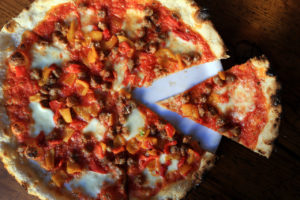
Pizza Salsiccia at Campo Fina in Healdsburg, Wednesday Oct. 8, 2014.(Kent Porter / Press Democrat) 2014
There are only three things needed to make a perfect pizza — crust, sauce and cheese. Sure, pepperoni, anchovies or pineapple may be required on your pizza, but the pure expression of a great pie needs no gilding.
How that crust and sauce come together, however, differs from region to region. From gut-busting Chicago deep dish to the simplest Neapolitan, we’ve found some of the best examples throughout Sonoma County. Mangia!
A few words on the origins of your favorite pies…
Neapolitan
The original. Neapolitan pizzas hail from Naples, Italy. Usually they’re personal-sized with a mottled crust (dark spots are a signature) and only topped with sauce, cheese, basil and olive oil. Pop it in a ridiculously hot oven for a minute or two and you’re done. Molto bene.
You’ll rarely find an authentic version in Sonoma County, but most of the local wood fired pizzas pay homage to this “true” pizza crust, then add all sorts of creative toppings that would horrify a purist. We’ll call them Neapolitan-inspired…
Sicilian Style
Also known as “grandma style” these pizzas are thicker and heartier and always square. You’ll get the best of all worlds with crispy, caramelized edges and lots of cheese and toppings. Detroit-style are based off of this style.
Detroit Style
Steel workers may or may not have inspired these pizzas when they used square automotive parts pans to cook up this light, unusually-shaped pizza. But in the past few years, this tasty, crisp crust has become popular.
Roman Style
A super thin crust often cut into squares.
Chicago Style
A signature style of the Windy City that’s deep, deep, deep. A high-rise buttery crust serves as a dam for all the dairy and tomato sauce stuffed inside. This is a commitment, ya know?
New York Style
Thin crust with giant slices that require folding in half if you’re going to do it right. Toppings tend to be minimalist.
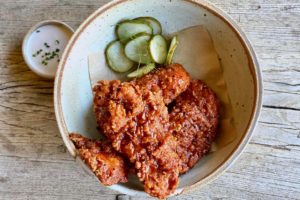
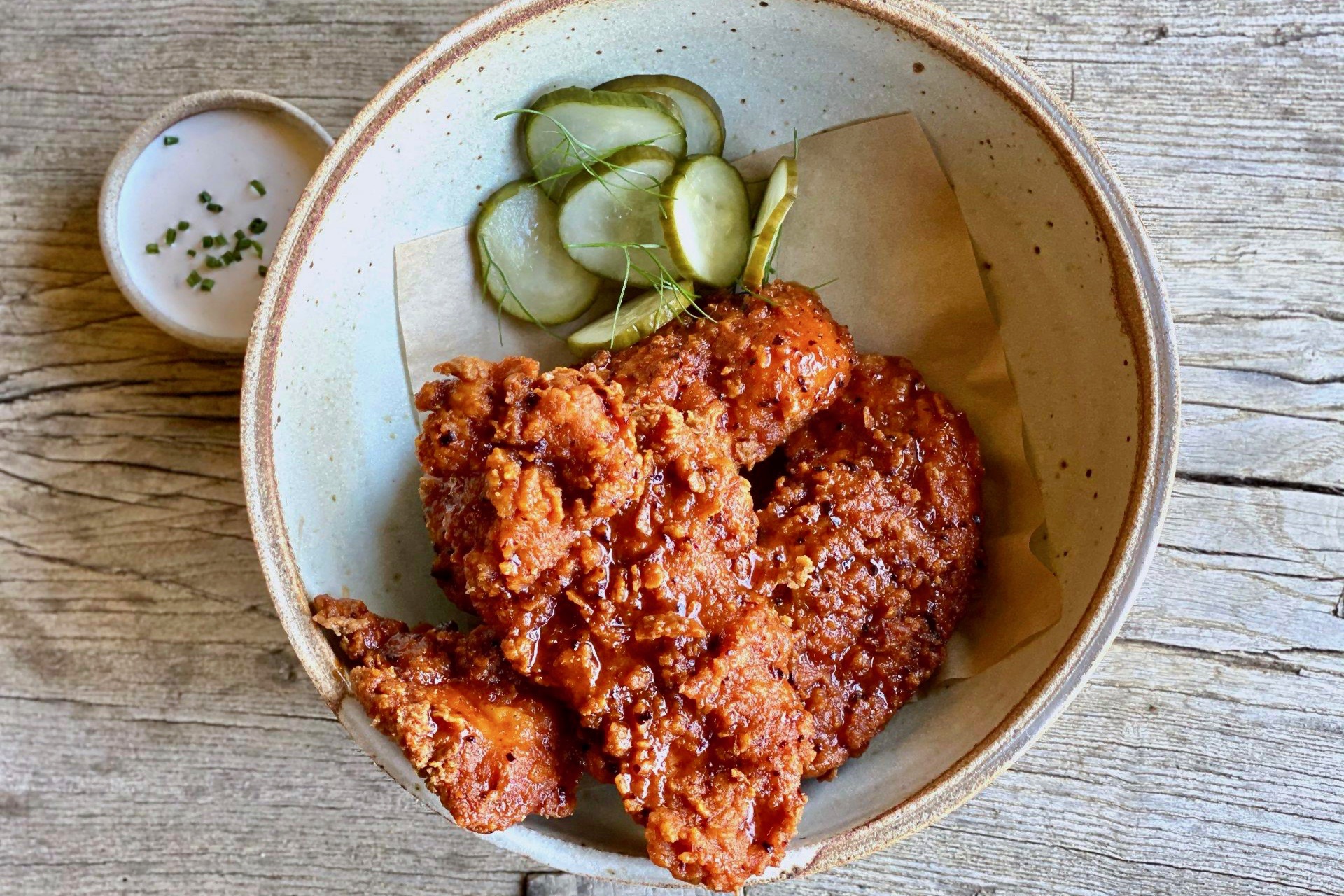
Fried chicken from Folktable in Sonoma. (Courtesy of Folktable)
Let’s not mince words here. Cornerstone Sonoma has long sought, and failed to find, foundered to find an audience. It’s a lovely botanic spot with nifty sculptures, wine tasting rooms and aspirational design shops, and it’s grown even more attractive since becoming Sunset magazine’s test gardens. But the glue necessary to bind it together into a destination was never really there, as tenants and restaurants quietly came and went without adding to the cohesion of a larger whole.
Until now.
Even as a fledgling restaurant, Folktable — a project from Top Chef finalist and restaurateur Casey Thompson and executive sous chef Melanie Wilkerson — is transforming meh into magnificent.
After an extended ramping up and limited takeout service, Folktable has finally spread its wings this spring with a new and expanded menu, some dine-in seating and, most importantly, expansive patio service amid the magnificent gardens, shops and former outdoor Sunset test kitchen.
With flowers blooming, warm sun and a bustling brunch set packing the place, it’s safe to say this spot is about to become the biggest buzz in Wine Country.
The casual-yet-intriguing Folktable menu showcases lush local ingredients in stunning garden surroundings, elevating the long-struggling Cornerstone Sonoma. Folktable is the right restaurant for the space, with good food, a beautiful location and solid service.
Sitting under a sprawling olive tree with a full bag full of takeout dishes, we couldn’t imagine a lovelier meal: fried chicken, tater tots smothered in Kewpie mayo and bonito, and buttermilk carrot cake, each thing better than the last.
Fried chicken at Folktable in Sonoma. (Courtesy of Folktable)
Best Bets
Fried Chicken Goujons, $18: This is just a fancy name for chicken fingers, but these are big and juicy breast meat pieces covered in sticky chile-honey sauce. Sweet milk-washed Hawaiian rolls and jalapeño ranch dip make it a picnic-like favorite.
Farm Harvest Salad, $14: Fresh greens with sliced apples and dried fruit with a tart vinaigrette was another highlight. It’s not a thriller, but it is a great light dish for hot days.
Turkish Eggs, $13: This dish may not be for everyone, but it’s a beauty. Poached eggs top warm Greek yogurt punctuated by Aleppo chile butter and crunchy shallots. Dip in crusty slices of sourdough for a satisfying breakfast or brunch dish.
Okonomiyaki Tots, $13: Here’s a riff on the savory Japanese pancake, topped with creamy mayo, sweet barbecue sauce, bonito flakes and scallions. It’s simply tots instead of a pancake, and makes a big shareable serving you’ll fight over.
There’s a lot more on the menu to love, including a dog menu (of course), coffee and pastries from their outdoor kiosk, and the Best Buttermilk Carrot Cake, $8, which lives up to its name.
Folktable falls under the growing brand umbrella of Sonoma’s Best Hospitality Group, owned by developers Ken and Stacy Mattson. The couple have spent more than $80 million on dozens of high-profile local properties in Sonoma. Thompson took the reins as executive chef for the group last year, working with Sonoma icons Ramekins Culinary School and the popular Mercantile shop on East Napa Street. The Mattsons’ portfolio also includes Dirty Girl Donuts and Sojourn Cellars, with plans to launch Motha Clucka (a breakfast spot in Boyes Hot Springs) and Thompson’s Georgette restaurant next year.
Folktable is open 11 a.m. to 4 p.m. Wednesday through Sunday, 23570 Arnold Drive, Sonoma, folktable.com.
Other weekend treats
Here are two other cheery weekend spots we’re loving right now.
Nimble and Finn’s
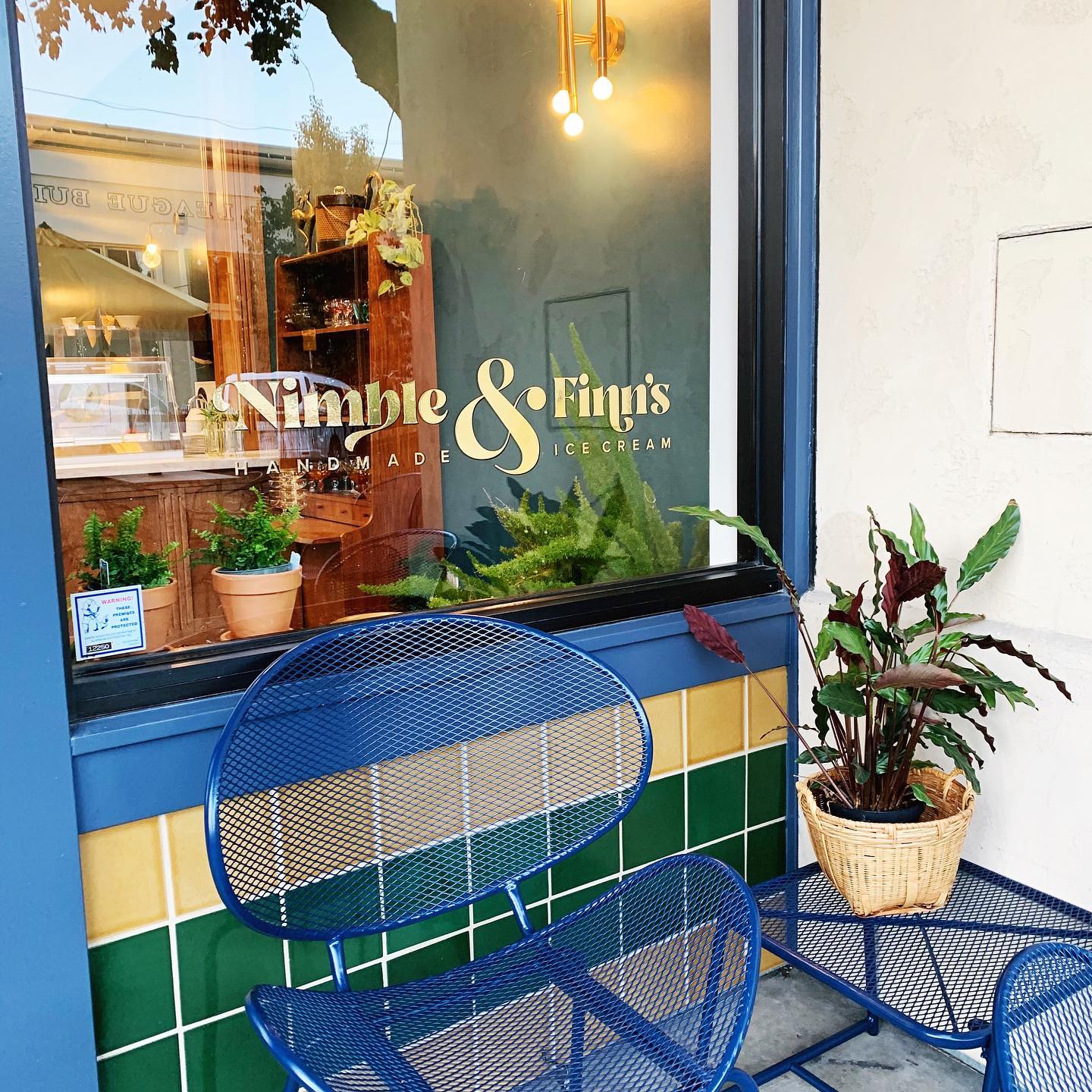
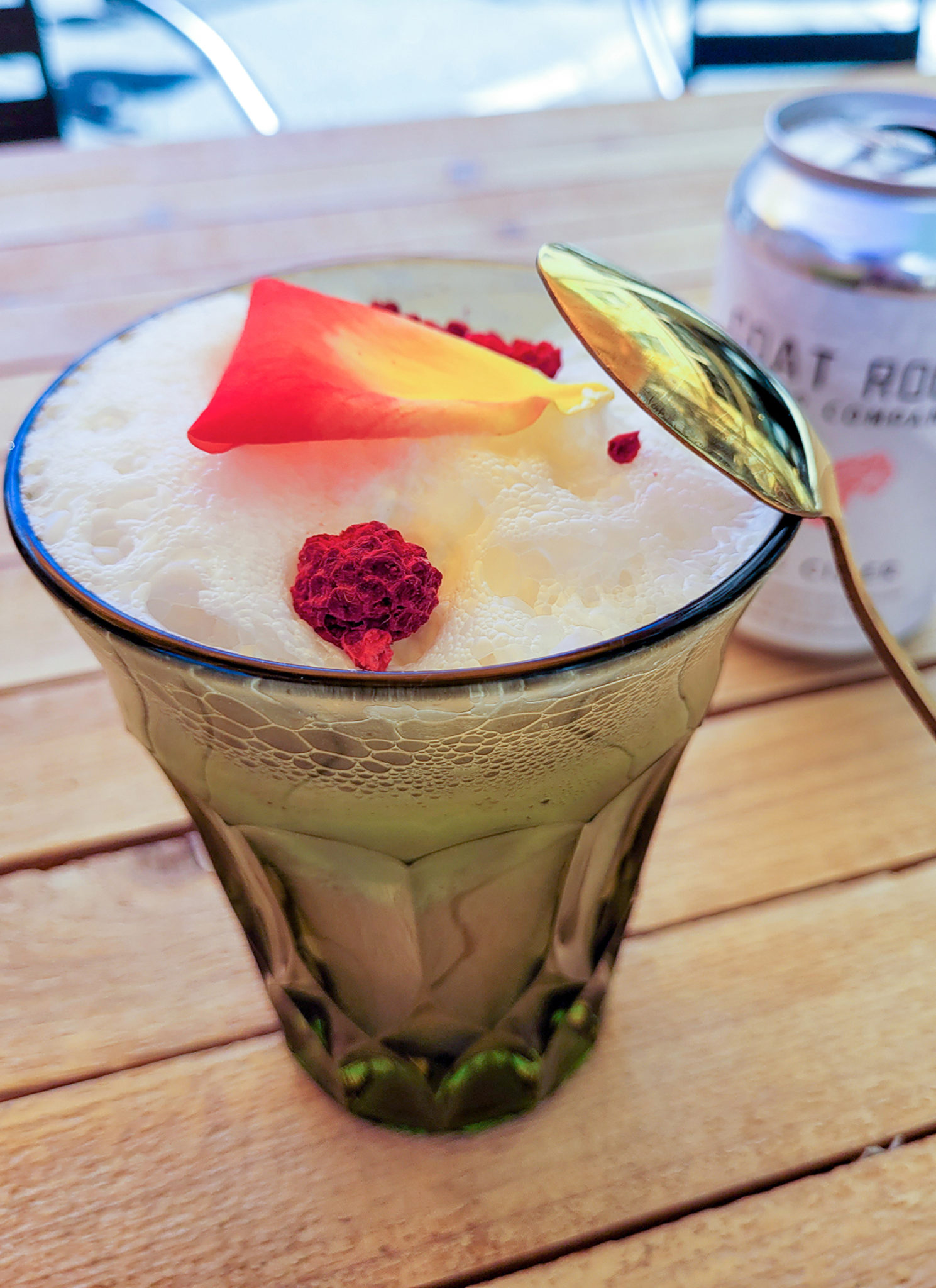
Guerneville’s legendary ice creamery has quietly opened a Santa Rosa outpost in Railroad Square. Seasonal flavors like Front Porch Mint Chip (the mint is from a plant outside one owner’s front porch), Meyer Lemon, Lavender Honeycomb and Whiskey Butterscotch are incredible, but add booze and you’ve got a cheeky little float.
With lower-octane alcohol like Champagne, wine, beer or hard cider, they’re a lazy afternoon sipper. We love the Permanent Holiday with creamy Meyer lemon ice cream, Lo Fi sweet vermouth and Goat Rock rosé cider, or the summery Strawberry Letter with strawberry sorbet, vermouth, elderflower and Champagne. Pair with one of their gourmet grilled cheese sandwiches.
123 Fourth St., Santa Rosa, nimbleandfinns.com. Open noon to 6 p.m. Thursday and Sunday, noon to 8 p.m. Friday and Saturday.
Nimble & Finn’s Ice Cream in Santa Rosa. (Courtesy of Nimble & Finn’s Ice Cream)Float at at Nimble & Finn’s Ice Cream in Santa Rosa. (Heather Irwin / The Press Democrat)
Society Bakery Cafe
That cute little bakery at the Sebastopol Antique Society you’ve zoomed past a dozen times? Yep, it’s a thing.
This sweet gem has solid breakfast pastries and excellent sandwiches, and we’re in love with their not-too-sugary ginger-molasses cookies and their open-face egg salad sandwich on Gougette bread. As a bonus, there are lots of gluten-free options, plus special-order cakes and cookies available for preorder.
2661 Gravenstein Highway S., Sebastopol, 707-861-9665, societybakerycafe.net. Open 10 a.m. to 4 p.m. Tuesday through Saturday.
Last spring, Matrix Winery in Healdsburg moved tastings from indoors to its outdoor patio. (Matrix Winery)
Thirteen months ago, Sonoma County wineries were forced to close their tasting rooms, the first of many economic blows delivered by COVID-19.
At the time, Michael Haney, executive director of Sonoma County Vintners, one of the major wine industry associations in the county, was optimistic wineries would find ways to sell wine and sustain their businesses during what turned out to be an excruciatingly longer period than anyone had imagined.
“Our members are super-resilient and super-creative,” Haney said in March 2020. “They aren’t panicking. They’re analyzing, they’re being innovative and they’re sharing what they know.”
Collectively, they aced it. As restrictions slowly lift, with limited-capacity indoor wine tastings now allowed and more people getting out to taste, it appears many producers have weathered the storm and are prepared for a new normal.
“Creativity created wine sales,” Haney said last week. “Wineries survived with virtual platforms. Their life’s blood is to engage with consumers and get wines to them, and they did this virtually. It didn’t make up for (the reduction in visitors), but it kept things going.”
Creative adaptations
Using Zoom, Instagram and FaceTime, plus delivery services, Sonoma winemakers shipped wines to consumers in advance and tasted along with them in real time, online. They threw bingo parties, held trivia nights, paired wines with cheese, gave cooking demonstrations and beamed live music to anyone, everywhere. Corporations also joined the fun, connecting their employees with wineries on Zoom, bottles in hand.
With restaurants and wine bars open only for takeout until recently and visitors not allowed (or their numbers restricted), wineries’ desperation to sell wine fortuitously collided with stuck-at-home wine lovers’ need for entertainment and salivatory stimulation.
A case study that supports Haney’s view is Three Sticks Wines in downtown Sonoma. The winery closed its tasting casita, The Adobe, on March 1, 2020, upon Gov. Gavin Newsom’s statewide order.
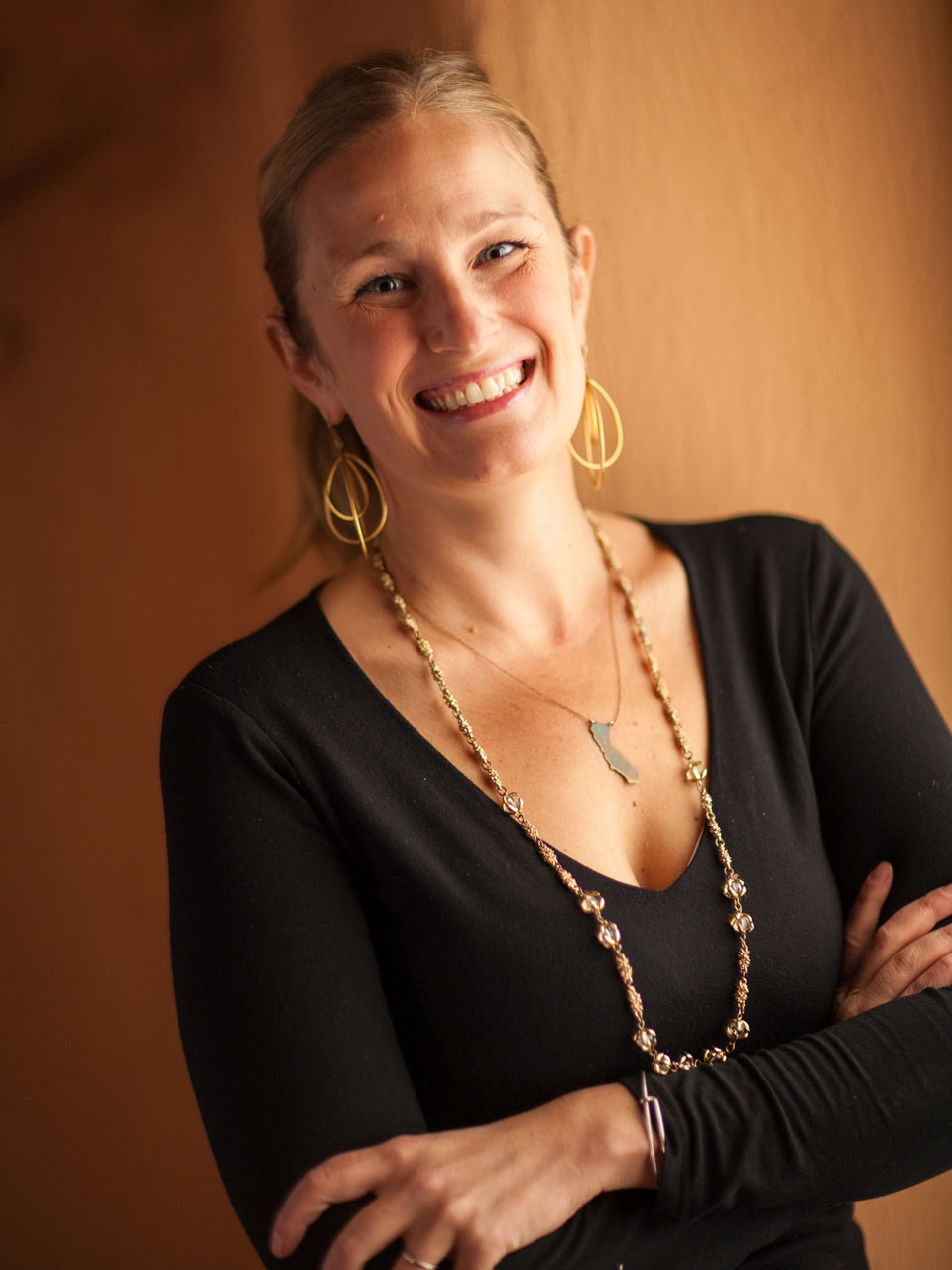
According to COO Prema Behan, “We knew we needed to be in constant contact with people, those we already knew and those looking for something new. We were lucky to have been around a long time and visible.”
Three Sticks Wines COO Prema Behan. (Courtesy of Three Sticks Wines)
Behan, winemakers Ryan Prichard and Bob Cabral and other Three Sticks principals began producing virtual tastings with members of their wine club and those on their allocation list. Through social media, Three Sticks reached out to potential customers with an array of options, from tastings with the winemaker to an online concert with Kix Brooks of country-western duo Brooks & Dunn. Sommeliers and chefs hosted conversations with Behan, Prichard and Cabral. Three Sticks sold tasting kits which included the winery’s exceptional chardonnays and pinot noirs, along with a Coravin, a wine serving tool that uses inert gas to preserve the remaining wine in the bottle. Drones were flown over vineyards to capture their beauty and the videos became part of virtual visits.
“The virtual world expanded for us,” Behan said. “We discovered that our virtual guests wanted a rich experience.”
When the state allowed wineries to open if they had a food component, Three Sticks worked with neighboring El Dorado Kitchen to offer wine and food pairings and takeout paella. Before tasting rooms were allowed to pour for guests indoors, the winery converted their employee parking lot into an outdoor tasting oasis, complete with bohemian-style furnishings.
The Adobe was built in 1842 by Captain Salvador Vallejo, brother of General Mariano Vallejo, the founder of Sonoma. Bill and Eva Price bought the building in 2012 to house Three Sticks and painstakingly refurbished it while keeping the site’s historic nature intact. The recent return of indoor tastings (at 25% capacity, which will increase if Sonoma County moves from the yellow to the orange tier) once again gives visitors a sample of history as well as wine.
“We stayed within our budget for the year (2020),” Behan said. “Virtual channels earned money back, and we had a lack of travel and other expenses (airfare, lodging, meals and other costs of doing business).”
Behan and other winery principals said many pandemic-induced changes in how wine is served at tasting rooms will remain, from virtual events and reservation-only visits to seating 6 feet apart and face mask requirements. Tastings will continue outdoors whenever possible, as wineries found their guests preferred sitting in Wine Country and not just peering at it through windows.
The 2020 requirement to serve food in order to stay open was a high hurdle for many wineries, though customers spoke loud and clear about how they appreciated small bites along with the wines; the now-optional food component isn’t going away.
What lies ahead
Meanwhile, some things are likely to disappear in the wake of COVID-19. Bellying up to the bar and elbowing through to get a pour is going the way of the dodo. Even so, wineries such as Joseph Swan Vineyards in Forestville will add bar service to existing outdoor tastings, though in a safe, distanced manner. As wineries eat the costs set by FedEx and UPS, deeply discounted wine shipping rates for consumers are not sustainable and might also disappear.
Rod Berglund, winemaker and co-owner of Joseph Swan Vineyards since 1989 and married to Joe Swan’s daughter, Lynn Berglund, admits he’s a low-key kind of guy, “Not into glitz and glamour, and we don’t have a lot to sell except wine,” he said. That’s just fine with many winery visitors, who enjoy rustic surroundings, a low tasting fee and the chance to chat with the winemaker, who might have to wipe juice-stained hands before opening a bottle.
A maker of age-worthy pinot noirs and zinfandels, Joseph Swan Vineyards has cultlike status among those who favor elegance and complexity over power and richness. The tasting bar in the winery served the Berglunds well until indoor services were suspended. They then leveled space outside and outfitted the area with a table, chairs and a sunshade.
“That’s worked really well,” said Rod Berglund. “With spaced-out reservations, it’s given us more time to talk with guests, to share our story. We’re old-fashioned and authentic. We’ve been doing this for 40 years.” (Following requests, the Berglunds will soon reopen their indoor bar.)
Much newer to the game is Matrix Winery, located on Westside Road southwest of Healdsburg. Previously Rabbit Ridge, Matrix is now owned by Ken and Diane Wilson and pours chardonnay, sauvignon blanc, pinot noir and zinfandel wines that contrast with the big-bodied reds made by sister wineries deLorimier, Mazzocco, Wilson of Dry Creek and Pezzi King.
The Wilsons’ son, Sawyer Wilson, manages the Matrix tasting room, which last spring pivoted to by-appointment, outdoor tastings on its patio, with bocce courts and vineyard views. Popular with late-afternoon tasters, Matrix previously welcomed walk-ins until 5 p.m., and the tasting room was remodeled two years ago to accommodate crowds.
Sawyer Wilson said that while some wine club members, used to dropping in without an appointment, pushed back a bit at COVID-19 regulations at first, they’ve adapted and so has the winery.
“It’s been great to see everyone utilizing the outside space,” he said. “It’s a large property and people can spread out. We have more one-on-one time with visitors, and it’s easier to make connections. We explain the wines, show the specials and it’s better for both sides.”
(Matrix will likely reopen the tasting bar and continue to provide seated tastings when restrictions end.)
Labor shortages
There is something for every wine taster, now and post-pandemic, although all is not sparkly and bright for the industry.
Karen Maley, general manager of Robert Young Estate Winery in Alexander Valley, agreed with several other vintners that pandemic conditions have dealt a powerful punch: labor shortages.
“COVID certainly has impacted wineries’ supply of qualified staff,” Maley said. “PPP loans (early in the pandemic) helped us keep them, but that became untenable during the second lockdown in December, at the same time demand for staffing outpaced supply.
“Tasting room staff are now in great demand. In the luxury travel industry, high-end experiences are expected; for a winery, the experience differentiates it from all the other great wineries.”
And high-end experiences are in the hands of experienced staff. Hospitality is so vital to Robert Young Estate Winery that Robert Young II, grandson of founder Robert Young, is keenly focused on the people side of the business. He serves many guests himself, always with stories of how the family became pioneers in the valley.
“We had a great year in 2020,” Maley said, “and the reason was we have a base of really loyal customers across the U.S. They were stuck at home, couldn’t go out to dinner, couldn’t vacation. They’re ready to return. (Job seekers) now have their pick of jobs, at wineries, in restaurants and hotels if they want to work in high-end hospitality and can sell.”
The rural life suits Avery Hellman. The artist, who grew up in San Francisco and Marin, moved to a 250-acre ranch outside Petaluma six years ago seeking a grounded life and plenty of space to write songs and create music.
Avery and partner Andy Fahlander Hellman live in a 1920s Sears catalog house with a wide wraparound porch that’s been renovated and expanded over time. They share the property with plenty of animals, both wild and domesticated—balancing creative pursuits with an interest in raising their own food and managing the land sustainably. It’s a quiet life, closely connected to the rhythms of nature—all of which is to say, they come quite honestly by their well-broken-in leather boots.
The home they’ve created calls forth a particular sense of place, says Avery, who uses gender-neutral pronouns. “For me, and for other people who live in rural places, the natural world is just as big a deal in your life as another person: whether or not it rains, what predators are around, whether there’s a fire. Those things are deeply impactful in your emotional life.”
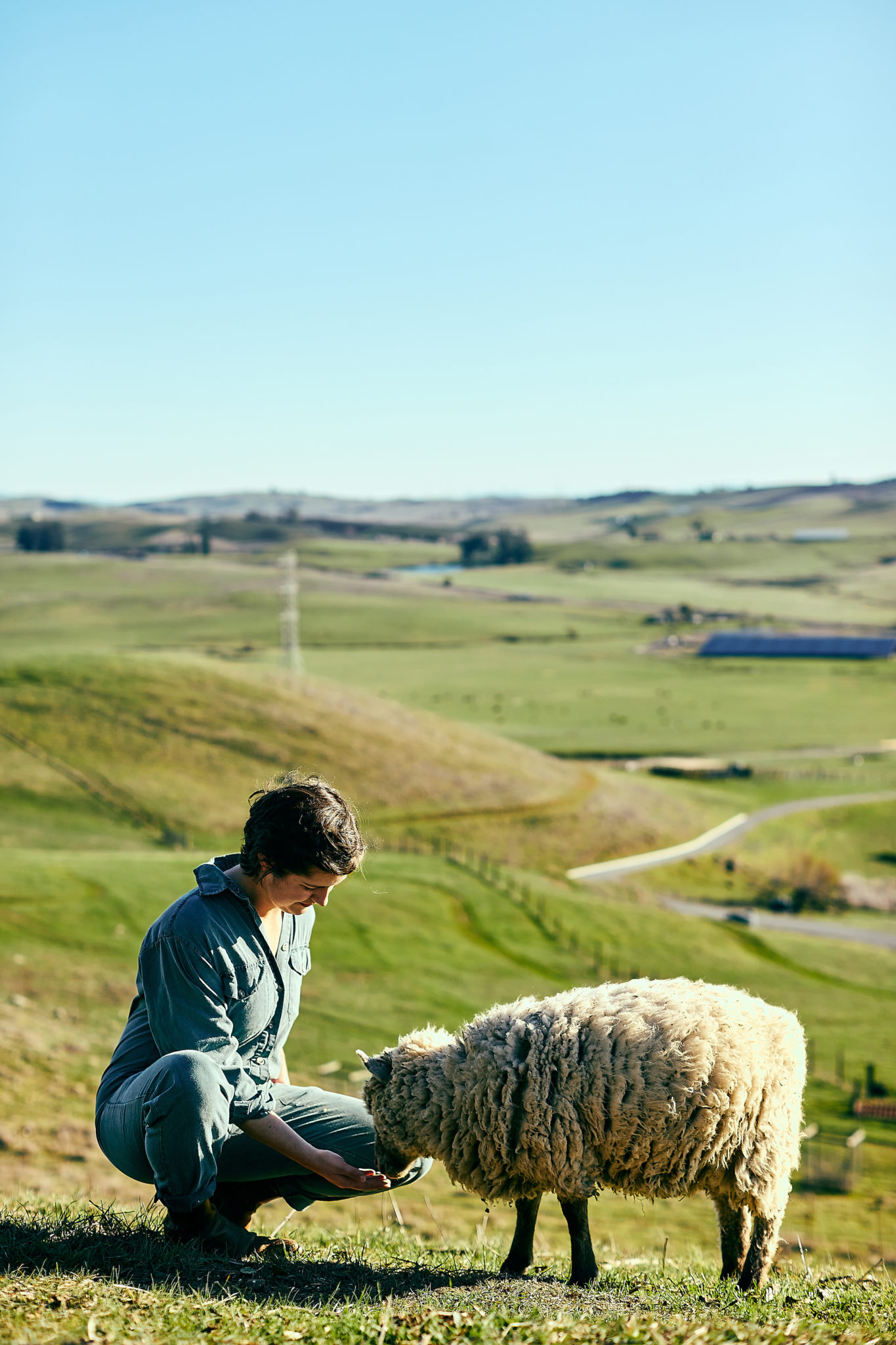
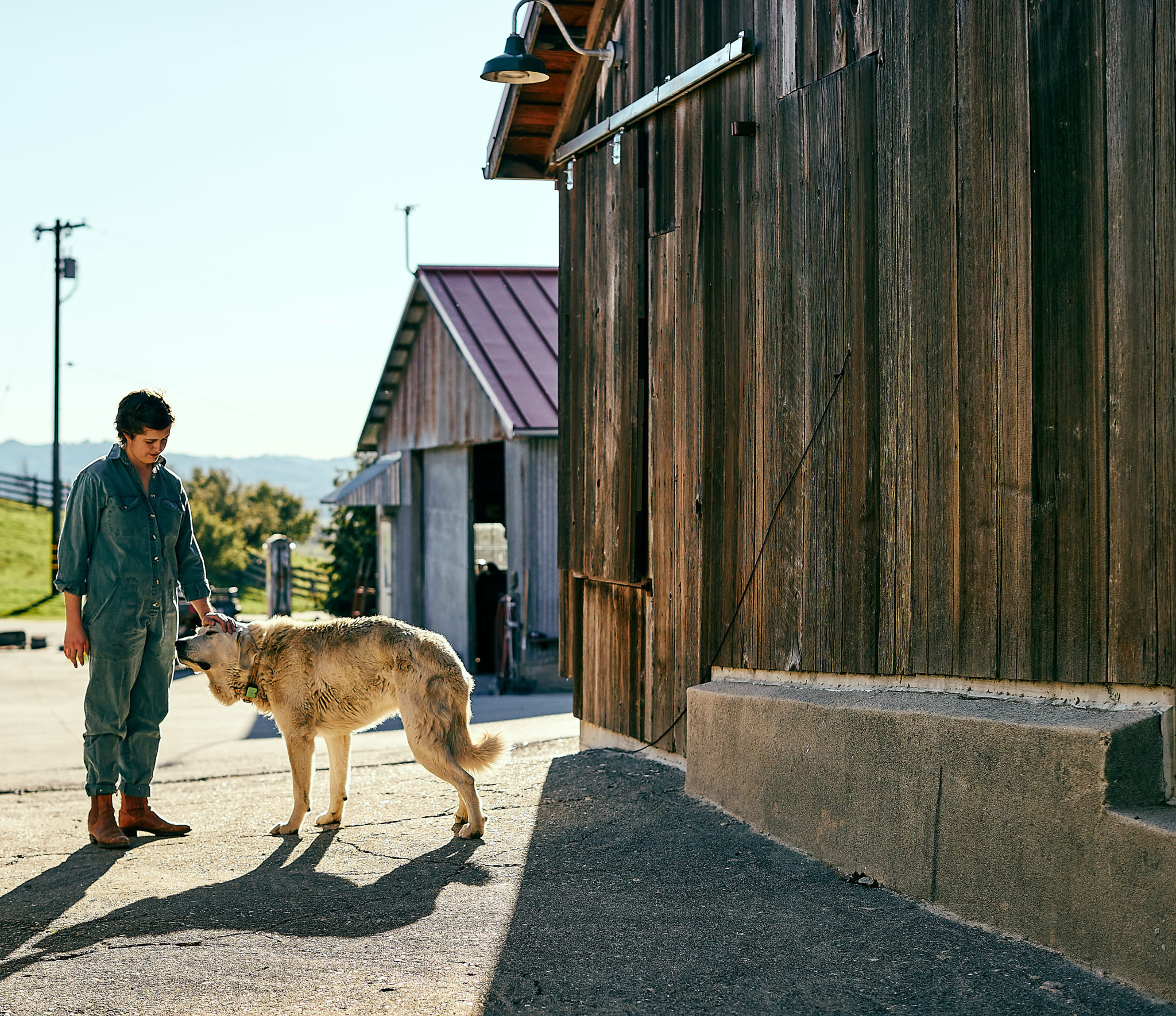
Avery with an orphan lamb, now grown, who was raised and bottle-fed by hand last spring. (Kim Carroll)Elderly dog Guy helps guard the livestock. (Kim Carroll)
The grandchild of philanthropist Warren Hellman, who founded the Hardly Strictly Bluegrass festival, Avery tells these stories both in music and through a podcast, “Where the World Begins,” that brings home truths of rural Sonoma life, including interviews, thoughts on sustainable land use, even questions of identity and character.
“I felt like rural stories were not always fully represented, and even sometimes misrepresented,” explains Avery. “I wanted to affirm this way of living. I don’t think that the people who make our art and our music come from just two cities on the coast. I just don’t see it that way.”
To Avery, the land is a living character in their creative work, and so too are the many animals that live upon it. On the property are five horses, a pair of mini donkeys, dozens of sheep (both babydoll Southdowns and a rare breed raised by the Navajo for wool to weave rugs), 14 cattle, flocks of chickens and guinea hens, and “loads of dogs” including Guy, a grizzled and loveable Great Pyrenees mix who helps guard the livestock.
Avery, who has been riding since they were a kid and has a rescue mustang in training for some barrel racing later this summer, says horses have a lot to teach about humanity: “They’re such a great mirror for people. If they’re not willing, if they’re not learning why you’re asking them to do something, then you’re asking wrong. You have the responsibility to think it through and try to find an alternative path.”
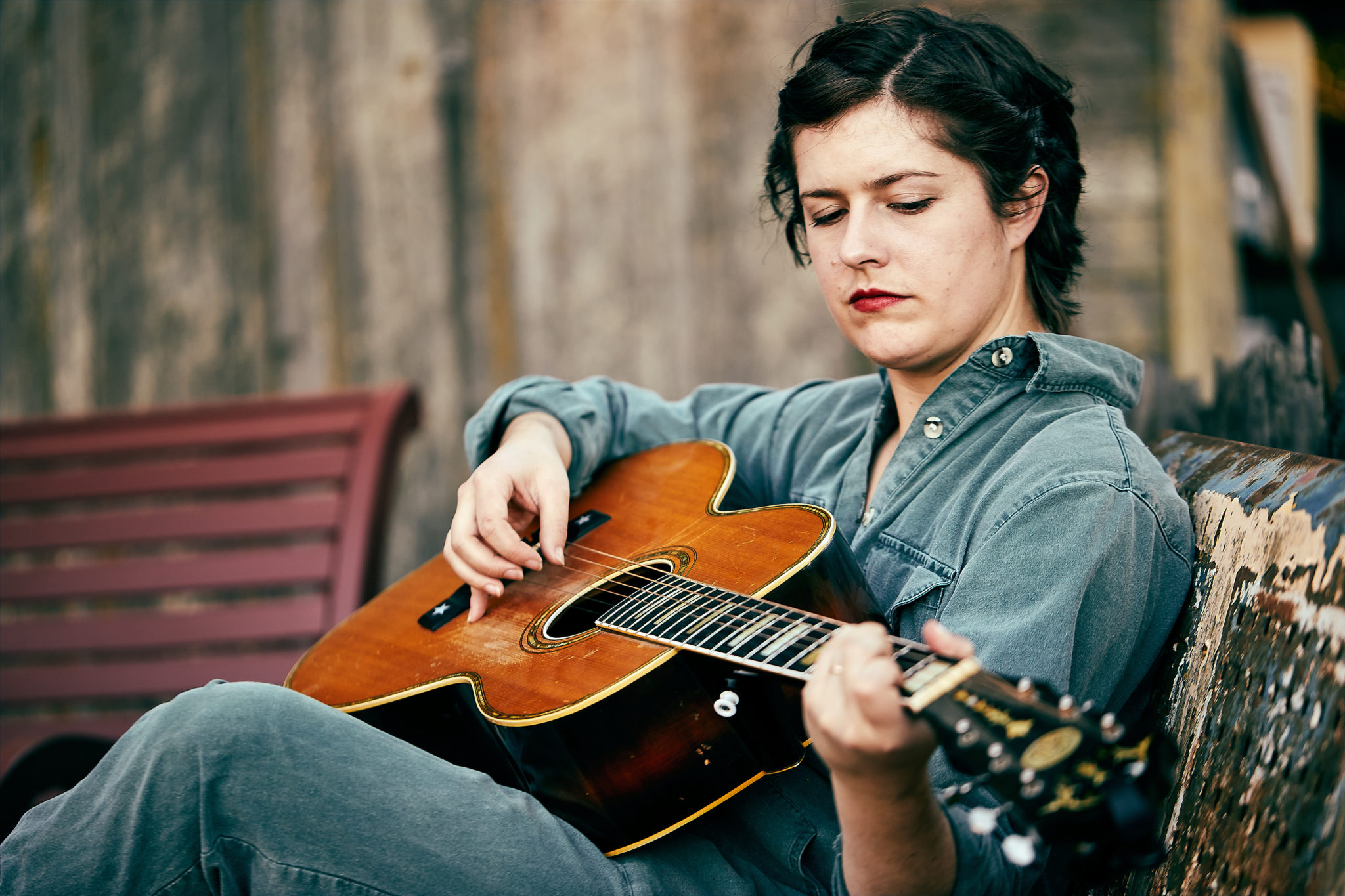
Avery plays a 1930s-era Oahu guitar with abalone shell inlays. (Kim Carroll)
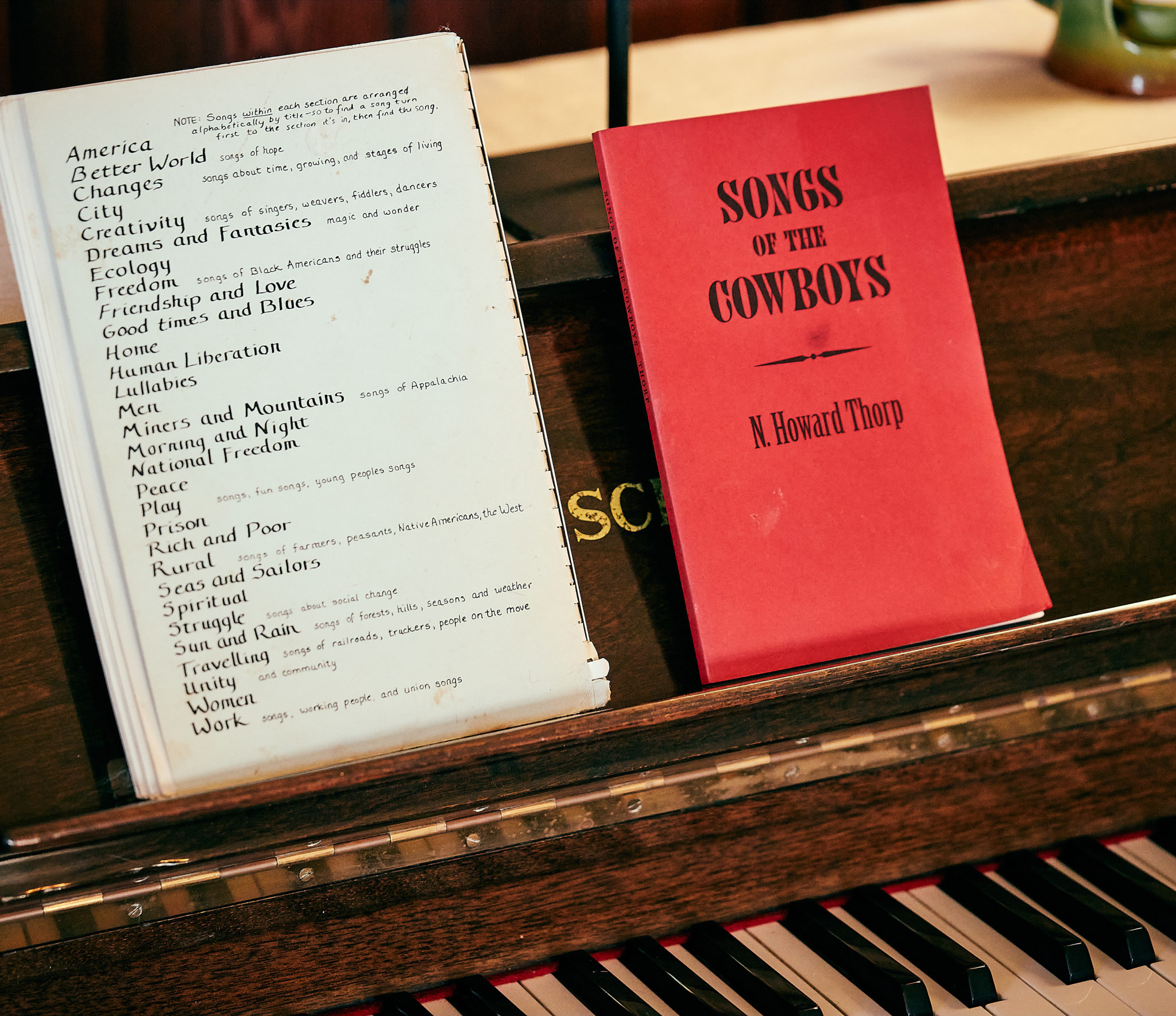
Vintage songbooks on the piano. (Kim Carroll)
Spring on the ranch, says Avery, is an inspiring time for both people and animals, a time of massive expansion. “The sheep and cattle have so much to eat, with all of the new grass, and you feel so hopeful about all of the resources the land has to give. It just feels infinite.” Avery forages for miner’s lettuce, which grows widely, while wildflowers—storksbill, poppies, lupines, even wild campanula—blanket the ranch’s steep, hillside pastures. And there are winter greens on offer in the garden, though it’s still a bit of a leaner time, as heat-loving tomatoes and peppers haven’t yet gotten going.
And, of course, now is also lambing time, the fourth season they’ve welcomed spring babies at the ranch. It can be busy, says Avery, especially if there are orphans needing to be bottle-fed three times a night, as there were last spring. “Seeing the baby animals be born, and their resilience, is pretty remarkable. It’s just so much fun to be around. The funniest thing is they’ll go to the pasture when they’re a week old, and instead of staying with their parents, they’ll group together and run and jump all around as a crew.”
Avery views the property as playing a role in modeling sustainable land use, calling upon the knowledge of longtime ranching neighbors and local groups like the Sonoma Mountain Institute and the Sonoma Ecology Center. They’re involved in researching new methods of grazing cattle and sheep to help pastures become more resilient, and they’ve invited these environmental organizations to the property to help restore waterways and conduct bird population surveys. Ones they see often—red-tailed hawks, Cooper’s hawks, American kestrels, white-tailed kites—are indicator species whose presence gives clues to the overall health of the landscape.
For Avery and Andy, each day’s creative projects—songwriting and rehearsing or perhaps working on a video or podcast project—are punctuated by calls to tend to chores with the animals and the garden. The two artists constantly feel the pull of the landscape — always inspiring but at times unforgiving — a feeling that takes a deep hold in their work. As the sun sets, there’s time to circle back from work and pause for reflection. “I’ll go on a walk with my partner and the dogs in the afternoon, after most of the day’s work is done, as the sun is setting,” says Avery. “And it’s a time when you can just enjoy what spring has to offer, with that mixture of the moisture and the rain, and the work.”
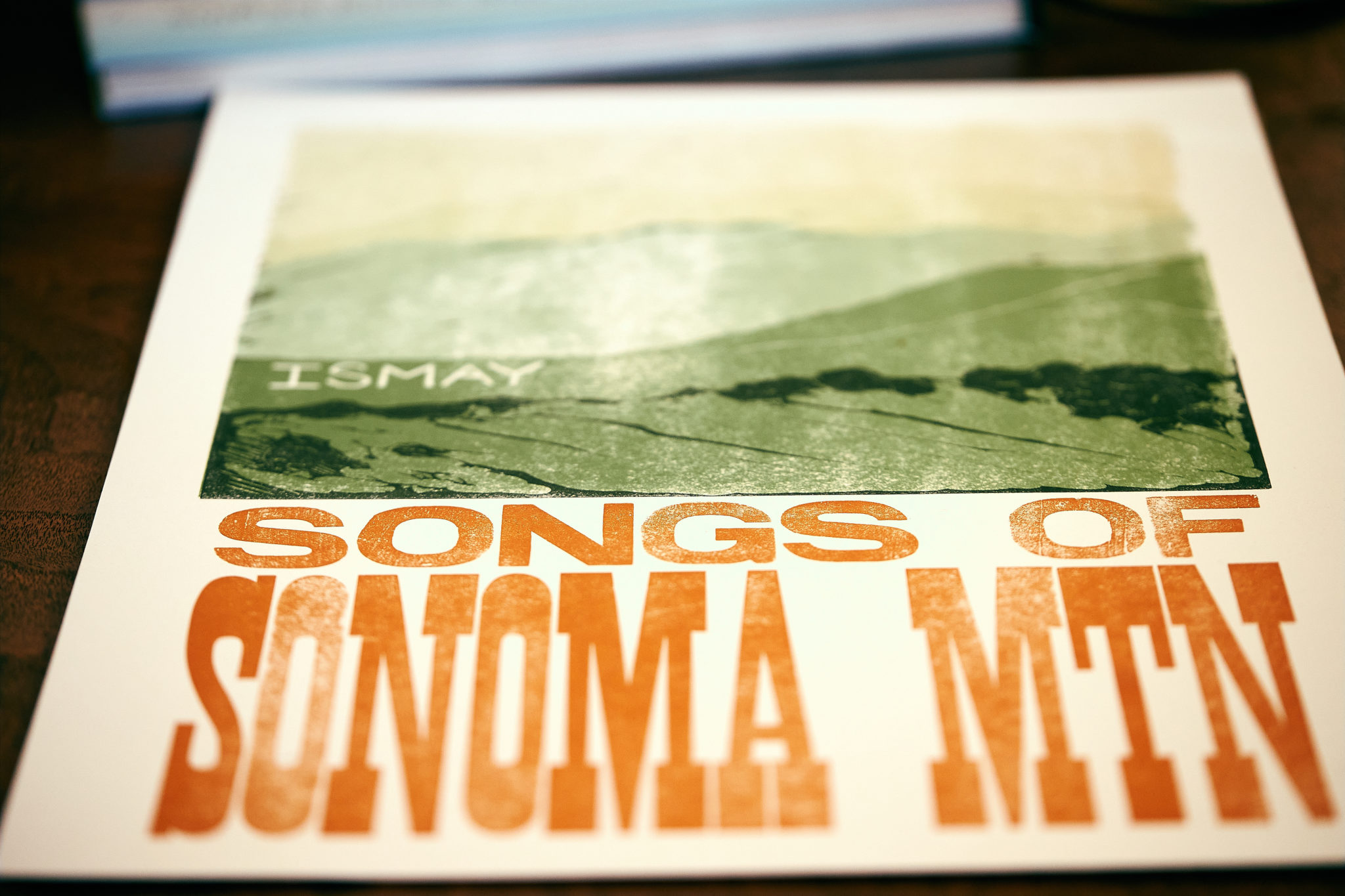
A letterpress poster for Avery’s latest album. (Kim Carroll)
Stories and songs of Sonoma Mountain
Avery Hellman has been interested in audio storytelling since high school, when they created a senior project inspired by the storytelling on the radio show “This American Life.” Their new podcast, “Where the World Begins,” is about the connection people make with the land, with stories set on Sonoma Mountain and interlaced with Hellman’s own music as well as delicate soundscapes they recorded at the ranch.
Avery comes from a musical family. Their grandfather was a bluegrass banjo player, and their father is a drummer whose band often rehearses at the ranch. Avery retreats to the large sheep barn for songwriting sessions and keeps a studio in one of the other outbuildings, where they spent a few months making a stop-motion video for one of the songs on their new album, “Songs of Sonoma Mountain.”
To listen to episodes of their Sonoma Mountain podcast, “Where the World Begins,” or to find their album “Songs of Sonoma Mountain,” which was named one of the Bay Area’s top ten albums of 2020 by KQED Arts, visit www.ismaymusic.com.
As Sonoma County continues to ease pandemic restrictions and Wine Country reopens, local wineries are thrilled to finally be able to offer a wider variety of in-person tasting experiences to their guests. And wine lovers have reason to be excited, too. In addition to finally being able to enjoy their favorite wines from someplace other than their homes, they have a variety of new food and wine pairings to look forward to. Click through the above gallery to see what some of our favorite wineries are serving up right now.
Mike Kopetsky is a landscape designer and owner of MIX Garden in Healdsburg. (Christopher Chung/ The Press Democrat)
As many of us realized last year, growing our own food provides a sense of control and safety in a world that sometimes seems to lack both. Planting, watering, weeding, and processing home-grown vegetables brings peace and purpose by renewing our connection to nature.
Mick Kopetsky, a lifelong plantsman and the owner of MIX Garden in Healdsburg, expects another busy spring this year. His nursery grows veggie starts at an off-site facility in Dry Creek Valley, cultivating some 300 varieties of vegetables throughout the season including many rarities — and 88 types of tomatoes. “It’s pretty intense in that mid-April timeframe,” Kopetsky says. “It gets crazy how many plants go out and how many plants have to come in.”
6:30 a.m.
The first thing our staff does in the morning is check on our plants, seeing what’s in stock and what’s out of stock. Based on that first walk-through, we drive out to our off-site facility in Dry Creek Valley — we call it “the farm” — and pull from the stock out there and load it up. Those trips tend to be 30 to 50 flats a day during the spring. The farm is also where our olive trees are, so that’s where we get the store’s olive oil. And we grow ornamental and edible squashes and pumpkins for the fall out there.
7:45 a.m.
Back at the store, there’s a morning meeting to assess priorities. At 8:00, the store opens, and the staff greet the first rush of customers, mostly residential gardeners shopping for plants. It’s amazing how many people have started gardening during the pandemic and want to grow a little food. We’re really well positioned to support that.
8:45 a.m.
We return with the plants from the farm and proceed to unload as well as “front” and “groom” the stock, pulling plants to the front of the flats, taking off yellow leaves, inspecting everything, doing remedial staking of plants that might be tipping over, just getting the place looking really crisp. It’s kind of an allhands- on-deck situation.
11 a.m.
We receive a delivery of a curated assortment of indoor ornamental plants. We unload them, check them in, tag them, and arrange them around the store however they look best. We’ve also just recently started importing terra-cotta pots from Italy, and we have our own line of organic seeds.
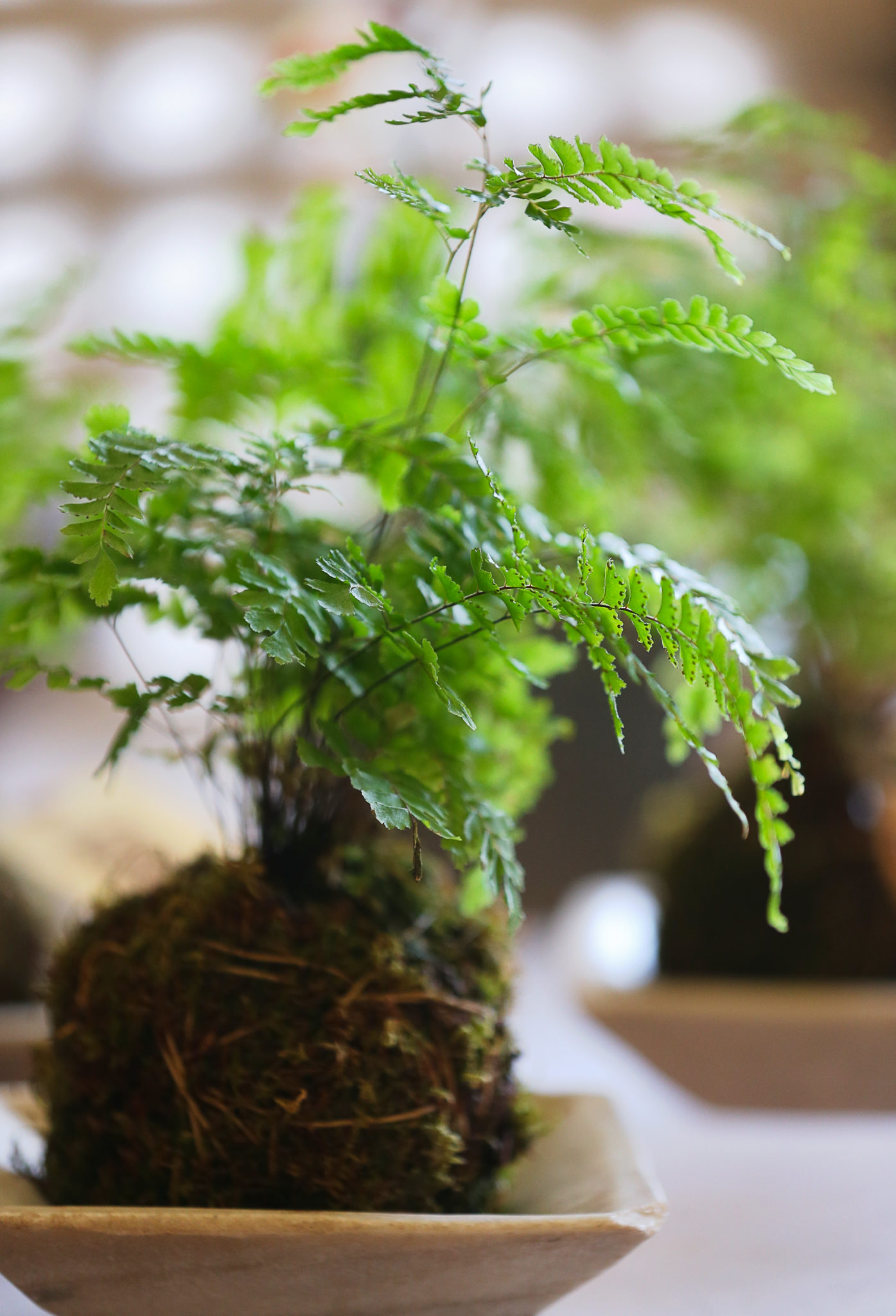
A kokedama for sale at MIX Garden in Healdsburg. (Christopher Chung / The Press Democrat)
12 p.m.
I tend to go home for lunch because I’m so into food, and I live just two minutes from work. For lunch, it’s mostly salads and sandwiches, or I’ll roast vegetables the day before and have that with a little piece of grilled meat or something.
I love vegetables — it’s probably why I do what I do. I have a quarter-acre of vegetables of my own out at the farm where we grow our nursery stock. If I’m going out for lunch, I love the farro salad with vegetables at Campo Fina. We used to farm produce as well as veggie starts, and the restaurant was our biggest customer — we used to sell them an immense amount of produce.
3 p.m.
Midday during the week, most of our customers are contractors. During the second half of the afternoon, we tend to get home gardeners back again. Around this time, we may also restock plants, and I may place an order for another delivery of ornamental plants.
5 p.m.
At the end of the day, it’s just closing things down, making sure everything got watered, and locking up the carts. Then we head home and get ready to return the next morning.
Evening
Honestly, I generally like just hanging out with a friend and making some food together. The thing about Sonoma County, of course, is we live in this amazing climate and this beautiful spot, so it’s good to enjoy that.
Colorful flowers bloom at MIX Garden in Healdsburg. (Christopher Chung / The Press Democrat)
What’s growing this spring
Mick Kopetsky says he’s seen a ton of interest from Sonoma residents looking to start a small cutting garden for flowers to bring into their homes — cosmos, sunflowers, and zinnias are especially popular.
Tomatoes, of course, are also a mainstay. Kopetsky currently loves “Red Pear,” a meaty tomato that’s great for making sauce and paste, and several types of pink tomatoes, including “Caspian Pink” and “Pink Berkeley Tie-Dye,” both of which he says have a wonderful flavor.
MIX Garden is known for its vigorous vegetable starts, which Kopetsky says comes from an approach that works from the soil up. He uses a special potting mix that contains beneficial mycorrhizae, tiny fungi which help plants’ roots absorb more water and nutrients from the soil. “Twenty years ago, people didn’t even know about mycorrhizae,” he says. “They’re an amazing vehicle for boosting plants’ health and productivity.” But in all honesty, he says, home gardeners shouldn’t worry too much about a less-thanideal set of veggie starts in spring.
“The truth is that no matter how terrible your starts might look, with a little bit of organic fertilizer, they’ll do just fine.”
Cheese, it is said, is milk’s leap toward immortality. As true as that may be, butter takes it at least halfway there. Butter was discovered, not invented: a container of raw milk, carried by horse or a rickety cart over a bumpy road, turns itself into butter, as it is the simple process of agitation that causes the cream to separate and solidify.
In Sonoma County’s earliest years, dairy farmers made their living by selling butter, not milk, because of the lack of refrigeration needed to distribute fresh milk. The whey, sometimes called buttermilk, was fed to other farm animals, especially pigs.
Butter concentrates milk’s flavors, and its character depends on what the cows, sheep, or goats eat. Animals that graze on fresh grass produce the richest, most nutritious, and most delicious milk. It is a gift of sunlight, captured by tender blades of spring grass.
Sonoma currently has three commercial butter producers: Clover Sonoma, Straus Family Creamery, and Petaluma Creamery. Local butter is truly one of our sweetest, freshest treasures in spring.
Butter Mochi
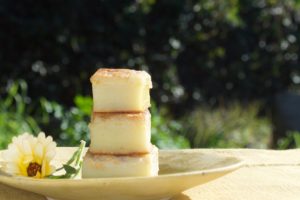
Makes about 24 squares Butter mochi highlights the voluptuous texture of spring butter better than almost any other sweet, and it is very easy to make at home. It’s also naturally gluten-free.
• 2 teaspoons butter, at room temperature, to line baking pan
•1 pound mochiko (sweet rice flour)
• 2 ½ cups granulated sugar
• 2 teaspoons baking powder
• 1 teaspoon kosher salt
• 2 12-ounce cans full-fat coconut milk
• 5 large farm eggs, well beaten
• 4 ounces local butter, melted
• 1 teaspoon vanilla
Preheat the oven to 350 degrees.
Cut a sheet of parchment or wax paper to fit the bottom of a 9 x 13-inch baking pan and secure it in place with a dab of butter. Lightly coat the paper as well as the sides and corners of the pan with butter.
Put the mochiko, sugar, baking powder, and salt in a medium mixing bowl and stir with a fork to blend well.
Put the coconut milk into another medium mixing bowl and whisk until smooth. Add the beaten eggs, and whisk together. Add the melted butter and vanilla, mix thoroughly, and add the dry ingredients, whisking or mixing with an electric mixer until very smooth.
Pour the batter into the prepared pan, set on the middle rack of the oven, and bake until the mixture is set but not too firm, about 1 to 1 ¼ hours. The mochi should have a golden crust over the top. Remove from the oven and cool until you can handle the pan. Invert the butter mochi onto a wire rack, remove the parchment paper, invert onto a work surface, and slide back onto the rack.
Let cool to room temperature, cut into squares, and arrange on a platter. Enjoy right away or refrigerate, covered, until 30 minutes before serving. Butter mochi will keep refrigerated for about three days.
After nearly losing their fledgling truffle business during the pandemic, two former French Laundry chefs recently charmed billionaire Mark Cuban into investing $501,000 in their revamped cooking class and meal kit concept — which, of course, includes plenty of truffles.
Tyler Vorce and Jason McKinney, who starred on a recent episode of ABC’s reality show “Shark Tank,” are the owners of Bay Area-based Truffle Shuffle, along with McKinney’s wife, Sarah, who also worked at the Michelin-starred Yountville restaurant. “Shark Tank” introduces budding entrepreneurs to multimillionaire and billionaire tycoons, “sharks,” who are willing to invest in the entrepreneurs’ businesses in exchange for equity — if they are sufficiently impressed by their pitches.
The two Truffle Shuffle business partners spent months rehearsing their pitch to the “Shark Tank” investors before participating on the show. Once they were on the show, they got several nibbles. But it was Cuban who ultimately offered the $501,000 loan in exchange for an 18% stake in the company.
Vorce and the McKinneys launched their business in 2018 as a way for chefs to ethically source truffles from Italy. Things were off to a good start until March 2020, when all of their restaurant accounts dried up and the team was left with 20 pounds of highly perishable truffles worth $1,000 per pound, according to Jason McKinney.
A serendipitous request from a private club for an online cooking class, featuring home-delivered ingredients for truffle risotto, turned things around. The online event sold out in a few hours and so did Truffle Shuffle’s entire inventory.
In a daring move, the company began pivoting to weekly online cooking master classes with meal prep kits sent in advance. At around $99 per class, they soon became popular; Sarah McKinney said they’ve cooked in front of more than 100,000 viewers since last year. (You can watch the classes for free on Instagram or on Truffle Shuffle’s YouTube channel.)
The pivot paid off. Shuffle Truffle now employs more than 40 people who work out of the company’s new Oakland headquarters. Their virtual cooking classes are hosted by special guests such as Snoop Dogg.
Truffle Shuffle has a number of upcoming classes planned, including one on how to make the Crepes Suzette shown on “Shark Tank,” Spiced Lamb Loin and Kurabota Pork Belly. On-demand classes ship out ingredients for Black Truffle Risotto, Lemon Ricotta Gnocchi and a Truffle Cheese Board with cheeses from Cowgirl Creamery and Cypress Grove along with their Truffle Honey.
Two kinetic sculptures designed by artist Ned Kahn to move in the wind in the temporary “Air Garden” on the site of the future Hotel Sebastopol on Friday, December 11, 2020. (John Burgess/The Press Democrat)
Ned Kahn’s uniquely engineered kinetic artwork — all hinged squares, flapping chain mail, patterns, and shapes — is displayed in public places around the globe and someday soon it could fly aboard the International Space Station. Though usually constructed on a grand scale — resulting in huge, reflective expanses that respond to wind and shifting air currents — Khan’s latest endeavor treats his Sebastopol neighbors to a temporary collection of smaller pieces right downtown, on Depot Street.
On the site of the future Hotel Sebastopol, artist and MacArthur genius grant winner Ned Kahn has created a kinetic installation called the “Air Garden.”
Kahn and his “trusty right arm,” Santa Rosa artist and ceramicist Todd Barricklow, erected the sculptures on the future site of Hotel Sebastopol — a development project currently on hold because of the pandemic. Kahn and Barricklow are calling the 1¼-acre area the “Air Garden,” a tribute to Kahn’s fascination with structures that make air visible — and, he hopes, render it more vibrant in the consciousness of those who see his work.
The sculpture garden is temporarily enclosed by a chain-link fence, for safety and security reasons, but Kahn hopes there will soon be opportunities to invite the public to experience the work up close. And when his crew is done moving heavy equipment and cranes around the lot, he plans to seed native grasses and flowering plants, creating “a little oasis of nature, kind of embedded in the heart of the town.”
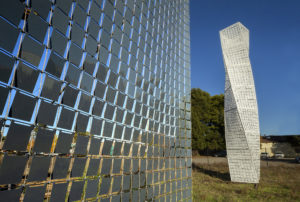
Looking upward through a 30-foot “Twisted Tower” covered in laser cut teflon squares designed to move in the wind in a temporary “Air Garden” created by artist Ned Kahn on the site of the future Hotel Sebastopol. (John Burgess/The Press Democrat)
Already there’s a 30-foot twisting tower of white Teflon pieces, a large “wind hammock” stretching 44 feet across, a series of sunset-colored panels, and a suspended circular piece that looks like a dream catcher. Passersby “have been so nice,” says Kahn. “That’s been probably the funnest part of the whole thing. All the feedback has been super positive.”
Kahn, who was named a MacArthur Fellow in 2003 (winning what’s commonly known as the “genius grant”) is best known for huge, shimmering arrays of metal and other materials set in motion by the air. He wants to do more than make strikingly vivid artwork, however. He hopes to inspire love for the air that animates it.
His work has always shown a fascination with physics and movement — the ways in which fog and light, sand, or even seeds can be coaxed and manipulated into intriguing scenes of beauty. “If you could alter people’s sense of stewardship and love for the Earth and the atmosphere and the air, then maybe you could change the way they feel about the air. Because the air, being invisible, it’s so easy to forget about it,” explains Kahn. Make it visible, he says, and people will remember.
“I guess my hope — and maybe it’s just a fantasy — is that some small number of people, when they see the air, how beautiful it is, it will shift their thinking, their relationship with the air and kind of fall in love… You love your kids so much you would do anything for your kids. If you had that same feeling, or even a trace of it, for the air …” he says, his voice trailing off.
Mom may have told you she has everything she needs, but was she thinking about spectacular geode coasters when she said that? This Mother’s Day, give her that little thing of beauty she didn’t know she wanted or needed — a visit to a few Sonoma County boutiques might reveal just the perfect gift. Of course, that doesn’t get you off the hook for spending the gift of time together. But as far as giving things goes, here’s a list of some of our favorites, all under $100. Click through the above gallery for details.