
How to Embrace the Mushroom Food Trend in Sonoma County

To hear Occidental mushroom specialist Wyatt Bryson tell it, if we really embraced the marvelous mycelium growing all around us, we could save the world.

It’s a lofty idea, perhaps, for the self-taught mycologist who seven years ago decided to dig deep into the magic of mushrooms. Yet he and many other local mushroom experts are increasingly sharing this message: Fungi are delicious, but also exceptionally nutritious, naturally medicinal, and excellent for the environment.

[Want to pick mushrooms? We’ve got you covered with expert guides and secret shroom spots]

As mushroom season swings into full gear during Sonoma County’s winter-spring rainy weather, it’s a perfect time to explore why fungi are emerging from the underground, and becoming an increasingly celebrated food. Whether you forage your own from the forest or shop at a store, the expanding array of specialty mushrooms available here is impressive.

America, actually, is a bit late catching the trend — even in the abundant food shed and mushroom-perfect landscape that is Sonoma County. Other countries around the world have long recognized the benefits. East Asia cherishes shiitakes, for example, believing they may help fight cancer, boost immunity, and support heart health with their abundance of polysaccharides, terpenoids, sterols, and lipids.

The low-calorie superfoods contain many of the same essential amino acids as meat, and offer fiber plus many vitamins and minerals.

“I have witnessed a recent explosion of mushroom interest since I began my fungal pursuits some 50 years ago,” says David Campbell, an expert mycologist who leads the Wild About Mushroom Co. foraging group out of Healdsburg. “Our American culture is emerging from the darkness of mycophobia, moving towards an attitude of mycophilia, long enjoyed by most other cultures on this planet. I like to remind folks that we are just catching up to the rest of the world, but more people are interested in more mushrooms, day by day, year by year.”

For the 2018 Global Wellness Summit trends report released last January, mushrooms led the list of hot topics, in their pure form and also as mushroom-infused products in coming years, the summit leaders predicted, as powders, lattes, cocoas, chocolate, broths, oils, teas, and even beauty products.

Consider Bryson, who, along with his brother, Hunter Bryson, opened Jewels of the Forest in Sebastopol in June 2017 as a retail and production shop for their all-natural mushroom jerky. Here, they wash organic oyster mushrooms, then marinate them in sauces like sesame-soy-garlic, or sweet chile with cane sugar, soy sauce, red pepper flakes, and garlic. Next, they’re dried in a commercial dehydrator so heavy it had to be rolled into the kitchen on pipes, Egyptian style. The result is tasty, healthy, vegan, and organic.

Already, their jerky is sold in some 150 stores across the country, and the duo is testing recipes for new flavors such as Thai coconut curry and teriyaki. They also stock other items in their store, including organic yerba mate blended with chaga and turkey tail mushrooms — both varieties that have traditionally been used as medicines in Asian and Native American cultures. The tea is made by The Chaga Company in San Francisco.

“We started our sales mainly by word of mouth, and getting people to try the jerky,” Bryson says. “But mushrooms are suddenly popular, as people understand their health and nutritional benefits. They’re an excellent alternative protein.”

Another mushroom jerky company, Sporgy, debuted last year, too, with owners and husband-and-wife team Adam Alexander and Carlee Leonhard showcasing smoked, marinated maitakes in flavors like barbecue, wine-thyme, and Mexican mole. The Healdsburg-crafted snacks can be found at farmers markets in Healdsburg, Windsor, Cloverdale, Santa Rosa, and Sebastopol, plus shops like Shelton’s Natural Foods and Jimtown Store.

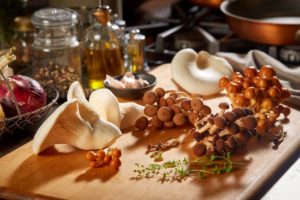
Unlike the sometimes boring button mushroom, boutique mushrooms are often particularly delicious, which certainly helps the craze. That’s just one of the reasons that Mycopia in Sebastopol has seen at least 20 percent sales growth each year over the past seven years. The farm and production facility grows seven mushroom varieties under its Gourmet Mushrooms label, including alba clamshell, brown clamshell, forest nameko, trumpet royale, velvet pioppini, maitake frondosa, and nebrodini bianco.

In business since 1977, Mycopia was considered an oddity when it first debuted, says sales and marketing director Justin Reyes. Founders David Law and Malcom Clark started cultivating fungi on a former chicken ranch, then grew the business as Clark explored the world in search of more exotic mushrooms.

“For a while, we were thought to be on the fringe, but the boutique varieties are hot right now, as opposed to the more common button mushrooms we grew up with,” says Reyes. “That’s partly because the concept of food as medicine is growing across the nation, with clinical trials showing maitakes, for example, as having good potential for anti-cancer properties.”

Exotic mushrooms are also mouthwatering alternatives to meat, for today’s increasingly plant-based diets. Reyes favors sautéed maitakes in tacos, king trumpets butter-seared like scallops or Cuisinart-chopped for a crab substitute, and forest nameko as a miso soup base, lending velvety texture from its natural protein gel.

The Mushroom Council U.S. organization has done taste tests with schoolchildren, too, for full-beef burgers, or burgers mixed half-and-half with ground mushrooms. The consensus: the mushroom blend wins, credited with extra juiciness and umami.

It’s encouraging to see palates savoring the bolder flavors and textures, Reyes notes. “It’s definitely the year of the mushroom,” he says. “America’s just late to the game, since even today, only 5 percent of U.S. sales are specialty mushrooms, while for the rest of the world, it’s 85 percent.”

Mycopia now occupies a 60,000-square-foot facility next to Merry Edwards Winery on Gravenstein Highway, and produces about 1 million pounds a year, plus another 3 million pounds from a second farm in Michigan. The company is one of only two operations in the country that grows mushrooms on purified natural compost in innovative, recyclable plastic pots. The method helps limit water use to an earth-friendly 8 to 10 gallons per pound, a remarkable consideration compared to the 1,500 gallons per pound for beef, notes Reyes. The ultra-rich compost, too, is returned to the soil, nourishing the earth.

Most Mycopia sales go to chefs and upscale markets like Oliver’s, but the public is welcome to visit the farm every Friday from 1 to 3 p.m. to direct-purchase bulk mushrooms. Customers can also purchase gift baskets and educational mushroom kits for at-home growing.

As for changing the world, the Bryson brothers also operate a research laboratory called Mycolab Solutions on their family farm in Occidental, and are currently developing a mushroom-based program with a food relief group in Cambodia. It makes sense, Bryson says, since boutique mushrooms are such nutritional powerhouses and generally easy to grow. His jerky, in particular, boasts a 12-month shelf life. “At our first-ever sales event in Occidental, we sold out within an hour,” he recalls. “We’ll just keep making more.”
Canned Wine and Cocktails Is a Hot Trend in Sonoma County

After decades of being the laughingstock of wine and spirits drinkers, cans are suddenly having a moment.

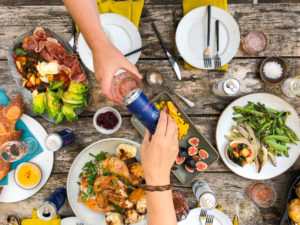
Portable, inconspicuous, single-serving-sized, and eco-friendly, there are some surprisingly delicious adult beverages pop-topping their way into our refrigerators and picnic baskets as well as appearing on some pretty swanky restaurant beverage lists. Click through the above gallery for a few of our local favorites.

Kendall-Jackson Culinary Team Releases Cookbook with Seasonal Recipes

Jess Jackson, the late founder of Jackson Family Wines, had a thing about carrots.

As a child growing up in Depression-era Northern California, the story goes, he watched a neighbor pluck a fresh carrot from the soil. When the neighbor gave him a taste, Jackson had an epiphany, making an indelible connection between the earth’s bounty and harvest as the time to fully take advantage of it. This understanding informed his devotion to instilling a sense of time and place in his wines, and it’s continued to inspire the Jackson Family Wines culinary dream team behind the recently released “Season: Wine Country Food, Farming and Friends” (Cameron, 2018).

Structured around seasonal recipes and the year-round growing cycle of Wine Country, the cookbook follows the threads between farm and ranch, kitchen and well-paired wines. What keeps it from being a stuffy tome is the charm of its central characters — Justin, Tracey, Buttercup, and Farmer T — whose side notes and “True Confessions” on each recipe are as personal as their longtime friendships. “My favorite way to serve caviar is with crème fraîche and chives on low-sodium Pringles. Try it before you judge,” writes co-author and executive chef Justin Wangler alongside the recipe for blini with caviar.

But why a cookbook?

As part of the Kendall-Jackson culinary team led by Wangler, fellow chef and co-author Tracey Shepos Cenami, estate farmer Tucker Taylor (aka Farmer T), and pastry chef Robert “Buttercup” Nieto serve thousands of meals at public and private winery events and five-course tasting menus daily in the restaurant.

“People who visit us are always asking for recipes, they’re enthralled with how we cook,” says Shepos Cenami. As a longtime Sonoma County chef, she knows just about every farmer, cheesemaker, and producer within 100 miles. “We want this to … inspire them to go to local farm markets or even grow their own food,” she says. “Not everyone has the gardens we have, but everyone can get a taste of that.”

The recipes can be ambitious, requiring things like verjus, finishing salts, or sunchokes and referring to Liberty Duck Leg Confit as a “basic.” The K-J team has ready access to the best ingredients in the world and for them, sorrel aioli is a pretty simple recipe. But that’s also a Sonoma idyll — a vision of vineyard farm tables where women in gauzy dresses eat nasturtium leaf salad with local goat cheese in the summer sun. Tuna casserole in the microwave we ain’t.

An ode to all that we take for granted, consider “Seasons” a kitchen challenge or simply an expression of the best that Wine Country has to offer, 365 days of the year. You’ll be satiated either way.

Downtown Santa Rosa Brewpub First 2019 Closure

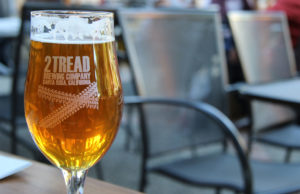
2 Tread Brewing Company opens a craft brew and pub with a large patio where you can ride up on your bike for a pint. Heather Irwin/PD

Downtown Santa Rosa’s 2 Tread Brewing has served its last beer according to co-owner Bill Drury. The restaurant is shuttered as of Jan. 9.

“Thank you to all that supported us over the last year. We had wedding parties, a number of 21st birthday parties, retirement parties, even a marriage proposal. We’ll miss you all,” said Drury.

It hasn’t been an easy road for the 6,000 square foot brewpub, which opened just three weeks before fires ravaged Sonoma County in 2017.

Adding to the rocky start was an already saturated brewpub scene in downtown Santa Rosa (six at the time), extensive construction delays, and most notably the brewpub had to open without, well, any of its own brew.

It took more than two months for the spot to be able to pour their own much-anticipated amber ales and IPAs, and by then folks were more concerned with rebuilding than celebrating.

The patio at 2 Tread Brewing Company opens a craft brew and pub with a large patio where you can ride up on your bike for a pint. Heather Irwin/PD

Despite all that, the food was solid as was the massive patio — which always left me wondering why the spot seemed so quiet even on warm summer days.

Drury maintains that the fires were the main cause of the closure and that they were never able to recover afterward.  They’re hardly alone. Many restaurants in the region have seen revenue dips of between 20 and 35 percent since the fires, especially in areas where homes were lost. Though December is typically a boon, slow winter months can be a death knell for struggling businesses.

In addition, skilled restaurant workers which were hard to come by before the fires have become almost impossible to find due to housing shortages and the high cost of living.

It’s going to be a rough winter, so buckle up folks. Or better yet, hit up a restaurant or two this week.

Yes, Foie Gras is Illegal in California. Again.

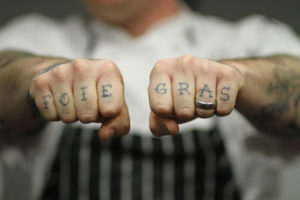
Foie gras is once again banned from California’s menus — at least technically — after the U.S. Supreme Court took a pass on weighing in on the offal situation this week. Whether or not local chefs will comply is a whole other question.

The legal battle goes like this: In 2004, foie gras was banned in California after animal rights groups protested the practice of “gavage” or force-feeding ducks to increase the size of their livers until they double or triple in size. The ban didn’t actually go into effect until 2012, when all but a handful of vocal chefs took the product off their menus.  In 2015, the ban was overturned, making it legal again. In 2017, that decision was reversed, but would not be enforced while foie gras proponents petitioned the U.S. Supreme Court. With the recent denial by the Supreme Court to rule on the case, the 2017 ban goes back into effect. At least until another appeal.

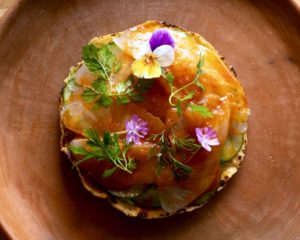
Seared foie gras with baby kiwi and almonds at Valette in Healdsburg.

But does anyone really care that much anymore? After years of verbal stone throwing between animal rights groups and chefs, the whole thing has gotten pretty convoluted and contentious. It’s also a bit of a tempest in a teapot.

Though it is hard to find many unbiased figures about how much foie gras Americans actually eat, suffice it to say we’re lightweights compared to Europeans. France, according to the Euro Foie Gras Association consumes more than 14,500 tons of the stuff annually. The Gallic consider its consumption part of their gastronomic heritage and frankly think Americans are silly for all this hubbub. Spain comes in second at 3, 240 tons, and the U.S. about 250 tons as of their 2016 figures.

Anecdotally, foie gras is a fairly rare find on local menus because of the product’s tendency to incite strong feelings. Why push it when you can surreptitiously send out a seared lobe to those on Team Foie as a “gift” and circumvent both the law and the naysayers?

It’s an ongoing battle, and one with passion on both sides. Whether you raise a glass of Sauternes to some secret foie with a nice side of pickled cherries and brioche, or you’re raising a glass of bubbly to its ban, what everyone can agree on is that the fight over foie gras isn’t over.

Why Everyone Is Freaking out About Thomas Keller’s Napa Taqueria

What happens when Thomas Keller opens a taqueria within spitting distance of the venerated French Laundry? Anyone with a fork, cellphone and blog goes nuts–and for good reason.

La Calenda opened Jan. 3 in Yountville serving an Oaxacan-inspired menu with pretty much the same stuff you might find at a neighborhood taqueria. Except it’s from the Keller Team, so they grow their own chiles, make their own tortillas (from corn, not masa), serve Rancho Gordo beans, and have a handcrafted Mexican lager specially made with California corn. So there’s that, along with the restaurant’s chef, Kaelin Ulrich Trilling who hails from Oaxaca, is the son of Mexican cookbook author and TV personality Susana Trilling, and most recently led the kitchen of Jonathan Waxman’s Bajo Sexto in Nashville. Mui cred.

But more than all that, the food just sounds amazing. The opening menu includes four of the seven legendary moles of Oaxaca, complicated, slow-cooked sauces that here include Mole Verde, Mole Chichilo, Mole Amarillo and Mole Negro. Tamales are wrapped in avocado leaves and include chicken or charred butternut squash ($6); there’s the simple queso fundito (cheese sauce, bro, $11); tacos de pollo pibili, grilled chicken in an orange-scented sauce ($11); pork jowl in Mole Verde ($22); or churros with dulce de leche ($9). For the kids, $10 gets you a chicken tostada or cheese quesadilla with rice pudding or ice cream.

La Calena has a full bar specializing in tequilia, mezcal, beer and wine.

There are no reservations taken, and the word is out, so expect a wait if you stop by the former Hurley’s in the heart of Yountville. Hours are Tuesday through Saturday from 5p.m. to 11p.m., 6518 Washington St., Yountville, details online at lacalendamex.com.

The Queen of Fruits Gets the Royal Treatment at Forestville Farm

There is something indescribably regal about olive oil. From its golden hue and luxurious texture to its revered usage through millennia, the oil of this humble Mediterranean fruit has anointed a thousand kings and lit the lamps of humanity.

It also happens to be pretty great on a salad.

Taking into mind both of those things, Sonoma’s Olive Queen gives the noble olive its due with a lineup of terroir-based blends that include a gently perfumed French Picholine, a zesty Spanish blend of Arbequina and Arbosana, and the bold but dignified Estate Reserve Queen’s Blend with Puglian Coratina olives.

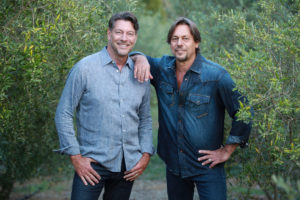
“Olives are truly the queen of fruits,” says Rob Akins, co-owner of Olive Queen, of the inspiration for the company name. He and partner Mark Berry say they fell in love with olive oil on trips to France, Spain, Greece, and Italy where they learned to appreciate the different regional styles — peppery, astringent, delicate, spicy. The couple also really wanted to revive their Forestville home’s history as a working orchard, and olive trees seemed a perfect crop.

“Our climate here turned out to be perfect for olives, with hot days and cool nights,” says Akins.

The couple obsessively studied olive farming and olive oil production, replanting their former apple orchard with dwarf olive trees. They also enlisted their neighbors to get involved. “We were the Johnny Appleseeds of our neighborhood,” says Akins, as we sit under a wood pergola overlooking his grove of olive trees just a few months from harvest.

After 15 years, Akins and Berry have 400 trees spread over three properties, resulting in about 1,000 bottles of estate-grown olive oil each year. They also source olives from nearby farms to make their blended oils.

“We treat every olive like a precious baby,” he says. Within 24 hours of harvest, the olives are cold-pressed and their oil ready to bottle.

“The Greek Yayas had it right. It’s an essential ingredient in daily life,” says Akins, who puts olive oil on pretty much everything he eats, including morning oatmeal. He prefers a lighter blend on that one. “Olive oil elevates everything you do.”

Olive Queen oils are available at local farmers markets, gourmet food shops, specialty stores, and many wineries. olivequeen.com

The Curious Case of the Healdsburg Hammer Theft

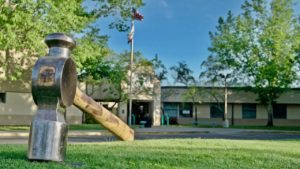
The 800-pound hammer that was stolen from the front lawn of Healdsburg’s community center. (COURTESY OF SCOTT KENEALLY)

It was the heist heard ’round the world. News of the theft of a giant hammer from the lawn of the Healdsburg Community Center last October spread swiftly, with TV stations from Boise to Boston running the story, as well as the New York Times and London’s Daily Mail. One couple told Healdsburg police officer Darryl Erkel they’d read about the (literally) grand theft in a local newspaper in Italy.

“It’s not a big story, but it has a sort of amusement factor,” muses Doug Unkrey, the ponytailed, 60-something artist/machinist/welder who created the 6-foot-tall, 21-foot-long objet.

In addition to spawning a series of hardware-themed puns (“Tools Steal Giant Hammer”; Unkrey “is offering a $1,000 reward to nail the thieves”), the incident raised awareness of, and appreciation for, the concentration of contemporary sculpture in the county. Unkrey’s “Hammer” was installed by the Voigt Family Sculpture Foundation, the nonprofit responsible for placing many such oversized, provocative, and whimsical pieces throughout the region.

“You go to a museum, you pay a fee to get in, you wander around, the guards say ‘Don’t touch,’” notes Judy Voigt, one of the foundation’s founders. “What we’ve done is put the art out where people are, so it becomes part of their daily lives.”

Until it disappears. In a commendable but futile attempt to lure “Hammer” back, anonymous locals drove a 3-foot-long nail into the grass at the community center. Onto the head of the nail was inscribed the word “Bait.”

At press time, alas, the hammer’s whereabouts remained unknown. “It’s essentially a cold case,” lamented Officer Erkel. Amused though he was by that attempt to “bait” the thieves, he would rather have the hammer than the nail.

Doug Unkrey is offering a $1,000 reward for information leading to the hammer’s recovery. Anyone with information can contact Healdsburg Police Officer Darryl Erkel at 707-431-3377 or police@ci.healdsburg.ca.us.

Sonoma Restaurants: Where to Eat Right Now

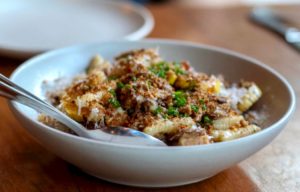
Cavatelli with Duck confit, delicata squash, roasted onion, taleggio, breadcrumb, parmigiano at Lowell’s in Sebastopol. Heather Irwin/PD

Comfort food speaks every language. Familiar, warm, and inviting, it’s what we crave in the darkness of winter. Whether your indulgence of choice is a Japanese pancake filled with mushrooms, fried chicken and biscuits, a bowl of roasted squash, or a cup of matcha, we’ve got you covered with four Sonoma County spots where you can relax and meditate about the coming year. Click through the above gallery for details and best bets.

Want to get food and wine news from Heather straight to your inbox? Sign up to our weekly Cork + Fork newsletter.

Sonoma County Serves Up Crawfish, Clam Chowder and Schnitzel in January

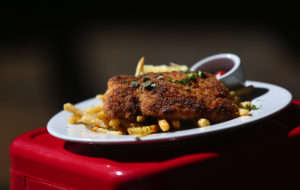
Schnitzel served on a bed of fries at Franchetti’s for Oktoberfest. (Christopher Chung/ The Press Democrat)

HAUS PARTY

Schnitzel is back for good at Franchetti’s (1229 N. Dutton Ave., Santa Rosa). They’ll be serving up schnitzel sandwiches on pretzel bread and other great German dishes like short rib sauerbraten with bread dumplings and weisswurst throughout January, er Germanuary.

Beginning in February, they’ll change up the entire wood-fired menu and rename the restaurant Franchetti’s Schnitzel and Pizza Haus, featuring all-day service throughout the week and featuring German dishes throughout the day.

Word is they’ll be serving the rarely found flammkuchen come February — a thin German pizza topped with creme fraiche, cheese and bacon. Stay tuned for more details.

IT’S CRAWFISH TIME

Tips Roadside (8445 Sonoma Hwy, Kenwood) will host a traditional Louisiana crawfish boil on January 9 at their Sonoma Valley restaurant. All you can eat crawfish, shrimp, corn on the cob and potatoes is on the menu. Seating is limited. Tickets are $35 per person with seatings at 5:30 and 7:15 p.m.

Details online at exploretock.com/tipsroadside

CHOWDAH DAY AT THE BAY 

If you’re a clam chowder fan, Bodega Bay is the spot to be on January 26. Throughout the day, local restaurants and businesses ladle up their best chowder recipes and you get to vote for your favorite. It’s a fun way to drive around the area, check out menus and decide — once and for all — who has the best clam chowder in Bodega Bay.

Last year I picked Blue Water Bistro as the “Critic’s Choice” winner with the Birds Cafe in second and Spud Point Crab Company in third. Your opinions may vary, and that’s the fun of the event, which is a value-priced $12 per person.

Details and tickets at bodegabaychowder2019.brownpapertickets.com.