It was sad news for Sonoma shoppers when Artefact Design and Salvage permanently closed their storefront in August after 17 years at Cornerstone Sonoma. The store housed a unique collection of new, salvaged, rare, exquisite and weird design items. Where would we now find decorative blobs of glass and gnarled tree branches to hang on a wall, or a giant chair made from teak root?
But in late October, Artefact proprietor and curator, David Allen, announced on social media that a new store was popping up. The business opened a week later on Sonoma’s Fremont Avenue.
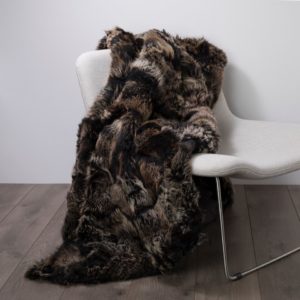
On display at this new more intimate space are Allen’s patented ARTEFACTcurator Wall Mounts — wall panels studded with brass screws that can hold decorative pieces like branches, flowers, vases and framed art. Wool blankets from Spain, cork purses, air plants and staghorn ferns are also available.
Allen’s new pop-up store should not disappoint those in search of the big, bold and eccentric. The entrance is flanked with terracotta heads of Bacchus and Maenad, which were previously perched on the roof of the Vanderbuilt Hotel in New York City. The heads were removed from the hotel due to safety concerns, and Allen saw to it that they made their way across the country. Outside the store, a yard houses oversized pieces like the decorative top of a massive column and a giant limestone seal from Philadelphia. Allen travels the US by truck in search of rare finds—Pennsylvania has become one of his favorite places for old architectural pieces that become available during demolitions.
If you’re not in the market for giant finds, there’s lots of little things to love at the Artefact pop-up store, and gifts items will be making an appearance before the holidays.
Speaking of holidays, it will be interesting to see what will become of the three hundred plastic snowmen that Allen would arrange in creative formations at Cornerstone Sonoma each year. Judging by the surprise element in his design and curation choices, we’re guessing (hoping) Allen will drop more zany decorative fun.
Artefact Design and Salvage, 27 Fremont Drive, Sonoma, 707-933-0660, artefactdesignsalvage.com, Open Wednesday through Sunday 12 p.m. – 6 p.m.
Inflatable ghosts and pumpkins have just been packed away, which, pre-pandemic, would signal it’s time to think turkey and gatherings. But since medical advice is to keep gatherings virtual or very small this year, now could be a good time to focus on early holiday shopping instead. By starting your holiday shopping early, you’ll have more time to ship gifts to family and friends and local businesses will appreciate an early kick-off to the holidays.
The Barlow in Sebastopol offers a range of options for the savvy holiday shopper. The former apple cannery now houses workshop and retail spaces where talented makers produce and sell their unique wares. Visitors to The Barlow can also enjoy drinks and bites from tasting rooms and restaurants. If you prefer to shop online, that can be done, too.
Click through the above gallery for some locally-made or designed gifts we found at The Barlow that are so cozy and “so Sonoma.”
Christopher Chung / The Press Democrat A bee collects nectar from a flower at Monte-Bellaria di California in Sebastopol. The farm’s lavender honey was made into a Gravenstein Honey Cider for the Gravenstein Apple Fair.
If you’re feeling a little frazzled, reaching for a sachet of lavender might be a good idea, according to science. A study published in 2018 found that sniffing linalool, an alcohol component of lavender odor, had a similar effect to popping a Valium. But stressful times may sometimes require stronger remedies. We found one in Sonoma’s West County.
Monte-Bellaria, a nine-acre farm in Sebastopol, offers visitors an opportunity to breathe fresh fall air and soothing lavender — replacing sniffing sachets with a more immersive experience. “Monte Bellaria” means “mountain of beautiful air” in Italian and the bucolic hillside property lives up to its name. Even as the lavender fields shift in color from purple to brown in fall, the landscape remains beautiful and fragrant.
“When we trim back for the fall, the essential oil is very present,” said Dr. Bill MacElroy, founder of Monte-Bellaria.
MacElroy, a statistician and former product development lecturer at UC Berkeley, MIT, Penn State, University of San Francisco and Notre Dame, experimented with different types of lavender before settling on the fragrant and hardy Grosso variety that makes up most of the property’s 35,000 plants. He was recently awarded a silver medal by the international judging association Lavender Sommelier.
After the lavender is harvested between July and the first rains, MacElroy gets to work distilling and infusing the essential oil into products which are sold until supplies run out. The farm also cultivates olives and does beekeeping — its products make for perfect holiday gifts. The Monte-Bellaria moisturizing balm, for example, combines beeswax, olive oil and lavender. Hydrosols offer a sweet spritz of lavender to linens and laundered clothing. The farm’s olive oils are grassy and peppery, and the lavender-infused honey has fantastic flavor and consistency. An added bonus: the shopping experience is far more blissful than a visit to the mall.
Resident beekeeper Eric Sias manages the Monte-Bellaria fields and leads farm tours and gives informative workshops. In a recent class on propagation, he talked about the idiosyncrasies of Grosso lavender, saying it’s the kind of plant you should “forget to water and then overwater.”
Testing, measuring and tweaking for improvement is a central part of the process at Monte-Bellaria. The farm recently troubleshooted an erosion problem by creating a drainage system that routes rainwater down the hill and into a creek that runs under the property’s footbridge and into the forest. Combining a scientific approach with creativity seems to be the secret to the farm’s success — that, and the beauty of the property.
Open weekends 10 a.m. to 4 p.m., Monte-Bellaria di California, 3518 Bloomfield Rd, Sebastopol, 707-829-2645, monte-bellaria.com
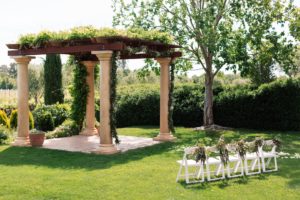
Vintners Inn in Santa Rosa is offering outdoor weddings for small, intimate weddings. (Vintners Inn)
As most brides and grooms will attest, planning a wedding can be quite a stressful endeavor. That’s perhaps even more true with the current restrictions on gatherings during the coronavirus pandemic.
“We have five different plans,” said Samantha Sasser, who anticipates tying the knot in July of 2021. “We just really adjusted our expectations.”
Sasser and her fiancé, of Rohnert Park, are just one of many couples whose plans have been affected by the pandemic. State and local health guidelines allow for weddings to continue for now but with detailed cleaning and social distancing protocols that must be implemented.
The state of California currently doesn’t allow wedding receptions or parties, only ceremonies. Sonoma County has determined that indoor venues can only operate at 25% capacity or 100 people, whichever is fewer, and that outdoor venues must have six feet of distance between people, which limits guest lists.
Rescheduling weddings
Emily Hax, of the venue Green Acres Petaluma, is doing her best to accommodate couples whose weddings were canceled in 2020 by scheduling them for 2021.
Hax said although Green Acres has plenty of outdoor space, she has decided to limit capacity for weddings in 2021.
While Hax said it’s hard to make these adjustments, especially as she’s losing income for the venue, she thinks it’s worth it in the long run.
“We’re doing this for the greater good. We’re trying to stop it (COVID-19) so we can go back to normal, faster,” Hax said. “Not only do you have the parents and the couple to be wed, but all the vendors that come, you have to count those people as well. It’s a little tricky and it’s pretty devastating for these couples.”
Like Green Acres, many wedding venues in Sonoma County are playing things by ear for the coming months and for 2021, while some are finding new ways to host couples and their immediate families.
Micro-weddings and livestreams
The Luther Burbank Center (LBC) in Santa Rosa normally hosts hundreds of wedding guests in its multiple indoor and outdoor venues every year. Adjusting to the coronavirus pandemic, the music center is now taking advantage of its newly renovated plaza, which is “perfect” for COVID-safe “micro-weddings,” according to Sari Feinstein, programming manager for LBC.
“With the changes and our complete new direction with COVID-19, we have been really grateful to our community and our partners that have all gotten creative and sat around a table — a virtual table — and discussed how we can still be that community gathering place, how we can bring joy in a time that really needs it,” Feinstein said.
The center, which now has a wedding guest limit of 12 people, including the couple, has partnered with staging professionals and videographers who can help couples film their weddings for livestreams on Facebook, Zoom and other platforms.
Other outdoor venues, like the Vintners Resort in Santa Rosa, are taking advantage of their extra space by separating family groups and separating dining tables by six feet. Still, wedding staples like dancing and gathering in groups are prohibited at these venues, and guests need to wear face masks unless they’re eating or seated at a distance.
The Kenwood Inn, in the Sonoma Valley, is solely offering their “Elopement package,” which includes a wedding planner, officiant and space for up to six people.
“We have done several of these since … restrictions have been in place, and they have worked quite well,” said Sharon Rooney, director of public relations for the inn.
These micro-weddings and intimate ceremonies are gaining popularity. While the trend started as a response to pandemic restrictions, many couples and families have found ease and comfort in these simpler, low-pressure weddings.
While the future of weddings remains uncertain, Sasser said she’s prepared to be flexible while planning her 2021 ceremony at Vine Hill House in Sebastopol.
“With all of our vendors, we’ve been asking, ‘What’s your cancellation policy? Can we get a full refund?’” Sasser said. “They’ve all been really great and really flexible with offering postponements if needed.”
What will the candidates eat on election night? Chances are it will be pasta, burgers and ice cream for dessert if Biden or Trump have their way.
With plenty of fast food, carbs and comfort classics on their go-to lists, Joe Biden and Donald Trump Jr. are pretty proud of their down-to-earth cravings. Both have been criticized for their predilection for junk food and honestly, from most published reports about their favorite meals, no one is going to accuse anyone on the campaign trail of being a gourmand — with the exception of Kamala Harris, the lone foodie (and cook) in the group.
We thought it would be fun to imagine what the candidates would eat in Sonoma County and to suggest dishes you can pick up to celebrate/console yourself in honor of Trump or Biden winning on Tuesday night. In the meantime, you can grab an elephant or donkey election cookie at Costeaux French Bakery (417 Healdsburg Ave., Healdsburg, costeaux.com) to show support for your favorite party (or eat the head off the one you don’t like).
Interesting fact: Trump and Biden are both tee-totalers, eschewing booze of any kind. Both are fans of Diet Coke. Harris loves a good glass of wine, which makes sense considering her home state is California. Pence, apparently, isn’t much of a drinker and enjoys the occasional non-alcoholic O’Douls beer.
Of course, we all love a good burger, and no one can refuse pizza and ice cream. We’re more alike than different, and good food is something we all can agree on!
All dishes are available for pickup. None of the restaurants listed here have endorsed any candidate; this is purely for fun. The list is in alphabetical order.
Vice President Joe Biden
Vice President Biden is a huge ice cream fan. (Photo: Shutterstock. Illustration, Heather Irwin)
Biden has repeatedly told reporters his favorite food is pasta, especially with red sauce. Our first choice is Campo Fina’s homemade pappardelle pasta with Liberty duck ragu, truffle bugger, leeks, sage and roasted winter squash (330 Healdsburg Ave., Healdsburg, campofina.com). But we also love a good Bolognese meat sauce at Ca’Bianca (835 Second St., Santa Rosa, cabianca.com). Wanna go old school? Art’s Place (563 Rohnert Park Expressway, Rohnert Park, artsplacerp.weebly.com) is the home of the famous Pasta King marinara and pesto.
Ice cream is Biden’s guiltiest pleasure. He once posed for the cameras with a tasty DQ Blizzard. But why not go plant-based? The nondairy chocolate shake at Amy’s Drive Thru (58 Golf Course Dr. W, Rohnert Park) is twice as good with half the guilt. Another sweet-tooth satisfier is the creamy vanilla bean small-batch pint from Noble Folk (Santa Rosa and Healdsburg, thenoblefolk.com). Other best bets for the Democratic contender? All-American caramelized apple pie from Two Dog Night Creamery (Sebastopol and Windsor, twodognightcreamery.com) or peanut butter chip from Fru-Ta (multiple locations in Sonoma County, fru-ta.com).
Senator Kamala Harris
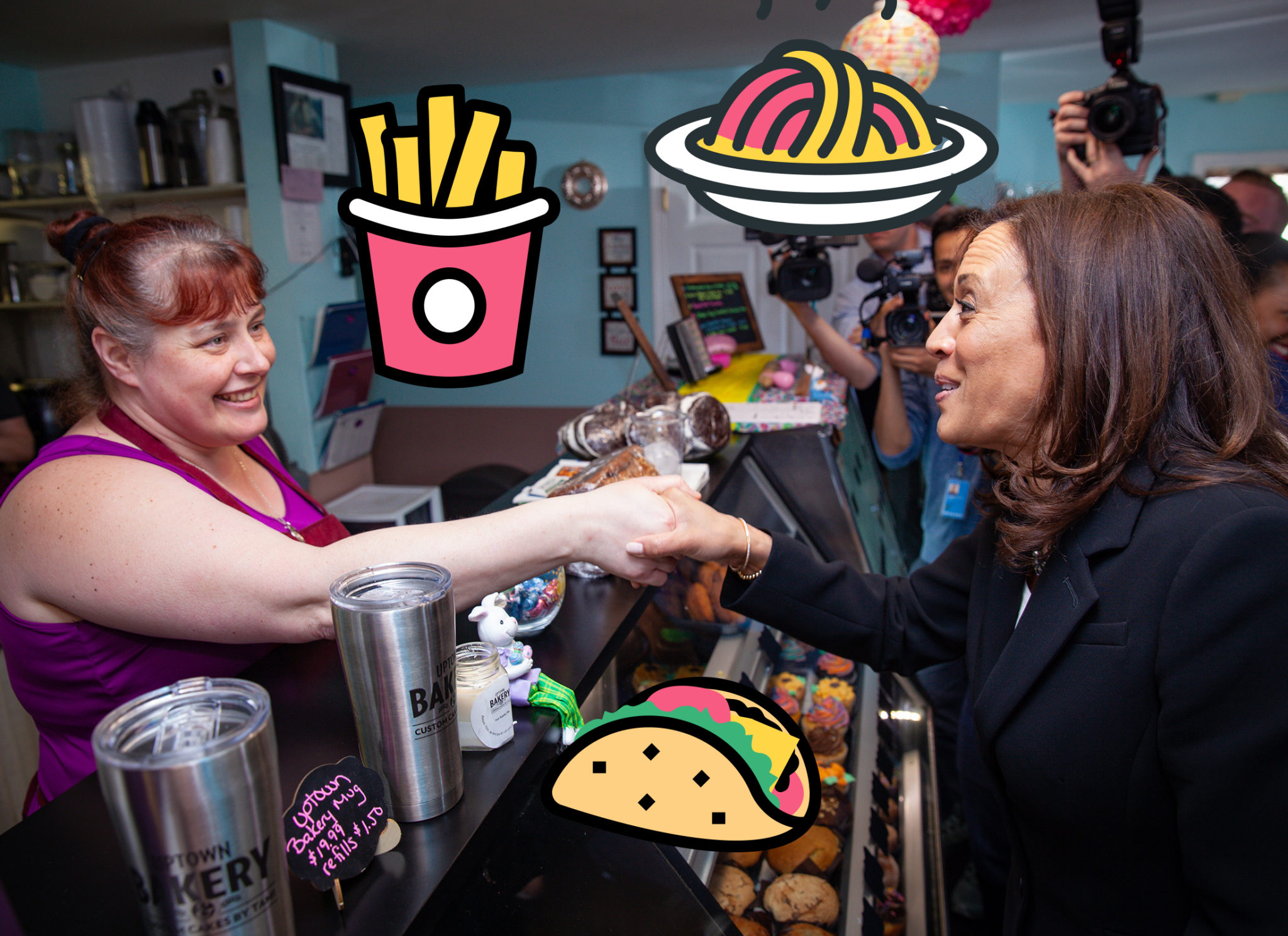
Kamala Harris likes fries, pasta and burritos. (Shutterstock photo illustration)
VP candidate Kamala Harris seems to be the cook in the group. She says she loves to make a good roast chicken, with beans and even French fries in duck fat (how very Californian), among other things.
Roast chicken is so boring. We think “Aunt Kamy” would go wild for Blue Ridge Kitchen’s Drunken Fried Chicken with truffle mac and cheese, bacon collard greens, Kentucky hot butter and apple honey, just to shake things up (6770 McKinley St., Sebastopol, brkitchen.com). Harris has strong feelings about a tuna melt sandwich and too much mayo, but Mac’s Deli (630 Fourth St., Santa Rosa, macsdeliandcafe.com) does it so right with a side of Kamala’s fave side dish, fries. Take it up a notch with duck fat fries with whipped ranch at Wit & Wisdom Tavern (1325 Broadway, Sonoma, witandwisdomsonoma.com).
For Kamala’s burrito habit, we’re picking Lepe’s (4323 Montgomery Drive, Santa Rosa, lepestaqueria.com) Surf and Turf with shrimp, carne asada and all the trimmings.
Vice President Pence
Vice President Pence’s favorite snack is popcorn! (Shutterstock photo. Photo Illustration Heather Irwin)
Pence is another simple eater. He loves popcorn, bacon and ice cream.
Mike’s not much of a drinker, but who can resist a little Bloody Mary-flavored popcorn from Comet Corn (cometcorn.com)? For pizza, keep it old school with a simple pepperoni pie from Homerun Pizza (484 Larkfield Center, Santa Rosa, homerunpizzalarkfield.com).
Pence is an avowed bacon man, and we think a tasty California twist on the BLT, the BLAT (with avocado and sourdough bread) might be a nice energy boost while visiting the Sonoma County Airport’s Sky Lounge (2200 Airport Blvd., Santa Rosa, santarosaskylounge.com).
President Donald J. Trump
President Trump loves well-done steaks and fast food. (Shutterstock photo. Illustration Heather Irwin)
Don’t ask the Prez if he’s a sushi fan, because the answer is a resounding no. Instead, Trump prefers his food well-cooked. He’s a fan of fast-food giants like KFC, McDonald’s, Burger King and Chik-fil-A. Here are a few local alternatives we think he might like!
The McDonald’s Filet-O-Fish is Trump’s go-to, but you haven’t had a fish sando until you’ve had the Crispy Cod Sandwich with rémoulade on a soft roll at Seafood & Eat. We think Donald might also go for a little butterscotch pudding for dessert, because who doesn’t like pudding (9238 Old Redwood Highway, Windsor)?
Make sandwiches great again with a fried chicken sandwich atBrewster’s Beer Garden with — wait for it — goat cheddar and aioli. But come on, it has bacon, too!
Or he could try steak at Valette. Snake River Farms’ beautifully marbled meat should never be cooked well-done, but hey, if that’s what Trump wants, at least it’s a darn good overcooked steak.
Whopper or Big Mac alternative: If it’s a drive-thru with a burger wrapped in paper, then In-N-Out is our choice, though Five Guys gets ’em nice and charred. We’d prefer to send him to Mike’s at the Crossroads (7667 Old Redwood Hwy, Cotati, mikesatthecrossroads.com) or Superburger (multiple locations, originalsuperburger.com), but if we’re doing a burger to remember, it has to be the California Smash Burger at Pizzando (301 Healdsburg Ave., Healdsburg, pizzandohealdsburg.com).
And finally, chocolate cake. There’s no comparison to Sax’s Joint’s chocolate cake with caramel icing, fudge and Rolos. It’s decadent almost to a fault, but nothing this good could ever be faulted (317 Petaluma Blvd. South, Petaluma, saxsjoint.com).
Healdsburg’s Single Thread Restaurant and Farm was among five Bay Area restaurants given a 2020 “Green star” — a new category — at a virtual California Michelin Guide event this week.
The new star distinction was given to chefs who “have taken responsibility by preserving resources and embracing biodiversity, reducing food waste and reducing the consumption of non-renewable energy,” according to organizers.
Owners Kyle and Katina Connaughton of Single Thread in Healdsburg own a small farm outside the town which grows many unique varieties of produce for their three-Michelin starred restaurant.
“We are incredibly proud to receive the Green Star recognition for our sustainable practices at the farm. Our farm team works incredibly hard not only to steward the land but also to do so using sustainable agricultural practices. This distinction highlights their hard work and the commitment to these practices by the whole team,” said Kyle Connaughton.
The stars, along with several “Michelin Discovery” restaurants (none in the North Bay) were a sort of consolation after the restaurant guide decided to forgo its annual California awards for 2020 in response to the pandemic and ongoing wildfires that have devastated the state.
On Tuesday, the French tire company long known for their European restaurant recommendations hosted a Virtual Family Meal where top California chefs discussed the state of restaurants after suffering from months of closures related to Covid and how restaurants have responded as front line feeders during the pandemic.
Other Green Star award winners in the Bay Area included Michael Tusk of Quince in San Francisco, Dominique Crenn of Atelier Crenn in San Francisco, Thomas Keller of the French Laundry in Yountville and Alice Waters of Chez Panisse in Berkeley.
Michelin’s new category of inspector “discoveries” were a nod to “new and aspiring culinary talent across California” and included 25 restaurants statewide. In the Bay Area, Tony’s Seafood in Marin, Aziza in San Francisco, Tacos Oscar in Oakland, Los Carnalitos in Hayward, Brotzeit Lokal in Oakland and Selby’s in Silicon Valley were noted.
Pulled pork, chickpea meatloaf, and Philly cheesesteak pretzel bun sliders from Fourth Street Social Club in Santa Rosa. (Courtesy of Fourth Street Social Club)
Two new restaurant openings and one reopening to be excited about right now…
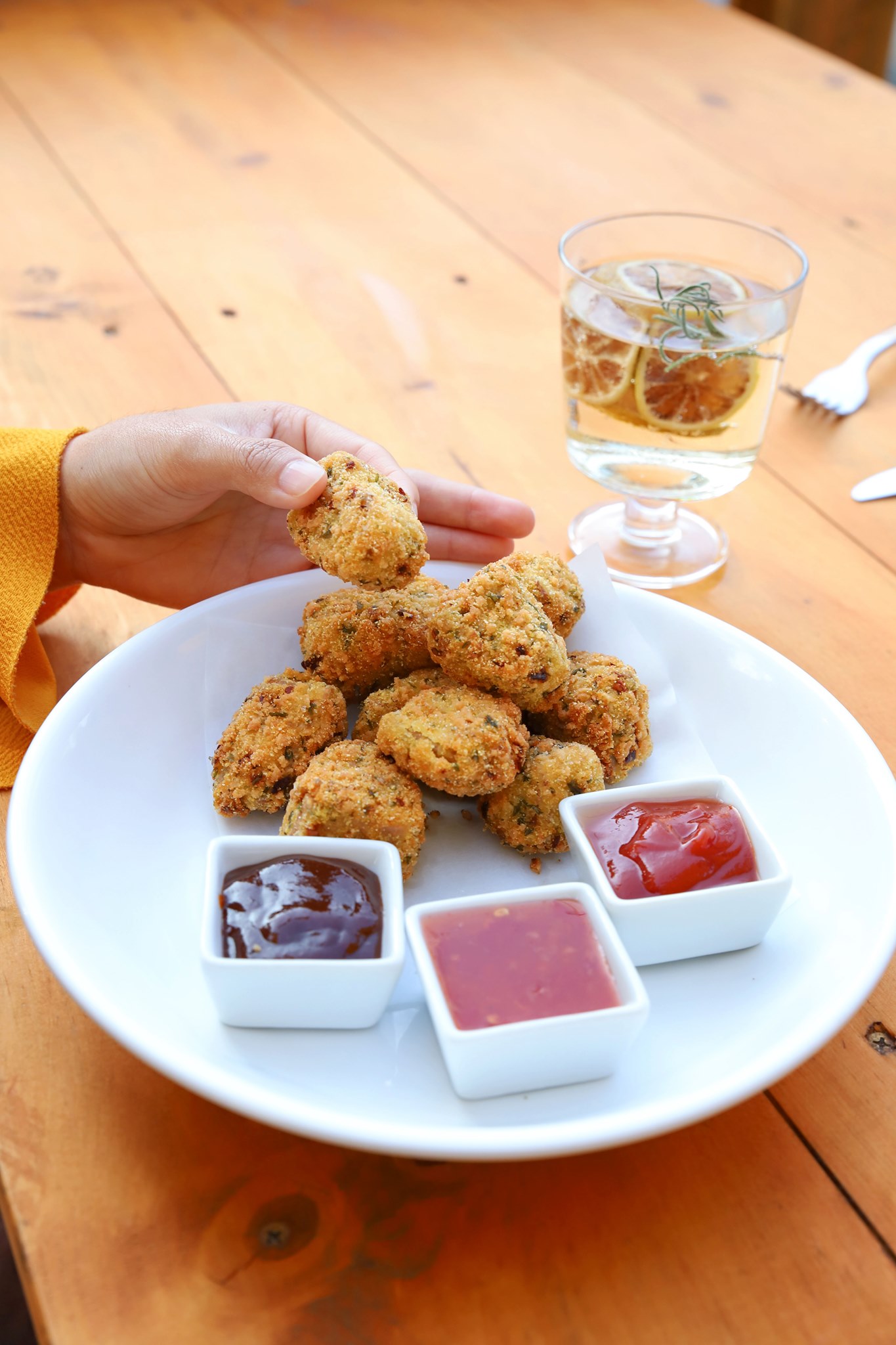
4th Street Social Club in downtown Santa Rosa has officially opened. The plant-forward eatery has been in development for months (and months) at the former Jade Room. 643 4th St., Santa Rosa.
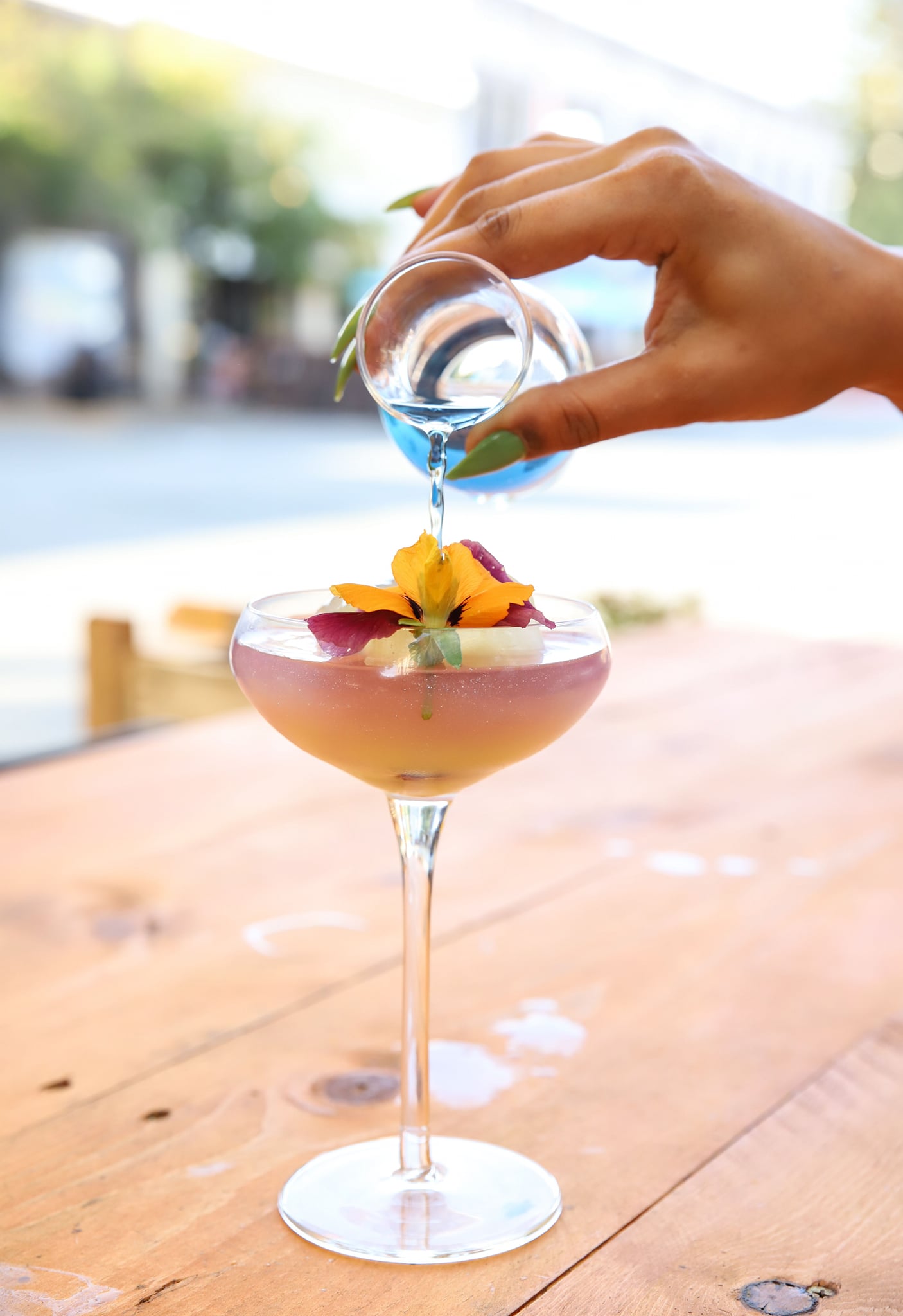
“Jacked Up Popcorn Chikn” is a house favorite at Fourth Street Social Club in Santa Rosa. (Courtesy photo)Cocktail from Fourth Street Social Club in Santa Rosa. (Courtesy of Fourth Street Social Club)
The popular, family-friendly Yogurt Farms frozen yogurt and ice cream shop has reopened under new ownership. 1224 Mendocino Ave, Santa Rosa.
In Windsor, former Stark’s chef Eric Foster has opened Grata, an Italian-inspired restaurant we’re chomping to get to as soon as possible. Burrata with preserved lemon honey, fritto misto, roasted beet and butternut squash salad and ricotta gnudi have our names all over them.186 Windsor River Road, Windsor.
Carbonara pizza with crispy guanciale, Yukon gold potatoes, poached farm egg, Pecorino Romano at Wit & Wisdom in Sonoma. (Heather Irwin/Sonoma Magazine)
I blame the agnolotti. Those delicious little pillows of al dente pasta filled with caponatina — a Sicilian mix of eggplant, caper and olives — sitting in a pond of tomato water and creamy, melty Parmesan have tongue-tied me so thoroughly I’m afraid Chef Michael Mina thinks me a silly hayseed.
Hey, you try to say “agnolotti” or “caponatina” with any authority when a multi-Michelin starred celebrity chef with some 30 restaurants worldwide casually stops by your table on a steamy Tuesday night at his new Sonoma restaurant, Wit & Wisdom.
“Oh, ah, oh! Chef! I love the anlotti. Angliota. Angolia. The cappynota. Capota…ca…,” I mumble with my mouth full.
He looks confused, like maybe I need some medical help. Someone please save me. General Manager Seth Johnson comes to my rescue. “The agnolotti, chef,” he says. Mina’s eyes crinkle like he’s smiling, but it’s hard to tell under the mask. It might be a grimace. I consider climbing under the table.
Tomato, tomahto. It’s one of the best things I’ve ever eaten. And he knows it.
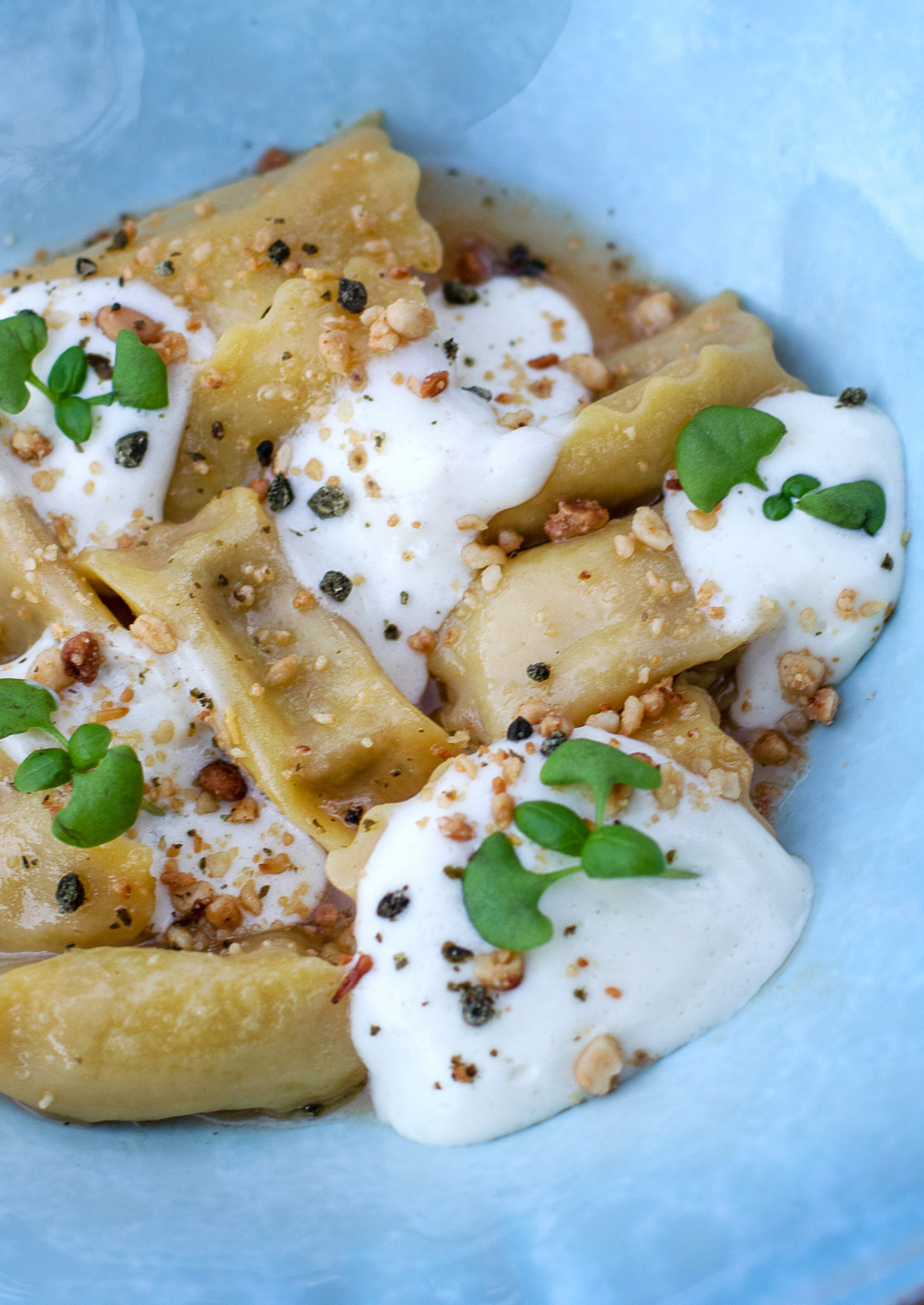
Caponatina Angolotti with tomato water glaze, capers and Parmesan fonduta at Wit & Wisdom in Sonoma. (Heather Irwin / The Press Democrat)
The agnolotti is not the only near-perfect dish on the table that night. Every single bite is better than the next, be it Liberty Farms black pepper duck wings or Carbonara Pizza with a soft-boiled egg, black pepper and a Pecorino cheese sauce mixed tableside and poured over the hot pizza.
Mina’s first Wine Country restaurant, recently opened at the Lodge at Sonoma, is so top-to-bottom exceptional, it’s easy to feel a little provincial. Mina and his team are professionals in a Big Fish, Big Pond kind of way, with critically-acclaimed restaurants in Chicago, Boston, Las Vegas, Dubai, Seattle and Mina’s home stomping grounds of San Francisco (where he has nine restaurants).
Suffice it to say the MINA group has the immense financial backing, top tier talent and the ability to get everything dialed in right out of the gate because they’ve done it 30-plus times and counting.
Trust me, I didn’t want to totally love it as much as I did, because it’s easy to discount someone like Mina as an outsider who doesn’t understand Wine Country cuisine.
Wrong. He does.
With a legit menu that sources (mostly) locally, there’s not much to poo-poo — except the Olympia Provisions charcuterie plate. Which, while amazing, doesn’t use local charcuterie. That’s honestly my biggest gripe.
“We couldn’t open some of our other restaurants,” Mina says of the pandemic restrictions. “But we wanted to open here.”
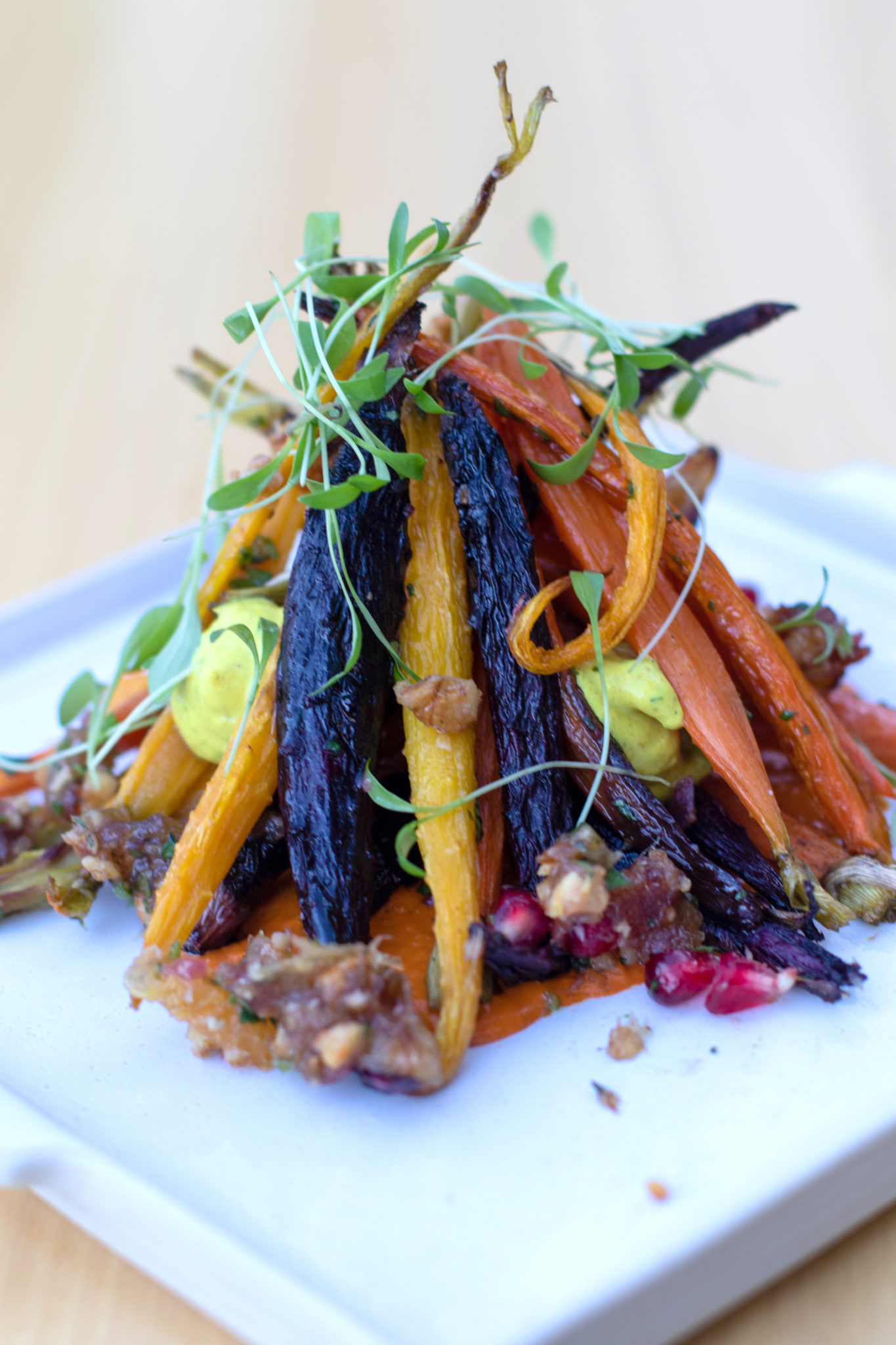
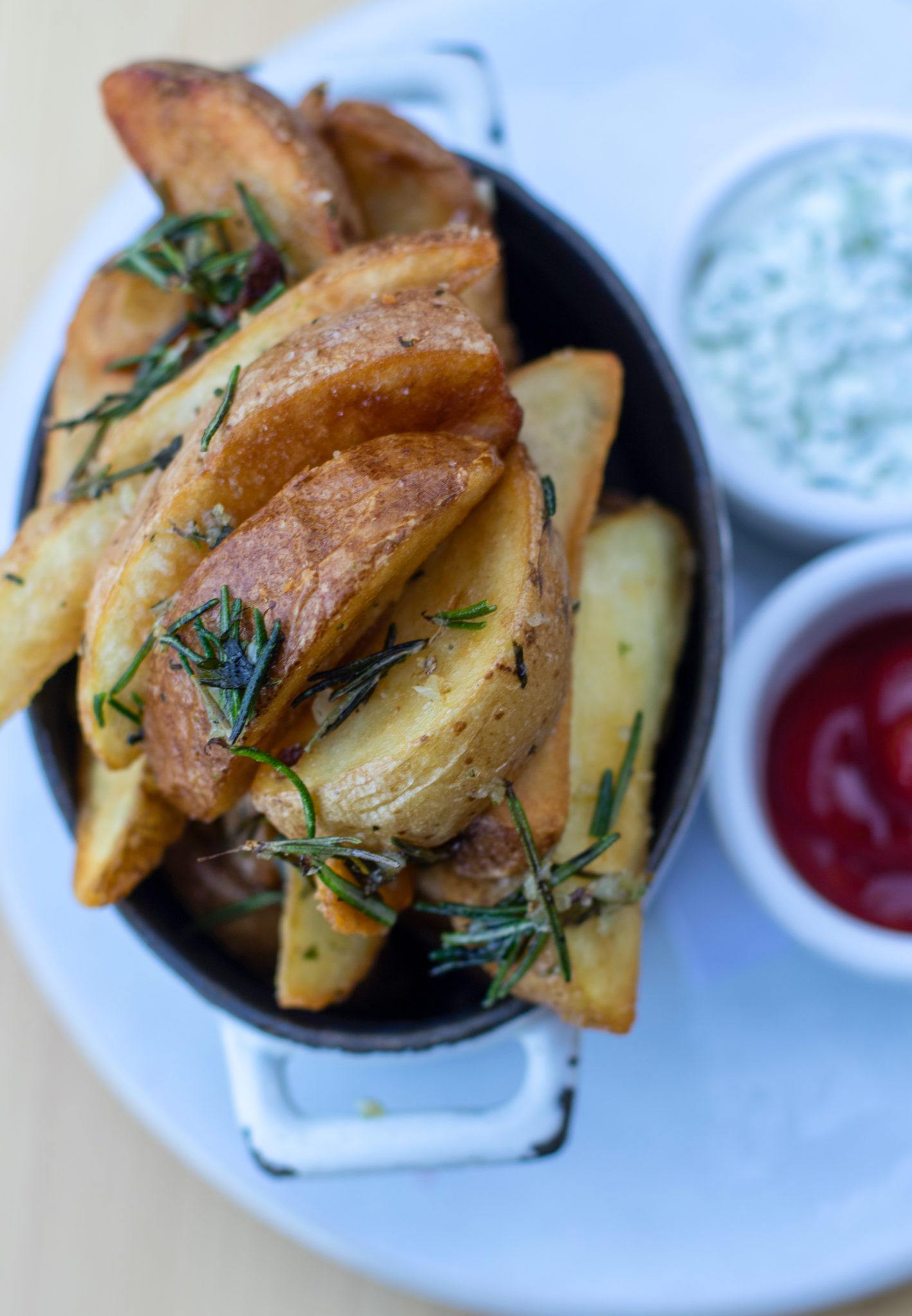
Roasted heirloom carrots with vadouvan yogurt, piquillo pepper, walnuts and tangerine vinaigrette at Wit & Wisdom in Sonoma. (Heather Irwin / The Press Democrat)Duck fat fried potato wedges with whipped ranch dip at Wit & Wisdom in Sonoma. (Heather Irwin / The Press Democrat)
Truly it has been a winding road to get the restaurant open at the former Carneros Bistro. More than a year ago, rumors started buzzing about a possible Mina concept. It wasn’t until June that the restaurant seemed to be a sure thing, finally opening in mid-September.
With a large, enclosed outdoor dining area, Wit & Wisdom has plenty of socially-distanced tables. Diners are encouraged to use digital menus accessed by a QR code (though paper menus are available).
A pleasant surprise are the prices, with many dishes under $15 and solid entrees like the pastas under $20. You can gild the lily with higher-end dishes like the Lobster and Black Truffle pot pie ($84), but in general, we were pleasantly surprised by the affordability.
There’s a robust spirit program, with creative cocktails like the Hummingbird ($13) made with mezcal, elderflower liqueur, lemon and passion fruit. The wine list is spectacular and runs 20 pages, as one might expect, with both trophy wines and more approachable sippers. By-the-glass selections don’t disappoint, and we loved a recommendation for a German pinot noir (Enderle & Moll Liaison, Baden, DEU 2016) with soft fruit notes that worked perfectly with the, uh, pasta pillows. Yeah, let’s call them that.
Best Bets
The menu runs two pages for dinner, and recently brunch was added. This is only a small sampling of the dishes.
Savory Pop Tart, $12: You’ll get the joke. A rectangle of crisp puff pastry hides a filling of savory pulled short rib. Accessorized with crispy onions, horseradish cream and flecks of red peppercorn. No toaster needed.
Liberty Farms Duck Wings, $14: Orange peel scented, caramelized duck “wings” are more like duck drumettes. Moist confit-style meat with a crispy Grand Marnier glazed. “Made my knees buckle a little,” said my husband, eating the leftovers.
Roasted Heirloom Carrots, $11: The prettiest dish on the menu. Multicolored carrots are roasted to a sweet softness, piled high with Vadouvan-spiced yogurt, pomegranate seeds, a pool of piquillo pepper sauce and tangerine vinaigrette. Flavor-boosted!
Caponatina Agnolotti, $17: This dish is so good it’s going to land somewhere near the top of my Best of 2020 dishes. It’s not about a single note, but a harmony of light tomato water, carby al dente pasta, restrained caponatina and salty cheese. Just amazing.
Liberty Farms Duck Breast, $32: Not your usual cherry-glaze sweet on sweet take. We like the more savory presentation of medium rare duck atop mustard creamed cabbage. Sadly the poached pears didn’t add a lot, but the pomegranate jus brought the whole thing together.
Carbonara Pizza, $18: A perfectly-blistered wood-fired pizza with crispy guanciale, thinly sliced Yukon gold potatoes and a light dusting of cheese. What made it special was the tableside mix of a soft-boiled egg, a tablespoon (at least) of cracked black pepper and fresh Pecorino romano. The sauce is poured over the pizza, imparting a spicy, sharp flavor that’s a foil to the creaminess of the cheese.
The Chocolate Bar, $12: Like the best Snickers you’ve ever had. Mirror-glaze dark chocolate, milk chocolate and dried peanut butter crumble. So sexy.
Bohemian Creamery Cheese Plate, $20: A proud collection of soft and hard goat, cow, sheep and buffalo milk cheeses from this small, women-owned West County creamery with Della Fattoria bread and Napa Valley olives.
Worth A Look
Hot and cold shellfish towers ($79 to $109) include fresh oysters, lobster, crab and shrimp.
Maryland striped seabass with shrimp arancini, early spring vegetables, Meyer lemon olive oil emulsion and spinach pudding at Farmhouse Inn in Forestville. (Charlie Gesell / Sonoma Magazine)
The Michelin Guide has postponed naming its 2020 restaurant selections for California. No stars and no Bib Gourmands will be announced for this year due to the ongoing pandemic and — most notably for California — the wildfires. With most of the state’s restaurants still limited to outdoor dining and takeout due to COVID-19 restrictions, Michelin representatives said the decision was made after talking to chefs and considering their feedback.
Michelin stars are among the most influential awards a restaurant can receive. Healdsburg’s Single Thread Restaurant and Farm is one of just a handful of California restaurants to win the coveted three-star award, the highest award given. Madrona Manor, also in Healdsburg, has one star. Farmhouse Inn & Restaurant in Forestville also got one Michelin star. The Restaurant at Meadowood in St. Helena, another three-star winner, was destroyed in the recent Glass fire.
Insiders are saying that “postponing” doesn’t necessarily mean the awards will be shelved altogether for this year. Although the usual October announcement won’t be made, the guide may be released sometime in early 2021 as many reviews already had been completed for this year before restaurants were forced to shutter and then limit services.
Guide organizers will host a virtual Family Meal event to support California restaurants at 4 p.m. Oct. 27. Both diners and chefs are invited to attend. (Details at guide.michelinman.com).
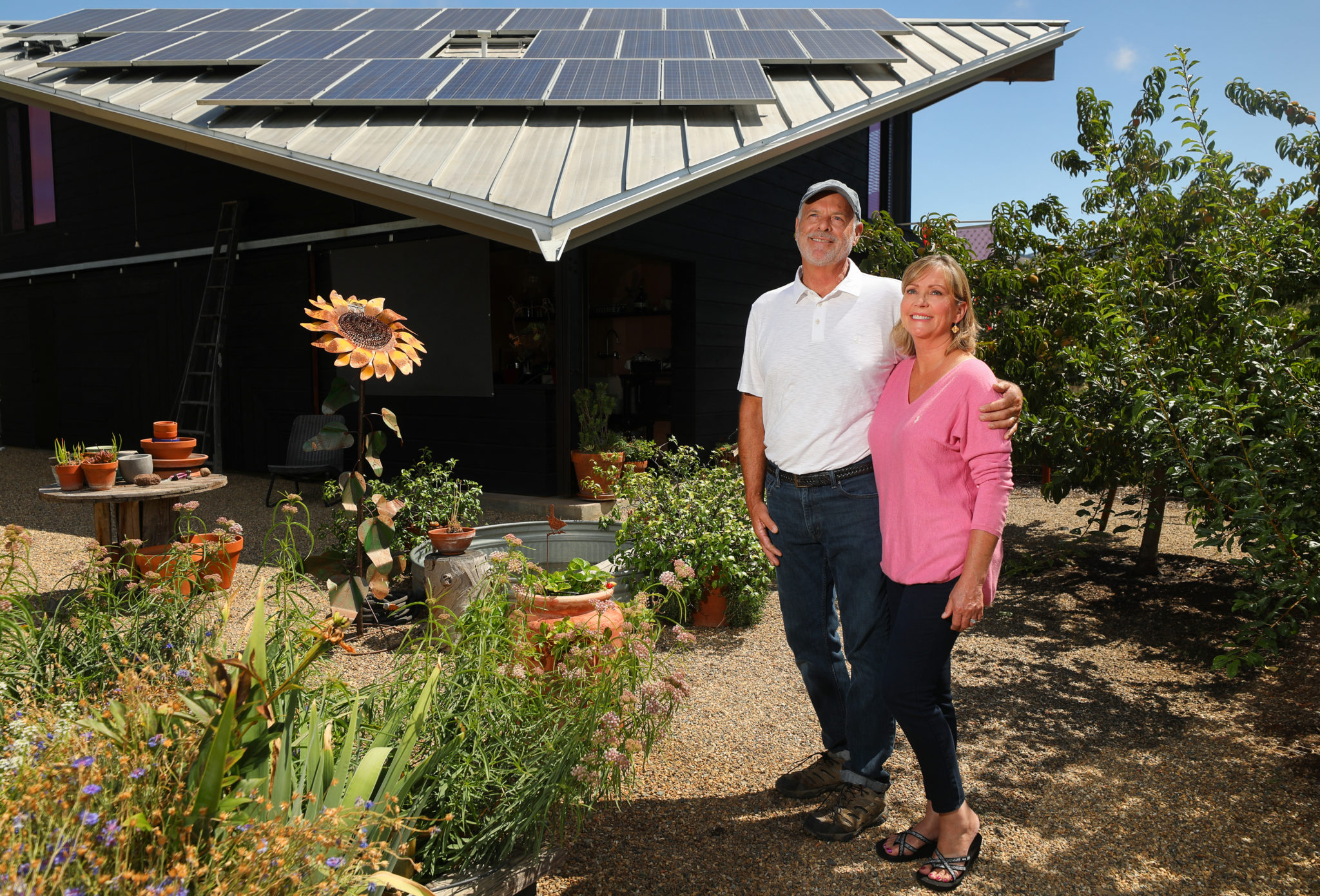
Jim and Susan Simmons practice green living with solar panels on their barn providing electricity to their Kenwood home. The sloping roofs of their home and barn are also designed to collect rainwater. (Christopher Chung / The Press Democrat)
Every year, as fire season approaches and winds pick up, Sonoma County residents face renewed worries over the threat of power shut-offs. Meet three families who have taken matters into their own hands with battery storage and solar power, gaining a sense of security that money can’t buy. Plus — What batteries really cost and the smart questions you need to be asking.
Going off the grid has been a fantasy for nearly as long as there’s been a power grid. In the 1970s, just a few hard-core survivalists and rural hermits actually made it happen, riding the wave of the back-tothe- land movement with companies like Ukiah’s Real Goods. Later, green celebs like Daryl Hannah and Ed Begley Jr., made it all sound easy and turned off-grid living into a lifestyle.
Solar power became popular in the late 1990s, and companies such as Tesla, Enphase Energy, and Sonnen started rolling out battery storage units around 2015, allowing homeowners to disconnect from the grid during power outages and create their own temporary microgrid to generate and store their own power, a process known as islanding. But true energy resiliency was still a pipe dream for most.
That all changed here after the fires of 2017.
The local demand for batteries has been so strong since then that Dana Smith, the director of sales at Novato’s SolarCraft, jokes, “We could change our name from SolarCraft to BatteryCraft.”
And Rody Jonas, owner of Healdsburg’s Pure Power Solutions, who has been installing off-grid battery systems for the past 27 years, estimates that so far this year, he’s installed 20 times as many systems as he did in 2017.
According to PG&E, 18 battery storage systems were installed in Sonoma County homes in 2017, increasing to 113 in 2018 and 225 in 2019, says spokesperson Deanna Contreras. And in the unincorporated areas of Sonoma County, 174 battery permits were issued in the first half of 2020, says Domenica Giovannini of the county’s Permit and Resource Management Department.
New solar and battery systems may not live up to the “off-grid” fantasy of the 1970s, but grid-connected homeowners can earn back some costs by selling back excess power. And these systems allow homeowners to go off grid temporarily when they need it most, easing the burden of power shutoff events. In a sense, going off the grid has been replaced by the concept of energy resilience — the ability to withstand natural disaster; the means to harness technology and take matters into your own hands, no longer at the mercy of a utility company.
If the learning curve seems daunting, 26% federal tax credits make it much more enticing. And a new state program, the Self-Generation Incentive Program (SGIP) can offer additional discounts to qualified residents who live in high-fire zones or have been affected by multiple power shut-off events. For those who have questions, Sonoma County’s Energy and Sustainability Division offers free advice and dedicated financing for green energy projects.
The three Sonoma families you’ll meet next all took the plunge into the world of solar and batteries for different reasons, from fire safety, to the cost of connecting a new home to the grid, to a desire for greater resilience. But all say they hope their experiences can convince others to adopt the new technology. As one homeowner puts it: “When you do the math, it’s a no-brainer.”
Jim and Susan Simmons practice green living with solar panels on their barn providing electricity to their Kenwood home. The sloping roofs of their home and barn are also designed to collect rainwater. (Christopher Chung/ The Press Democrat)
Jim & Susan Simmons: Off-grid pioneers with a DIY approach
To look at the Kenwood home of Jim and Susan Simmons and then discover their power is fueled by lead-acid batteries is more than just a study in contrasts — it’s a shocking surprise. On the one hand, you have a modern glass-walled dwelling that never needs air-conditioning topped by a wide-hanging, angular steel roof (picture the brim of a Spanish conquistador’s helmet) that also doubles as a cistern to capture water. And yet when Jim Simmons walks out to his barn and lifts the lid on his power storage, all you see are 24 forklift batteries.
“It wasn’t our original plan,” he says with a laugh.
Back in 2011, when they bought the 2-acre property, they intended to hook up to the grid, just as Jim, an architect, did for most of his clients. “I’m not a Birkenstock guy; I like my power,” he says. But when they called PG&E, the power utility quoted them $40,000 just to hook up to the grid.
Keep in mind, this was several years before grid-tied batteries such as the Tesla Powerwall were on anyone’s radar. If not the Jurassic, it was at least the Cretaceous age of battery storage. But at the urging of their two college-age sons, the Simmonses mapped out an off-the-grid system with the help of Mill Valley company Beyond Oil Solar. “The owner allowed us to buy the materials through him and then he recommended the installers. These guys were out of Mendocino and of course their background was pot; they needed the power to grow it.”
After installing an OutBack system with a 24-panel solar array on his barn roof and a storage array of 24 2-volt lead-acid batteries, the total was just over $23,000 after tax credits, and, says Jim, “the best thing is, we’ve never had a PG& E bill.”
For peace of mind, Jim can look at an app on his phone to see how much solar energy is being generated, check battery levels, and make adjustments, like turning on a back-up generator. The downside to the forklift batteries is that every couple of months, they need to be maintained by opening the tops and adding a cup of water. “You have to be fastidious about it, because if they go dry, that kills that cell,” he says.
In October of 2017, as the Nuns fire scorched Kenwood, the Simmonses’ home became a refuge. “My wife started cooking for people, many who stayed behind to take care of their vineyards because it was right in the middle of harvest. It was a little surreal because you could see fires come over up the mountains. You’d be eating dinner, trying not to choke on the food while watching these poor people’s homes go up in flames.”
These days, a backup propane generator kicks in if the battery drains below 50 percent, but it’s rarely used. Their biggest pull on power are the well pumps, which were installed before they decided on solar and are not as efficient as they could be— something they would fix in retrospect. At this point, they know their improvised system will likely only last about three more years, so they’re already thinking about an upgrade to more modern lithium battery like a Tesla Powerwall.
“Looking back, it was the right thing to do,” Jim says. “If it didn’t work out, we’d be out of some money. But we were looking at such a huge cost otherwise. We decided, ‘Let’s take the risk, let’s take the gamble.”
Bottom Line
Jim and Susan Simmons had a 20-panel, 7.3-kilowatt solar system installed in 2013 and added four more panels in 2015. Their battery is an array of 24 2-volt forklift batteries.
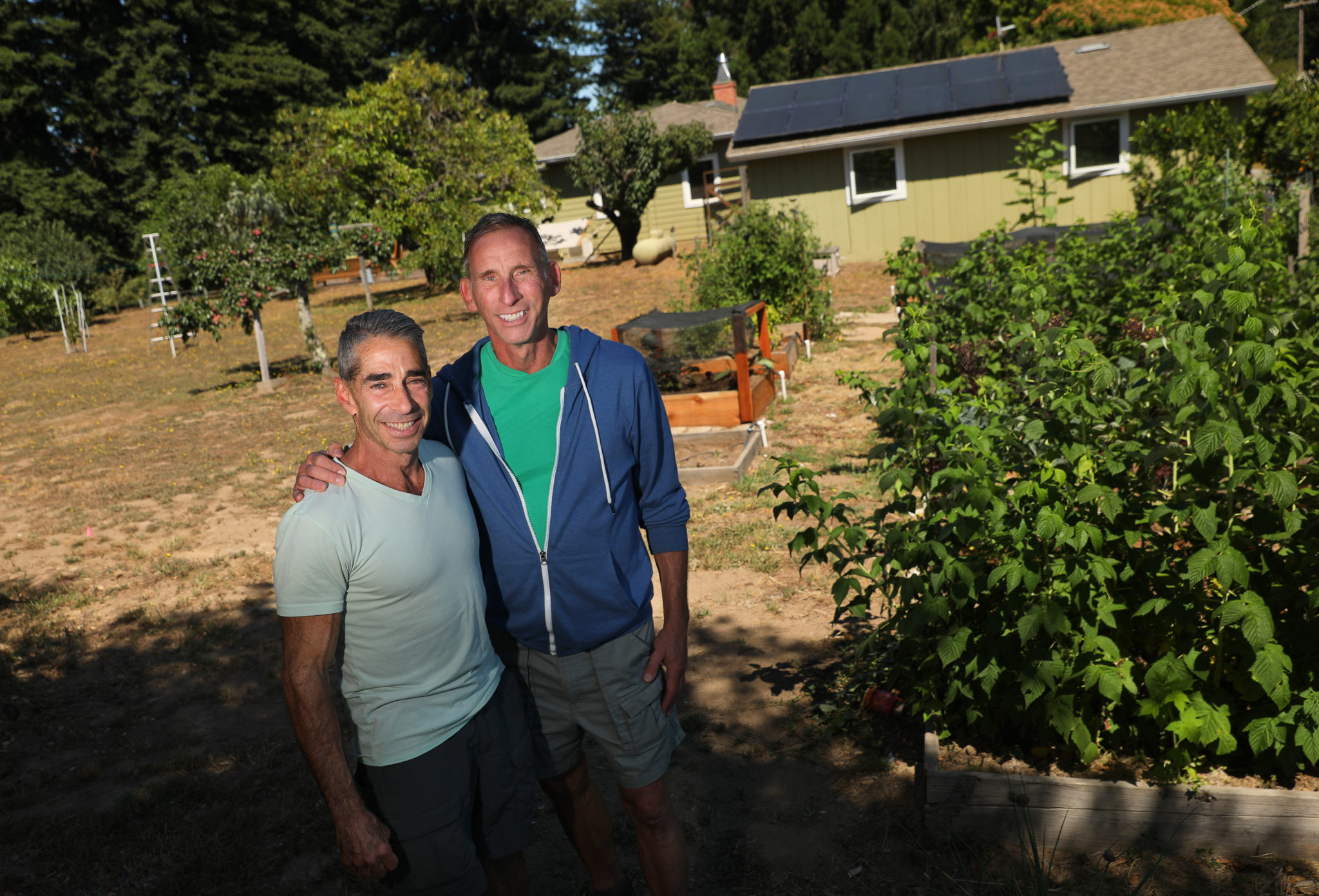
Tony DeYoung, left, and Joe Metro installed solar panels and added a solar storage battery at their property near Occidental. (Christopher Chung/ The Press Democrat)
Tony DeYoung & Joe Metro: Going solar first, then adding a top-of-the-line battery
Eight years ago, after more than two decades in San Francisco’s Noe Valley, Tony DeYoung and Joe Metro decided they wanted a weekend retreat in the country, one with enough space for their Malinois puppy, Zara, to run around. But after looking at a dozen west county offerings, they still couldn’t find the right spot. On a whim, they asked their real estate agent if they could revisit an Occidental property at nighttime.
It didn’t matter that it was a run-down former pot farm. “We looked up and saw all these stars like you’d never seen,” says Metro, a CFO. “They were so intense.” A half hour later they made an offer. “We were totally clueless,” says DeYoung, a digital marketer turned teacher. “Remember ‘Green Acres’? That was us. We didn’t really know about water and power failures and electric.” But as they started learning more about organic farming, planting blueberries, passion fruit, pluots, and avocados, they knew they also wanted to be green when it came to their remote power supply.
Their 11-acre spread is sandwiched between redwood forest on one side and pastureland on the other. As part of a massive 2015 renovation, the couple installed solar panels on a detached garage. In 2018, when they moved to Occidental full time, they added a German-engineered, American-made Sonnen battery from Sebastopol’s Synergy Solar.
Last year, the house was a beacon of light during the Kincade fire’s power outages. “We were like the local Starbucks,” DeYoung says. “Neighbors would drop by and get a cappuccino, connect to the internet, and we threw in hot showers as a bonus.”
Their 3.36-kilowatt grid-tied system includes a 12-panel array that generates around 20 kilowatt hours of energy during the summer and around 8 kilowatt hours in the winter, Metro says. When they need to cut back on their usage, they shut off their second freezer, switch from desktop to laptop computers, turn off the hot tub, and, when possible, hang their clothes outside to dry.
As early adopters (theirs was only the fifth Sonnen battery installed in the county), DeYoung and Metro weighed all their options, even getting a quote for a new propane generator, which was nearly $25,000 with the cost of a new pipeline and $2,000 a year in maintenance. “Solar was cheaper than that, and there’s zero maintenance and zero noise,” Metro says.
Before going solar, they made sure their home appliances were lean. “The first thing we learned is you have to make your house energy efficient, so now all the lights are LED, we have a superefficient refrigerator, and we added efficient well pumps— so you’re dropping your power footprint,” DeYoung says.
Now, as another fire season is here, DeYoung and Metro prepare for the return of what has become another harbinger of fall: their neighbors’ gas generators buzzing and humming along at all hours during power outages.
Standing in the middle of a ripening fruit farm, surrounded by exotic apple varieties he’s learned to graft, DeYoung says, “What you buy here is you buy quiet. That’s really what you’re buying. I don’t know if you’ve gone into San Francisco lately, but there’s that constant noise, and I think that noise is what’s making people so freaking neurotic.”
“Listen to how quiet it is,” he says, pausing. “That’s why solar and battery makes so much sense. Why ruin that?”
Bottom Line
Joe Metro and Tony DeYoung had a 12-panel, 3.36 kilowatt, grid-tied solar system installed in 2015. They added a 12 kilowatt-hour Sonnen Eco 12 Battery in 2018.
System and installation: $16,000 Battery: $23,000 Total: $39,000 After $3,500 SGIP rebate and 30% tax credit: $24,850
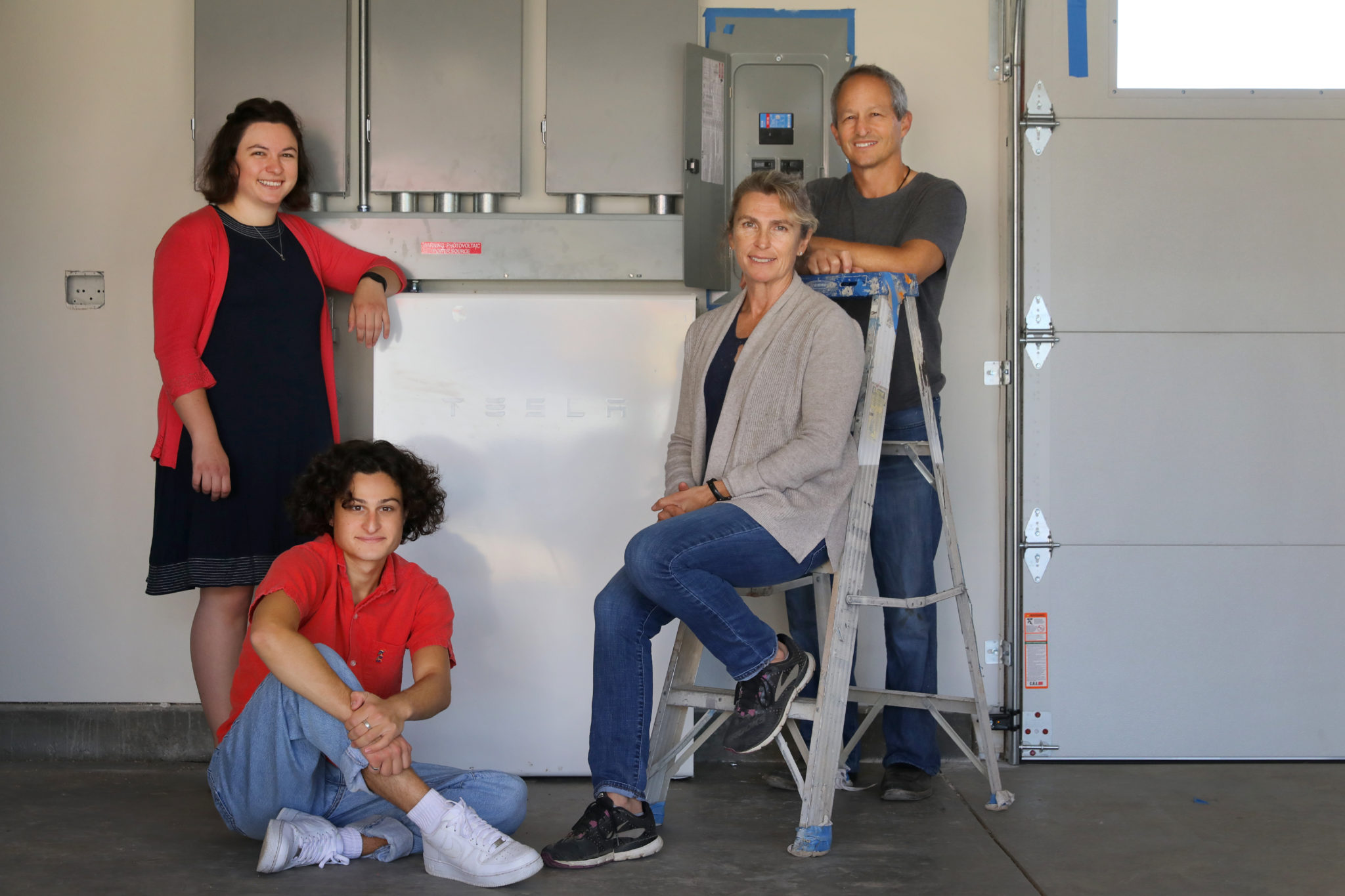
Joshua Weil, right, and his wife Claire Mollard, with their children Caleb and Sydney Weil have installed two Tesla Powerwalls along with solar panels into their rebuilt home, in Santa Rosa. (Christopher Chung / The Press Democrat)
The Weil-Mollard family: A Tubbs rebuild with a solar-powered fire suppression system
“That’s where the fire came over the hill,” says Josh Weil, standing in his front-yard vineyard, looking northwest from his nearly rebuilt Larkfield home.
He’ll never forget that surreal night, nearly three years ago. Working past midnight at Kaiser Permanente in Santa Rosa, the ER doctor called home to warn his wife Claire Mollard of the fast-approaching Tubbs fire. The sky was glowing bright red and flames were only a hundred yards away as she rounded up their 15-yearold daughter, Sophie, and their two dogs and fled the house in less than 15 minutes. Not long after, their house burned down to the chimney.
Somehow their goats, Lucy and Ethel, survived the fire, becoming one of many symbolic stories of resilience in a broken community. But “we lost our cat, Rainbow Bear, which I’m still kind of heartbroken over,” Weil says. “The power was off, and my wife couldn’t see when she ran back into the house to look for the cat. If we had electricity, maybe our cat would still be here. Those things matter.”
Now, three years later, their new home’s fire suppression system, fueled by well booster pumps, will be powered by solar panels and two Tesla Powerwall batteries installed in the garage.
“It’s been a long road getting here,” says Weil, walking past workers as they prep the new driveway before concrete is poured. The T-shirt he’s wearing with a medical cross and the baseball meme “Rub Dirt On It” is an understatement.
The family had solar panels from Pure Power Solutions in Healdsburg installed on their previous 1970s house. They turned to the company again to install a new system, this time with a battery. Weil’s colleague had recently installed Tesla Powerwall batteries in his Skyhawk home and highly recommended them. “I’m a big fan of Tesla and have a Tesla car so it just made sense,” Weil says.
The 27 kilowatt-hour pair of Powerwall batteries cost a little over $24,000 before tax credits. Weil is appealing a decision that rejected his SGIP rebate because his well is also shared by two other neighbors. The 18-panel solar array installed on his garage roof was around $23,000 before tax credits.
Living in a house perched on a hill overlooking Santa Rosa to the southwest, Weil knows it’s not if, but when, another fire breaks out in the region. So having a battery that can disconnect from the grid and keep power running will make “a huge difference,” he says. “Having continuous access to power during a power shut-off is nice. But having it during a fire event when lighting and booster pumps for our fire suppression systems might be the difference between whether or not my family gets out safely.”
The family has lived most of the past three years in a Santa Rosa home offered up by a generous retired surgical colleague. Now, during the Covid-19 pandemic, Sophie and her two siblings, all now in college, are back with the family. Having all three kids around isn’t something Weil and Mollard expected, but the whole family is looking forward to moving back into the new house together. “That will be special,” Weil says.
This time they’re starting out with a clean slate. Everything in the new house is built around efficiency — radiant heating, solar, LED lighting, and state-of-the-art appliances. These features are more expensive at the outset, but Weil chose these them for same reason he bought an electric car soon after they became available. “I do it because I can. But I feel like if I do my part, it helps drive the system and sustain it, and eventually it becomes more available
to other people. So being in the position to lead the way on that, we feel like we’re doing our small part for the world, and we’re hoping to make it more possible for other people down the road.”
And as a doctor, he says, “I’m also thinking about what climate change means for the health of people going forward. Here’s my ability to make a more efficient home and use the power from the sun. It’s just the right thing to do.”
Bottom Line
The Weil-Mollard family has a new 18-panel, 5.9 kilowatt, grid-tied solar system and two Tesla Powerwall batteries that store 27 kilowatt-hours.
System and installation: $23,206 Battery: $24,309 Total: $47,515 After 26% tax credit: $35,160
The family is also applying for SGIP rebates, which should further lower the cost of their system.
How Batteries Work
Sunlight falls on rooftop solar panels made of photovoltaic cells that convert the sun’s energy into DC (direct current) electricity. A line from the solar panel array goes to an inverter, which converts DC to AC (alternating current) electricity for use inside the home. The type of inverter can vary from system to system.
There are also many types of batteries. These days, most large-system batteries are lithium batteries.
The battery connects to the home’s main electrical distribution panel, which supplies power to the house, and to the home’s electrical meter, which both connect to the utility’s power grid.
The inverter and battery also connect to a second electrical panel, commonly called a protected loads panel, which powers crucial appliances during a grid power outage as the system disconnects from the grid and creates its own microgrid. This is called islanding. Within the home’s self-powered microgrid, homeowners can designate power to a well pump, septic pump, lights, Wi-Fi, the garage door opener, and a refrigerator, for example, while switching off power to less critical items such as a pool pump or an air conditioner.
An electric car charger is usually connected the main electrical panel and not to the protected loads panel. That’s because during a power outage, the car could drain battery storage too quickly, leaving other critical electrical needs unmet.
A safety switch automatically prevents solar-generated power from being sent to back to the grid when the grid is down.
And a monitoring system, either hardwired or wireless, allows users to gauge the system’s energy production and battery storage at any time, day or night.
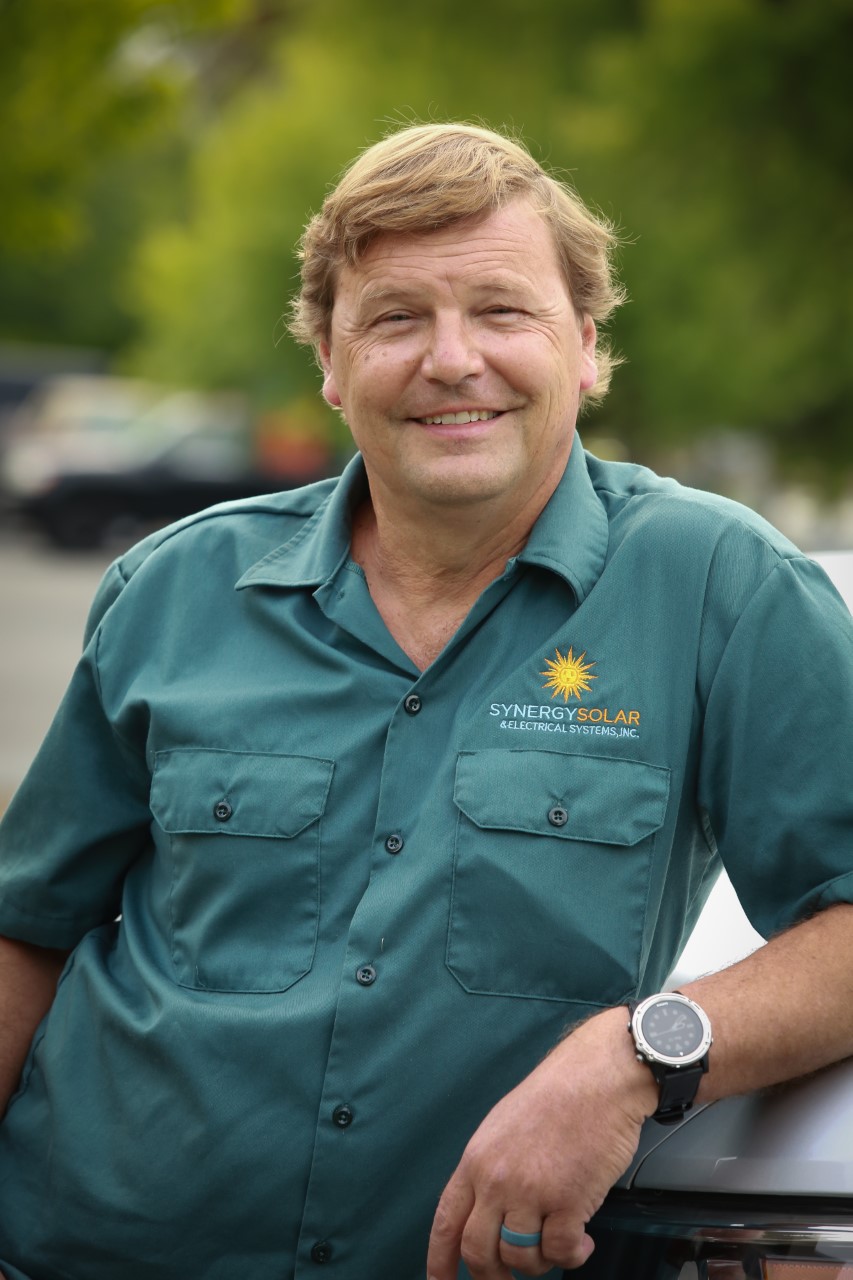
Jeff Mathias of Synergy Solar.
What you need to know about solar power
As the co-owner of Synergy Solar in Sebastopol, Jeff Mathias started out in 2006 building off-grid battery systems in remote areas like Cazadero and the Healdsburg hills. He even installed celebrity chef Guy Fieri’s solar system — the batteries survived the Kincade fire, but the 100-panel solar array didn’t.
While Mathias is currently backlogged at least three months on solar battery-storage installations, he took time out to talk about SGIP rebates, islanding, and how to get educated about solar.
Q: If I’m interested in solar with a battery and I call you and you come out to my house- what happens from there?
A: What I typically do is talk about how solar is really a justification based on a bill. We get a customer’s 12-month PG& E history and we size the system based on that. With that 12-month history we can come to an equation where we say, ‘We’re going to leave you with a $10 minimum charge, but we’re going to eliminate your electric bill basically.’ Most often it’s a dollar-and-cents decision. My main goal with that customer is to set expectations. We sell our systems almost exclusively under what we call protected load panels. Our systems aren’t designed to run the whole house. We don’t want to run the hot tub, we don’t want to run the pool pumps or the air conditioner or even the electric car charger, because if the power goes out at midnight, the whole battery will be transferred to the car. We set the expectation — what do we want?
Q: In addition to tax incentiues, how do people qualify for the equity of resiliency portion of SGIP rebates?
A: It comes down to basic ‘and/or11 logic. If you are in fire zone 2 or 3 OR have had two or more power shut-off events AND you have an electric well that will be on the battery OR you’re on the medical baseline OR you’re low income, then you can qualify for the equity resiliency portion of the SGIP. That’s a rebate of a dollar a watt. So on a Sonnen Eco 20, that’s a $16,650 rebate.
Q: What is “islanding” and what physically happens when there’s a power outage?
A: If we didn’t have islanding, when the power went out, your system would be exporting power to the grid and there would be absolutely no way for PG&E to shut it off and thus no safe way for them to work on the electrical lines that were down. So now, with battery systems, they all have an automated disconnect switch. When it senses the AC system is down, it literally disconnects the house’s system from the grid and then allows the microgrid behind the grid to charge the house.
Q: What’s your best advice for a total newbie?
A: I think the best resource for a customer is to basically look at three vendors, try to get three different technologies, and let the vendors educate. And try to keep it to local and experienced vendors.
You don’t want a salesman who’s only been in business for three months. With three vendors, you’ll get different opinions and different ideas, but you will get educated. To try to find things out on your own is not an easy process.