She spent just 13 years with Jack London, yet the wife of one of America’s most beloved writers, bravest adventurers, earliest environmentalists and infatuated lover of Sonoma Valley, devoted nearly 40 years, until her death in 1955, to protecting and polishing his legacy. This year marks a century since London’s 1916 death, at the young age of 40, and Charmian London would likely be pleased that so much of his Glen Ellen ranch, his accomplishments and his memory have been maintained.
“Mate-Woman,” as London called her, spent decades tending to his copyrights and writings, a prolific output of more than 50 works of fiction and nonfiction, and hundreds of short stories, essays, newspaper and magazine articles, speeches and letters, translated into as many as 70 languages. And with London’s stepsister, Eliza Shepard, she struggled, sometimes mightily, through the Depression and World War II to pre- serve the mountainside he venerated and keep his Beauty Ranch going.
“Jack London loved Sonoma and in an important way, he was one of the first people to put Sonoma on the map and in the international imagination,” said former state librarian Kevin Starr, author of the book series “Americans and the California Dream.” “He sought the redemptive life on the land in Glen Ellen and as a rancher. Collectively, within the 50-plus books he wrote, are guide maps of Sonoma places that later became famous.”
This is a watershed year for Jack London State Historic Park, which occupies a portion of the original Beauty Ranch. The Jack London Park Partners group plans to spend 2016 celebrating London’s enduring legacy. Special events and activities kick off with the Klondike Challenge, encouraging people to pledge to walk 500 miles throughout the year, the distance London hiked from the Yukon to the Klondike in Canada. The kickoff coincides with London’s 140th birthday on Jan. 12. The commemorative year culminates with a memorial at his grave site, on the centennial of his death, Nov. 22. Fittingly, London died on his ranch and is buried there.
To honor her husband, Charmian London built a sturdy stone lodge, the House of Happy Walls, a smaller version of the magnificent Wolf House that mysteriously burned to the ground on a hot August night in 1913, two weeks before the couple were to have moved in. Like Wolf House, Happy Walls was designed by eminent Bay Area architect Albert Farr, to eventually serve as a Jack London museum; the first public visitors streamed under the portico in 1960, finally fulfilling Charmian’s wishes; nearly 100,000 people a year now come to Jack London State Historic Park, and he is remembered by readers around the world.
As a writer, London’s creative fire was stoked by social revolution. Far more than a manly writer of popular adventure stories such as “The Call of the Wild” (1903) and “White Fang” (1906), he also exposed the plight of the underclass and the working poor. His dystopian “The Iron Heel” described the rise of a tyrannical oligarchy that some observers find relevant today. He dressed in rags and lived among the destitute in the streets of London’s East End to research “The People of the Abyss.” His unfettered range took in everything from astral projection to prize fighting to penal reform.
London scholar Earle Labor, an emeritus professor at Centenary College in Louisiana and author of the recently published “Jack London: An American Life,” recalled meeting a young man from the Congo at a seminar. The man confided that his father had been killed in a jungle village, yet the son later learned to read French and discovered “The Call of the Wild,” which has been in continuous print since it was published in 1903. The story of Buck, a tenacious sled dog, inspired the young man’s own survival.
On a recent day in the state park, Tony Holroyde, visiting from England, paused on the porch outside London’s restored cottage and reflected that the rugged American writer lit a fire under him when he was a youth.
“He brought adventure alive in my imagination,” he said. “I don’t think I otherwise would have left the U.K. and spent two years running around the world. But I didn’t do it on horseback and I didn’t do it on a leaky ship.”
And yet in the last years of his short life, the 1,000 words a day London claimed to produce were largely in service to his 1,400 acres overlooking what he romantically referred to as the Valley of the Moon. The most highly-paid writer of his day, London pumped out the prose to pay for Beauty Ranch, his “biggest dream,” which started out as a refuge from urban grime and became a grand experiment in sustainable agriculture. Ridiculed in his time, he’s now regarded by many as a visionary.
Mike Benziger, who planted his family vineyard within the same well drained volcanic soil nearby on the mountain, said London was struck by the overgrazed and degraded condition of the Hill Ranch when he purchased the first 130 acres in 1905 and set out to make “the dead soil live again.”
“He felt he was in a position to save it. That was his life-altering experience the day he set foot on Beauty Ranch,” Benziger said. “That became literally this mission for the rest of his life, to find respite in this place and make it healthier and make it an example for future generations.”
Credit for London’s enduring legacy goes to the early efforts of his widow and several generations of heirs, including members of the Shepard family, who inherited the ranch from Charmian and made most of it available to the state for parkland, and the offspring of Jack London’s two daughters, Joan and Becky, many of whom carry on his commitment to social equality and justice in their own ways.
But London’s spirit has also been taken up by a multitude of other acolytes and academics who approach him from a kaleidoscope of perspectives. They include literary scholars, historians, agriculturists, preservationists, naturalists, teachers and outdoor enthusiasts who roam the 26 miles of trails that crisscross what is now Jack London State Historic Park.
“He wrote books kids used to read and still have to read. That’s how many people get exposed to Jack London, and it’s pretty much all most people know about him. He wrote dog books,” said Chuck Levine, a director of Jack London Park Partners, which has greatly expanded the park’s visibility and use since taking over management three years ago after the state threatened to close it due to budget constraints.
“The reason we should care about Jack London is that he was deeply concerned about the human condition,” Levine continued. “And the fact he was a writer allowed him to express that concern and his views about how the world could be changed to help the state of mankind.”
A meadow and a screen of trees but no fencing separate his property from the park. He lives on a piece of land sold off decades ago to help keep the ranch going. Levine crosses over almost daily. Since moving to Glen Ellen in 2002, the former CEO of Sprint has spent more than 300 hours exploring the park on horseback, just as London did a century earlier. He declares himself a pragmatist but admits, almost apologetically, that when he first crossed a wooden bridge onto what was once London’s land, “In my heart it felt magical.”
Levine is typical of the passionate volunteers who lead nature and historic hikes, give tours, work in the cottage and Happy Walls museum, patrol and maintain the trails, help with special events and man the parking kiosk.
At the same time, the partners are launching a $1 million capital campaign to modernize the museum in the House of Happy Walls with more high tech and multimedia presentations; the exhibit has changed little in decades.
If London were to return today, he would have no trouble finding his way around Beauty Ranch and the park. Aside from the 160 acres that London’s heirs, the Shepards, held back in a family trust when they turned the remainder of the property over to the state in the late 1970s, it has remained largely the same for over 100 years.
Some 700 feet up the slope of Sonoma Mountain, the ranch still has the old fieldstone barns, the elaborate piggery dubbed the Pig Palace by scornful observers, the concrete-block silos that were cutting-edge at the time, the picturesque ruins of the Kohler and Frohling winery destroyed in the 1906 earthquake and now the backdrop for the Transcendence Theater Co., and the mid-19th century cottage where Jack lived with Charmian and wrote in a study outfitted with a Dictaphone, Gramophone and Remington typewriter — high-tech at the time.
Above the working farm is wild land thick with oaks, broad-leaf maples, manzanitas and madrones, as well as Douglas fir and redwoods — the eldest a sapling at the birth of Christ. The mountain is etched with canyons and creeks, and the year-round Graham Creek (Wild Water Creek in London’s day) is a spawning ground for steelhead trout. High meadows break out with golden poppies in spring and offer unbroken views of Sonoma Valley and beyond. Bobcats, mountain lions, gray foxes, hawks and falcons scour the mountainside for prey.
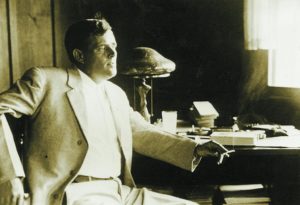
At the center of any mention of London is his larger-than-life persona that makes him a magnetic character even now. He was a dashing man’s man with a face for the camera, and courted danger in exotic places, from the Klondike to the South Seas. He was, among many things, a prospector, oyster poacher, seaman and hobo riding the rails to Washington, D.C., as an idealistic member of the Industrial Army of the Unemployed in the 1890s.
“The greatest story Jack London ever wrote was the story he lived,” said Matt Atkinson, who led tours for years as a ranger at the state park. He is now the fire chief of Glen Ellen, where the name of its favorite son carries on with a hotel, saloon and rustic retail center across from what for years was the World of Jack London Bookstore; it’s now a wine tasting room.
London crammed far more living into 40 years, said Atkinson, than most people would or could in 80 years.
At the same time, he was a bundle of contradictions. His writing ran from pedantic to brilliant. He was a Socialist who was partially raised by an African American wet nurse, yet many of his most memorable characters are rugged individualists. Threaded through his writings are racist tones that make the modern reader wince. He was the highest-paid writer of his day, the first to earn $1 million, which he spent as fast as he made it. He lived well while serving as a voice of the proletariat, and like John F. Kennedy, projected a charismatic virility, yet privately suffered from health problems exacerbated by a reckless lifestyle of hard-drinking, smoking and a poor diet. It all caught up with him at 40.
In his day, London was an international celebrity, as famous as a movie star. His death of reported uremic poisoning brought on by kidney failure — still a subject of speculation and debate along with the burning of Wolf House — rated front-page notice in the New York Times.
As one journalist wrote in the days after his death, “No writer, unless it were Mark Twain, had a more romantic life than Jack London.”
“I like to say that if Jack London were alive today he would probably have a reality show, because he really organized his life that way. He knew the value of publicity. Once he became a famous writer and had developed a persona, he exploited that persona for all it was worth, and in particular, to help boost his book sales,” said Bay Area filmmaker Chris Mullion, who is working on a documentary called “Jack London, 20th Century Man.”
Among London’s most audacious stunts was to promote his book, “Cruise of the Snark.” He and Charmian set sail on the South Seas with crew members who had never sailed before. It resulted in some memorable writing and boosted his star. But London contracted yaws, a hideous tropical infection, along the way, and scholars believe his self-treatment with a mercury-based ointment led to the kidney problems that contributed to his death.
That London was even born is a sort of miracle. The San Francisco Chronicle reported in June 1875 that a pregnant Flora Wellman tried to shoot herself after astrologer William Chaney, with whom she was living, disavowed the baby and tried to force Wellman to have an abortion. She gave birth to Jack six months later. Wellman married Civil War veteran John London when Jack was an infant and gave him her new husband’s name. London was a young man when he discovered that Chaney was his biological father and sought him out, only to be rejected again.
The facts of his life provide endless fodder for researchers and enthusiasts, who comb over writings that were often a mixture of truth and fiction. “Martin Eden” and “John Barleycorn,” an anti-alcohol tract exploited by Prohibitionists, were semi-autobiographical. London had periods on the wagon but he never gave up the drink for good.
“He’s a very complicated person. He’s got a lot of layers to him. I take him not always at his word,” said Tarnel Abbott, 62, London’s great-granddaughter. A social activist in Richmond, her father, Bohemian longshoreman Bart Abbott, was the only son of Joan London. The eldest of Jack’s two daughters, Joan was a radical in her own right who wrote about the plight of farm workers, fought for labor and aligned herself with Trotsky, activities that brought her under the scrutiny of the FBI. Joan had a complicated relationship with her father, stuck in the middle between two warring parents. Her mother, Bess, embittered that London left her for Charmian, kept her daughters away from Beauty Ranch.
But parsing fact from fiction misses the broader message, Abbott said. “There are things he has said or written that have meaning for me, that make me feel like I do try to carry on the way he might approve.”
Of London’s seven great-grandchildren
Abbott has emerged as the most outspoken keeper of the London legacy, and last summer presented an adaption of London’s “The Iron Heel” with music and giant puppets at the state park. Older sister Chaney Delaire — named for her great-grandfather’s absent father — lives in a modest house in Santa Rosa and worked 15 years in planning and community development for the nonprofit Burbank Housing. If there is any common thread through the generations, she said, it’s a deep appreciation of “the earth, the land and how important it is.”
But it fell to the offspring of London’s stepsister, Eliza, to steward the land London declared the most beautiful in California. When Charmian died, she left Beauty Ranch to Irving Shepard, Eliza’s only son. He tried to make a go of it as a guest ranch and dairy farm, but when Irving’s children, Milo, Jill and Joy, inherited the property, it came with a $1 million tax debt. Milo, who died in 2010, adapted by planting wine grapes and selling all but 160 acres of Beauty Ranch to the state in 1979.
His son, Brian Shepard, and Shepard’s cousin, Steve Shaffer, oversee the Jack London vineyards for a family trust. The Cabernet Sauvignon, Merlot, Zinfandel and Syrah grapes have been sold exclusively to Kenwood Vineyards for 40 years. Brian’s brother, Neil, is the owner and driver of the Jack London Ranch Clydesdales and lives on the ranch, as does Shaffer.
They are committed to the same ethos of sustainability set by their great-uncle 100 years ago. Inspired by the farming practices he saw in the Far East, where farmers managed to keep land productive for centuries, London became an agricultural innovator. He terraced the land to protect the topsoil from washing down the mountain in rainstorms. He made his own compost, running a cable car from his mare barn to a manure pit outfitted with a concrete floor to keep in the nutrients. He tilled by horse, not tractor.
“I just came to wonder at how London landed here, on this truly great piece of property. The soils are really deep and varied,” said Brian Shepard, a laconic, 6-foot-4 man with the weathered hands of a farmer. “I appreciate the foresight, the good luck, whatever, that London realized this was a special place.”
“I’m blessed,” added Shaffer, almost sheepishly. “I didn’t do anything to deserve any of this. I just want to do my best to preserve it.”
London is experiencing a bit of revival, with a new generation of scholars examining his life and his work, shining a light on a writer who has not always been taken seriously. Readers may overlook London, some say, because they miss the underlying layers of what appear to be simple adventure stories. But that was a good measure of his genius: He was able to write stories that were page-turners and also had complexity for those who read deeper. Sonoma Valley educators are trying to engage young readers in Jack London, whose legend is still alive in the Valley of the Moon.
“Students are often surprised he had such modern ideas for being a guy who was ‘back in the day,’” said Alison Manchester, an English teacher atdren, Abbott has emerged as the most outspoken keeper of the London legacy, and last summer presented an adaption of London’s “The Iron Heel” with music and giant puppets at the state park. Older sister Chaney Delaire — named for her great-grandfather’s absent father — lives in a modest house in Santa Rosa and worked 15 years in planning and community development for the nonprofit Burbank Housing. If there is any common thread through the generations, she said, it’s a deep appreciation of “the earth, the land and how important it is.”
But it fell to the offspring of London’s stepsister, Eliza, to steward the land London declared the most beautiful in Sonoma Valley High School and a board member of the Jack London Foundation, which sponsors an annual writing contest that draws submissions from young authors from around the world.
“I would call him America’s storyteller,” said Jay Williams, who is at work on the second of a three-volume biography of London while on break from his work at the Huntington Library in San Marino (where most of London’s papers are stored). “That was how he was regarded in his time. We’ve lost that sense of Jack because we’ve been pigeon-holing him as a socialist or a traveler or an adventurer. When you look at him as a storyteller, it encompasses everything he did and that ultimately will be his legacy.”