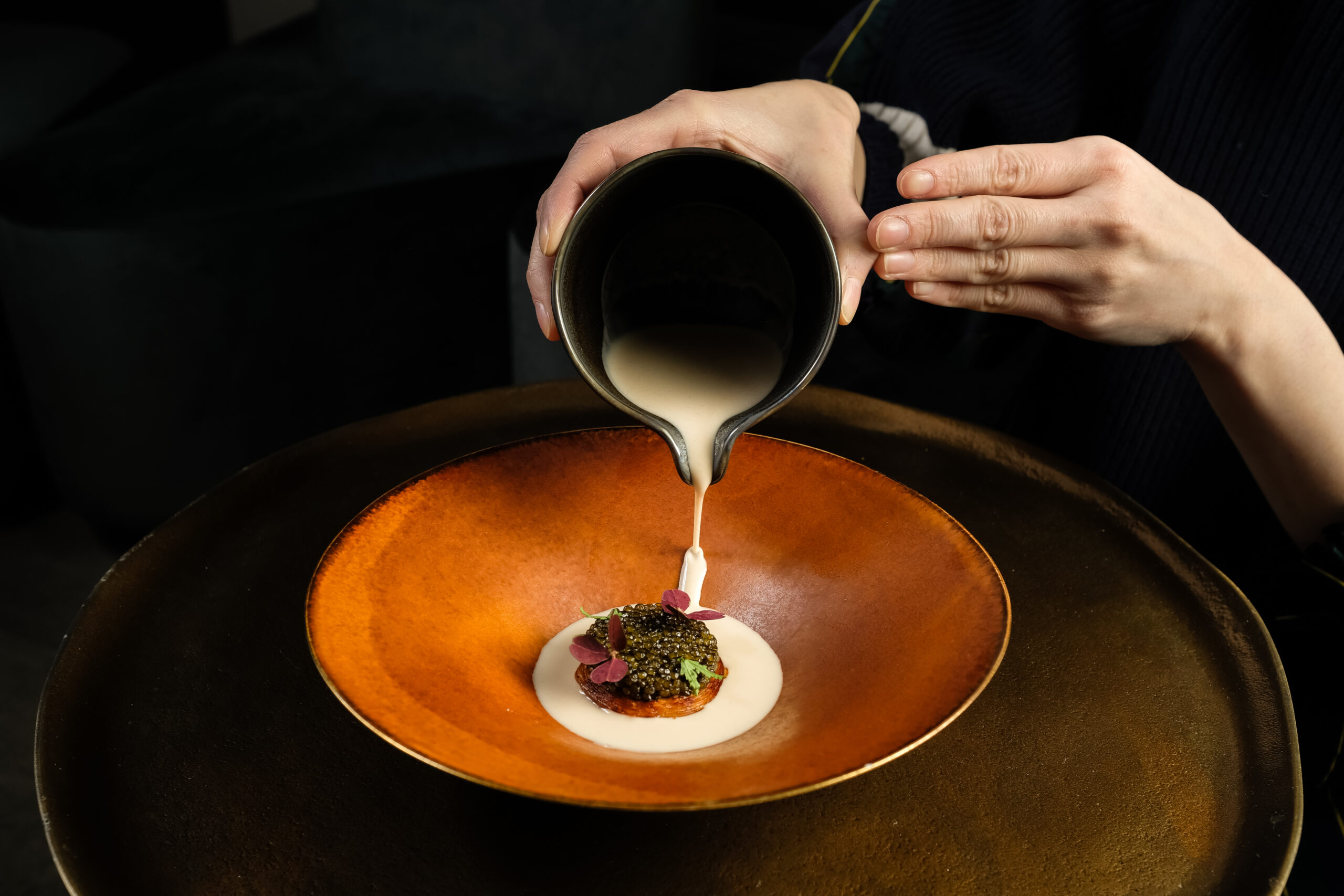
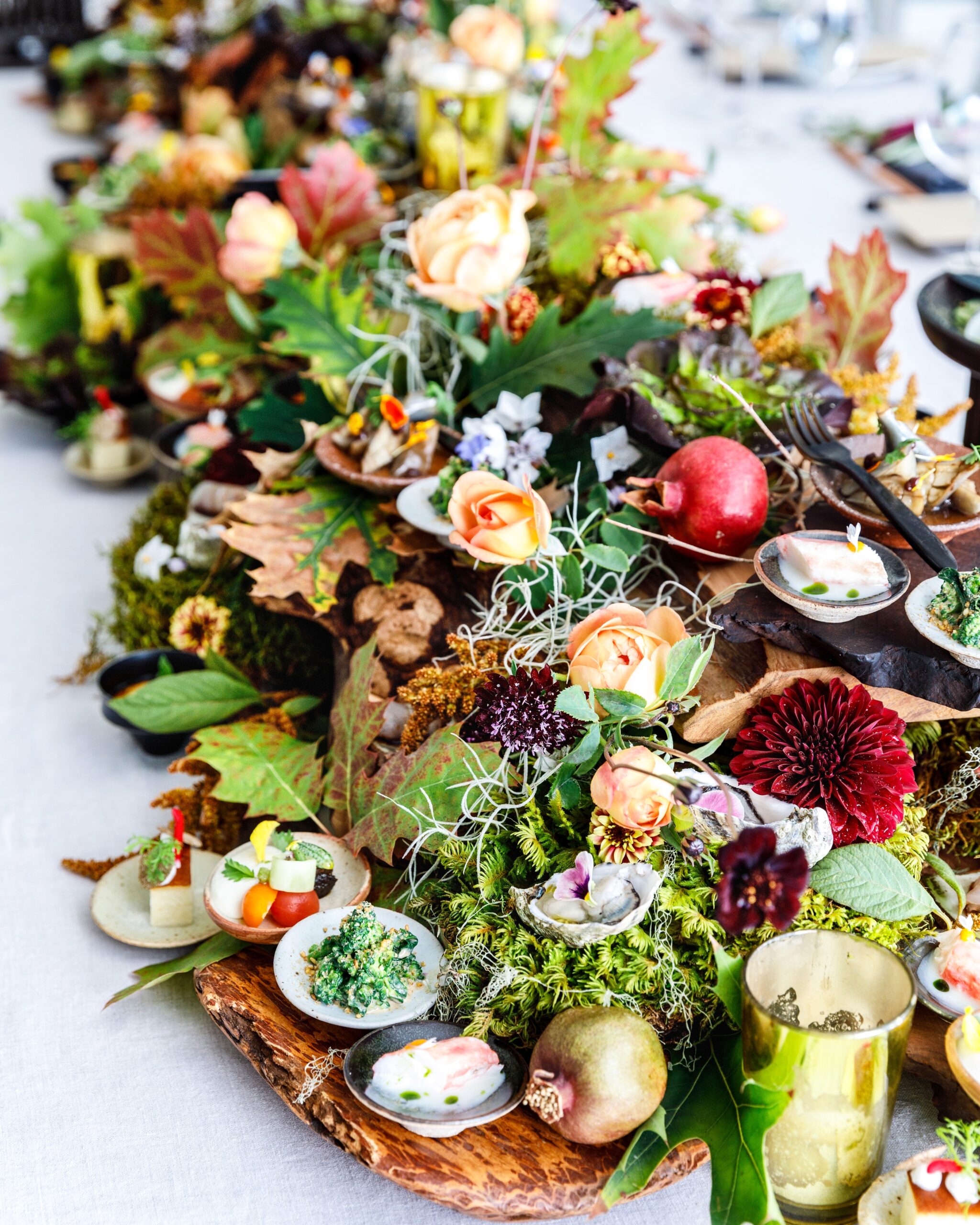
The Art of Plating dinner with Single Thread’s Chef Kyle Connaughton and Katina Connaughton and winemaker Olivier Bernstein on Thursday, Oct. 4, 2018 in San Francisco, CA.
Two renowned Michelin-starred restaurants from opposite sides of the country are joining forces for a night of haute dining in Healdsburg.
On March 31, the husband-and-wife team behind Single Thread restaurant, Kyle and Katina Connaughton, will welcome Junghyun “JP” and Ellia Park of the two-Michelin starred Atomix for a night of culinary collaboration. The two couples will craft a 10-course tasting menu reflecting both restaurants’ Asian-influenced cuisines and service styles.
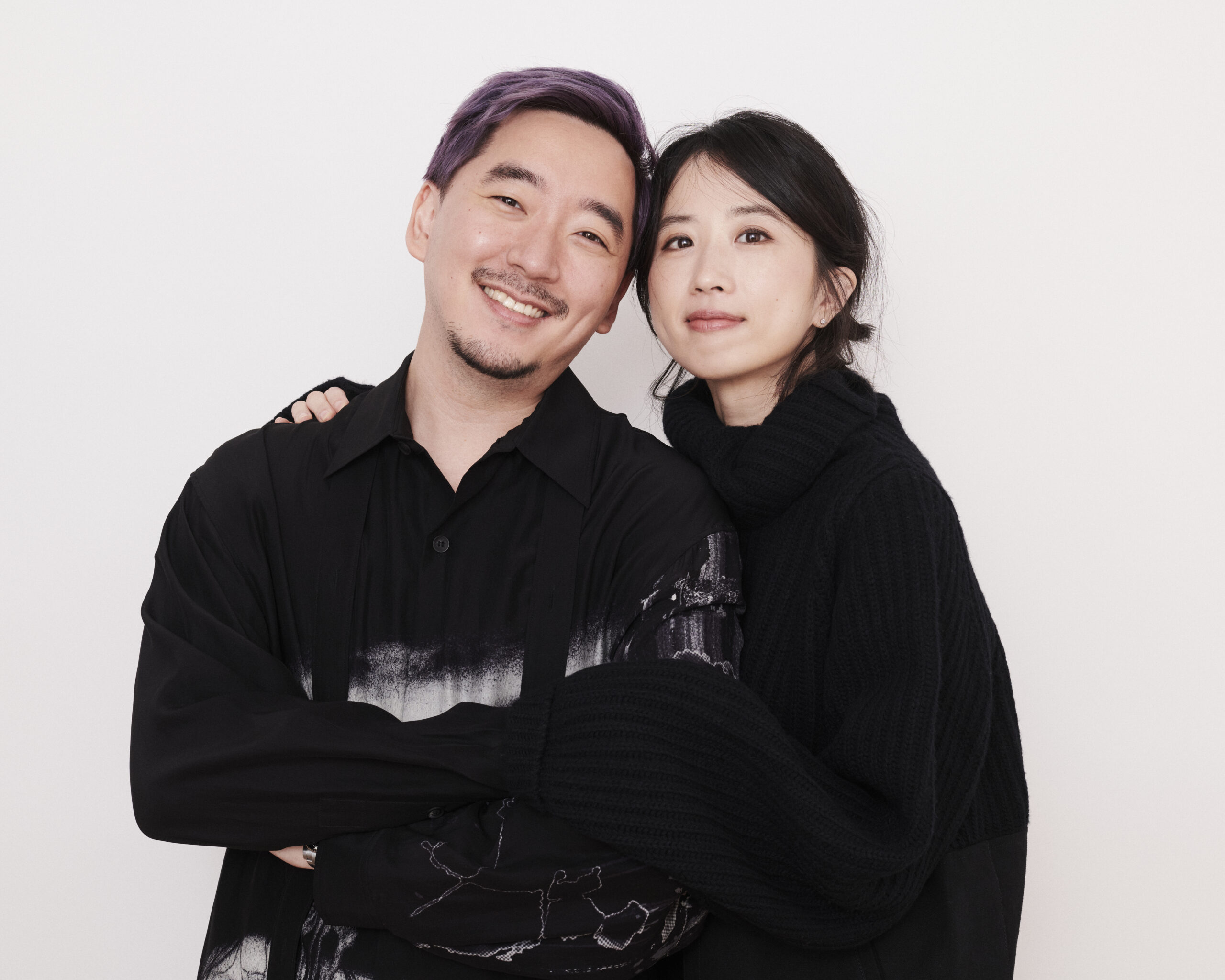
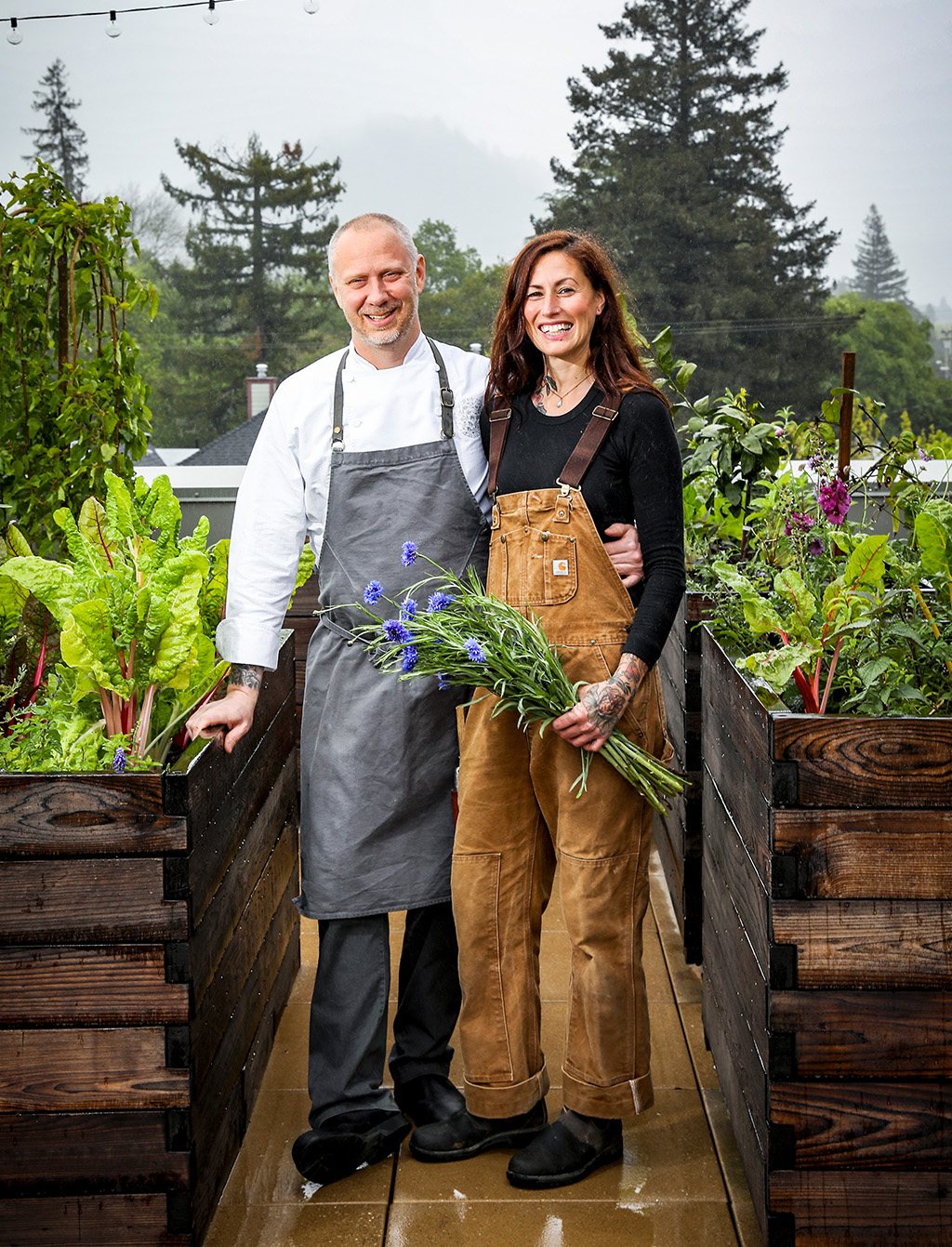
Junghyun “JP,” left, and Ellia Park of Atomix in New York. (Peter Ash Lee)Kyle and Katina Connaughton of Single Thread in Healdsburg. (Eva Kolenko)
This is not the first timeSingle Thread and Atomix have teamed up for a night of Asian-fusion fine dining. In 2019, the Parks hosted a collaborative cooking night with the Connaughtons in New York, during which the four restaurateurs shared their respective techniques and philosophies.
“We are incredibly excited to cook and collaborate with our good friends JP and Ellia,” said Chef Kyle Connaughton in a press release. “We had the pleasure of joining them at Atomix in 2019 and it was so inspiring to see not only their cuisine but also their warm hospitality. We look forward to sharing that inspiration with our team and welcoming them to our home.”
Atomix in New York. (Courtesy photo)
The Art of Plating dinner with Single Thread’s Chef Kyle Connaughton and Katina Connaughton and winemaker Olivier Bernstein on Thursday, Oct. 4, 2018 in San Francisco.
The couples met before their joint cooking ventures came to fruition, when the Parks visited and dined at Single Thread shortly after its 2016 opening.
“We still vividly remember how our first dining experience moved us, through its unique space, cuisine and hospitality,” the Parks noted. “We kept in touch with Chef Kyle and Katina since that visit, and have become good friends since. Collaborations are thrilling because we can exchange two restaurants’ culture and cuisine, and learn so much from the experience.”
Single Thread. (John Troxell)
Single Thread’s philosophy of “omotenashi,” a Japanese word meaning to anticipate and wholeheartedly tend to a guest’s every need, serves to enhance its farm-driven Japanese cuisine. Pair that focus on hospitality and seasonality with Atomix’s sophisticated Korean fare and you get a match made in upscale, Asian-dining heaven.
The collaborative 10-course meal will be served at Single Thread in Healdsburg on March 31 and is priced at $425 per person, plus tax and gratuity. Wine pairing is an additional $300 per person and the reserve wine pairing is $500 per person. Reservations will be available beginning Feb. 1 onTock.
Fried Chicken Dinner for Two with a green salad, bean cassoulet and chicken gravy from Table Culture Provisions in Petaluma. (John Burgess/The Press Democrat)
The concept of “upscale comfort food” has always rung a little tinny in my ears, mainly because cuisine described this way is rarely either.
Fried bologna on white bread with ketchup is comfort food. Add a dash of fresh chervil and sea salt and the dish is just ironic — not gourmet.
Walking the line between comfort food and haute cuisine is the challenge Table Culture Provisions chef/owners Stéphane Saint Louis and Steven Vargas have set for themselves, and they seem to be pulling it off nicely. It’s not impossible to make the disparate styles work together. It just takes the right mindset.
Saint Louis and Vargas gained notice after they invested their pandemic stimulus checks in Tesla and turned the investment into a $17,000 windfall that helped them launch their restaurant and mobile kitchen. Operating out of a borrowed space in Petaluma, they served mostly takeout food and carved a niche in the local dining landscape with craveable dishes like waffle-style potato chips (called gaufrette if you’re fancy) with onion dip, fried chicken, burgers and boozy brunch standards with panache rather than irony. Other special dinners included a Haitian feast, classic French dishes like cassoulet, dry-aged steaks, trout en croute and upscale brunch plates including an insane Monte Cristo.
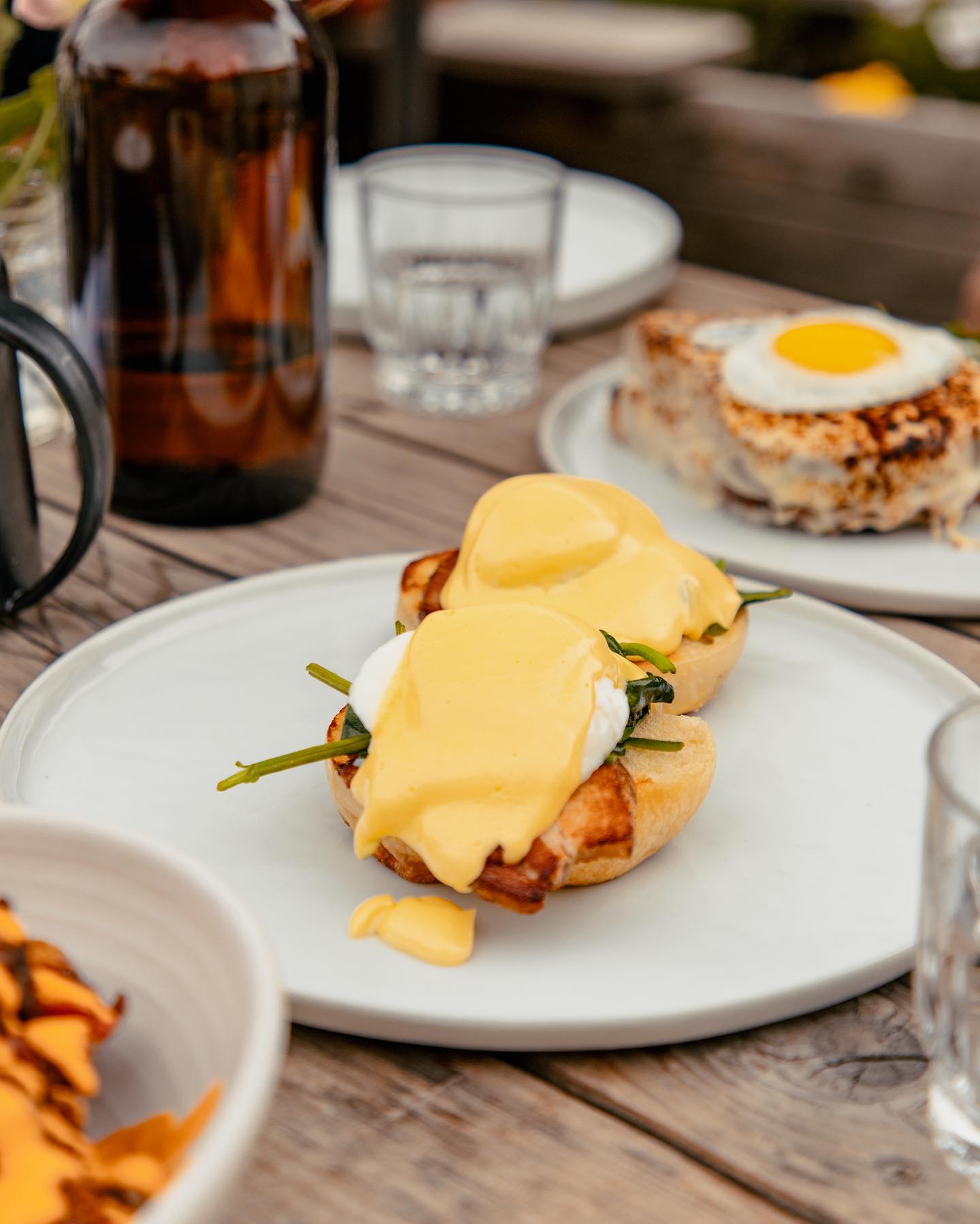
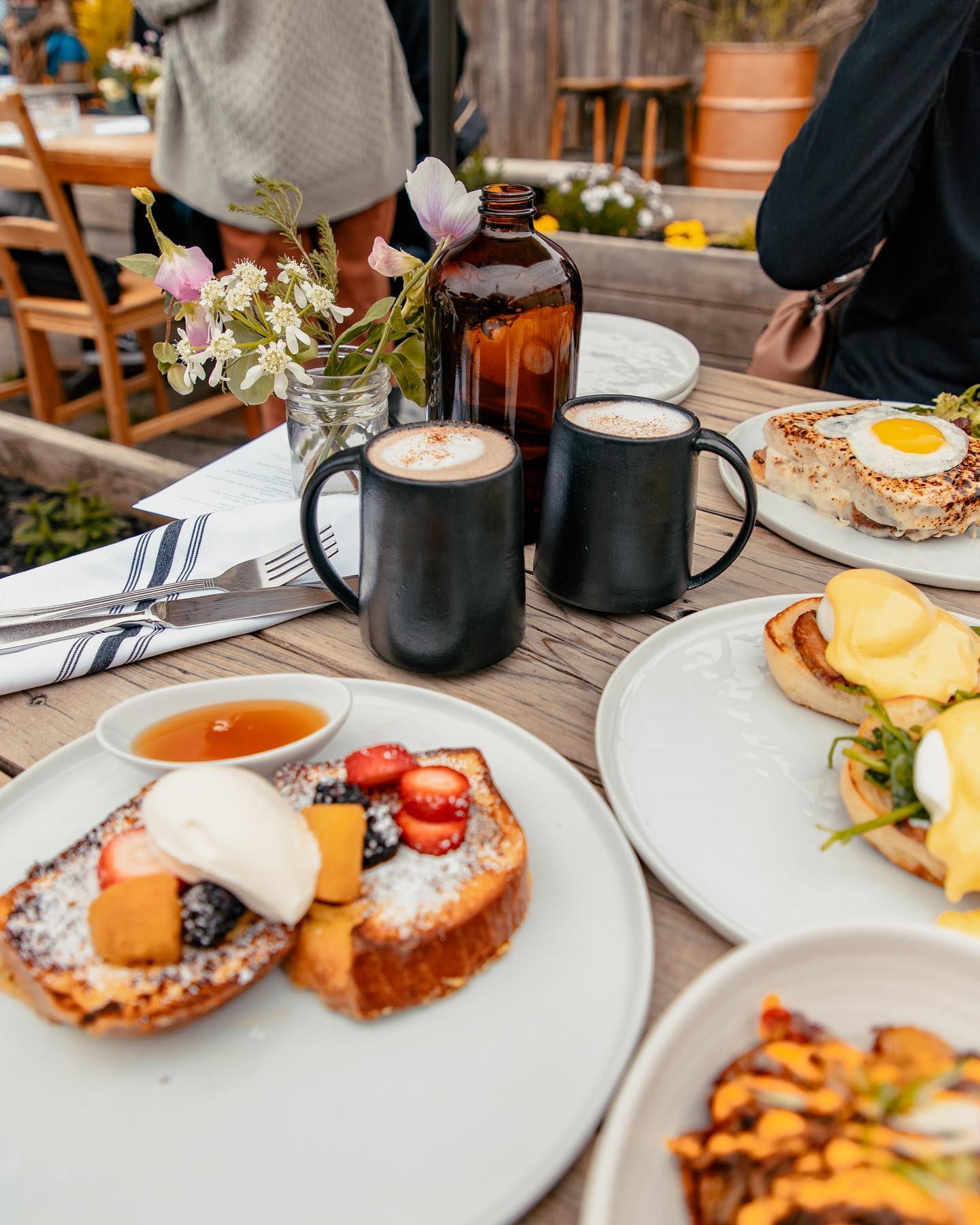
Eggs Benedict from Table Culture Provisions in Petaluma. (Courtesy of Table Culture Provisions)Brunch plates from Table Culture Provisions in Petaluma. (Courtesy of Table Culture Provisions)
Now they’re in a new, small place of their own, in the former Chili Joe’s on Petaluma Boulevard, with many of the same favorites plus plenty of newcomers. The move to the new location is part of a larger plan to work with Asombrosa Farm in Petaluma, a 65-acre plot with a 7,000-square-foot barn and culinary garden.
A New York-born world traveler, Saint Louis grew up in Haiti and moved to Northern California in his late teens, where he attended the California Culinary Academy. Stints at restaurants in Palm Springs, Miami, Petaluma and Sonoma followed. He moved to France to study at the Paul Bocuse Institute, parlaying that into positions in Shanghai and Copenhagen. Vargas is a Santa Rosa Junior College culinary graduate who Saint Louis recruited to work with him at Petaluma’s Della Fattoria and later, the Shuckery.
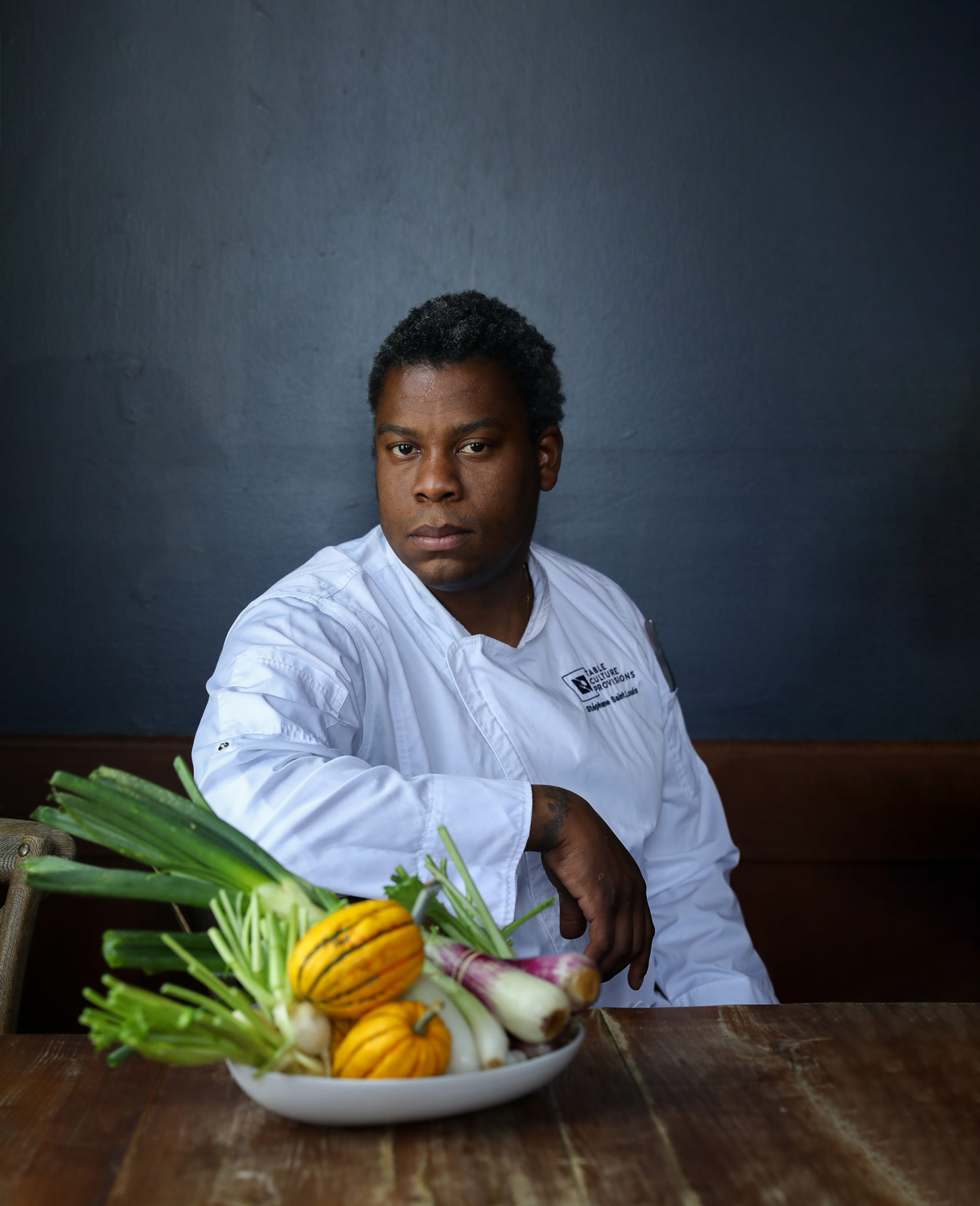
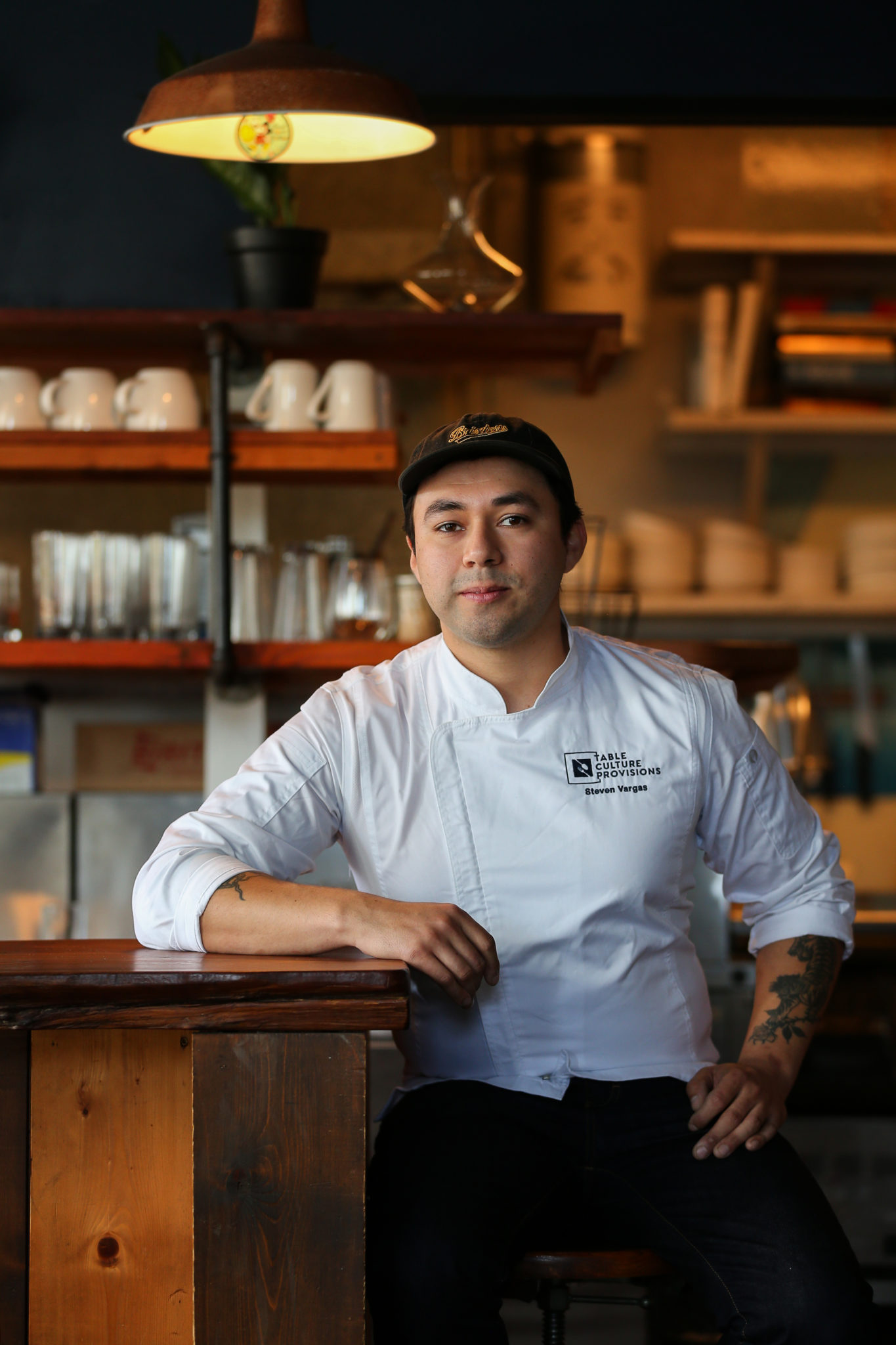
Stéphane Saint Louis, chef/owner of Table Culture Provisions in Petaluma. (Christopher Chung/The Press Democrat)Steven Vargas, chef/owner of Table Culture Provisions in Petaluma. (Christopher Chung/The Press Democrat)
Back to that upscale comfort food. If you’re having trouble deciding which way to lean, consider the tasting menu — highly recommended ($80).
Their amuse-bouche of inky black caviar (add $10) and crisp delicata squash rings begging to dive headfirst into creamy onion dip is both familiar and exotic ($14). This homey comfort food with the delicate and unexpected pop of salty roe is exactly the thing you’d see a chef make for himself after service. It’s creamy, crunchy and supremely satisfying.
Table Culture Provisions is focused on hyper-seasonal cooking, and the Chanterelle Bites ($14) are a perfect midwinter appetizer with bits of mushroom, parsley and herbs in a buttery tart crust. Also on both the tasting menu and a la carte menu is the Beef Croquette ($14) with a confit of melting brisket packed inside a crisp outer shell and dipped in Dijonnaise.
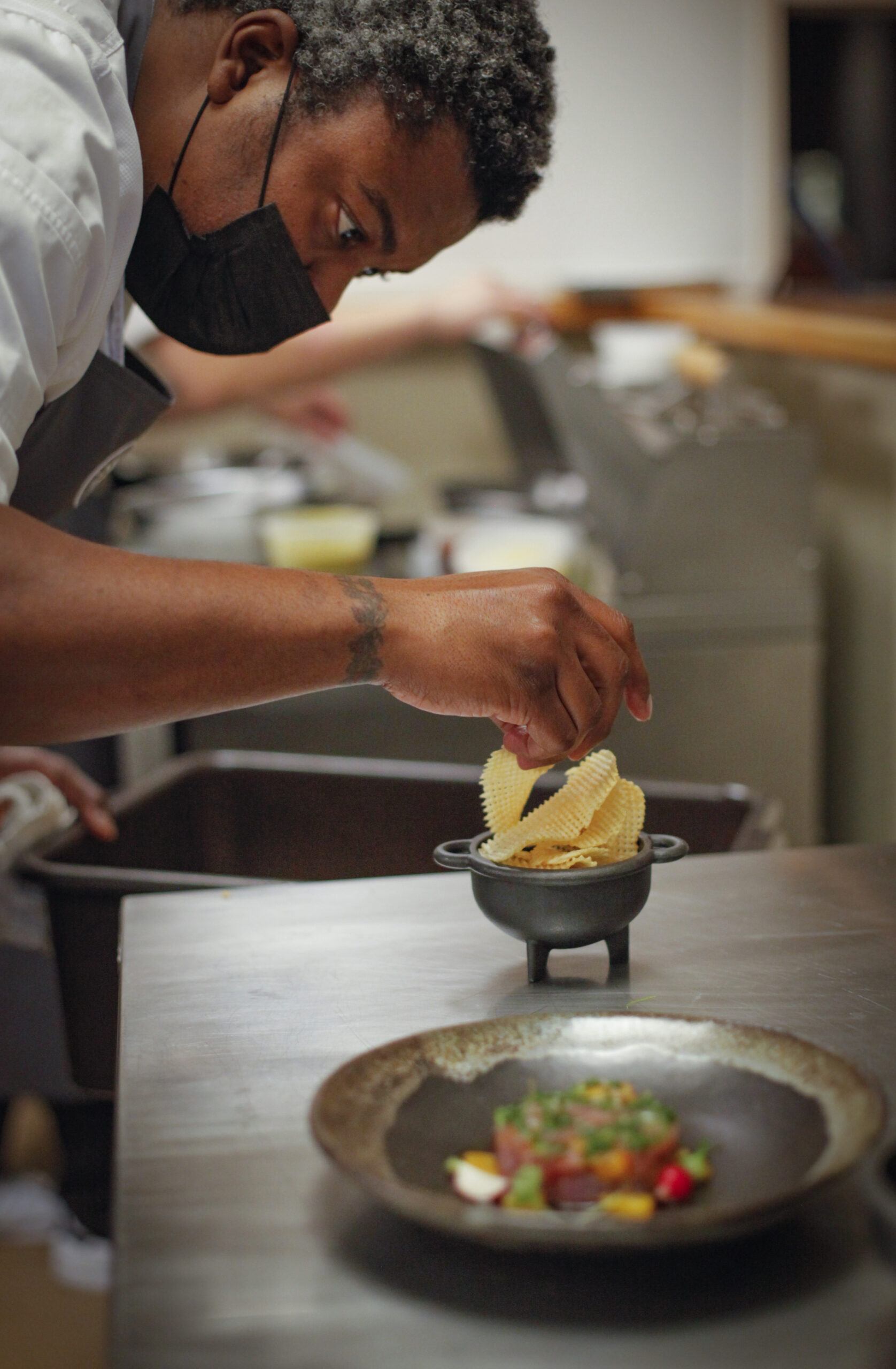
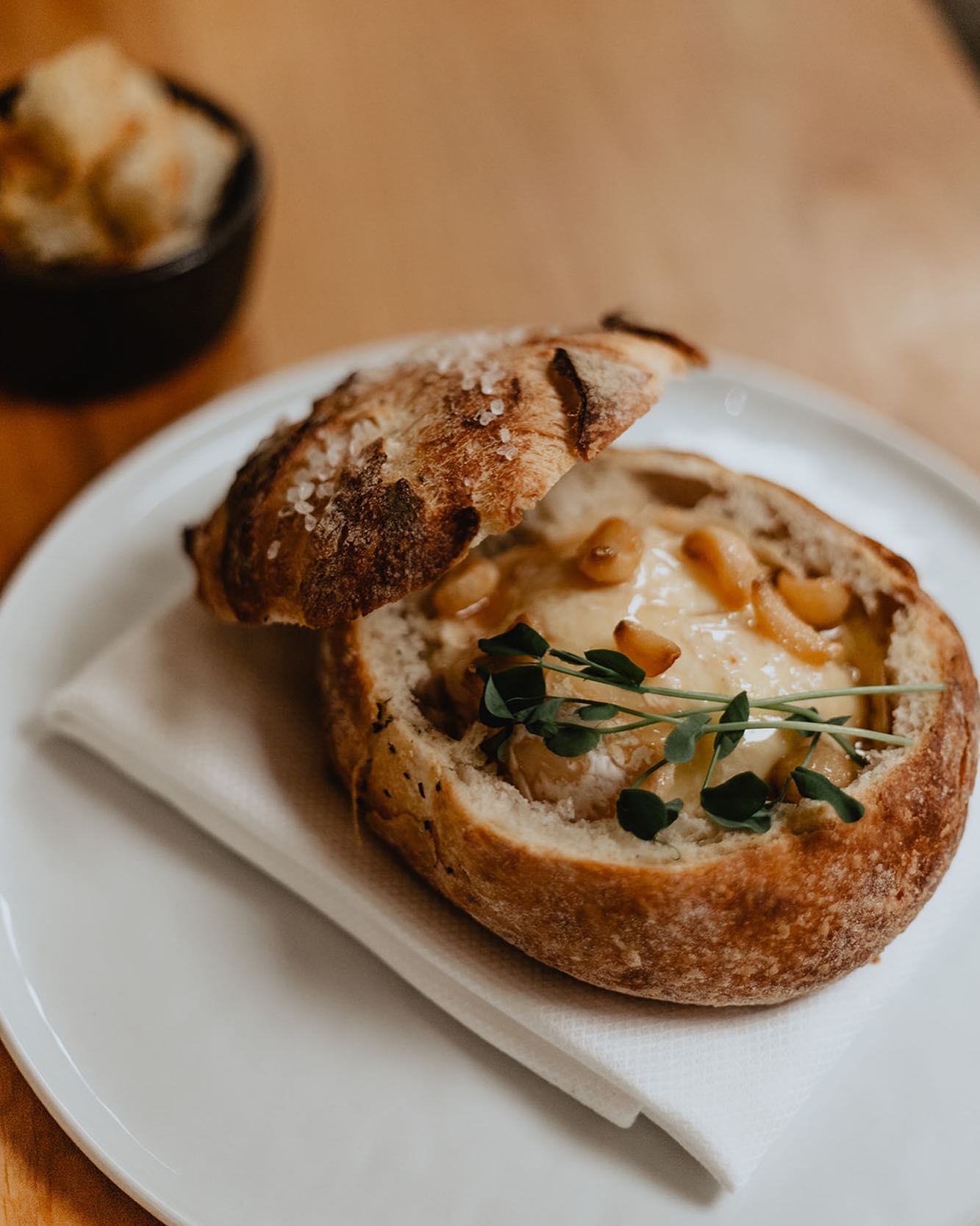
Chef Stéphane Saint Louis puts finishing touches on a dinner dish at Table Culture Provisions in Petaluma. (Crissy Pascual/Petaluma Argus-Courier)Bread and cheese course with Red Hawk cheese and honey candied garlic at Table Culture Provisions in Petaluma. (Courtesy of Table Culture Provisions)
Do not miss the bread course with buttery, yeasty Parker House rolls ($12). If there is a more satisfying bread than these old-style hotel rolls, I’ve yet to find it. Though they’re different in shape than the traditional folded rolls, the buttery tops and sweet, fluffy middles are classics. Beef bone marrow and butter are combined for a spread that’s silkier than a silk worm’s silky pajamas. Nori salt doesn’t add much to the dish, but it’s pretty.
Scallops and cauliflower in the same dish seem like a huge mistake, and at first whiff of the Pan Seared Scallops ($24), I was worried. But the mild, sweet sunchoke puree seemed to bind together the briny flavor of the scallops with the sulfurous crucifer in a surprising way. A bite of crisp garlic chips on top dispelled any further concerns.
The Tomahawk is a tasting menu specialty and required if you’re a beef eater. A petite cut of rib-eye (off the bone) is cooked medium-rare, perfectly seasoned and has a luxurious chewiness that makes you remember why you love steak in the first place. Add shaved truffles if you dare. It comes with potato pave (thin slices of potatoes that put au gratin to shame) and rich jus for a “just-enough” serving. Our sweet finish of a caramel streusel tart was a highlight.
With a clean and minimalist interior, short but tempting wine list and crowd-pleasing menu that includes fried chicken and fish and chips, this tiny 10-table restaurant has figured out comfort food with flourishes of French technique and seasonal ingredients that make a perfect addition to the Sonoma County dining scene.
Sonoma wines can be ordered online and delivered to your doorstep. (Shutterstock)
You’re heeding Sonoma County health officials’ recent request that you stay home as much as possible, until the omicron variant slows its spread. But you still want wine, and you want it now — or at least in time for tonight’s dinner. What to do?
There are rescue “crus” out there for you, services and stores that have sharpened their skills at getting wine to people, pronto, since the pandemic hit nearly two years ago. Order and pay for wine online, then have the goods delivered to your door or your vehicle in the parking lot. No need to enter a store. Convenient and conscientious.
Some contact is necessary to complete a wine transaction, however, as alcohol handoffs from retailers can only happen with photo ID proof that the recipient is 21 or older. In some cases, a signature is required. (In the early, chaotic days of COVID-19, state regulators didn’t actively seek out selling-to-minors scofflaws, but the danger is real today that a business caught providing booze to minors will lose its alcohol sales license.)
Still, the contact is minimal when it comes to buying wine online and having it delivered or available for curbside pickup. Wear a mask and disinfect your hands before and after; the deliverer will do the same, making for a shopping experience that is safer than pushing a cart through aisles and standing in line at the register.
These retailers offer online ordering with delivery and/or curbside pickup. We’re not counting in-store pickup here — once through the doors, you might as well shop for wines yourself.
Sonoma’s Best Modern Mercantile
If you live in the town of Sonoma or visit there, you’re in luck. This store and deli has free delivery to addresses in the 95476 ZIP code, with a minimum six-bottle order. They offer free curbside pickup, too. Sonoma Valley and Carneros wines are plentiful — lots of love is given to Bedrock Wine Co., Bucklin and Mathis, among other producers. There are also some interesting French and Italian bottles, as well as California outliers such as Obsidian Ridge Cabernet Sauvignon from Lake County and Paul Lato Matinee Pinot Noir from Santa Barbara County. All wines are selected by wine director Todd Jolly.
1190 E. Napa St., Sonoma, 707-996-7600, sonomas-best.com
Wilibees Wines & Spirits
The two Wilibees locations, in Santa Rosa and Petaluma, offer an expertly chosen range of wines, many from local producers whose wares aren’t in chain stores as they simply don’t make enough. The selection of small-batch whiskeys and craft beer stored in temperature-controlled coolers is also impressive. The Santa Rosa Wilibees has a high-end deli and a wine-and-beer tasting bar. Those not ready to venture inside can order online or by phone, then arrange for curbside pickup.
700 Third St., Santa Rosa, 707-978-3779, wilibees.com
All too often, wine buffs find very little excitement when perusing the shelves at chain supermarkets. The big stores carry mostly the same, or similar, wines, supplied by mega wine companies. Yet living in Wine Country has its perks and most of Safeway’s Sonoma County stores have sections devoted to Sonoma and Napa wines, alongside the bag-in-box Franzia Chardonnay, the Barefoot Bubbly and the mass-produced Veuve Clicquot Champagne. Purchases of six or more bottles score a 30% discount.
Safeway has a confusing number of delivery and curbside pickup programs, with varying fees, digital coupons, promo codes and membership perks. Calculating the cost of a wine order from the website is difficult, given the many parameters, but $10 appears to be a typical delivery fee for orders of $30 or more. Exact fees are displayed when the order is placed and take into consideration the value of the order, requested delivery time and distance between the store and destination. In Safeway’s “drive up and go” service, online purchases are delivered by a store employee to your vehicle, which you park in a designated space.
safeway.com
Whole Foods Market
For years, Amazon tried to figure out how to sell, ship and deliver wine to consumers across the country. Thwarted by different alcohol beverage regulations across the states — California is a snap compared to New York and Pennsylvania — the company now routes online wine orders and delivery through its Whole Foods stores in states that allow it. Many of the usual suspects are available — the ubiquitous Kim Crawford New Zealand Sauvignon Blanc, Kendall-Jackson Vintners Reserve Chardonnay and multi-varietal maker Josh Cellars, for example. But there are also many Sonoma-made gems, among them Alexander Valley Vineyards Cabernet Sauvignon, Siduri Russian River Valley Pinot Noir, Carol Shelton Wild Thing Mendocino County Zinfandel and Silver Oak Alexander Valley Cabernet Sauvignon. There is a $9.95 charge for local delivery, which can happen as quickly as two hours. Visit each store’s website and click on wine; from there, the transaction is directed to amazon.com.
1181 Yulupa Ave., Santa Rosa, 707-575-7915 wholefoodsmarket.com/stores/santarosa
390 Coddingtown Mall, Santa Rosa, 707-542-7411, wholefoodsmarket.com/stores/coddingtown
621 E. Washington St., Petaluma, 707-762-9352, wholefoodsmarket.com/stores/petaluma
201 W. Napa St., Sonoma, 707-938-8500, wholefoodsmarket.com/stores/sonoma
In a pinch — Instacart
This app-driven grocery delivery business serves many Sonoma County wine retailers, among them BevMo, Costco, Glen Ellen Village Market, Lucky, Raley’s and Safeway (which also has its own service). Order wines on Instacart (instacart.com/store/hub/alcohol) by typing in your ZIP code to view nearby businesses and their wine offerings. A gig personal shopper will pick up the bottles and deliver them to the designated address. Contactless delivery is advertised for groceries but is not available for wine. Fees and delivery times vary wildly, depending on Instacart memberships, peak pricing, distanced traveled by the shopper and more.
Bottle prices, shopping/delivery fees and timing of delivery can be tricky to predict with Instacart wine ordering, but it just might work in a pinch.
Ordering from the winery
At the start of the pandemic, when tasting rooms were closed by state order, some wineries offered their own delivery services to keep the revenue flowing and people employed. If you’re keen on buying wines directly from particular producers without leaving the house, call the tasting rooms to inquire about delivery or pickup possibilities. This service might not appear on websites, but you just might get lucky.
The new Troubadour sandwich shop from the owners of Quail & Condor is currently serving an egg salad sandwich that might be enough for two, with Japanese-style milk bread leavened with croissant trimmings, then mixed with buttermilk and toasted milk powder for a sweet, indulgent sandwich just asking for bites that are more face-plant than nibble. (Heather Irwin/Sonoma Magazine)
When England’s Fourth Earl of Sandwich bestowed his title upon two slices of state bread wrapped around a cold slab of roast beef — or so the story goes — it was out of convenience rather than culinary creativity. His rousing 1762 card game simply couldn’t be interrupted for something so banal as sitting down to eat. Silverware be damned.
It would be centuries before Lord Sandwich’s rather blank culinary canvas became a respected food genre that includes such classics as the Dagwood with its mile-high lunch meat, bread and cheese; the sugary overload that is a Fluffernutter (marshmallow fluff with peanut butter); the open-faced croque-monsieur with ham, cheese and bechamel sauce; or the soon-to-be-legendary Hokkaido milk bread and egg salad sandwich now being served at Healdsburg’s Troubadour as a daily special.
Made with inch-thick slices of pillowy Japanese-style bread, creamy egg salad and whole hard-boiled eggs, it’s a monster of a sandwich (perhaps big enough for two) so light you won’t realize you’ve downed the whole thing until you’re holding nothing but crust. The bread is leavened with croissant trimmings, then mixed with buttermilk and toasted milk powder for a sweet, indulgent sandwich just asking for bites that are more face-plant than nibble ($12).
Chicken liver mousse with onion jam on toasted sourdough at Troubadour in Healdsburg. (Heather Irwin/Sonoma Magazine)
That’s the kind of magic bakers Melissa Yanc and Sean McGaughey are conjuring at Troubadour, their newly opened bread and sandwich shop. The Single Thread alums who opened the buzzy Quail & Condor bakery last year have spun off a second Healdsburg business at the former Moustache Bakery, promising “chef-inspired and locally sourced wizardry” in their ’wiches.
At Troubadour, they focus on their housemade sourdough breads rather than the lacquered pastries, cookies and sweet treats of Quail & Condor (though there are a handful of sweets to go with the sandwiches).
Here, messy heaps of warm pastrami are piled on slices of their Super Seed loaf (wheat, chia, quinoa, flax porridge) along with caraway kraut, Swiss cheese and pickled mustard seed ($18).
The chicken sandwich features roasted chicken on Yecora Rojo sourdough (a grain native to Southern California) and topped with shaved truffle, mayonnaise and pan drippings.
The list goes on, including daily specials like a Dungeness crab sandwich ($22) on dark Yecora Rojo sourdough bread with creamy crab salad and just enough yuzu mayonnaise to give it a light citrus kick. Mustard greens add a delightful bitter note.
Don’t miss the Chicken Liver Mousse ($12), a quenelle of velvety mousse with onion jam and toasted sourdough that’s a steal of a deal.
Wine by the glass and beer are available if you’re dining inside at long shared tables, and a small selection of deli items including roasted vegetables and premade sandwiches are available. Chocolate chip cookies, pie and cake along with loaves of bread are available for purchase.
You’ll likely feel overwhelmed with the choices, but you can thank Lord Sandwich for the blessings Troubadour is about to bestow on you.
Lisa Rhodes lives every day with a deeply rooted sense of history. She and her husband, Michael, spent three years restoring an 1898 Queen Anne home perched on a prominent corner just four blocks from the Healdsburg Plaza. It was process that uncovered layers of history and personality within the very walls of the house itself. “When you go through a hundred-plus-year-old home, you just find things—old moldings, knobs, doors. Things you want to keep,” Lisa explains.
Those finds include vintage ledgers with yellowing pages that detail 150-year-old business transactions (“the writing is just gorgeous,” Lisa says), ornate keys to long-forgotten gates, stacks of crumbling newspapers—even a section of redwood wall with the original builder’s name and the date that the home was completed scrawled in blue chalk.
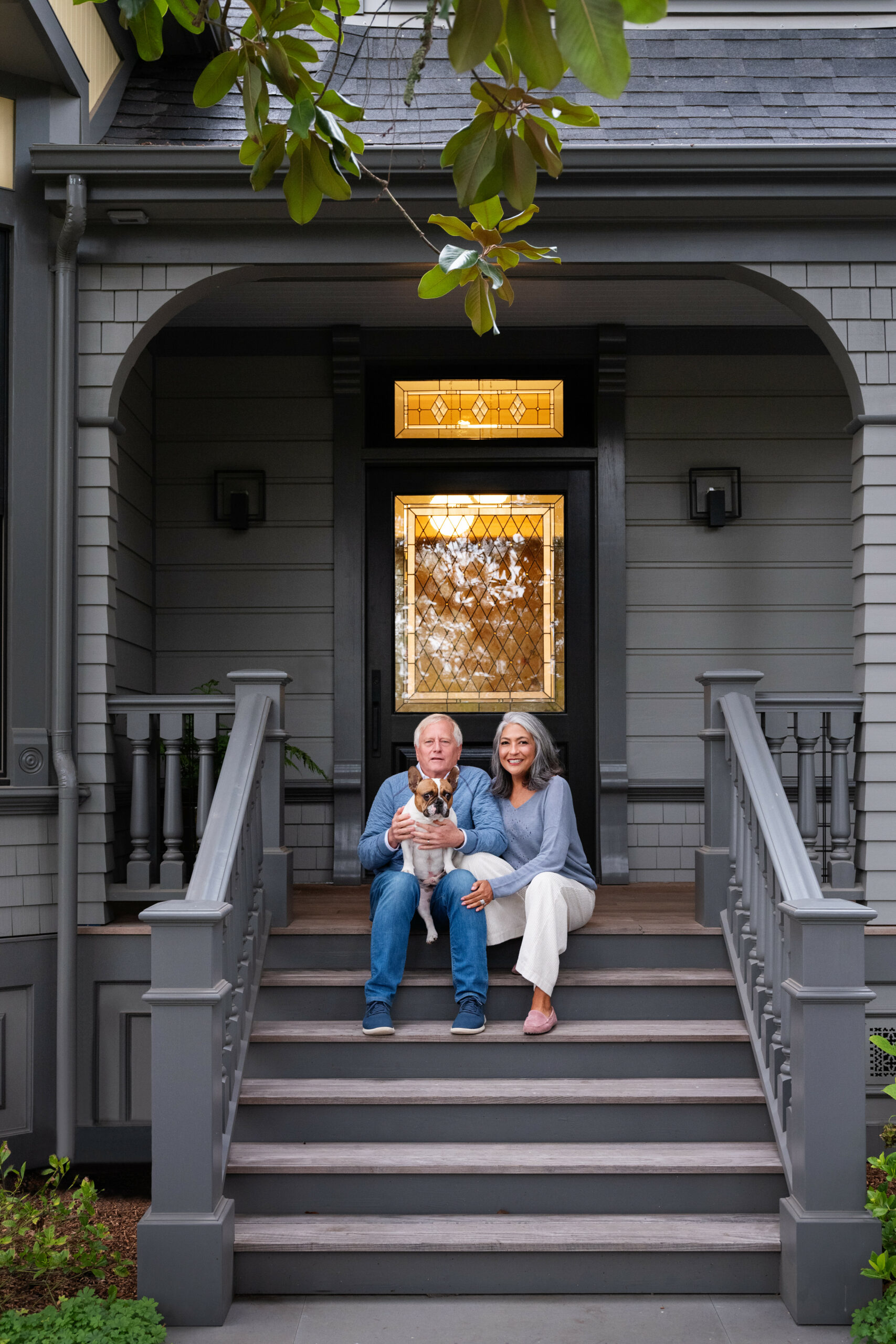
Michael and Lisa Rhodes in front of their home in Healdsburg. (Eileen Roche/for Sonoma Magazine)
Downstairs, in what used to be the home’s root cellar, Lisa keeps a small museum of sorts with treasures unearthed during the remodel. And the memories they hold continue to speak volumes to the home’s newest owners.
“I didn’t know this was going to be our forever home. But I’m just so enchanted by her,” says Lisa. “I believe the house found her people.”
Lisa and Michael hadn’t expected to find their forever home in Healdsburg. Michael, a trial lawyer, and Lisa, who has worked in the legal field and at nonprofits, have family in Southern California and raised their two children primarily in San Diego. “I grew up in Orange County; my husband grew up surfing. We’re beach people, always barefoot in the house,” says Lisa. “But we’ve been welcomed here like no other place we’ve ever lived together.”
Lisa’s work with the local nonprofit Corazón Healdsburg has helped ground the couple within the community. “Our first office was at (the restaurant) Campo Fina. I said, ‘Let’s sit down and see how we can help,’ and before we knew it, we were on the back patio there, brainstorming the vision and the mission.” Corazón Healdsburg advocates for disaster resilience and provides education, health care, and direct financial assistance for local families in need, especially Latino farmworkers. It’s a mission that resonates deeply with Lisa, whose own family is Latino.
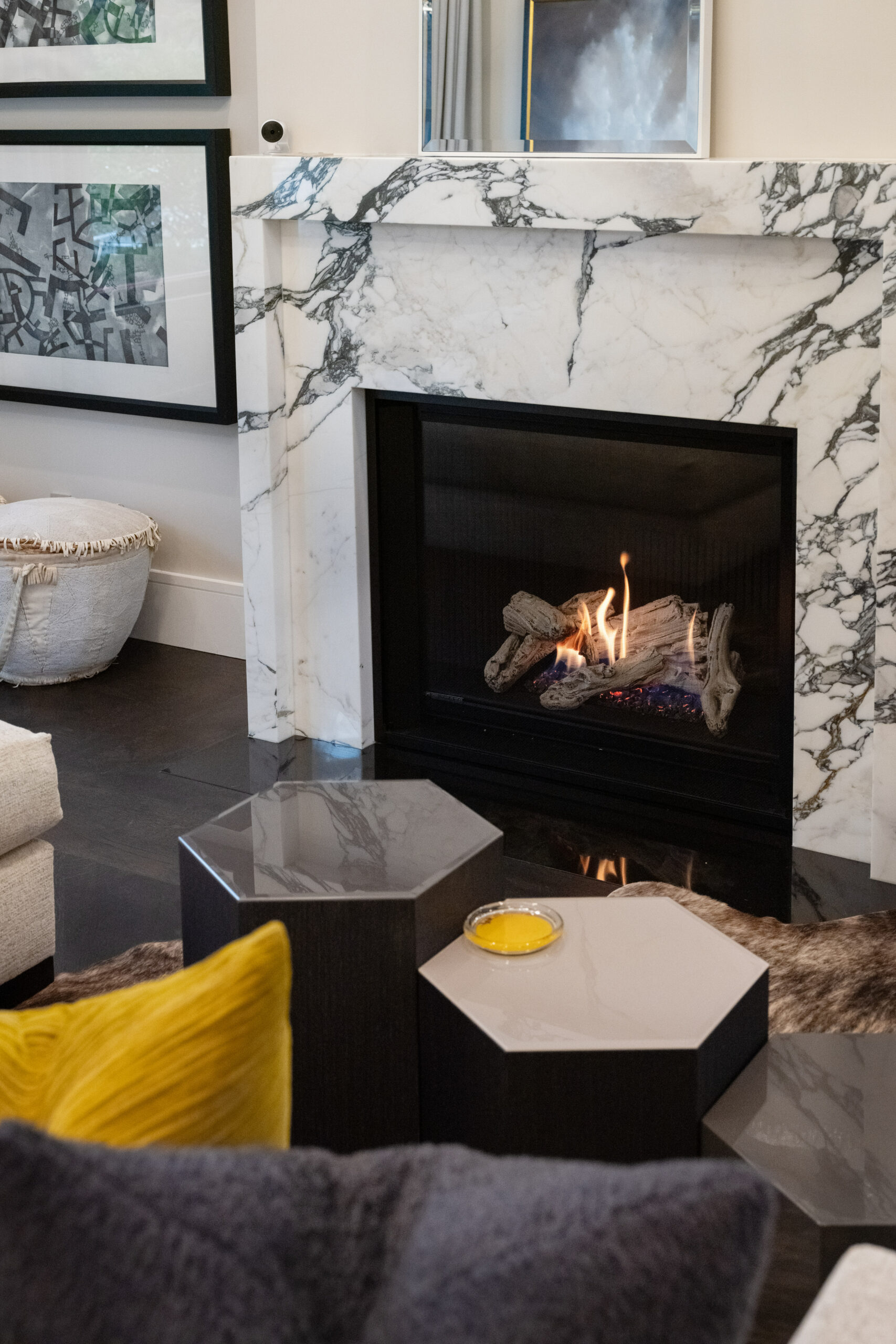
In the living room. (Eileen Roche/for Sonoma Magazine)A fireplace in the living room. (Eileen Roche/for Sonoma Magazine)The home’s glass conservatory area, with Lisa’s collection of ferns and orchids. (Eileen Roche/for Sonoma Magazine)
“There’s a sensibility here; Healdsburg is really unique,” says Lisa. “I think it’s the landscape, being surrounded by these incredible trees. We have sequoias and redwoods, and we get a little bit of every season. We can see the foliage turn and drop. San Diego, where we came from — it’s a temperate 70 degrees year-round. Here, it gets cold, and we can cozy up and turn on the fireplace.”
But to create those comfy spaces for cozying up was rather an undertaking. Lisa and Michael bought the house from the Nortons, one of Healdsburg’s founding families, who built the home in 1898. The home hadn’t had anyone living in it full-time for years and needed lots of work.
Though neighbors in the high-profile location expressed worry that the couple would drastically change the home, or possibly tear it down, Lisa explains that she and Michael always intended to restore it back to glory, particularly the front façade, with its distinctive curved, shingled porch.
With the help of contractor Ken Finley, they rebuilt the sagging beams and restored the exterior in a mix of historically accurate shake shingles and tongue and groove siding, with decorative wood accents. Lisa also relocated the front door to its original location, and worked with a stained-glass artist on a custom design for the transom and door that reflects a subtly modern update of a Victorian style. “We’re lucky we still have craftspeople who can do this work, but as we move into the next generation, I think they’ll be harder and harder to find,” says Lisa.
Now, the front porch and entryway provide a canvas where the couple can embrace their love of the seasons— bountiful displays of pumpkins and squash in fall; Lisa’s famously elaborate ofrenda, or altar, for Day of the Dead in early November; beautiful lights at Christmas; and all kinds of hearts for Valentine’s Day. During these quieter, winter months, it’s also about raised beds for winter greens and planting gladiolus bulbs in the cutting garden, in the shade of a large magnolia that dominates the view from the living room.
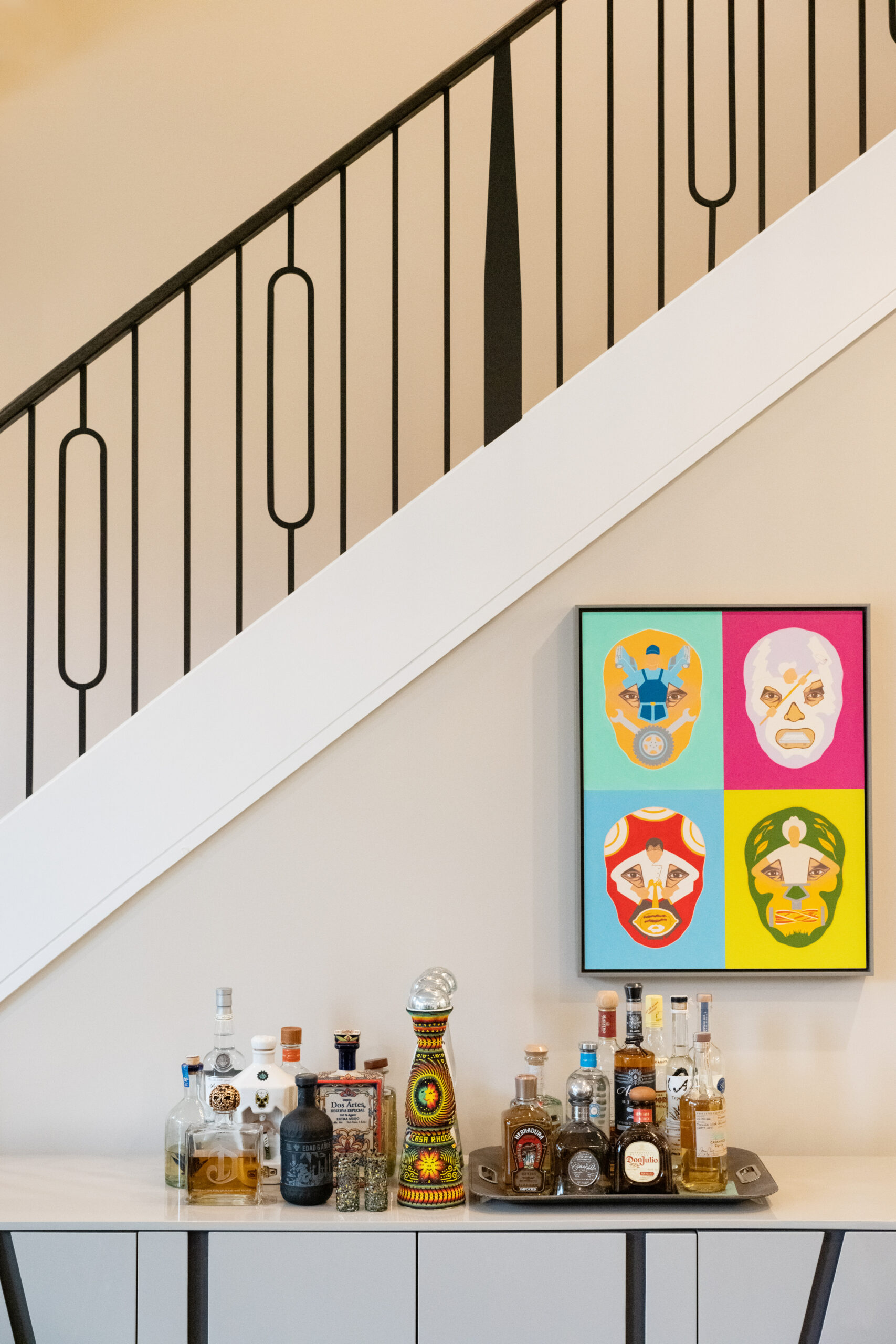
A painting by Bay Area artist Alberto Ybarra. (Eileen Roche/for Sonoma Magazine)In the kitchen. (Eileen Roche/for Sonoma Magazine)
Inside the house, a more modern, casual sensibility echoes throughout the space, which was created in collaboration with architect Bill Egan. “I told him what how I saw things, and we worked together on how we wanted to live in the house,” says Lisa. Growing up, Lisa’s family home was always the spot for celebrating birthdays and holidays, so she and Michael knew the dining area and other entertaining spaces would be key. They enjoy the warmth of the open family room, which has a big fireplace and connects to both the kitchen and the dining room, where Lisa’s tequila collection occupies pride of place on the credenza below a painting by Alberto Ybarra.
Michael often works from home in an office painted a deep crimson, anchored by a vintage painting of an Irish boxer and a vivid Oaxacan rug that Lisa had kept for years, which happened to fit perfectly in the space. Lisa’s office near the kitchen also has a sink for arranging flowers, shelves to store vases and baskets, and files for her design magazines. “I love looking through things, tearing through magazines. My best friend through this whole process from beginning to end was Pinterest. You can definitely be caught down a very deep hole there—and then suddenly it’s dinnertime,” she laughs.
New bifold doors in the family room open out to extensive back gardens and a broad flagstone patio, hemmed in by towering 200-year-old redwood trees. Healdsburg landscape architects Lucas & Lucas also created planting beds filled with Japanese maples and easy-care grasses, and integrated a pool and a small patch of artificial turf for the couple’s French bulldog, Guy.
The couple’s three grandchildren were finally able to visit over the past summer, cozying up with books and stuffed animals in the window seat upstairs, having breakfast in the sunny, pale-pink breakfast nook off the kitchen, and romping with Guy the bulldog out by the pool. Lisa and Michael say they look forward to many more years of memories in the home with friends and family. And the home itself deserves that love and attention, says Lisa. “This is one of the last grande dames here in Healdsburg. I was drawn to her, and she was drawn to me.”
It may be modern mania right now in the world of home design, but classic style has a lot to offer, too. Here’s a look at two Victorian homes — one in Healdsburg and one in Cloverdale — that offer the best of both worlds with historic exteriors and ornamental details yet a sleek and modern look throughout.
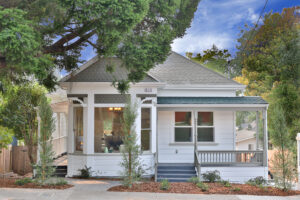
The Healdsburg property, located on Grant Street just off the Healdsburg plaza, was recently renovated by Jim Luchessi of Healdsburg-based JL Builder. Most of the home’s original redwood remains but the exterior has been refurbished and repainted in a way that brings out the original scallop detailing and siding.
New finishes have been installed inside the home to appeal to today’s home buyers (the property was recently sold). Realtor Tatiana McWilliams, who listed the home, says many home buyers are looking for turnkey properties that have been fully renovated. She said they like quartz or quartzite counters in the kitchen because of these materials’ durability (save the marble for the bathrooms, she says) and prefer engineered wood floors over solid wood floors as the former tend to wear better.
The home’s interior walls have been painted white, which highlights the original moldings but also creates a more modern look. Rosettes and bevels have been preserved and add a romantic vibe to the home, especially around a bay window in the sitting room, while sleek cabinets and light fixtures feel very contemporary.
The building has been expanded with additional rooms upstairs, featuring clean-lined trims and moldings, and an accessory dwelling unit (ADU) downstairs with a kitchen and glass doors toward the yard.
Further north, on North Main Street in Cloverdale, a Victorian property serves as both a home and business space. Cloverdale is popular among home buyers for its relative affordability and small-town quaintness and this bright lemon-hued property, listed for $1.75 million, has plenty of charm. It currently houses a hair salon and spa on the ground floor and, upstairs in the residential area, features finishes such as a copper kitchen countertop, highly ornamented trims and moldings and brass bathroom fixtures.
The 3 bedroom, 2 bathroom property has been decorated with modern furnishings and painted in neutral colors that give prospective buyers an idea of its style potential. It also can yield considerable extra income, if the commercial space is rented out.
The home on 131 North Main St. is listed for $1.75 million by Tatiana McWilliams of Compass Realty in Healdsburg. For information, please call 707-303-6230, or email realtor@tatianamcwilliams.com
It’s not every day you hear the words “new construction” and “historic neighborhood” in the same sentence. But a group of brand new properties have recently popped up in between victorian, craftsman and Italianate homes in Healdsburg’s Johnson Street Historic District, located just a short walk from the Healdsburg Plaza.
The new homes were designed in a style that emulates the historic homes in the neighborhood, according to lead architect Matt Taylor of Santa Rosa firm Farrel-Faber and Associates. Rather than creating replicas of the historic homes, the goal was to design the new properties in a fresh way that would make them blend in with the older properties. The color palette of the exteriors doesn’t stray far from the colors of the surrounding homes but design details on the new constructions (window trims, mullions and moldings) have cleaner lines than their century-old predecessors.
The new constructions in the Johnson Street Historic District have sold fast — only two properties remain: an Italianate-style 4 bedroom, 4 bathroom property at 136 Lincoln St. and a craftsman-style 5 bedroom, 4.5 bathroom property at 132 Lincoln St.
The Italianate-style property, listed for $3.4 million, features a wall of windows in the living room that opens up toward the yard and provides the kind of indoor-outdoor living that has become particularly popular in the wake of the pandemic. The paneled walls in the craftsman-style home, which is listed for $3.5 million, have been painted white to resonate with today’s demand for light and airy interiors. This property also has folding glass doors that open toward the back deck and yard.
Both homes come with modern kitchen work surfaces in quartz and quartzite, while the bathrooms feature a more traditional upscale material: marble. Freestanding bathtubs and stained-oak vanities topped with ornate fixtures add a touch of history to the bathrooms. Each home has an Accessory Dwelling Unit (ADU), which is attached to the gated garage. The ADUs have a kitchen and bathroom and can serve as extra living space or a home office. Click through the above gallery for a peek inside the homes.
The properties at 132 Lincoln St. and 136 Lincoln St. in Healdsburg are listed by Mary Anne Veldkamp. For property details, please call 707-481-2672, or email maryanne.veldkamp@cbnorcal.com.
It’s tricky to keep track of all the restaurant openings happening in Sonoma County, even when it’s your full-time job. The hale and hearty spirit of local entrepreneurs won’t be subdued by a raging pandemic, skyrocketing rents, labor shortages and a sobering restaurant failure rate of about 60%. They persist despite all of this, thank heavens.
Click through the above gallery for an updated list of newly opened or soon-to-open restaurants in Sonoma County. (If I missed one you know about, please let me know at heather.irwin@pressdemocrat.com.)
As we settle into winter in Wine Country, mild and sunny days allow us to spend plenty of time outdoors. There’s no lack of places to explore but sometimes we could use some fresh ideas. For a change of scenery, Sonoma County residents and visitors might enjoy a day trip to Napa Valley. Click through the gallery above for some of our favorite places to sip, stroll and play outdoors.
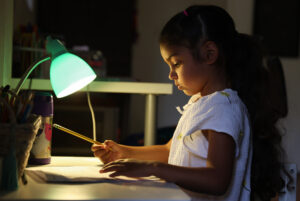
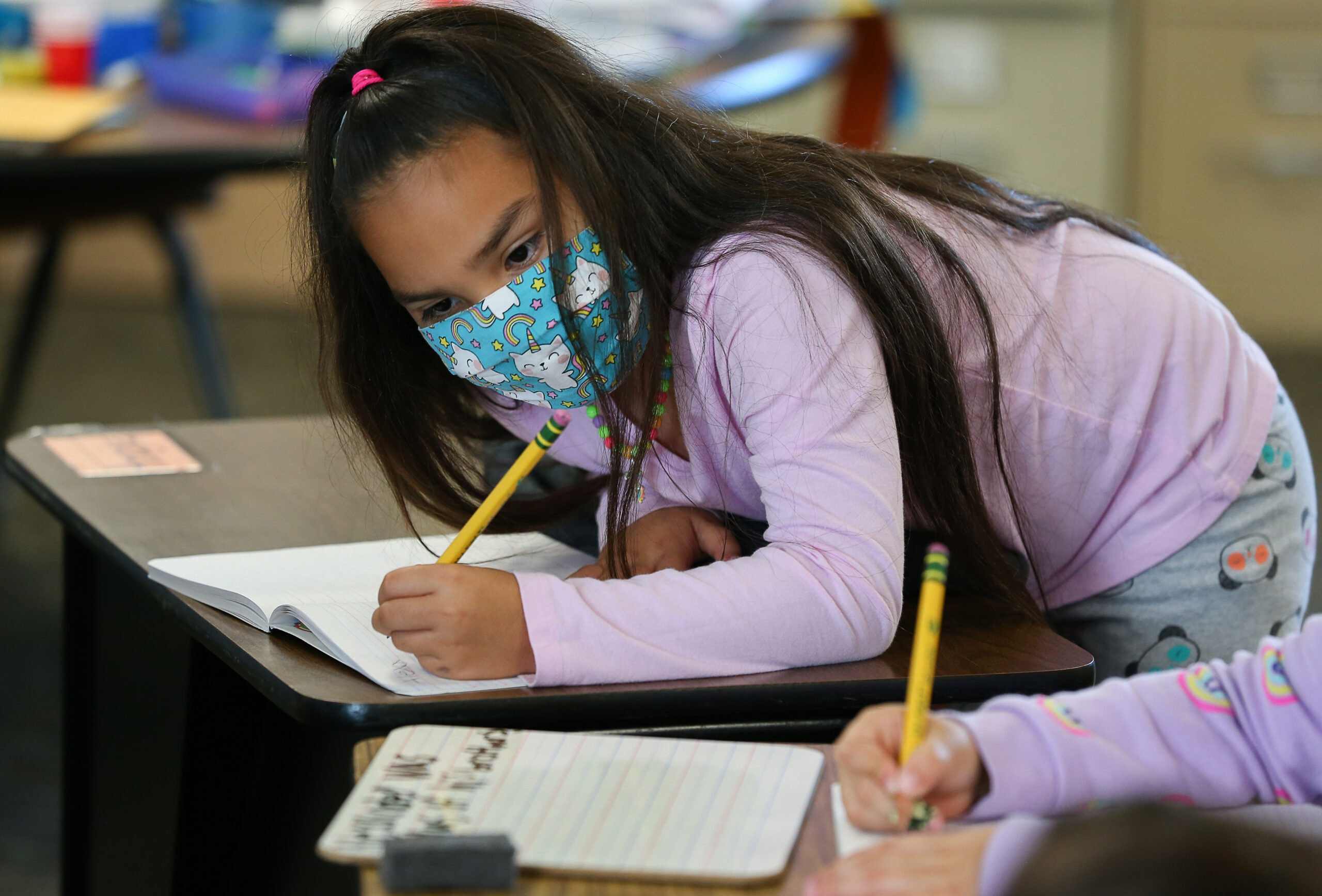
Hania Nazario, 5, a kindergartner at Cesar Chavez Language Academy, does her homework at home in Santa Rosa. (Christopher Chung/ The Press Democrat)
The floor of Jen Grady’s classroom at Mattie Washburn Elementary School was shaking ever so slightly.
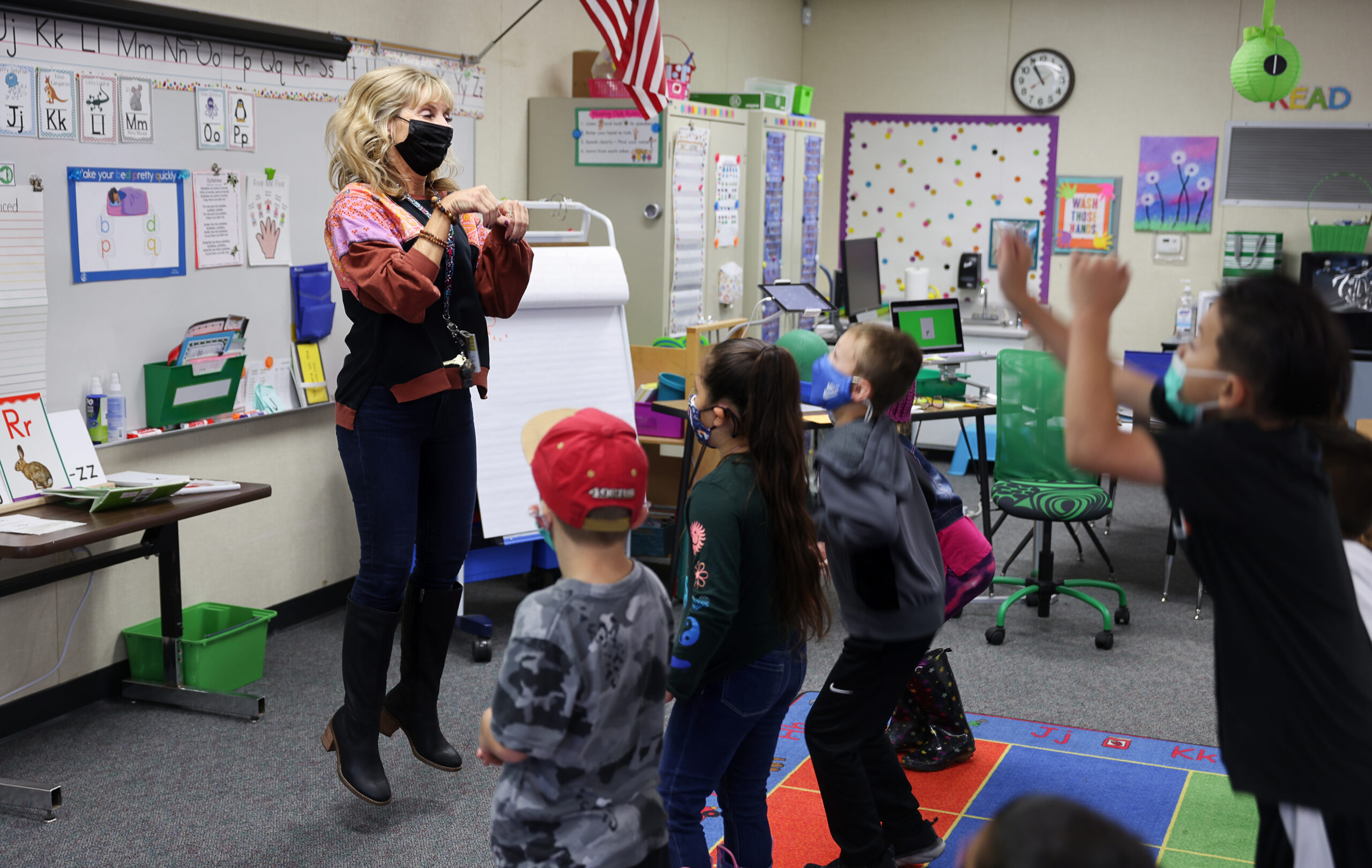
On the plush grid of her multicolored carpet, 10 pairs of feet landed with muffled, rhythmic thuds. As the students, all first-graders, hopped, they sounded out the letter “r,” a tricky consonant for many 6- and 7-year-olds to master. But the movement, mimicking a rabbit, held a clue, Grady reminded them. “It’s a developmental thing,” she explains. “They want to say, ‘er.’”
As a reading intervention specialist who has spent 19 years at the K-2 campus in Windsor, Grady’s job is to help students struggling to meet California’s grade level standards in reading and writing. This academic year, that work — and the shared experience for many fellow teachers across Sonoma County — has been an unsettling game of catch-up. “We struggled choosing who was going to get the spots” in her classroom, Grady says. “Because so many of them needed it. Because so many of them are behind.”
The return of nearly all of Sonoma’s 66,450 public school students to classrooms in August was hailed as a pandemic milestone. As a group, they had been stuck at home and consigned mostly to online-based instruction since March 2020, in some cases for months longer than most of their Bay Area peers—the result of stubbornly high local Covid case rates and local public health guidelines that were among the most conservative in the state.
But that period appears to have exacted a steep toll on the education of many students, say parents, teachers, and learning experts, who now find themselves on the front lines of an unprecedented reckoning with the vast and varied academic ground lost to the coronavirus pandemic and its potentially lasting fallout for a generation of children.
In Sonoma County, the pandemic has compounded academic woes in the wake of repeated disasters — wildfires, floods, and power outages — that have erased weeks of instruction across many school districts since 2017. Now, with Covid still a persistent worry on campus and school workforces stretched by staff turnover, educators and families are struggling to determine just how far students have fallen behind.
Schools have disclosed little data from either this school year or last on student proficiency, but officials are focusing on those likely to have struggled most based on pre-existing trends, and the pandemic’s disparate impact on certain communities. That includes Latino students and those from lower-income families, those with parents who have no work-from-home option, foster and homeless youth, and students with disabilities.
“Some of the struggles are those that would have always existed,” says Kitu Jhawar-Terris, a veteran therapist who oversees a local team of school-based counselors. “But now we’re turning the lens, focusing (on) and understanding more of what challenges and struggles students are experiencing.”
Some signs of trouble — academic and behavioral — have been different this year: Students and educators describe eerily silent classrooms filled with children hesitant to speak up; first and second-graders who struggle to hold a pencil correctly; and, on many campuses, a marked increase in referrals to the principal’s office.
Now, the race is on in classrooms across the county to identify and reach those who fell farthest behind. More than $228 million in state and federal aid has been funneled to local districts to launch new tutoring programs, deploy teams of school therapists, and introduce lessons geared to social and emotional health.
The concern spans all grade levels. Parents of young children fret about the setback in foundational learning, while older students have less time to make up for losses. “I think, historically, the kids that did OK are going to continue to do OK,” says Rhianna Casesa, a professor in Sonoma State University’s elementary education department. “The kids that historically didn’t do OK even pre-pandemic — so, you know, our students of color, our emergent bilinguals, our students from low socioeconomic backgrounds — they will continue to not be OK.”
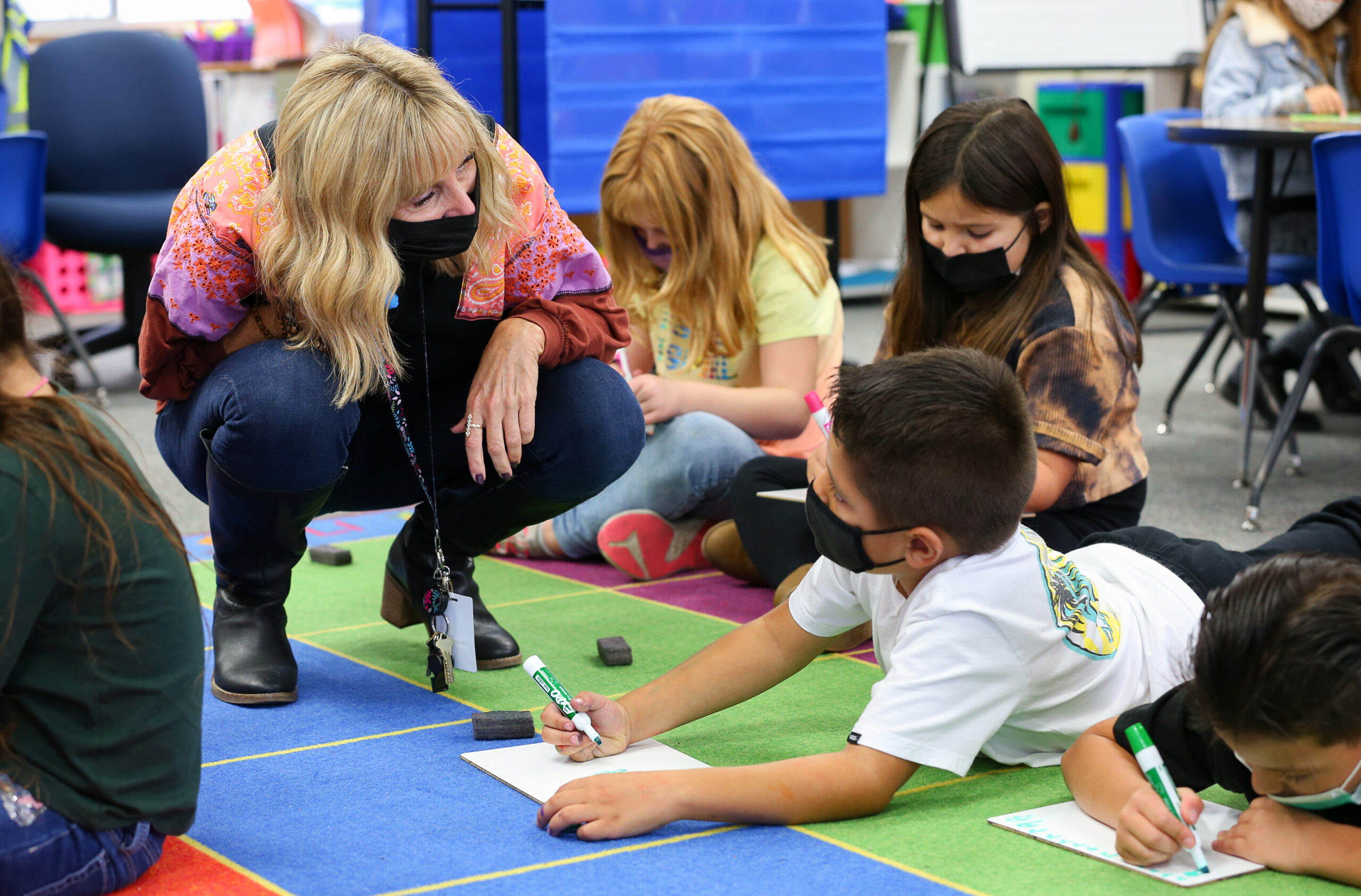
Teacher Jen Grady asks her students at Windsor’s Mattie Washburn Elementary to hop like rabbits while sounding out the letter “r.” (Christopher Chung/The Press Democrat)
Jeanelle Payne says she has been unsettled by the silence that’s taken hold in some of her history classes this year at Montgomery High School. The students talk little, if at all. She asked fellow teachers if they were witnessing the same thing.
They were, says Payne, a 17-year classroom veteran. Students were struggling to break down large assignments into small tasks or were not working well with a partner or in a group. Many teens showed an extreme reluctance to participate in class discussions. “I am seeing withdrawn students, disengaged students. Students who don’t know how to be a student anymore,” says Payne. It is as if some of her students “fell into their screens and they haven’t come out yet,” she says.
Students say they feel the differences, too. For Daniel Garcia, a junior attending Roseland University Prep, the contrast with his freshman year is night and day. “Now that we’re back in school … nobody says anything,” he notes.
The upheaval in the county’s academic calendar can be traced back several consecutive years before the pandemic. It began in 2017, when, a few weeks into the school year, a historic firestorm tore through the North Bay, burning several campuses and 5,300 Sonoma County homes, displacing thousands of families and killing 40 people. More wildfires, inescapable smoke, destructive floods, and debilitating power shut-offs and outages have since added to the tally of missed days.
Students in Santa Rosa, the north county and the west county have missed out on the most instruction in the past five years, according to data provided by the Sonoma County Office of Education. Geyserville Unified School District closed for 33 days between fall 2017 and November 2021. Guerneville School District closed for 32 days, followed by Santa Rosa City Schools and Kenwood School District, both at 31 days. Mark West Union, Piner-Olivet Union, and Rincon Valley Union School District all closed for 25 days.
“We’ve been here before, especially in Sonoma County,” Payne says on the losses that preceded the pandemic. “So, on the one hand, yes, I’ve led students through trauma before.”
But to hear local students, teachers and mental health professionals tell it, the pandemic has traumatized students on a different scale. Hania Nazario, a kindergarten student at Cesar Chavez Language Academy in Santa Rosa, missed only a month of day care at the start of the pandemic. She returned, but with only four other children. So when she started kindergarten in August 2021 at Cesar Chavez, she was overwhelmed and withdrawn, say her parents, Xavier and Karolina Nazario. “The first few days were rough,” Karolina says. “She said it looked like there were a hundred backpacks outside and that was very scary.”
Stephanie Manieri, programs director for Latino Service Providers, a nonprofit serving the county’s Latino residents, described strain among teenagers she works with in the Youth Promotores program. “I’m seeing symptoms of burnout, and I don’t use that term loosely,” says Manieri, an elected board trustee for Santa Rosa City Schools. “They’re really tired and exhausted and unmotivated, and it’s not because they’re receiving no support. It’s just because they haven’t had a proper break, and they haven’t had stability in such a long time.”
Jhawar-Terris, the therapist, says she and members of the school mental health team she oversees with nonprofit Social Advocates for Youth are treating students struggling with the effects of isolation. “Those students who were really excited to go back to school are now experiencing some of that social isolation, even though they’re around friends; they’re around other people,” she says. “They almost have to relearn how to maintain those friendships in person.”
Face masks required in the classroom, while a necessary health protocol, can make it harder for people on campus to connect, say Payne and Garcia. “Sometimes when somebody is talking, their voice is low and muffled by their mask, and it makes it really hard to hear,” Garcia explains.
“It’s also hard with the masks to read faces,” Payne says. “Does this blank stare mean, ‘I don’t understand. Can you ask it in a different way?’ or, ‘I’m physically here, but mentally I’m somewhere else and I don’t care about this’?”
Students and educators describe eerily silent classrooms filled with children hesitant to speak up, first- and second-graders who struggle to hold a pencil correctly and, on many campuses, a marked increase in referrals to the principal’s office.
In Santa Rosa, Sonoma County’s largest school district, officials have had little to show to gauge the breadth and depth of pandemic-era academic loss for students.
The cycle of tests and periodic assessments schools regularly use to measure and track student development was mostly paused while classrooms were closed, and reintroduced in scaled-back form once they returned. Little if any of that data for local schools has been made available. “We know we have students we need to assist in some learning gaps,” says Anna Trunnell, superintendent of Santa Rosa City Schools. “And through this year, we’re trying to find ways we can assist with intervention and additional support.”
Annual reports called summative assessments, revived by the state and federal government this past spring after a hiatus in 2020, were intended to shed some insight into what progress Sonoma County students made toward grade-level standards during distance learning. “There was some concern, with the suspension of testing in 2020, (that) if that was done again, there’s two years without data,” says Jennie Snyder, deputy superintendent of educational support services for the county Office of Education.
Santa Rosa City Schools, with nearly 15,000 students enrolled this year across 25 campuses, used two online assessments to monitor students’ proficiency in math and English language arts, says Kimberlee Armstrong, associate superintendent of educational services.
Third- through sixth-graders in the district were assessed using tests from a vendor called Let’s Go Learn, while seventh- through 12th-graders took tests from Illuminate Education, a data and assessment platform. Some students took the tests online from home, while others tested in person when the district began bringing students back to campuses part-time in April. As of November, the district had yet to aggregate or release school- and district-wide data from those assessments.
Sonoma County’s public school families had waited with excitement and frustration for the reopening of classrooms. Resentment had grown, too, over several months, as students in neighboring counties returned to in-person instruction earlier in the school year.
Several Marin County school districts, for example, reopened campuses for a mix of in-person and remote instruction beginning as far back as the fall of 2020, after the county moved into the second-most restrictive tier on the state’s Covid-monitoring system. Many in San Rafael were able to attend school full time in person by March 2021.
Likewise, Napa Valley Unified School District, which serves 17,240 students, returned to part-time in-person instruction beginning in October 2020 as the county moved into a less restrictive state tier. Sonoma County, meanwhile, remained stuck in the most restrictive category of operations until the state did away with that system in June.
For three weeks in November, Sonoma magazine sought access to data from Santa Rosa City Schools about student performance, including numbers that would show how different student groups fared in assessments and shed light on known disparities between different ethnic groups and socioeconomic backgrounds.
District officials initially provided some data on 11th grade math and reading proficiency, broken down by school, but later said the dataset was inaccurate because it did not capture the entire population of 11th-graders who took the test. A similar snapshot
the district provided of seventh-grader data included several who were listed as students of the district’s high schools. Sonoma magazine opted not to use the data because of its apparent errors.
Trunnell and Armstrong say the district’s migration to a new student data management system over the summer complicated the data retrieval. As of mid-November, the school board had not yet reviewed any assessment data from the previous spring.
“I know there’s a lot of interest in seeing that,” says trustee Stephanie Manieri. “I just imagine there’s a lot of things taking priority.”
School districts will need to report their assessment data from spring 2021 to the California Department of Education by Feb.1.
“(Students) are really tired and exhausted and unmotivated, and it’s not because they’re receiving no support … they haven’t had stability in such a long time.” District Trustee Stephanie Manieri
In the meantime, districts are looking to interim assessments, which are smaller-scale evaluations administered to students several times a year. These interim assessments can be more useful, says Armstrong, the Santa Rosa assistant superintendent. They show teachers what grade-level skills their students are retaining or struggling to grasp across a trimester, semester, or year — what Armstrong calls “leading indicators” of student progress. Instructors then have time left in the term to help their students improve on specific skills. “That’s the true way for us to accelerate learning, based on the individual needs of every student,” says Armstrong.
At Mattie Washburn Elementary in Windsor, students were assessed at the start of school to determine their proficiency in grade-level skills. Students who needed the most help catching up were routed to intervention specialists. At the end of the trimester in November, teachers assessed their students again to check on their progress. “We are going to be using that data (as) not only a step in time of how they’re doing, but then to drive our instruction moving forward,” says Mattie Washburn’s principal, Susan Yakich.
In Santa Rosa, district leaders have not required all teachers to administer interim assessments in the past, or even this year, but Armstrong says it’s now “strongly recommending” the practice. Across the district in past years, she says, some teachers had already adopted, on their own, the cycle of short-term check-ins. “That’s great, but it’s not equitable,” Armstrong says.
Two Santa Rosa campuses are also piloting use of one assessment, called MAP, or Measures of Academic Progress, which was created by an Oregon-based nonprofit, the Northwest Evaluation Association. Elsie Allen High School and Hilliard Comstock Middle School teachers will be using the assessments to track their students’ progress throughout this year, Armstrong says.
District officials have their eye on the 2022 school year to potentially deploy new requirements for interim assessments across the school district.
At Mattie Washburn Elementary School, teacher Jen Grady works with student Andrew Ceja on his writing (Christopher Chung/The Press Democrat)
Sonoma County school administrators have often described their efforts in the current school year as “learning acceleration,” rather than remediation or recovery. The distinction is more than parsing words, according to Snyder, the deputy superintendent with the county’s office of education. It denotes a markedly different approach.
Typically, remediation prioritizes catching students up on grade-level skills they lack from the previous year, before moving into content for their current grade. Alternatively, learning acceleration emphasizes lessons and material appropriate for students’ current grade, using assessments to determine which skills from their previous grade the students need to improve. Teachers then build that content into lessons, as well.
“We began to hear in the spring, ‘We’ve got to reteach and remediate,’” Snyder says. “What the research has really shown is that kind of approach actually sets kids back even further.” She was referring to a 2018 report by the nonprofit New Teacher Project, based in New York, that relied on nearly 30,000 student surveys, more than 20,000 work samples, and several thousand assignments and lessons to assess which students made larger gains throughout a school year.
“We saw a promising trend,” the report’s authors conclude. “When we make different choices about how resources are allocated — when all kids get access to grade-appropriate assignments, strong instruction, deep engagement, and high expectations, but particularly when students who start the year behind receive these resources — achievement gaps shrink.”
The application can look different in each classroom. Elizabeth Olah, an English language development specialist at Mattie Washburn, describes her approach as being guided by her students’ engagement with the skills she’s teaching. “I’m using what’s called the push approach,” she says. “I’m trying to push vocab that is more than what they already know, more than what they’re going to come up with on their own. They might have come in very comfortable with short vowel sounds. Now I’m pushing them to think way beyond that, to words that have multiple syllables.”
“Teachers are being asked to do a lot more than they’ve been asked to do in the past … They need more resources so that they can adequately meet their students’ needs. SSU’s Rhianna Casesa
Jimena Mendoza is a second-grader who spends time with Olah each week. Her mother, Yvonne, said she thought the biggest setback for her daughter during the year of distance learning was with her progress in English language. The Mendoza family speaks Spanish and English at home.
But back in the classroom now, with Olah’s help, Jimena is often the first student to speak up when Olah asks her students to read aloud. Jimena even helps her classmates sound out words and sentences.
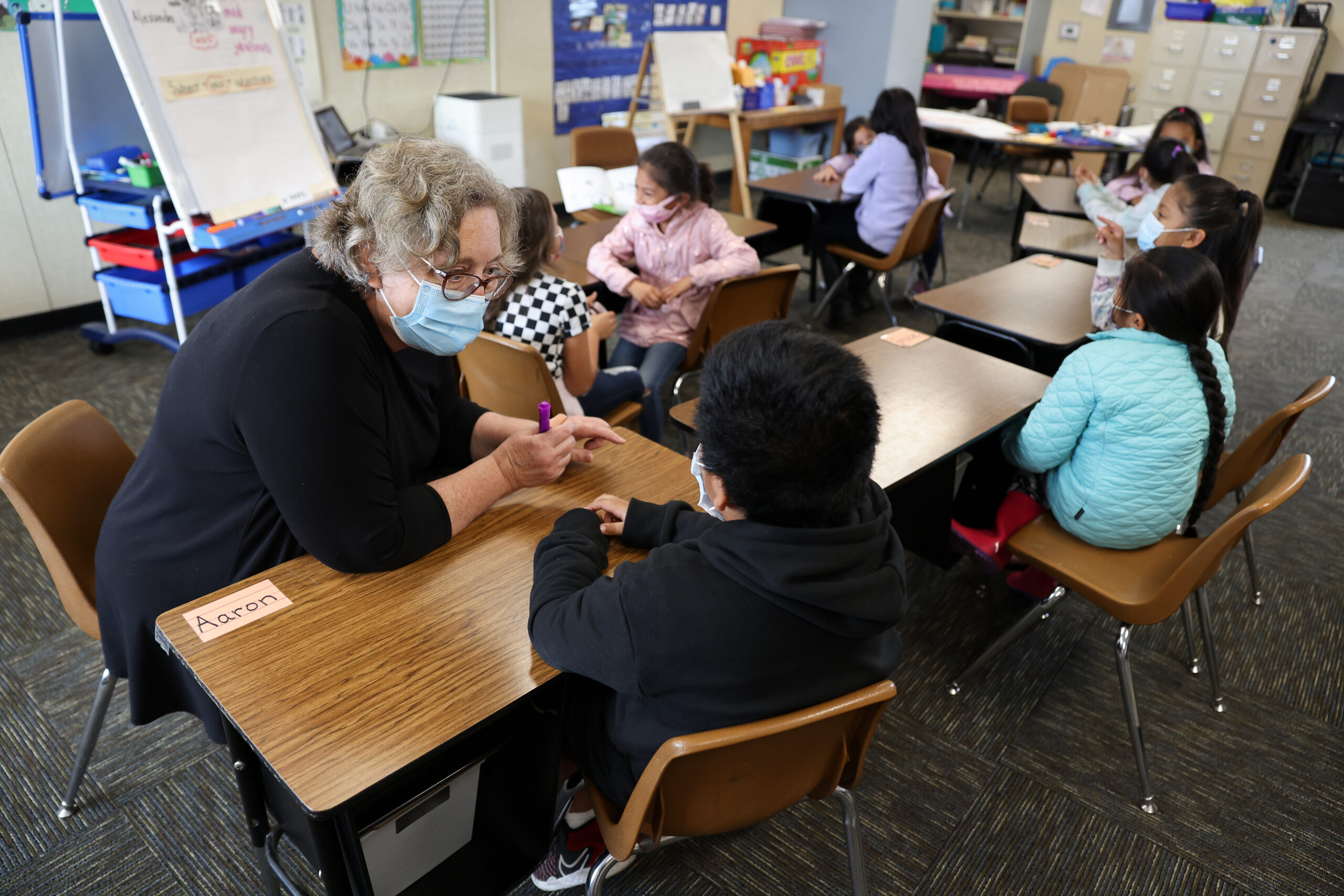
Second-grader Jimena Mendoza-Rios practices writing during her English language development class at Mattie Washburn Elementary School in Windsor. (Christopher Chung/The Press Democrat)
Students, Olah says, have “tells” when they’re ready to move on from one lesson or skill to another. “In the beginning, it’s too hard,” Olah explains. “And then once they get the hang of it, as a group, it comes too easy and they do it too quickly. And then I know they’re ready for more, and I begin to push.”
Casesa, the SSU professor, says it’s important to remind kids that though they lost skills during the year of distance learning, their schools are striving to help them recover. “If you are a fourth-grader and you’re coming into your first day, and your teacher’s already telling you that you need to catch up, it’s pretty defeating,” she says.
A mother to an elementary-age daughter herself, Casesa encourages parents worried about their children to have faith in educators to address students’ needs—as long as they get the proper support from their districts.
“Teachers have been trained on meeting kids where they are in differentiating instruction, and working with small groups of kids to get them from point A to point B,” Casesa says. “Teachers are being asked to do a lot more than they’ve been asked to do in the past. And so they really need a lot more support, they need classroom aides, they need paid prep time. They need more resources so that they can adequately meet their students’ needs. Because they know what to do.”
Back in Jen Grady’s classroom, Andrew Ceja lay quietly on the floor, carefully writing a lowercase “r” on his whiteboard.
Grady has had to train several first- and even second-graders on how to properly hold a writing utensil this fall, something she has rarely encountered with prior classes over her two decades of work. But Andrew was not one of them. “Because his parents worked on it with him,” she says.
Parents’ involvement in distance learning played a key role in young students’ overall retention of skills, Grady and other teachers across the county say. This year, they’ve seen firsthand the impacts on children who had less support. “Normally, the reading intervention program services kids who … (are) on the cusp of learning,” Grady says. “But now I’m getting a lot of kids that have very (few) skills.”
“A lot of kids’ parents just didn’t know how to help their kids or didn’t have time,” she says. “(It’s) no fault of theirs. As far as distance learning went, parents did the best they could.”
Even with his parents’ support, Andrew entered first grade behind in some kindergarten- level skills, including his ability to blend and segment syllables in a word. To catch up, he spends time outside of his regular classroom with Grady four days a week.
His mother, Yuset, feels distance learning was largely ineffective. As Andrew stayed home with his older sister and brother under Yuset’s supervision, internet connectivity issues and problems logging into Zoom class hampered his lessons most days. Yuset, a stay-at-home mom, would go up and down the stairs of their Windsor home several times each day, checking in on Joe, then an eighth-grader at Windsor Middle School, and KK, then a fourth-grader at Brooks Elementary, in each of their rooms. After that, she would head back to the kitchen table, where she and Andrew would work together on his lessons.
At least one student would usually be in tears at some point during their Zoom lessons. Andrew got stressed, asking her why he had to participate. He struggled to retain reading and math lessons. “It was really tough,” she says.
Yuset had to fill many of his hours each week with supplemental work, teaching him colors and reading to him, she said. But she still was grateful for the ability to do so. “Thank God, every single day I can stay home,” she says. “There were a lot of kids (on Zoom) by themselves.”
Yvonne Mendoza, second-grader Jimena’s mother, was able to bring her children to her parents’ house on the days when both she and her husband needed to work. She bought iPads for Jimena and her brother, Esteban, in fourth grade at Brooks Elementary, so they could have reliable technology to access their schoolwork.
“They got very techie,” Yvonne says. “My daughter was able to screenshot and send me a picture of her assignment. ‘Mom, I’m stuck on this problem.’ I had my phone right next to my computer, and whenever I saw Jimena’s name pop up, I would go to the break room.”
Elizabeth Olah, Jimena’s teacher, saw students dealing with all kinds of situations during the year of distance learning. Sliding her finger down her attendance sheet, she points to the names of a couple of students who spent a month or more in Mexico last year, logging onto their class via Zoom. Several students gave the class online tours of their new quarters. Another student who lived on a farm was regularly accompanied on Zoom by the sounds of cows and other animals.
“There were some definitely difficult situations they had to work through,” Olah says, adding that some students who were left unsupervised would simply stay in bed. “They had their Zoom on, but they were sitting in their bed and they were not getting up and they weren’t getting near the screen and they weren’t participating.”
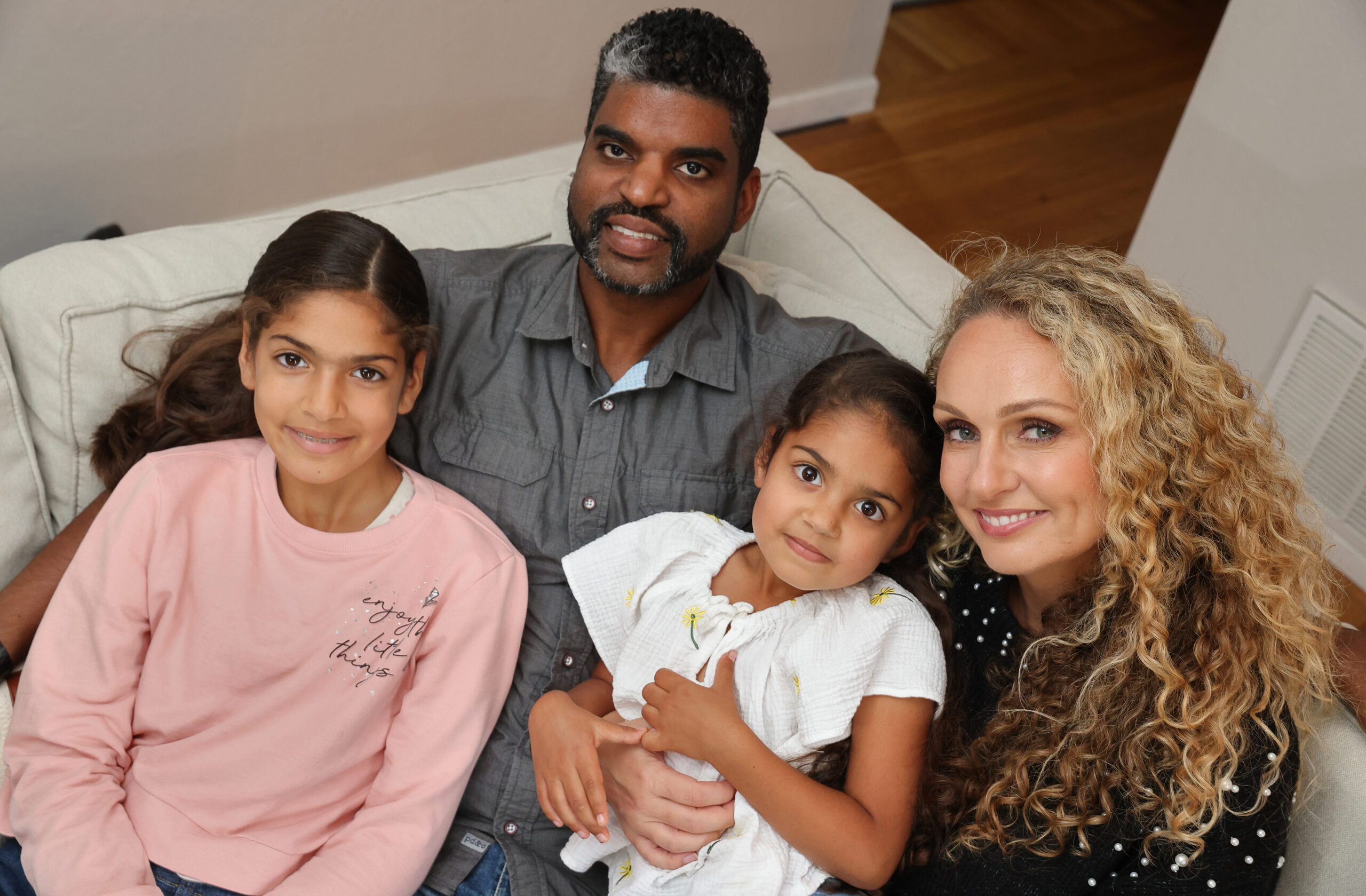
Xavier and Karolina Nazario with their daughters Zosia, 9, and Hania, 5. (Christopher Chung/The Press Democrat)
Xavier Nazario, the father of Cesar Chavez kindergartner Hania and her sister, Zosia, a fourth-grader, voices the same uncertainty shared by other parents and teachers about the pandemic’s long-term fallout for children. “I think the challenging thing is, we don’t know (all) the impacts this pandemic has had,” Nazario says.
The disparities that divide students could widen and the barriers that many face as they grow older could rise, with implications echoing across the rest of their lives. “I don’t think we’ll know until our kids, if they’re fortunate enough, go to college, what type of anxiety they’ll have or how they’ll view the world,” Nazario says.
Some educators, including Olah, are almost defiant in their optimistic outlook. They remain encouraged by the progress they’re seeing students make back in the classroom. “I am very excited to see what happens by the end of the year,” Olah says. “I think we may get there. They’re running from way behind, but they are making up ground and they’re making it up pretty quickly.”
Others, like Montgomery High’s Jeanelle Payne, are still wrestling with doubts about how their students will fare, both now and into the future. “We had high hopes for coming back, but now we’re in it, and it feels like just another year to survive,” she says. “(We have) some who are awesome, and some that are really struggling.”
Some students are bouncing back, “but that’s not everybody.”
“This is just the state of education right now,” she says. “We’re trying to teach academics, but there’s so many other needs.”
Teacher Elizabeth Olah works with a student during an English language development class at Mattie Washburn Elementary School in Windsor. (Christopher Chung/The Press Democrat)
Mental Health Support
Now, perhaps more than ever, school leaders have prioritized behavioral health and emotional support initiatives to help with student wellness. The recognition of this need is unfolding on a national scale: in December, the U.S. Surgeon General, Dr. Vivek Murthy, issued an advisory with recommendations to marshal a “swift and coordinated response” to the growing student mental health crisis.
Sonoma County’s 40 public school districts and 56 charter schools were allocated $228.4 million in pandemic-related aid to bring those plans to life. Here are a few examples of ways schools are working to address students’ mental and behavioral health needs:
• In Petaluma schools, Covid money is paying for teacher training to address students’ social and emotional needs and engage their families. The training is just one part of a total $2.2 million geared toward support strategies for learning loss.
• Officials in the Windsor Unified School District allocated nearly $400,000 to professional development on social and emotional learning.
• Santa Rosa in the fall deployed a new social/ emotional assessment tool called Pandora, to gather information from its students on their social and emotional awareness and needs. District staff were set to begin to examine that data in November and December.
• Most districts have launched after-school tutoring in math and English, often with a particular eye toward English language learners, students from low-income households, and foster youth.
• Many schools have also boosted credit recovery options to help secondary students who failed courses during distance learning stay on track to graduate.
Anna Trunnell, superintendent of Santa Rosa City Schools, says plans to support students with pandemic-related issues need to have a perspective extending beyond even this school year. Schools have through September 2024 to spend the last of their federal Covid dollars.
“We know that the shift won’t happen overnight,” Trunnell says.
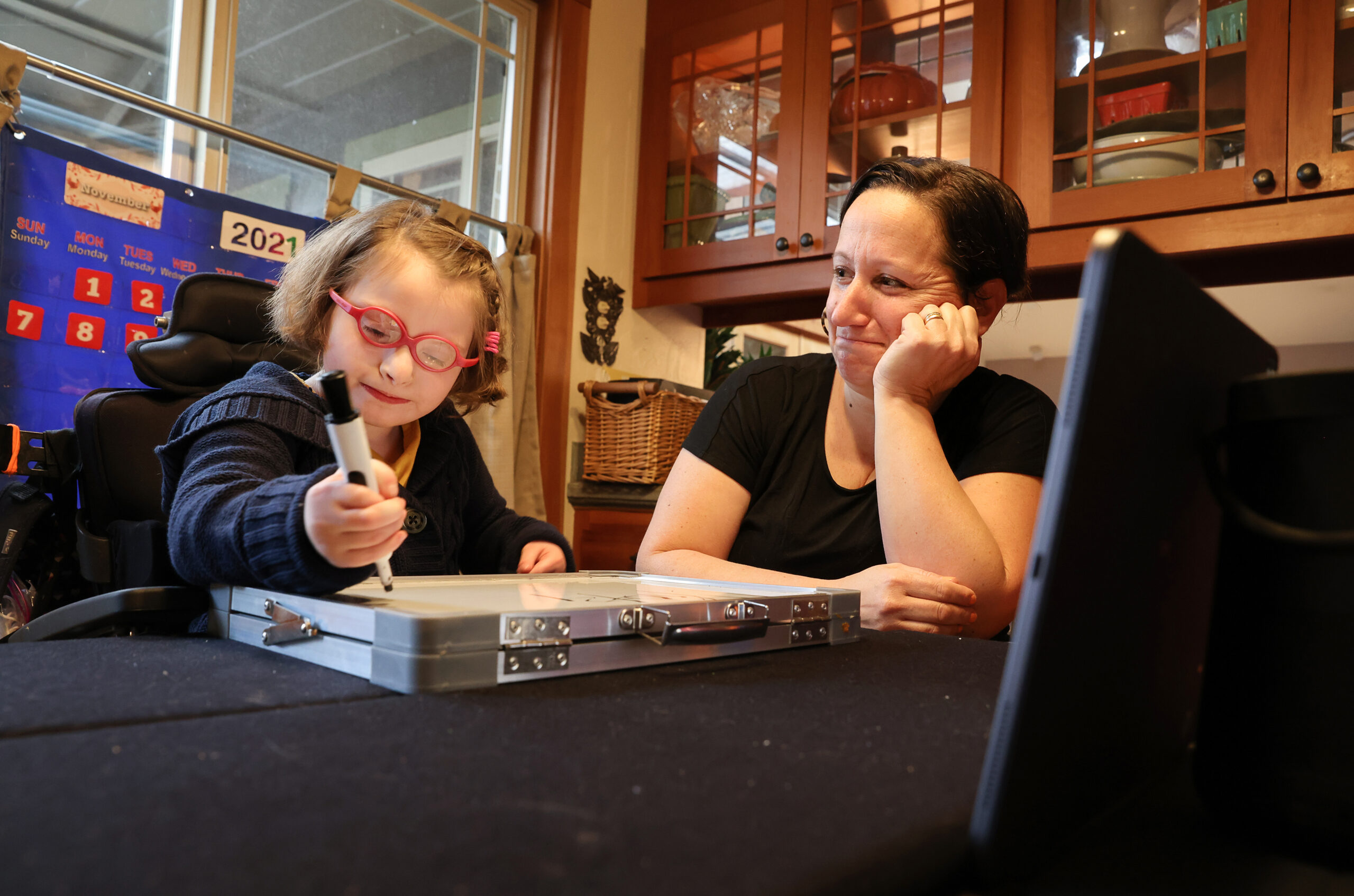
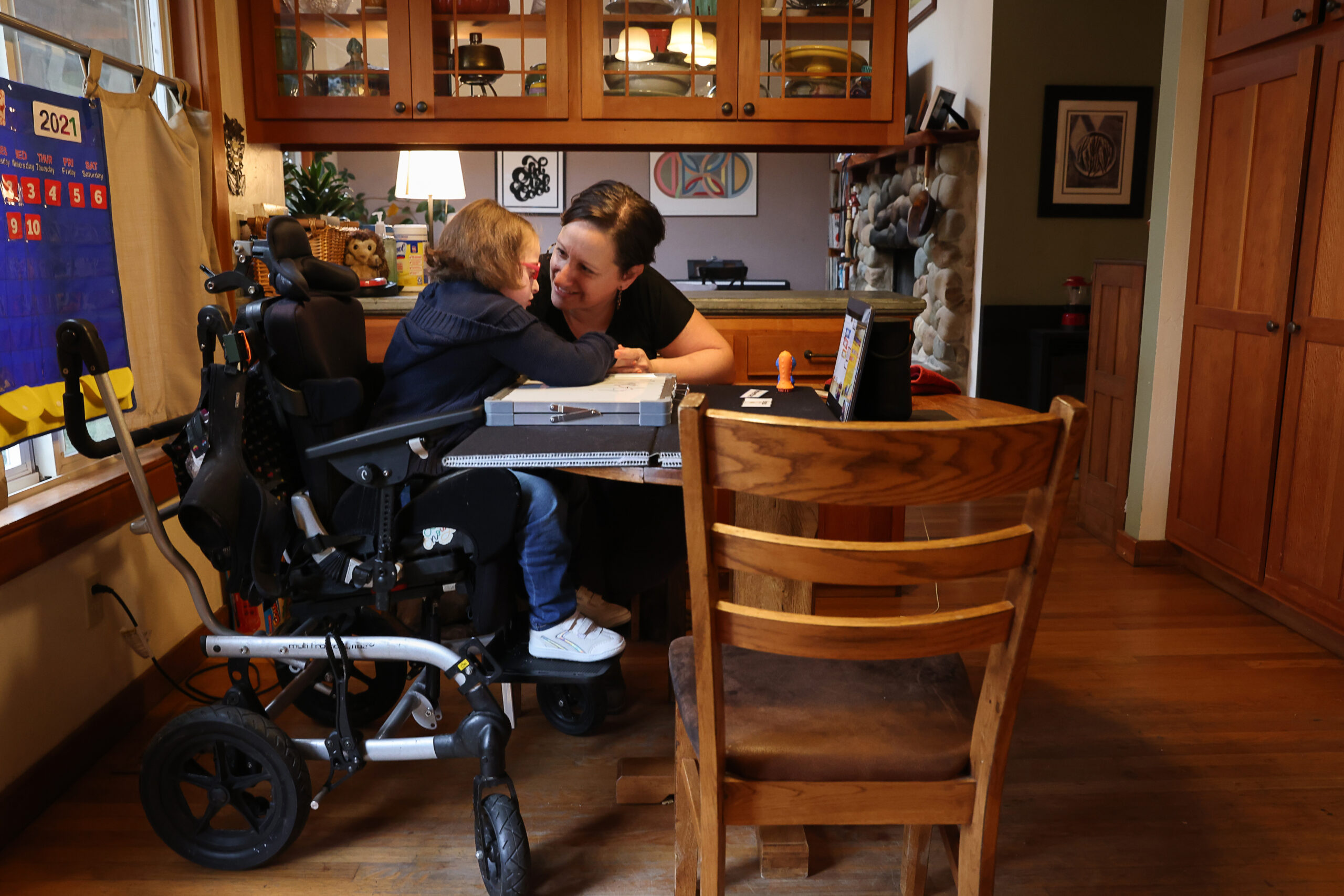
Andrea Loveday-Brown watches her daughter, April, 8, write on a white board during her online special day class in the West County Consortium at home in Sebastopol. (Christopher Chung/The Press Democrat)Andrea Loveday-Brown interacts with her daughter, April, 8, during her online special day class in the West County Consortium at home in Sebastopol. (Christopher Chung/The Press Democrat)
‘We’ve never felt this invisible’
Not all students returned to the classroom at the start of the school year. April Loveday-Brown, who is disabled and has complex medical needs, is one of them. Each day, her mother, Andrea, logs her onto Zoom to attend classes at Parkside Elementary and receive therapy from home.
Andrea says parents of special education students face an ongoing struggle to get their children enough access to instruction. “We have never felt this invisible. And that’s coming from someone already raising a kid that feels very marginalized in general.”
At the beginning of the current school year, April was only receiving around four hours of instruction and therapy a week. Her mother pushed for three months to get that number up to nearly eight hours.
She wants local families to understand that for students like April, things have not gone back to normal. “The language at the beginning of the pandemic was, ‘We need to take care of our most vulnerable,’” Andrea says. She finds it ironic that now that things are moving forward for so many others, the families of special needs students continue to feel unseen.
Many families in 2020 and 2021 protested the limits of remote learning for children with disabilities, as well as Sonoma County’s months-long delay in bringing special education students back for in-person instruction.
This year, many of those students have returned to their classrooms, says Adam Stein, executive director of Sonoma County’s special education agency.
Stein says he is hearing a mix of positive experiences, especially from families whose children are back in class. But even those families have had tenuous access to services at times.
Staff shortages and the lack of substitute teachers are disproportionately affecting students with disabilities, says Stein. “If you’re a district and you can’t find anyone to step into basic instructional teaching programs, how are you going to find someone who’s going to go into homes? We’ve got great ideas, we’ve got funding. We don’t have any people to provide that (service).”