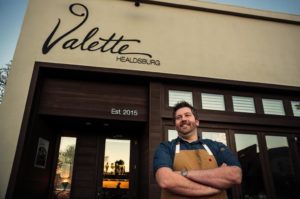
Dustin Valette, owner/chef of Valette in Healdsburg. (photos by Chris Hardy)
When Dustin Valette says he feels a spiritual connection to his new Valette restaurant in downtown Healdsburg, he’s not just talking feel-good fluff. It’s possible he sees a friendly ghost or two in the space that was formerly Zin Restaurant & Wine Bar.
First, there’s the name.
“It pays homage to our family’s history with the building, since my great-grandfather, Honore Valette, owned it in the ’40s, back when it was a bakery,” the chef said. “He had many bakeries throughout the Bay Area, actually, including two in Healdsburg. This building was Home Bakery, and he also had Snowflake Bakery.”
Second, there’s the long history with his good friends, Jeff and Susan Mall, who for the previous 15 years owned Zin. The Malls, who said they were unable to reach agreement with their business partner on the future of Zin, closed it last December and moved to Baja California. The building is now Valette’s treasure, with 130-year-old redwood plank tables and a busy open kitchen.
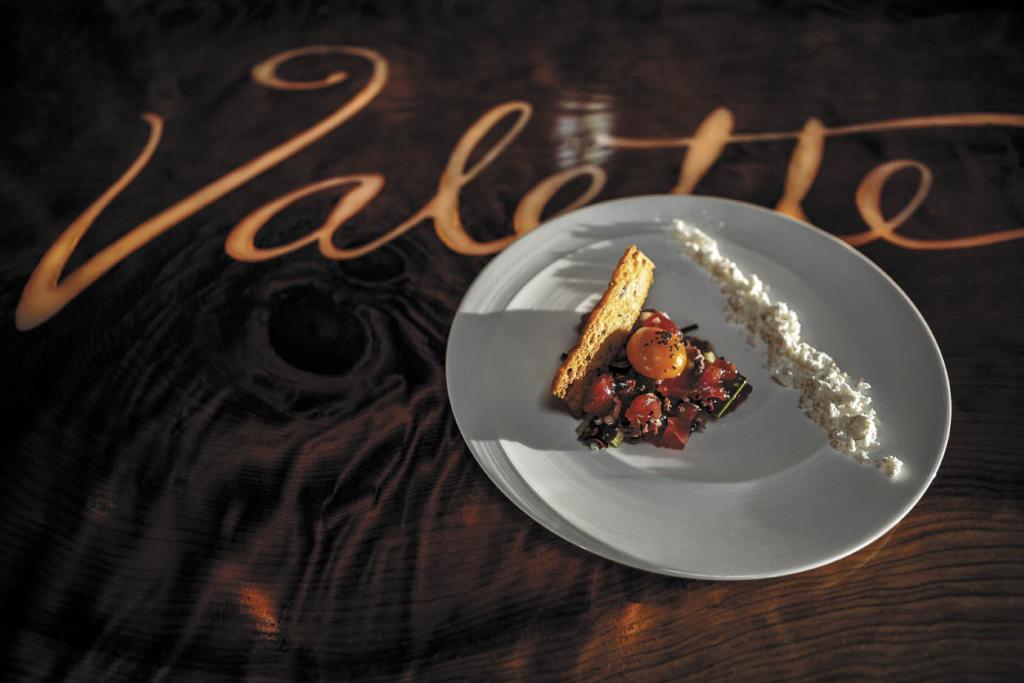
There’s nothing nostalgic about the menu, however. Valette spent the past six years as executive chef with Charlie Palmer at Dry Creek Kitchen, and yes, he offers the superb artisanal salumi for which he became famous there. Now, the charcuterie is finished in a box custom-made by Valette’s brother, Les Garzini. But the Healdsburg native puts his own imaginative twist on other recipes, brimming with eclectic accents while still showcasing the simple beauty of mostly local ingredients.
Those are Bernier Farms vegetables in the celeriac soup dotted with toasted pistachio, beet tartare and a golden goat-cheese puff. Thin-shaved Early Bird Farm radishes gild the Hawaiian ahi niçoise with salted cucumber, 64-degree egg yolk and olive powder, and Liberty Ducks star in the cured smoked duck breast and thigh roulade with Pinot-poached foie gras.
The dressing on the black quinoa dumplings is extra-special, made with charred scallions. “They come from Valette Estate,” the chef quipped. Another signature is the sourdough flatbread, baked on-site.
Stax Social Eatery in Cotati offers DIY mix-and-match meals like this “Good Indian Stuff” tray.
Stax it Up: One of the hottest trends in the restaurant scene right now: Do it yourself entrees. Shifting menu decisions from the kitchen to the customer, clever restaurateurs offer a set list of ingredients for customers to customize to their gluten-free, meat-free, low-carb, Paleo-friendly, low-cal and “I don’t like onions or olives” needs. Among some of the local newcomers: Pieology’s top-your-own pizzas, Chipotle’s DIY burritos and bowls, and the recently-opened Heritage Eats (Napa), with their luxe meat and condiment sandwich fixings.
Stax Social Eatery (actually written as St@x), which recently opened in Cotati takes it one step further, with thematic trays of ingredients you can stack up any way you want.
Here’s how it works: Select from eight different trays (or tasting menus) which include tiny bites of 10-12 items. We fell hard for the “Good Indian Stuff” vegetarian tray, made up of Bombay spice potatoes, cauliflower “tots”, roasted eggplant with peanut masala, Indian flatbread, pea cakes, mango yogurt sauce, chutney, fig jam, lentils, coconut rice and chickpeas.
Stax Social Eatery in Cotati offers DIY mix-and-match meals like this “Good Indian Stuff” tray.
Then…play with your food — using fingers (heck with forks) scoop, stack, dip and nibble your way through, making up flavor combos (kulcha, red chutney, eggplant and spiced lentils, perhaps). Each tray includes 10 to 12 items, so go with a crowd and order multiple trays including the Louisiana (boudin balls, crispy pork skins, Johnny cakes, remoulade, collard greens) “Low Country” (pork rillettes, country ham, catfish, crispy chicken skin, mustard greens and pickled peaches), Northern Italy (smoked sausage, risotto cakes, brown butter gnocchi, white bean puree) or teen-friendly sliders with mini burgers, Spam and egg, pulled pork, pretzel rolls, onion jam and mac and cheese).
Stax Social Eatery in Cotati offers DIY mix-and-match meals like this “Good Indian Stuff” tray.
We couldn’t help but wonder how the kitchen staff could possibly put together these complicated trays from more than 75 individual items. “That’s gotta be some mis en place,” said my co-eater friend. In fact, Chef Paul Croshal has it down to a science, though it can get a little hectic during busy weekends, especially with more than 90% of the menu has to be made daily — and these aren’t simple dishes by a long shot. Showing off his culinary chops, Croshal makes nods to of-the-moment buzz eateries like Momofuku’s cereal milk and cookies (sugary corn flakes steeped in milk, then strained out, leaving only the deliciously sweet drink) on his menu.
One customer described the milk and cookies experience as, “The cereal milk must be made from rainbows and unicorn blood.”
Also on the dessert menu, a mini “Pie Party” of apple pie, lemon cream and chocolate cream with cornflake milk ice cream.
Stax Social Eatery in Cotati offers DIY mix-and-match meals and desserts like cookies and milk
Keep in mind that they also have a selection of pre-planned sandwiches like the shrimp po’boy, Cuban pork sandwich and ratatouille sandwich ($10-$12) if you’re not up for the DIY experience. Beer and wine available.
Just go with curiosity, a sense of adventure and a few friends for the best experience. We’re pretty sure this is about the most fun you can have at a restaurant — and still be legal.
Stax SOcial Eatery: Open 11a.m. to, well, whenever o’clock Tuesday through Sunday. 8204 Old Redwood Hwy, Cotati, staxsocialeatery.com.
There aren’t many stand-up comics who are beloved international superstars, perform in four languages, run marathons for charity, and have become a poster boy for transvestites.
OK, there’s only one.
He’s Eddie Izzard, the British comedian who will play the Wells Fargo Center for the Arts in Santa Rosa on June 17, beginning a six-day dash through the Bay Area. Izzard arrives as part of a world tour that has taken him from Cardiff to Katmandu. While Izzard has sold out New York’s massive Madison Square Garden, he’s coming to Wine Country to play the more intimate, 1,600-seat Wells Fargo theater.
Izzard’s act is a joy ride of free-associating absurdist humor, so much so that John Cleese, the legendary comedian from Monty Python’s Flying Circus, calls Izzard the “Lost Python.” His narratives skip like a stone across a pond, bouncing from the predictability of British movies (“They usually involve a room with a view, and a staircase, and a pond”), to using Monterey Jack cheese as a weapon, or the relationship between fake breasts and jellyfish. Then he’ll admire the cleverness of the average pear, which is only ripe for a half-hour, often when you’ve just left the room.
It’s all served with crooked smiles, eye rolls, quick stops and self-deprecating warmth. “Must not do that joke again,” he’ll say as he pretends to write on his hand after a joke bombs.
Wrap all this in stage garb that can often be, well, lively. Izzard is a handsome man, all beefy and blond, but he’s performed in boots, nail polish and red lipstick, with fishnet stockings and a slit skirt — a look he describes as “male lesbian.”
While some of his peers spend their off-hours collecting Porsches or engaging in Twitter feuds, the 53-year-old Izzard pushes himself, mentally and physically. His life slogan is, “We Can All Do More Than We Think We Can Do.” Izzard has certainly proved that. He loves language and has done shows in English, French, German and Spanish. Izzard once ran 43 marathons in 52 days, raising money for the Sport Relief charity.
Izzard also has a keen interest in current events and plans to run for mayor of London in 2020. “Being a transvestite has toughened me for politics,” he said.
Couple’s cabin remodel creates a legacy for their kids. (photos by Rebecca Chotkowski)
It may now be a vacation getaway they visit for a blissful week or weekend here and there. But for Ron and Toni Andrews, their freshly remodeled cabin along the Russian River in Healdsburg is home. The place where their clan and friends will gather for good times. The house where their children will bring the grandkids they’re counting on. And the house the peripatetic couple will keep, no matter where they land.
“We’re originally from Georgia. But we’ve moved 14 times in 29 years of marriage,” said Toni, with no trace of complaint. “We were corporate nomads.”
More “Steel Magnolia” than “Georgia Peach,” as her husband put it, the petite Toni has bravely packed up every time her husband’s career in genetics research and medicine called them to a new location. But the last move, from Danville to Orange County, finally got to her. She broke down and cried.
It was not just uprooting their three kids: Ryan, then a senior in high school and now 24, Kat, now 21 and Rhett, 17. It was also leaving dear Danville friends like Barbara and Dennis Hyland.
So when Barbara’s sister, Patti Hughes, announced she wanted to sell her cabin on Fitch Mountain, around which the Russian River flows to the ocean, Toni, by now a master at turning any house into a home, saw an opportunity. With fond memories of get-togethers at the cabin with their friends and all the kids, she figured she and Ron could buy it and keep it within their “friend family.”
But Ron wasn’t seeing it.
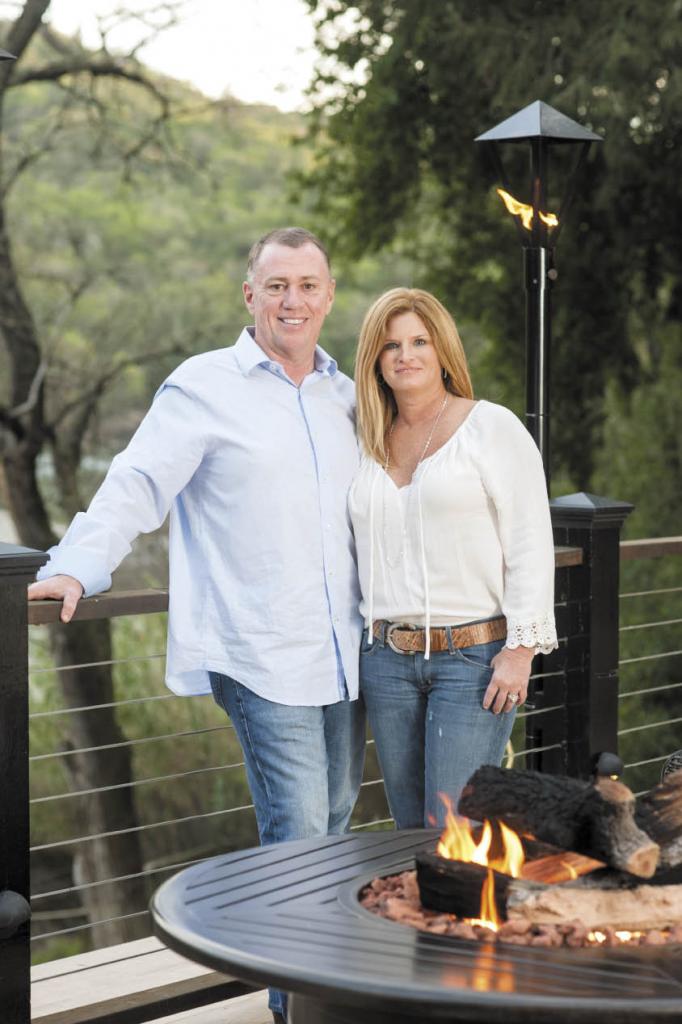
Ron and Toni Andrews aimed to keep the cabin in their “friend family.”
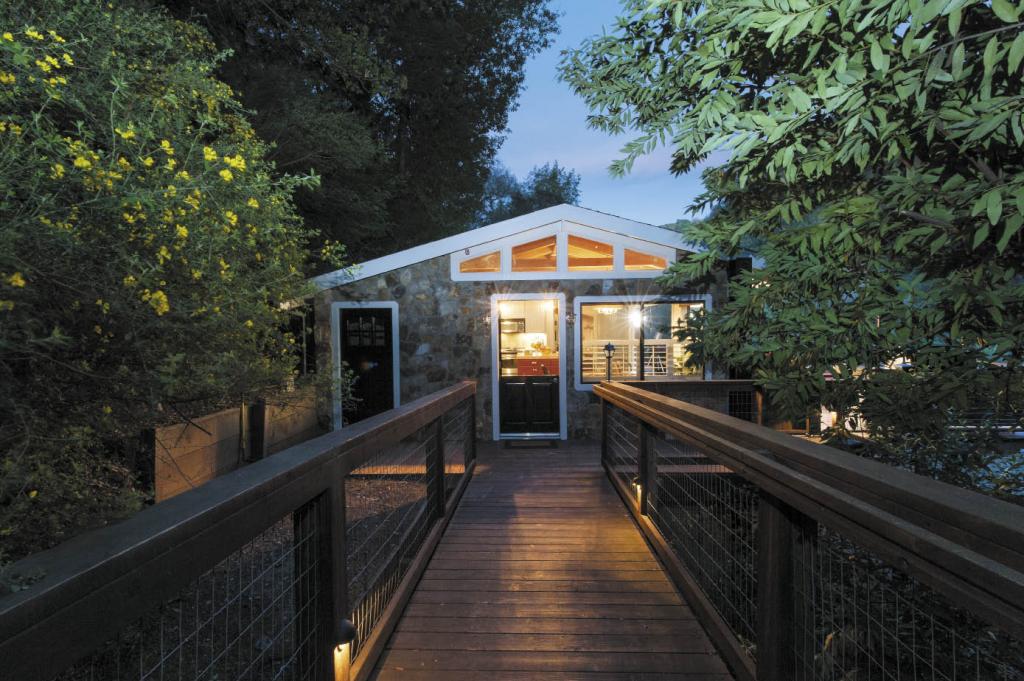
While Hughes had made a valiant effort to keep the house up — reinforcing it and upgrading the infrastructure, adding a parking platform on the road and building a long “Swiss Family Robinson” deck walk with multiple switchbacks from the road to the front door — she hadn’t had a chance to do much to the interior. Her husband died suddenly and she lost interest in the project.
While Ron loved the location, with beach access to the Russian River where they could put in their kayaks for lazy floats, the house itself seemed dark and uninviting. Although it was built in 1925, any old features that might have given it some architectural charm had been remodeled away.
“Being from the Deep South, there’s a certain warmth we want in a house and that we’ve been used to,” he recalled. “I didn’t think they could pull it off. Could we really make this a place where we’re going to want to come and stay instead of just for a weekend?”
Toni wasn’t dissuaded. She and Ron had just finished remodeling a house in the exclusive gated community of Coto de Caza in Orange County. The river cabin wasn’t much to the eye when the Andrewses purchased it in summer 2014. But she found a kindred spirit in Amanda Bloom of Amanda Bloom’s Decorative Designs & Remodeling in Cota de Caza, who not only had creative ideas, but could get them done. The two women collaborated well.
“The property itself is magical,” Bloom said of the nearly 2 acres of riverfront, complete with vegetable gardens, a guest cottage and boathouse for canoes and kayaks. The Andrewses had their own private beach until a landslide caused by late 2014’s torrential downpours obliterated it. So plans are in the works to engineer a new access, perhaps with a floating dock.
“It’s one of the most unique properties up here,” Bloom said. “Nobody has this park-like setting. There are peach trees and plum trees and apples.”
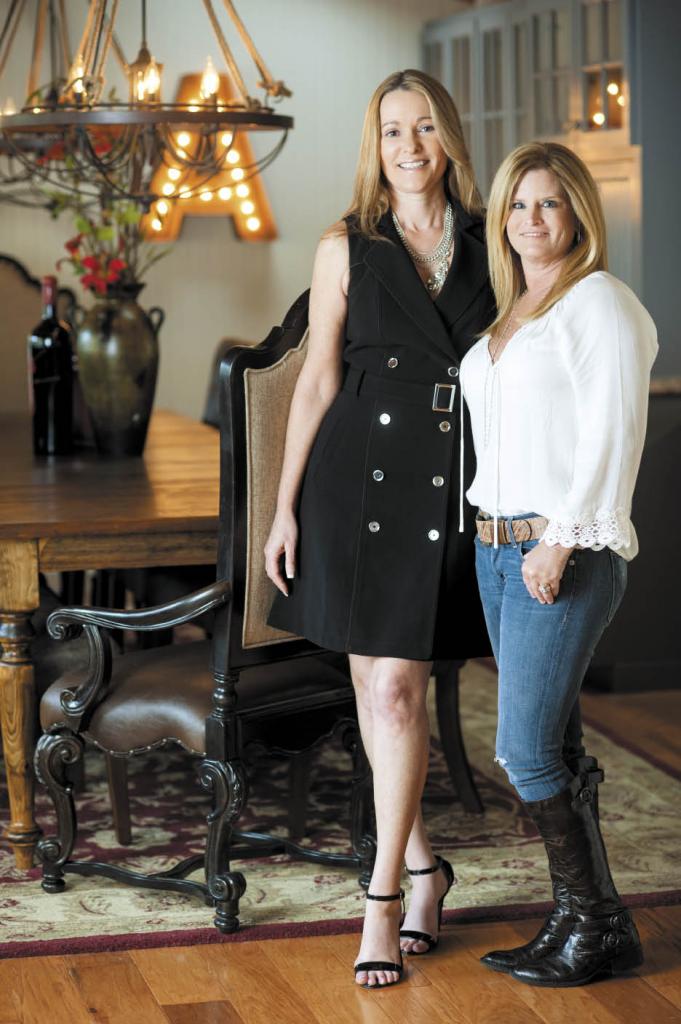
Designer Amanda Bloom and homeowner Toni Andrews had a shared vision of what the cabin could be.
The 958-foot-high Fitch Mountain is a jumble of rustic cabins, large homes and vacation rentals for those who enjoy the forested shade and swimming in the Russian River in summer, and endure what can be frequent storms in non-drought winters. A popular retreat since the late 1800s, its summit is a mere 3 miles from downtown Healdsburg, yet a world away with its hiking trails, oaks, madrones and spectacular views.
Ron was on a long-distance flight when he received a file on his computer with real estate sale papers to sign for the Fitch Mountain house. Like it or not, he was in. But this wine enthusiast, who had been looking for a getaway home in Wine Country, has no regrets.
“Every time we looked, even though I didn’t necessarily want this house at the time, I tended to want to be up here, because of how quiet and serene it is,” he said of the Healdsburg area. “We loved the little town. This just seemed to be the place. It was about the serenity and the people.”
Quiet is something he particularly craves in his down time after years as an executive in the medical diagnostics industry and founder of his own international company.
After years working for Roche Diagnostic Corp., which at the time was working on genetic mapping of HIV, Andrews saw the possibilities for using the same technology to fight breast cancer, which had plagued his grandmother and eventually claimed her life.
He took over a foundering medical device company and built it into Clarient, a comprehensive cancer diagnostics company that tests for special molecular pathways to help doctors personalize treatment for breast cancer patients.
He’s also working with some of his former colleagues on a for-fun wine venture called Vinome, which would similarly map the taste receptor genes for individual wine drinkers to help them determine their best taste preferences. He anticipates it also could help wineries and sommeliers market with more precision to consumers.
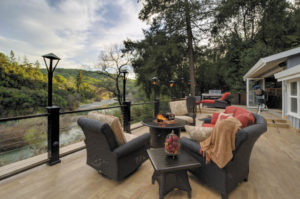
In the cabin, Bloom turned a forgotten storage room into a snug wine cellar with stone floors, a chandelier and wood and wrought-iron elements to hold the couple’s Sonoma bottles. But more enticing for wine tasting on a sunny day is the deck overlooking the river. Bloom made it an extension of the kitchen by replacing a wall with 13 feet of folding glass doors that open entirely and help bathe the room in light.
To the deck, Bloom added porcelain tile that looks like wood. It serves as a waterproof roof for the second deck below, creating a year-round recreation room for table tennis and other games.
The project is an object lesson in how an ordinary house can be transformed with a minimally invasive facelift. Bloom worked within the existing footprint, which included a kitchen, dining room and living room, all spread out in a line looking out to a massive deck with river views. The bottom floor has three bedrooms, two bathrooms and a laundry room similarly strung in a line facing the river.
The 2,800-square-foot house at some time, probably in the 1980s, had been paneled in pine virtually floor to ceiling. It was too much, Bloom said. She saved some of the pine, but incorporated other surface materials and color that reflected the outdoors to break up the visual monotony.
She created a more inviting entrance by covering the exterior wall of the house in stone and replacing the ordinary front door with a cute Dutch door.
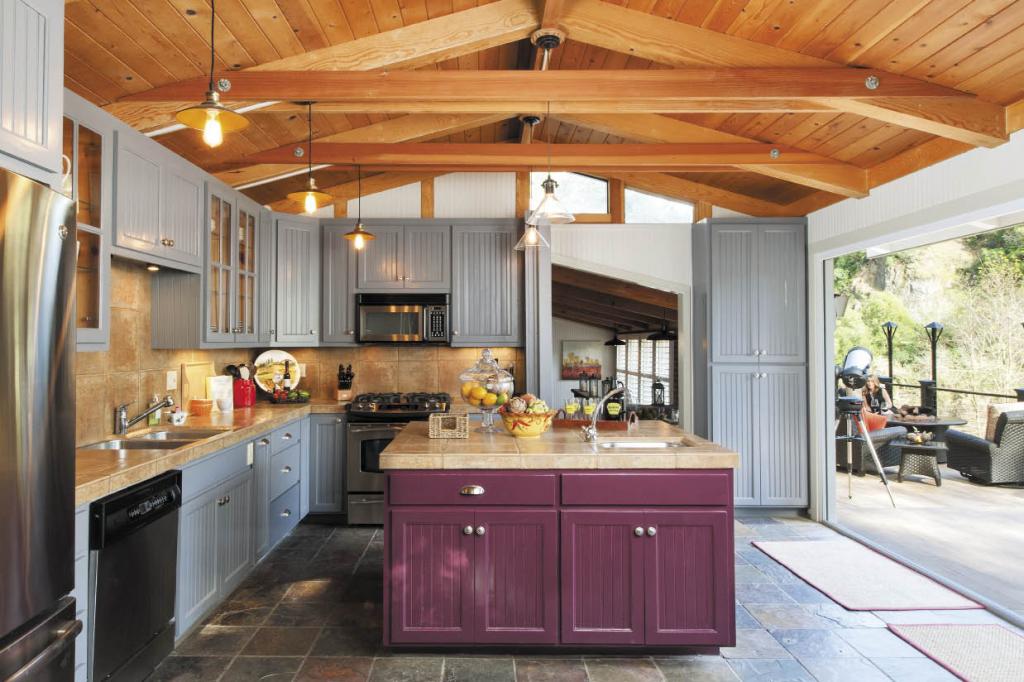
Bloom kept the existing cabinets, but updated the kitchen by removing a built-in breakfast nook and adding a warmly sophisticated color scheme of burgundy and gray. This is Toni’s turf, the place where she makes fresh risottos from the garden and Southern specialties, from stewed tomatoes and homemade cornbread cooked in seasoned skillets to fried okra and garlic mashed potatoes.
Outside, Ron is the barbecue king, with favorites such as cedar plank salmon and beef loin bathed for hours in a special rub of espresso, brown sugar and chipotle powder.
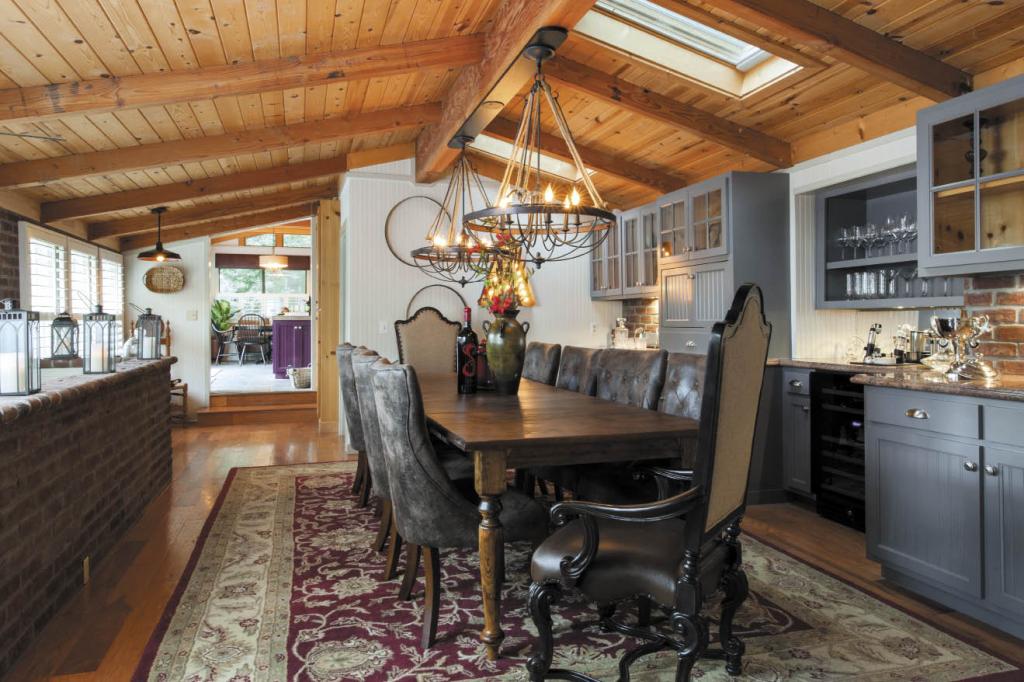
When they’re not dining alfresco, they can all gather in the dining room, which Bloom dramatically transformed by painting the plain pine cabinets a soft gray, installing a contrasting brick backsplash and incorporating a wine-serving area. Vintage wrought-iron lighting floats above the aged and repurposed dining table. The old brickwork is repeated on the opposite wall by the stairwell to the sleeping area.
The designer similarly brightened up the living room and opened the view by cutting windows into a side wall along with a Dutch door that matches the one in the kitchen, to bring in cross circulation.
Downstairs, small changes also made the dark, dated sleeping area more inviting.
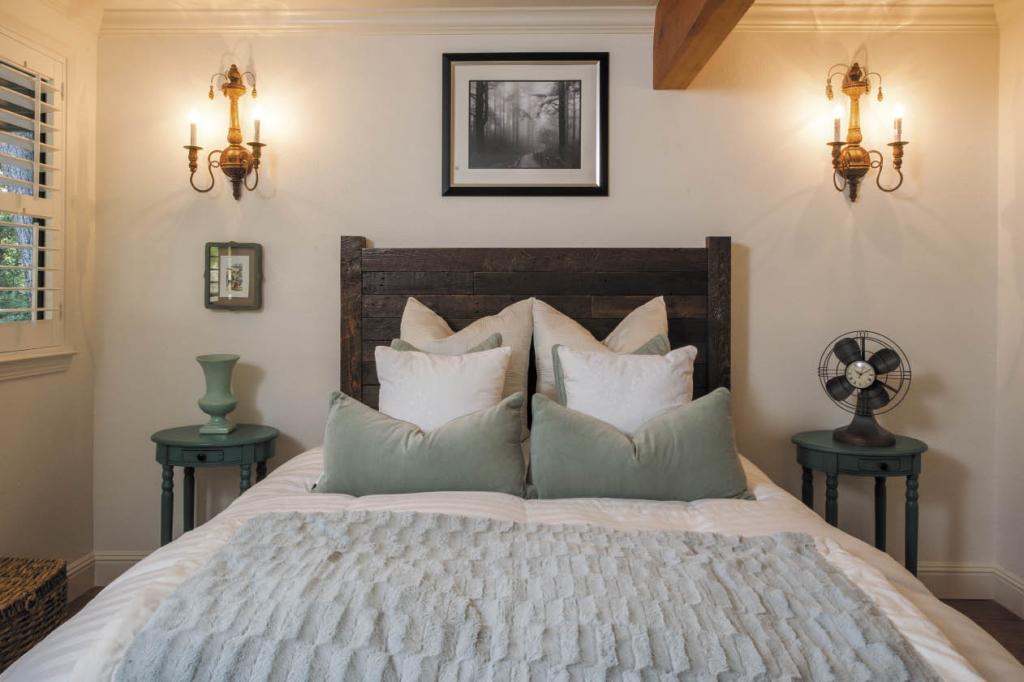
At Toni’s suggestion, part of the hallway was incorporated into the master bedroom, creating a little entry and space for a master bath. Carpets were ripped out and replaced with oak floors. A ventless fireplace was installed for coziness and French sconces for romance. The formerly drab brown space was infused with color, in a palette of crisp white, mint, burlap and robin’s-egg blue.
The overall effect is classy but comfortable, in that casual way that characterizes Sonoma Wine Country. The Andrewses want it to be inviting.
“It’s a legacy to leave our kids, a gathering place for our family,” said Ron, a gregarious man with a soft touch. “We want to leave our children great memories of us. And we want to leave our grandchildren great memories of us. The values we had growing up, we want to extend to them. We can do that here.
“As long as the sun keeps shining and the water keeps running and there are grapes in the valley, we’ll be up here.”
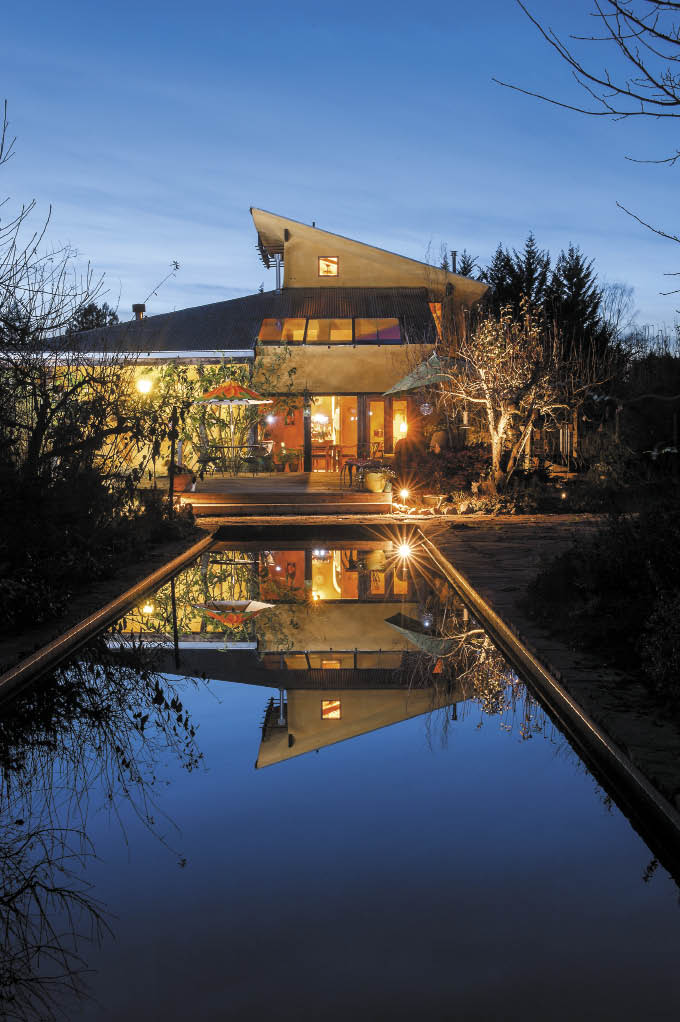
A house made of rice straw bales is as durable as it is environmentally elegant. (photos by Rebecca Chotkowski)
If there is an Eden, it might just be in the high hills northeast of Occidental, where one of the first straw-bale dwellings in Sonoma is tucked away on a country lane.
Enter the 6-acre property through a spectacular iron gate and a curved roof in the distance teases the imagination. It signals an adventure in design in its definition of space, of inside and of outside.
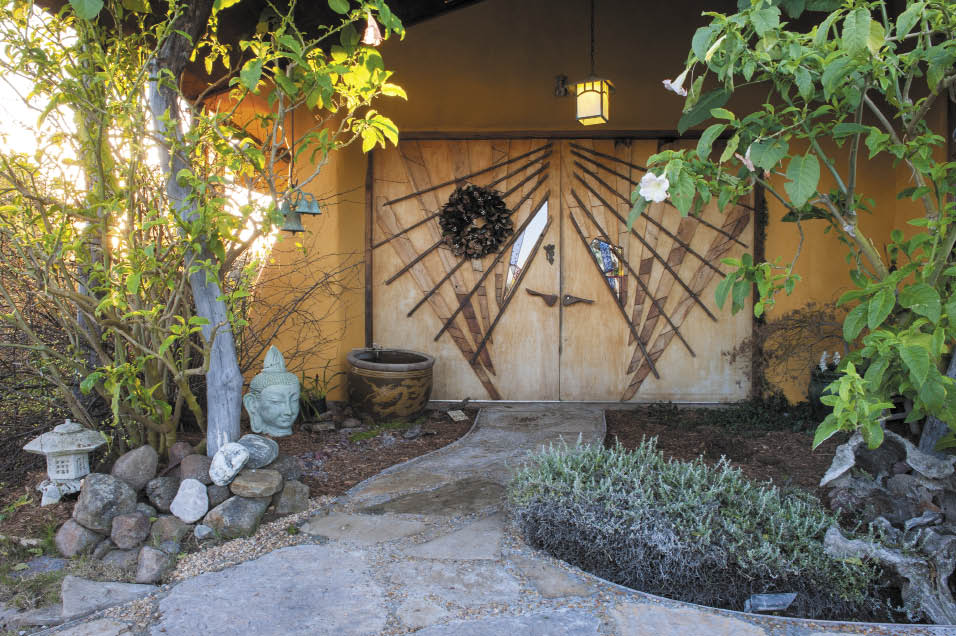
A stone pathway curves through archways, one covered with kiwi vines, one with wisteria and another with an old grapevine. The path ends at a broad deck and two enormous doors, nearly as big as a double garage. Despite their size, the doors are elegant and distinctive, opening outward, not upward, into the home of Annie Scully and Patsy Young, who built the house with the help of a contractor, an architect and an array of specialty artisans 17 years ago. The inspiration came from a straw-bale home Scully had visited in Mendocino County. When she and Young found their spectacular little Occidental property, they set out to learn how to craft a new home with a similar feeling.
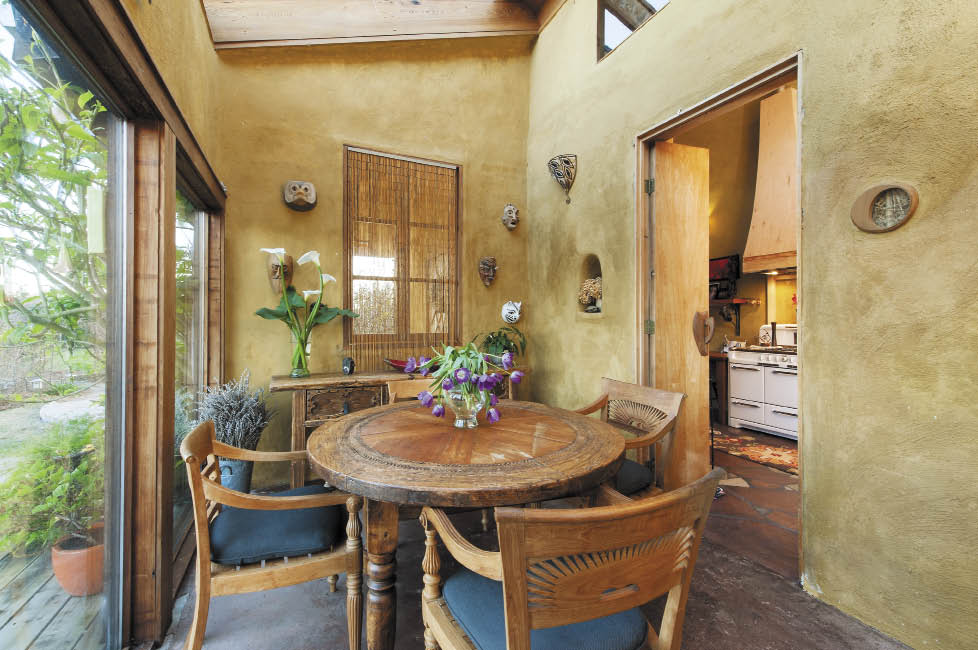
A glimpse into the straw wall interior of the home.
“It took us nine and a half months just to get the plans through the county,” Scully recalled. The home is something of a hobbit house, with gentle curves and alcoves everywhere, few angles, whimsical touches and a comfortable warmth that never wavers. On a cold day or in the midst of a sizzling heat wave, it’s about 70 degrees inside. Straw-bale walls don’t just provide structure, they provide insulation and, in a subtle way, breathe, keeping the air within fresh and pure.
“Our architect positioned the house, which faces south, so that the summer sun is directly overhead and never shines through the windows,” Scully explained.
In the winter, the sun, lower in the sky, heats the passive solar floor, which both radiates and retains heat. The thick straw-bale walls help maintain the steady temperature. For extra warmth, there is a wood stove with a beautiful hearth made of cob, a blend of straw, mud and aggregate.
Outside the broad, south-facing windows is a large, unfinished pond that will be used to collect rainwater. Beyond it are trees, some from the property’s past as an apple orchard and some recently planted, including Scully and Young’s Christmas tree from their first year here in 1998, which now stretches taller than the house. They plan to finish a gray-water system, which collects water from sinks, showers and washers for reuse on the land, sometime this year. The goal from the beginning has been to create a home with the smallest ecological footprint possible, by using recycled and chemical-free building materials, solar heating and, eventually, gray water and rainwater.
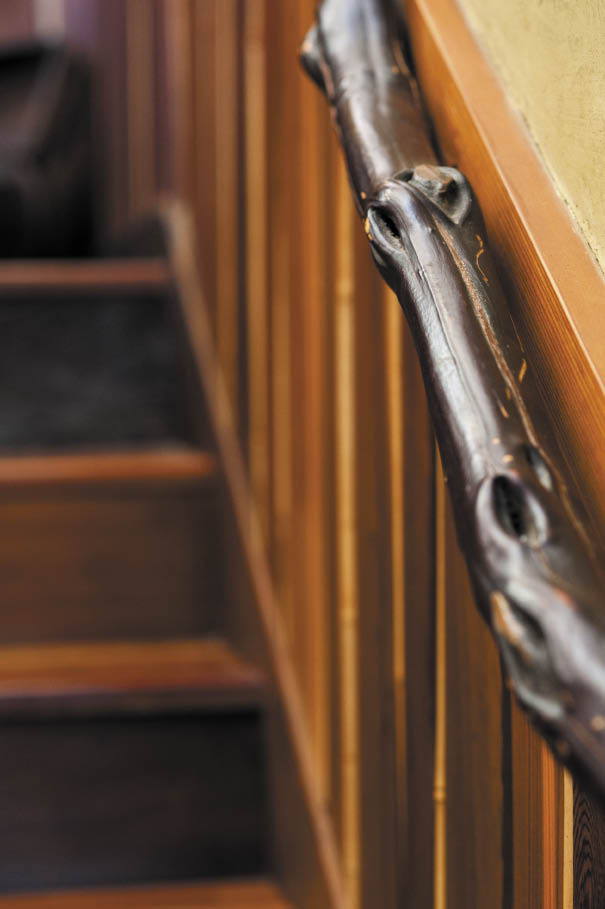
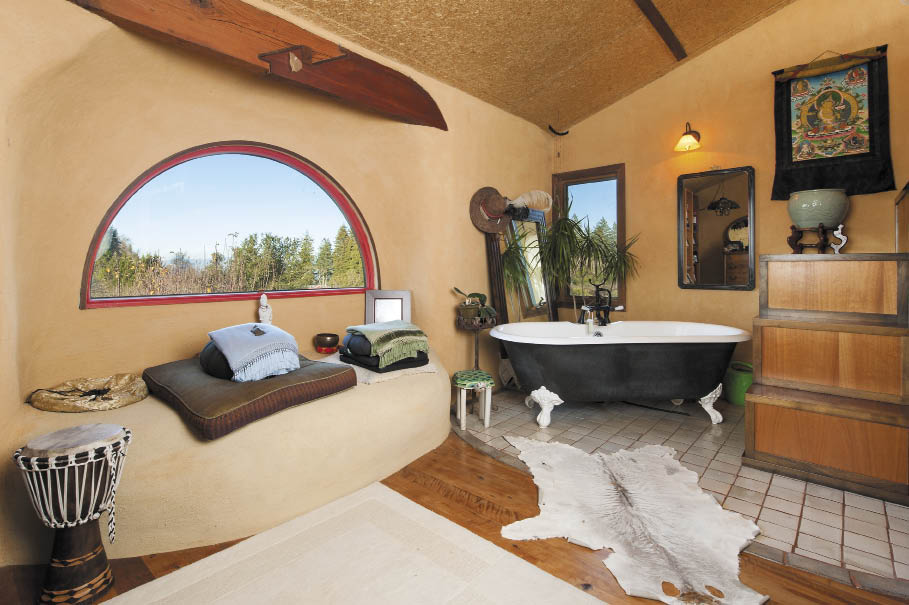
A stairway between the kitchen and living room leads to a second level, with a tiny balcony that looks down on the living room. The staircase is made of recycled redwood and bamboo, with curving manzanita banisters. Upstairs, the sitting area merges seamlessly with a bath, where an old claw-foot tub is positioned to give the bather a perfect view of the hills and woods. Another little staircase, flanking the bath, leads to the couple’s sleeping loft.
The wall that separates the kitchen from the staircase is finished with American Clay, a natural clay-based veneer that is as smooth as satin and stunningly durable. Nicks vanish with a wipe of a damp cloth and the finish shimmers in the day’s changing light.
Downstairs there is a mudroom with a washer and dryer, a tiny pantry, a kitchen counter made of what looks like granite but is actually Vetrazzo (made of recycled glass including beer bottles), and a deep copper sink.
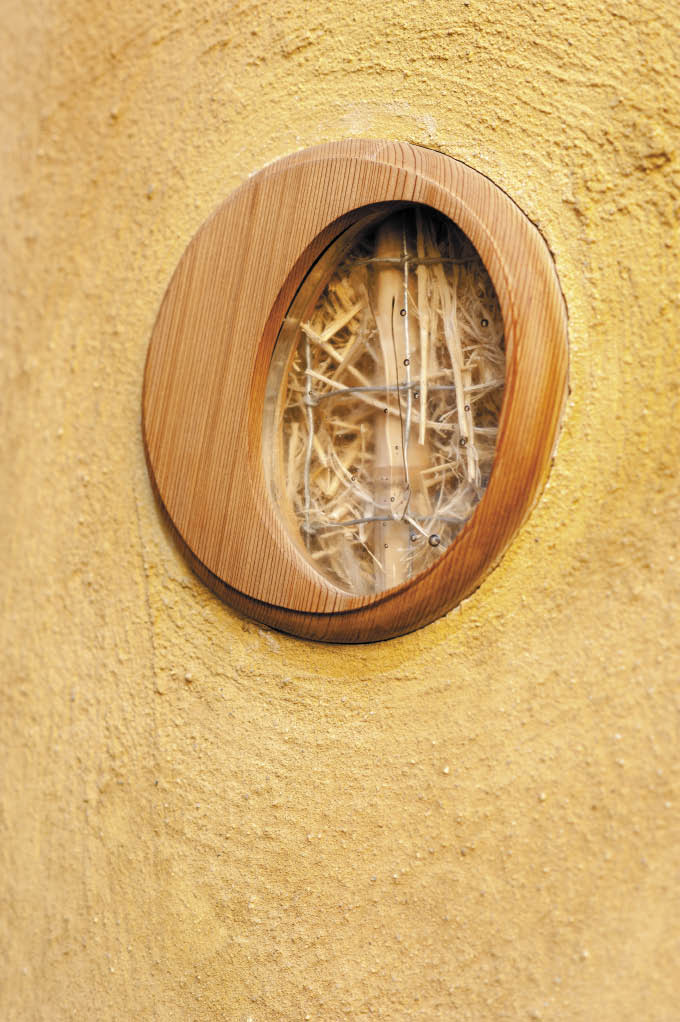
Then comes the dining room, with its breathtaking view of the deck and the lap pool. A north-facing window is covered with bamboo curtains that suggest falling rain. There’s a little alcove filled with river rocks, and as you turn to face the kitchen, you notice a signature element that is a part of all straw-bale structures. It is a “truth window,” a view into the interior of the wall showing straw encased in chicken wire and supported by bamboo.
Today, the house is 1,200 square feet. When budget allows, the dining room will be expanded with a pizza oven, and north of the deck, a master bedroom will be built. When it’s finished, Scully and Young will move into it from their little sleeping loft.
The property includes two other straw-bale buildings, one a tiny cottage with an upstairs sitting area that looks down on a gazebo made of braided mulberry trees. Scully and Young plan to expand it and turn it into a bed-and-breakfast cottage.
The other is the Moon House, originally built for Young’s parents and now occupied by a friend of Scully and Young. It is shaped like a crescent moon, with high straw-bale walls forming the outer curve and floor-to-ceiling windows creating the inner curve. The space, at just 850 square feet, feels roomy, in part because the curve of the crescent gives a feeling of inclusion, of being part of the outdoors.
As beautiful as they are, these homes are also practical and durable. Rice straw, which is used in many straw-bale buildings, is so durable that the Environmental Protection Agency has strict regulations on what can and can’t be done with it. It cannot be buried or burned, and it’s useless as compost, as it breaks down at a glacial pace. Large rice producers such as California’s Lundberg Family Farms pile up tons of rice straw, so its use as a construction material can help house the world.
Other types of straw, wheat, oat, barley and rye among them, can also be used, but rice is notable for its durability.
The main house has a stick frame that does most of the weight-bearing. The foundation has 32 piers, 11 feet deep and 2 feet wide, and the perimeter is surrounded by cement. All the materials, from the straw to the recycled redwood, are organic and chemical-free. The straw bales are encased in chicken wire, with bamboo poles weaving them together.
“It is like sewing,” Young said.
The walls are finished with stucco and plaster. Natural lime kills any bacteria that may be in the straw. The high ceiling is made of ground straw and other ingredients, produced by a man who lives in Oregon and refuses to share his recipe.
The Occidental home has taken shape slowly and continues to grow as finances allow. Young teaches Spanish at Santa Rosa Junior College and Scully is a teacher at Elsie Allen High School in Santa Rosa, where her partner also taught for a decade. When the workday is done, they head to their enchanting little home, where the sounds of nature, and not of electronics, furnaces or water heaters, fill the air.
Often there is only a sweet, warm silence. It’s an Eden Scully and Young have created for themselves.
Some people might think it crazy to wait in line 17 hours — much of it in cold, driving rain, no less — for a 10-ounce glass of beer.
But this is not just any beer, insists nelson Rivera, who traveled more than 400 miles from Los angeles to Santa Rosa in February to taste one of the planet’s most famous and coveted brews: Russian River Brewing Co.’s Pliny the Younger.
The limited-edition triple India Pale Ale regularly ranks in the top six in the world on beer-rating websites. It’s not easy to get, sold for only two weeks a year at the downtown Santa Rosa brewpub and select locations. But it is well worth the wait, Rivera said, savoring a glass of the amber-colored beer with two friends as they dried out inside the packed brewpub and celebrated the end of their quest.
“Yes, I would do it again,” said Rivera, 23, as he enjoyed his seat at the bar and status as first in line to sip this year’s Pliny release.
Thousands make a pilgrimage to Santa Rosa every February to taste Pliny the Younger, an extra-hoppy and beautifully balanced ale with a potent 10.25 percent alcohol content. While here, visitors spend millions of dollars on lodging, meals, entertainment and more beer. In 2013, the two-week Pliny release brought some $2.4 million in economic activity to the region, according to the most recent estimates.
Pliny the Younger may be the most acclaimed beer made in Sonoma, but a scrappy and ambitious group of craft breweries is transforming a place known as the heart of California’s Wine Country into a region renowned for its stellar lineup of beers.
The number of craft breweries have doubled in Sonoma County since 2011. Two of the 22 local breweries — Lagunitas Brewing Co. in Petaluma and Bear Republic Brewing in Healdsburg and Cloverdale — are now ranked among the 50 largest craft breweries in the United States.
Up-and-comers including Fogbelt Brewing Co. in Santa Rosa, HenHouse Brewing Co. and 101 North Brewing Co. in Petaluma, and St. Florian’s Brewery in Windsor also are attracting notice. Though they are small in production volume — the equivalents of the so-called boutique wineries — they are big on cachet as word spreads of Sonoma’s ale and lager riches.
Local brewers have an effect on craft beer “like that of the Mondavi family for wine in Napa,” said Ben Stone, executive director of the Sonoma County economic Development Board. “They have created an awareness of Sonoma County, an image for Sonoma County. It really has become a hallmark for Sonoma County.”
Natalie Cilurzo, co-owner of Russian River Brewing Co., said millennials are particularly attached to craft beer because many of their parents made the switch to the first generation of full-flavored beers that began appearing in the 1980s. “That’s what they grew up with. Their parents drank Sierra Nevada,” she said. “Our parents didn’t drink Sierra Nevada. Our parents drank Miller Lite, Heineken.”
“That’s all they know,” her brewer husband, Vinnie, chimed in.
Even those in the Sonoma wine industry are taking notice, especially as craft beer attracts millennials in the highly coveted 21-to- 35 age demographic.
“Craft beer is a significant challenger for basic wines and wine needs to up its game to compete,” said Mike Veseth, editor of the Wine Economist blog. “The simplest wines are challenged by the relative value and interest that craft beers present.”
The Brewers Association, which represents U.S. craft brewers, tracks the 50 largest artisan breweries, by volume. D.G. Yuengling & Son of Pottsville, Pa., ascended to No. 1 last year, displacing Boston Beer Co., the maker of Sam Adams, at more than 6 million barrels a year (though there is some consternation that the company is considered a craft brewer). Lagunitas is No. 6, and racing to expand nationally and even internationally. Bear Republic is No. 39, and then it’s a big drop to the rest of the Sonoma pack.
America’s $100 billion annual beer industry continues to be dominated by the “Big Three,” Budweiser, Miller and Coors, yet their executives are nervous enough to create their own “craft” brands (Blue Moon and Shock Top, for example) or to buy existing craft breweries, as Budweiser did with 10 Barrel Brewing Co. in Bend, Ore. even though the little guys claim just 11 percent of the nation’s total beer production, their output grew a remarkable 18 percent in 2014, according to the Brewers association. Overall beer production was up by only 0.5 percent, attributed to a decline suffered by the big brewers. The growth has attracted private equity firms looking for investment opportunities.
Lagunitas is an imposing presence in and out of Sonoma, with owner Tony Magee’s brewery producing almost 75 percent of the beer made in the county. Production at the Petaluma brewery and a new Chicago facility will likely surpass 850,000 barrels this year, about 40 percent more than in 2014.
It’s a much different story for Lagunitas’ across-the-road neighbor, 101 North Brewing Co., which opened in September 2012. It’s on the verge of going into the black for the first time and its owners (brothers Joel, Jake and Joe Johnson, and their friends, John Brainin, John Lilienthal and Anthony Turner) use a second-hand barrel system they purchased in 2010 from Lake Placid Brewing Co. in Plattsburgh, N.Y., for a $100,000 low-bid offer that was immediately accepted.
“Those guys across the way are so much larger than us. We are quite some time away from even being some semblance of their size,” said Joel Johnson, 101 north’s brewmaster.
The company awaits delivery of two 90-barrel tanks to increase production and keep up with retailer demands; it currently has three tanks. It produced 1,750 barrels last year, a 50 percent increase in annual production. The partners had to cobble together the $1 million needed to get the brewery off the ground in 2010. Recent distribution deals with Safeway and Costco are cause for celebration at 101 north, and nearly 80 local and regional pubs serve its beer, including the popular Heroine IPA.
Johnson, 45, looks the part of new-generation brewmaster, with a soul patch, earrings in both ears and a neck tattoo. But he also has the bona fides. He brewed for Bear Republic and honed his skills making its flag- ship beer, Racer 5 IPA. Experience like that has helped 101 North compete in a crowded market, especially for the hoppy IPAs that are ubiquitous on the West Coast.
“We would like to say in 10 or 15 years that we are on our way to being more than just a speck on the map,” Johnson said. “If we could get on the top-50 brewery (list) size-wise, it would be great.”
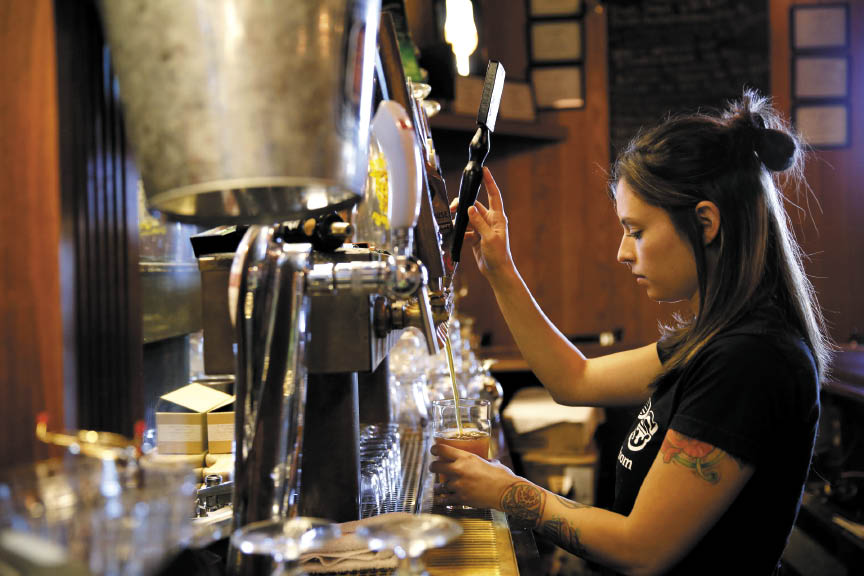
Bartender Cheryl Avery pours a pint of beer at Taps Restaurant and Tasting Room in Petaluma. (photo by Beth Schlanker)
The local artisan beer industry began in 1976, when Jack McAuliffe opened New Albion Brewing Co. in Sonoma. It is widely regarded as the first craft brewery in the modern era, though no longer based here. There is also a history of hop production in the region. In 1858, William Thomas Ross grew hops on one of the first farms near Forestville. Hops were a major crop in Sonoma County from 1880 to 1950, reaching a high of 3 million pounds in the 1930s.
Following in New Albion’s footsteps, the Hopland Brewery opened in 1983 in Mendocino County as the second brewpub in the U.S. after Prohibition and the first in California. Finally craft brewers had a place for patrons to eat and drink their beers. The brewery, which later became Mendocino Brewing Co., attracted a legion of fans, many of whom were home brewers who later expanded the popularity of full-flavored beers in the 1980s. That group included Ken Grossman of Sierra Nevada and Dean Biersch of Gordon Biersch Brewing Co. in Palo Alto.
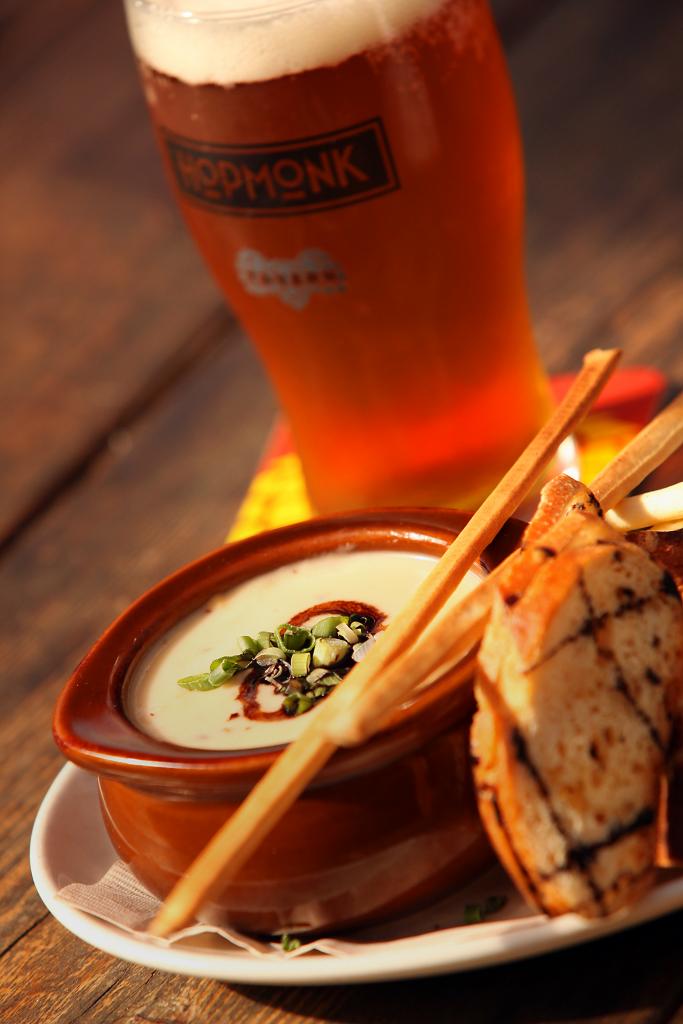
“Here’s this brewpub and it had this atmosphere that was unbelievable,” Biersch said, describing the Hopland Brewery. In his latest effort, Biersch has tried to recreate that excitement by opening three local HopMonk Tavern Brewpubs (Sebastopol, Sonoma and Novato), upscale beer gardens that focus on food pairings with beer.
However, it was home brewers who helped set the stage for what craft brewing has become here, and they keep on coming. Some dream of turning their hobby into a business, and look up to those who have already made it. Grossman started as a home brewer and even operated a supply store in downtown Chico called The Home Brew Shop. Now younger brewers can gain experience at these established places, just like the guys at 101 North.
“I probably respond to a dozen to two dozen emails a week from home brewers,” said Russian River Brewing’s Vinnie Cilurzo.
Specialization is the current trend in the craft-beer industry and an especially vital point in Sonoma, where brewers such as Cilurzo, Magee and Bear Republic’s Norgrove family have made an indelible mark with their flagship IPAs. you can’t go into a bar in the county without encountering at least one IPA on tap, and likely a few more.
“It’s getting more challenging and you certainly have to differentiate more,” said Bart Watson, chief economist with the Brewers association.
That’s what Steve Doty is doing with his one-man shop, Shady Oak Barrel House in Santa Rosa, which specializes in sour beers and those brewed with Brettanomyces yeast. Like the county’s other famous beverage, some of his beers can take up to two years to age. His brews, including Funkatronic, are available at Bottle Barn and the Rincon Valley Tap Room & Bottle Shop, both in Santa Rosa, although availability varies be- cause of Doty’s small production.
“There are very few people who are specializing in things,” Doty said. “That’s why I don’t think we are even close to crowded.”
As the demand for craft beer skyrockets across the country, a new brewery opens every 16 hours, Watson said. The local contribution is significant. A report by the Sonoma County economic Development Board found that craft brewing pumped $123 million into the local economy in 2012, creating almost 500 jobs and another 179 positions indirectly. Hotels and eateries that serve those who visit Beer Country, taxi services and gas stations, even convenience stores that sell aspirin to those who have overindulged, contribute to the economy, thanks to beer.
Kelly Jung said she was impressed that Vinnie Cilurzo came out and greeted customers in line.
Cilurzo said most of the well-known craft brewers have not allowed success to go to their heads. after all, they started as fans, then became home brewers, and still retain the enthusiasm they first had when they were cooking grains, malt and water in their kitchens.
“It’s how we did it. It’s how so many did it,” he said. “It’s about not forgetting your roots.”
Irish lox topped salmon over red potatoes, leek fondue, and ale butter, by Hopmonk Tavern executive chef Billy Reid, served with Hopmonk Dunkelweizen. (photos by Christopher Chung)
No one needs to tell Jeff Bull that cold beer is hot for creative food pairings. The Santa Rosa home brewer and self-admitted craft beer geek lists among his favorite sudsy combos a spicy, mocha porter with German chocolate cake.
He waxes poetic on his bullseyebrewco.com blog about the pleasures of partnering beer and cheese, beer and maple bacon Kettle chips, beer and ice cream, and beer and oysters. He also posts uncommon culinary hints from regional craft brewers (“Ever hear that Girl Scout cookies and beer go well together? Oh, HELL YES. Ninkasi Brewing Devil and Tagalongs”).
“Pairing beer with food is one of my favorite activities,” Bull said. “I love the diverse flavor profiles offered by both.”
Bull and his brethren are just the type of microbrew lovers helping fan the flames of an ever-increasing array of beer dinners in Sonoma. These days, local brewmasters hold court like the fanciest winemakers, sharing their skills as cicerones (beer sommeliers) to show others how an artful IPA can enhance spicy duck wings dunked in fried Maytag blue cheese, and how a soulful stout can be a sophisticated star alongside a burger adorned in truffles and foie gras and drenched in demi-glace.
HopMonk Tavern owner Dean Biersch knows well the charm of beer and fine food, often arranging one-night-only, fancy, suds-soaked meals at his pubs in Sebastopol and Sonoma. With 18 beers on tap and dozens of bottled microbrews, he likes to challenge his chefs for inspirations such as a Lagunitas Brewing Co. Petaluma Pils partnered with bitter apple and corn croquettes.
Part of the fascination, he said, comes from the often-layered flavors of artisanal beers, which can boast notes ranging from pear and lilac in Healdsburg’s Bear Republic Brewery Co. Cher Ami, to caramel and coffee in Sonoma’s Carneros Brewing Co. Negra IPA.
“The range and quality of American craft beer in 2015 is amazing,” Biersch said. “Most are hybrids based on tradition, but featuring unique yeasts and hop varietals. This has created new and open territory for chefs interested in beer. It’s the combination of unique pairings and flavors, the relaxed tavern or beer garden setting, shared tables and the personal stories from brewers, chefs and owners that make beer dinners so fun and informative.”
Growlers sit on a shelf behind the bar at Russian River Brewing Company in Santa Rosa. (photo by Christopher Chung)
In the 1800s, when a man wanted to enjoy a few beers outside his local tavern, he didn’t stock his cellar with bottled beer. Instead, he asked the barkeep to fill a growler with fresh draft beer to go. Growlers usually took the form of half-gallon galvanized buckets, delivered to patrons by “bucket boys” who carried the pails through the streets on notched poles. this custom was called “rushing the growler.”
No one knows for sure the origination of the term “growler,” but one popular theory is that the vessels were named for the sloshing sound the beer made inside the buckets during transport.
Whatever the reason behind the name, growlers are experiencing a revival in taprooms all over Sonoma. Not only do they allow beer lovers to bring home unbottled, limited-volume brews for drinking at home, the reusable glass jugs are eco-friendly, too.
Patrons pay a small fee for an empty growler — usually $6 to $8 — which they can bring back to the brewery for discounted refills. (Once emptied, a growler should be rinsed immediately with warm water. If it’s been left to sit for a couple days, warm water with just a touch of dish soap will do the trick.)
If a growler’s seal — typically a flip-top lid — is left intact, the beer will stay fresh in the refrigerator for a week or so. Once a growler has been opened, it’s best to finish off the beer in a day or two.
Nearly all Sonoma brewers offer growlers in their taprooms, including Dempsey’s Restaurant & Brewery, Lagunitas Brewing Co. and Petaluma Hills Brewing Co. in Petaluma; Fogbelt Brewing Co., Russian River Brewing Co. and Third Street Aleworks in Santa Rosa; Carneros Brewing Co. in Sonoma; Woodfour Brewing in Sebastopol; Bear Republic Brewing Co. in Healdsburg; and St. Florian’s Brewery in Windsor.
For 36 years, The Beverage People co-owner Nancy Vineyard has seen the home-brewing industry rise and fall repeatedly, first in the mid-1990s and then in the early 2000s.
“It always goes up when the economy goes down,” she said. “People don’t have jobs, but they want to continue to have beer.”
The Santa Rosa retail and mail-order store offers classes in home brewing, as well as kits that provide all the key equipment and ingredients for beginners to get started. a standard kit runs about $100.
“That’s just the hardware,” she said. “But with your own water, and saved beer bottles, that will make a 5-gallon batch of beer with an ingredient kit, which costs between $35 and $55.”
The entry-level kit includes a book by Byron Burch, “Brewing Quality Beers,” which is required reading for anyone just starting out. The key components of the kit are the fermenter (a 6.8-gallon plastic bucket with a lid), a 5-gallon carboy for secondary fermentation, plastic fermentation lock, siphon hose, bottle brush, bottle filler, crown caps, capper, odor-free cleaner and no-rinse sanitizer.
Vineyard suggests starting out with a pale ale or IPA ingredient kit, because most people know how those beers are supposed to taste. Included are the malt ex- tract, hops and yeast.
Home brewers also need a large stockpot for cooking the ingredients (20- to 32-quart), Pyrex measuring cups and cases in which to store the bottles out of the light.
Relatively new on the scene is Beer Belly Brewing Supply in Windsor. Owner Christal Farias, a Healdsburg native, opened the shop in June 2014, after she and her friends found themselves unable to buy last-minute sup- plies on Sunday, their favorite day to brew together. So she opened her own store and began hosting Beer Camp, an evening of beer, food and a talk given by a professional brewer ($35-$45).
The next Beer Camp is May 19 at 6:30 p.m., with Fogbelt Brewing.
Entrants in the first Sonoma County Home Brewer’s Competition will show off their suds at a May 23 tasting at the Veterans Memorial Building in Petaluma, 11 a.m. to 4 p.m. It’s too late to enter the competition, sponsored by the Petaluma Downtown Association, but attend the tasting and be inspired to brew a batch for the 2016 event.
The $25 ticket includes a logo glass and 20 tastings, plus opportunities to learn about home brewing, equipment and ingredients. There will be food trucks and music, too. Attendees vote on their favorite beers and the top 10 are judged by an expert panel. The ultimate winner will brew his or her recipe at 101 North Brewing Co. And Have It Distributed Locally.
For aficionados, two beers put Sonoma on the map: Lagunitas Brewing’s ubiquitous flagship India Pale Ale (IPA) and Russian River Brewing’s Pliny the Younger, a triple IPA that’s available just two weeks a year. But as local craft-beer drinkers know, there’s a lot more to Sonoma brewing than these two superstars. Impress yourself and your friends with these other local beers that are nearly as good (or perhaps even better).
Pliny the Elder, Russian River Brewing
If you can’t make the trip or don’t want to wait in line for Pliny the Younger, the sixth-best beer in the world, according to Beer Advocate, the eighth-best brew isn’t a bad consolation prize. Pliny the Elder, a classic, hoppy double IPA, is one of the most coveted beers around, and it’s right in our backyard, Santa Rosa.
Blind Pig, Russian River
With as much hype as the Plinys get, Blind Pig, a less intense, well-balanced and flavorful IPA, tends to get overlooked. Many hop heads, including this one, prefer Blind Pig over the hoppier Plinys.
Saison, Henhouse Brewing
There aren’t many California breweries whose flagship beer is a saison, or farmhouse ale, but Petaluma’s HenHouse excels at the style. Its signature brew is a rich, golden color that’s light in body, with less of the tartness that puts some drinkers off of saisons. It’s a great first saison for people new to craft beer. HenHouse doesn’t bottle or have a taproom, but its beers are widely available on draft in the North Bay.
Death & Taxes, Moonlight Brewing
A mainstay of the Sonoma craft brew scene, Santa Rosa’s Brian Hunt produces this signature dark lager that has the flavor profile of a dark beer, but without the heaviness of a stout or porter.
Berliner Weisse, Woodfour Brewing
The selection changes often at this Sebastopol brewery, but this tart, low- alcohol wheat beer is a mainstay. At approximately 3 percent alcohol by volume, it’s a great midday pairing with lunch from the brewpub at The Barlow.
Old Adobe Stout, Petaluma Hills
This dry stout should please fans of Guinness, and it’s a great reason to visit Sonoma County’s most laid-back, cozy taproom.


 There’s nothing nostalgic about the menu, however. Valette spent the past six years as executive chef with Charlie Palmer at Dry Creek Kitchen, and yes, he offers the superb artisanal salumi for which he became famous there. Now, the charcuterie is finished in a box custom-made by Valette’s brother, Les Garzini. But the Healdsburg native puts his own imaginative twist on other recipes, brimming with eclectic accents while still showcasing the simple beauty of mostly local ingredients.