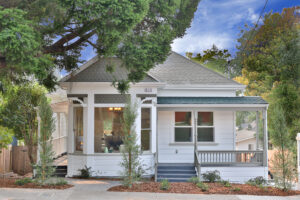
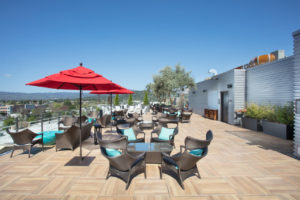
It may be modern mania right now in the world of home design, but classic style has a lot to offer, too. Here’s a look at two Victorian homes — one in Healdsburg and one in Cloverdale — that offer the best of both worlds with historic exteriors and ornamental details yet a sleek and modern look throughout.
The Healdsburg property, located on Grant Street just off the Healdsburg plaza, was recently renovated by Jim Luchessi of Healdsburg-based JL Builder. Most of the home’s original redwood remains but the exterior has been refurbished and repainted in a way that brings out the original scallop detailing and siding.
New finishes have been installed inside the home to appeal to today’s home buyers (the property was recently sold). Realtor Tatiana McWilliams, who listed the home, says many home buyers are looking for turnkey properties that have been fully renovated. She said they like quartz or quartzite counters in the kitchen because of these materials’ durability (save the marble for the bathrooms, she says) and prefer engineered wood floors over solid wood floors as the former tend to wear better.
The home’s interior walls have been painted white, which highlights the original moldings but also creates a more modern look. Rosettes and bevels have been preserved and add a romantic vibe to the home, especially around a bay window in the sitting room, while sleek cabinets and light fixtures feel very contemporary.
The building has been expanded with additional rooms upstairs, featuring clean-lined trims and moldings, and an accessory dwelling unit (ADU) downstairs with a kitchen and glass doors toward the yard.
Further north, on North Main Street in Cloverdale, a Victorian property serves as both a home and business space. Cloverdale is popular among home buyers for its relative affordability and small-town quaintness and this bright lemon-hued property, listed for $1.75 million, has plenty of charm. It currently houses a hair salon and spa on the ground floor and, upstairs in the residential area, features finishes such as a copper kitchen countertop, highly ornamented trims and moldings and brass bathroom fixtures.
The 3 bedroom, 2 bathroom property has been decorated with modern furnishings and painted in neutral colors that give prospective buyers an idea of its style potential. It also can yield considerable extra income, if the commercial space is rented out.
The home on 131 North Main St. is listed for $1.75 million by Tatiana McWilliams of Compass Realty in Healdsburg. For information, please call 707-303-6230, or email realtor@tatianamcwilliams.com
It’s not every day you hear the words “new construction” and “historic neighborhood” in the same sentence. But a group of brand new properties have recently popped up in between victorian, craftsman and Italianate homes in Healdsburg’s Johnson Street Historic District, located just a short walk from the Healdsburg Plaza.
The new homes were designed in a style that emulates the historic homes in the neighborhood, according to lead architect Matt Taylor of Santa Rosa firm Farrel-Faber and Associates. Rather than creating replicas of the historic homes, the goal was to design the new properties in a fresh way that would make them blend in with the older properties. The color palette of the exteriors doesn’t stray far from the colors of the surrounding homes but design details on the new constructions (window trims, mullions and moldings) have cleaner lines than their century-old predecessors.
The new constructions in the Johnson Street Historic District have sold fast — only two properties remain: an Italianate-style 4 bedroom, 4 bathroom property at 136 Lincoln St. and a craftsman-style 5 bedroom, 4.5 bathroom property at 132 Lincoln St.
The Italianate-style property, listed for $3.4 million, features a wall of windows in the living room that opens up toward the yard and provides the kind of indoor-outdoor living that has become particularly popular in the wake of the pandemic. The paneled walls in the craftsman-style home, which is listed for $3.5 million, have been painted white to resonate with today’s demand for light and airy interiors. This property also has folding glass doors that open toward the back deck and yard.
Both homes come with modern kitchen work surfaces in quartz and quartzite, while the bathrooms feature a more traditional upscale material: marble. Freestanding bathtubs and stained-oak vanities topped with ornate fixtures add a touch of history to the bathrooms. Each home has an Accessory Dwelling Unit (ADU), which is attached to the gated garage. The ADUs have a kitchen and bathroom and can serve as extra living space or a home office. Click through the above gallery for a peek inside the homes.
The properties at 132 Lincoln St. and 136 Lincoln St. in Healdsburg are listed by Mary Anne Veldkamp. For property details, please call 707-481-2672, or email maryanne.veldkamp@cbnorcal.com.
It’s tricky to keep track of all the restaurant openings happening in Sonoma County, even when it’s your full-time job. The hale and hearty spirit of local entrepreneurs won’t be subdued by a raging pandemic, skyrocketing rents, labor shortages and a sobering restaurant failure rate of about 60%. They persist despite all of this, thank heavens.
Click through the above gallery for an updated list of newly opened or soon-to-open restaurants in Sonoma County. (If I missed one you know about, please let me know at heather.irwin@pressdemocrat.com.)
As we settle into winter in Wine Country, mild and sunny days allow us to spend plenty of time outdoors. There’s no lack of places to explore but sometimes we could use some fresh ideas. For a change of scenery, Sonoma County residents and visitors might enjoy a day trip to Napa Valley. Click through the gallery above for some of our favorite places to sip, stroll and play outdoors.
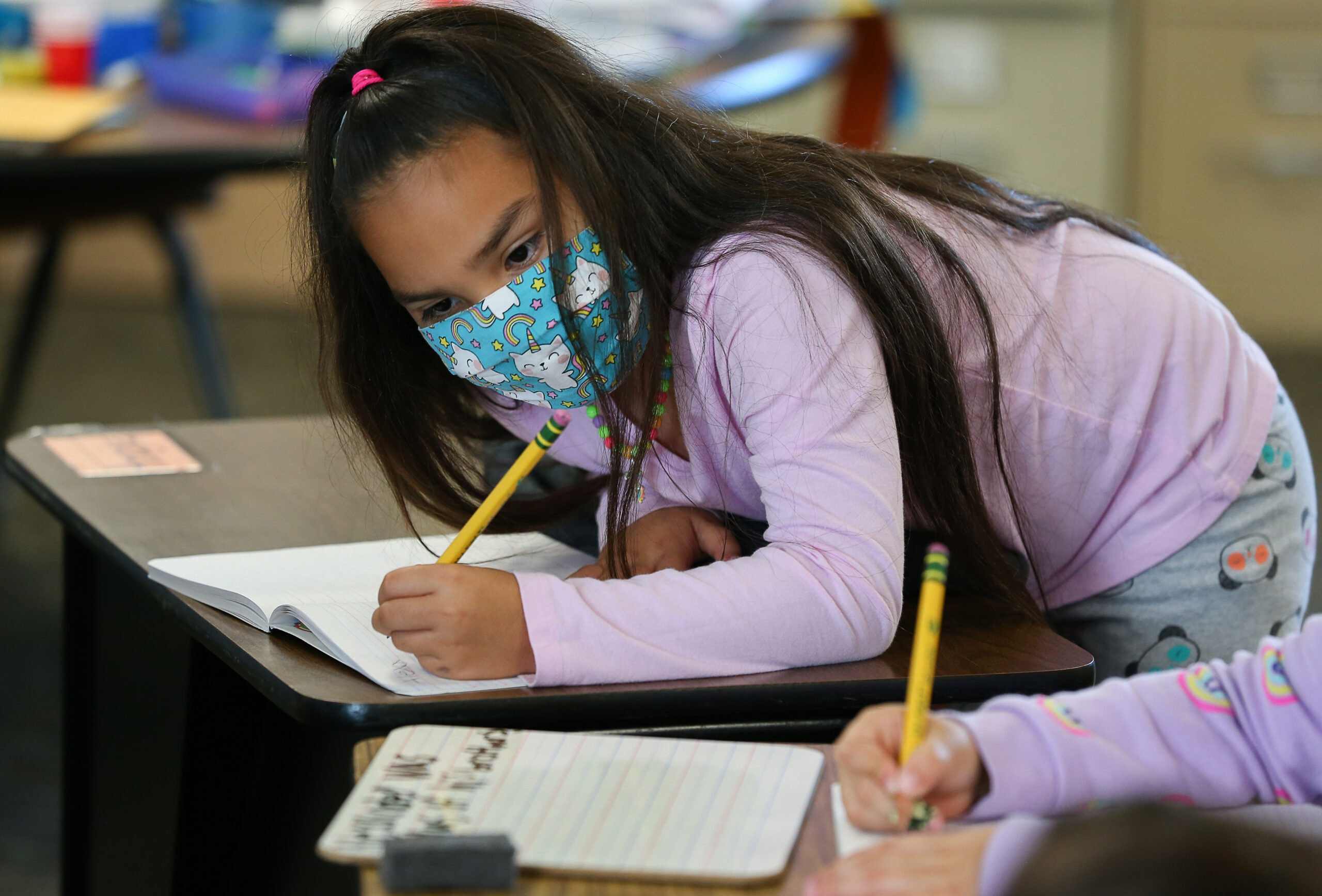
Hania Nazario, 5, a kindergartner at Cesar Chavez Language Academy, does her homework at home in Santa Rosa. (Christopher Chung/ The Press Democrat)
The floor of Jen Grady’s classroom at Mattie Washburn Elementary School was shaking ever so slightly.
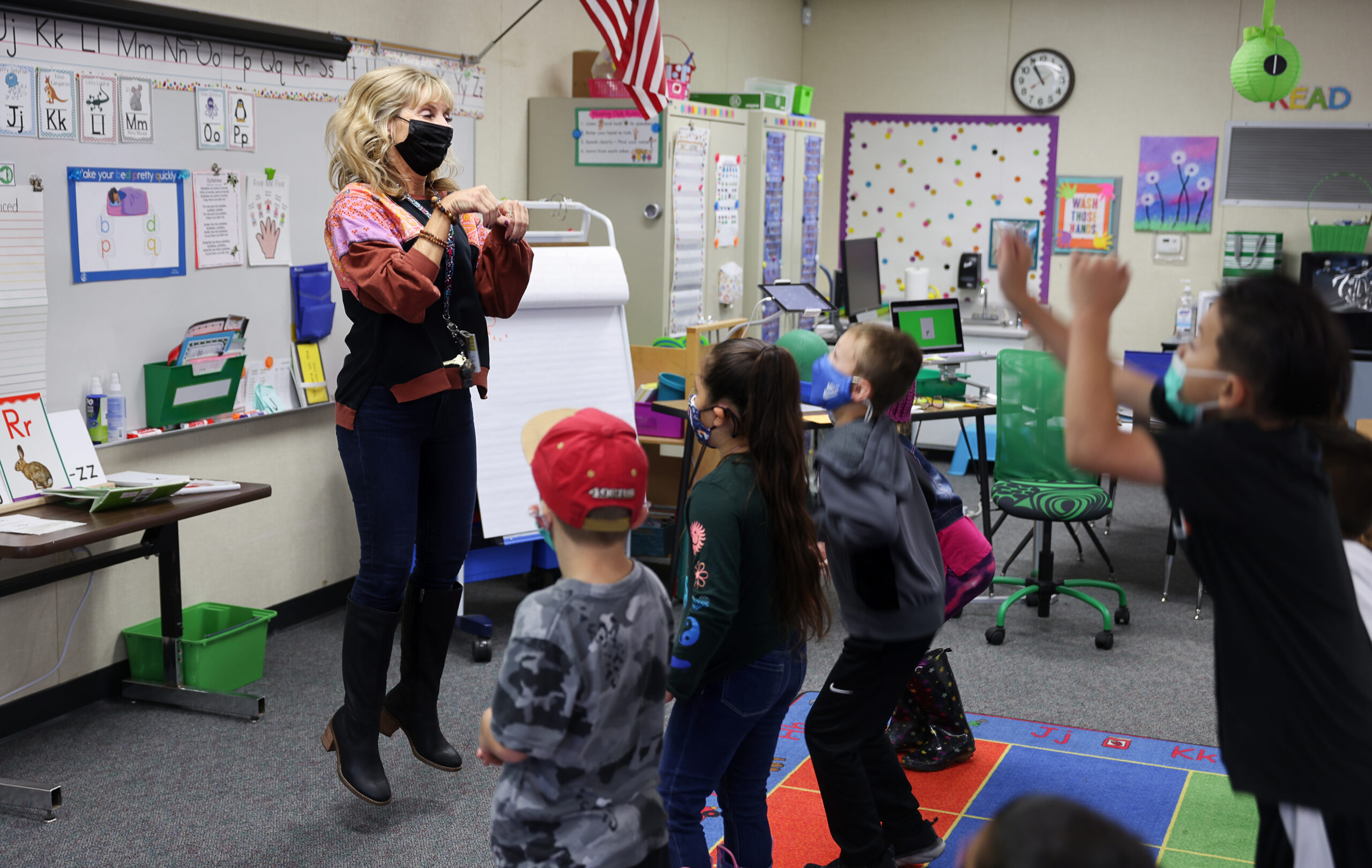
On the plush grid of her multicolored carpet, 10 pairs of feet landed with muffled, rhythmic thuds. As the students, all first-graders, hopped, they sounded out the letter “r,” a tricky consonant for many 6- and 7-year-olds to master. But the movement, mimicking a rabbit, held a clue, Grady reminded them. “It’s a developmental thing,” she explains. “They want to say, ‘er.’”
As a reading intervention specialist who has spent 19 years at the K-2 campus in Windsor, Grady’s job is to help students struggling to meet California’s grade level standards in reading and writing. This academic year, that work — and the shared experience for many fellow teachers across Sonoma County — has been an unsettling game of catch-up. “We struggled choosing who was going to get the spots” in her classroom, Grady says. “Because so many of them needed it. Because so many of them are behind.”
The return of nearly all of Sonoma’s 66,450 public school students to classrooms in August was hailed as a pandemic milestone. As a group, they had been stuck at home and consigned mostly to online-based instruction since March 2020, in some cases for months longer than most of their Bay Area peers—the result of stubbornly high local Covid case rates and local public health guidelines that were among the most conservative in the state.
But that period appears to have exacted a steep toll on the education of many students, say parents, teachers, and learning experts, who now find themselves on the front lines of an unprecedented reckoning with the vast and varied academic ground lost to the coronavirus pandemic and its potentially lasting fallout for a generation of children.
In Sonoma County, the pandemic has compounded academic woes in the wake of repeated disasters — wildfires, floods, and power outages — that have erased weeks of instruction across many school districts since 2017. Now, with Covid still a persistent worry on campus and school workforces stretched by staff turnover, educators and families are struggling to determine just how far students have fallen behind.
Schools have disclosed little data from either this school year or last on student proficiency, but officials are focusing on those likely to have struggled most based on pre-existing trends, and the pandemic’s disparate impact on certain communities. That includes Latino students and those from lower-income families, those with parents who have no work-from-home option, foster and homeless youth, and students with disabilities.
“Some of the struggles are those that would have always existed,” says Kitu Jhawar-Terris, a veteran therapist who oversees a local team of school-based counselors. “But now we’re turning the lens, focusing (on) and understanding more of what challenges and struggles students are experiencing.”
Some signs of trouble — academic and behavioral — have been different this year: Students and educators describe eerily silent classrooms filled with children hesitant to speak up; first and second-graders who struggle to hold a pencil correctly; and, on many campuses, a marked increase in referrals to the principal’s office.
Now, the race is on in classrooms across the county to identify and reach those who fell farthest behind. More than $228 million in state and federal aid has been funneled to local districts to launch new tutoring programs, deploy teams of school therapists, and introduce lessons geared to social and emotional health.
The concern spans all grade levels. Parents of young children fret about the setback in foundational learning, while older students have less time to make up for losses. “I think, historically, the kids that did OK are going to continue to do OK,” says Rhianna Casesa, a professor in Sonoma State University’s elementary education department. “The kids that historically didn’t do OK even pre-pandemic — so, you know, our students of color, our emergent bilinguals, our students from low socioeconomic backgrounds — they will continue to not be OK.”
Teacher Jen Grady asks her students at Windsor’s Mattie Washburn Elementary to hop like rabbits while sounding out the letter “r.” (Christopher Chung/The Press Democrat)
Jeanelle Payne says she has been unsettled by the silence that’s taken hold in some of her history classes this year at Montgomery High School. The students talk little, if at all. She asked fellow teachers if they were witnessing the same thing.
They were, says Payne, a 17-year classroom veteran. Students were struggling to break down large assignments into small tasks or were not working well with a partner or in a group. Many teens showed an extreme reluctance to participate in class discussions. “I am seeing withdrawn students, disengaged students. Students who don’t know how to be a student anymore,” says Payne. It is as if some of her students “fell into their screens and they haven’t come out yet,” she says.
Students say they feel the differences, too. For Daniel Garcia, a junior attending Roseland University Prep, the contrast with his freshman year is night and day. “Now that we’re back in school … nobody says anything,” he notes.
The upheaval in the county’s academic calendar can be traced back several consecutive years before the pandemic. It began in 2017, when, a few weeks into the school year, a historic firestorm tore through the North Bay, burning several campuses and 5,300 Sonoma County homes, displacing thousands of families and killing 40 people. More wildfires, inescapable smoke, destructive floods, and debilitating power shut-offs and outages have since added to the tally of missed days.
Students in Santa Rosa, the north county and the west county have missed out on the most instruction in the past five years, according to data provided by the Sonoma County Office of Education. Geyserville Unified School District closed for 33 days between fall 2017 and November 2021. Guerneville School District closed for 32 days, followed by Santa Rosa City Schools and Kenwood School District, both at 31 days. Mark West Union, Piner-Olivet Union, and Rincon Valley Union School District all closed for 25 days.
“We’ve been here before, especially in Sonoma County,” Payne says on the losses that preceded the pandemic. “So, on the one hand, yes, I’ve led students through trauma before.”
But to hear local students, teachers and mental health professionals tell it, the pandemic has traumatized students on a different scale. Hania Nazario, a kindergarten student at Cesar Chavez Language Academy in Santa Rosa, missed only a month of day care at the start of the pandemic. She returned, but with only four other children. So when she started kindergarten in August 2021 at Cesar Chavez, she was overwhelmed and withdrawn, say her parents, Xavier and Karolina Nazario. “The first few days were rough,” Karolina says. “She said it looked like there were a hundred backpacks outside and that was very scary.”
Stephanie Manieri, programs director for Latino Service Providers, a nonprofit serving the county’s Latino residents, described strain among teenagers she works with in the Youth Promotores program. “I’m seeing symptoms of burnout, and I don’t use that term loosely,” says Manieri, an elected board trustee for Santa Rosa City Schools. “They’re really tired and exhausted and unmotivated, and it’s not because they’re receiving no support. It’s just because they haven’t had a proper break, and they haven’t had stability in such a long time.”
Jhawar-Terris, the therapist, says she and members of the school mental health team she oversees with nonprofit Social Advocates for Youth are treating students struggling with the effects of isolation. “Those students who were really excited to go back to school are now experiencing some of that social isolation, even though they’re around friends; they’re around other people,” she says. “They almost have to relearn how to maintain those friendships in person.”
Face masks required in the classroom, while a necessary health protocol, can make it harder for people on campus to connect, say Payne and Garcia. “Sometimes when somebody is talking, their voice is low and muffled by their mask, and it makes it really hard to hear,” Garcia explains.
“It’s also hard with the masks to read faces,” Payne says. “Does this blank stare mean, ‘I don’t understand. Can you ask it in a different way?’ or, ‘I’m physically here, but mentally I’m somewhere else and I don’t care about this’?”
Students and educators describe eerily silent classrooms filled with children hesitant to speak up, first- and second-graders who struggle to hold a pencil correctly and, on many campuses, a marked increase in referrals to the principal’s office.
In Santa Rosa, Sonoma County’s largest school district, officials have had little to show to gauge the breadth and depth of pandemic-era academic loss for students.
The cycle of tests and periodic assessments schools regularly use to measure and track student development was mostly paused while classrooms were closed, and reintroduced in scaled-back form once they returned. Little if any of that data for local schools has been made available. “We know we have students we need to assist in some learning gaps,” says Anna Trunnell, superintendent of Santa Rosa City Schools. “And through this year, we’re trying to find ways we can assist with intervention and additional support.”
Annual reports called summative assessments, revived by the state and federal government this past spring after a hiatus in 2020, were intended to shed some insight into what progress Sonoma County students made toward grade-level standards during distance learning. “There was some concern, with the suspension of testing in 2020, (that) if that was done again, there’s two years without data,” says Jennie Snyder, deputy superintendent of educational support services for the county Office of Education.
Santa Rosa City Schools, with nearly 15,000 students enrolled this year across 25 campuses, used two online assessments to monitor students’ proficiency in math and English language arts, says Kimberlee Armstrong, associate superintendent of educational services.
Third- through sixth-graders in the district were assessed using tests from a vendor called Let’s Go Learn, while seventh- through 12th-graders took tests from Illuminate Education, a data and assessment platform. Some students took the tests online from home, while others tested in person when the district began bringing students back to campuses part-time in April. As of November, the district had yet to aggregate or release school- and district-wide data from those assessments.
Sonoma County’s public school families had waited with excitement and frustration for the reopening of classrooms. Resentment had grown, too, over several months, as students in neighboring counties returned to in-person instruction earlier in the school year.
Several Marin County school districts, for example, reopened campuses for a mix of in-person and remote instruction beginning as far back as the fall of 2020, after the county moved into the second-most restrictive tier on the state’s Covid-monitoring system. Many in San Rafael were able to attend school full time in person by March 2021.
Likewise, Napa Valley Unified School District, which serves 17,240 students, returned to part-time in-person instruction beginning in October 2020 as the county moved into a less restrictive state tier. Sonoma County, meanwhile, remained stuck in the most restrictive category of operations until the state did away with that system in June.
For three weeks in November, Sonoma magazine sought access to data from Santa Rosa City Schools about student performance, including numbers that would show how different student groups fared in assessments and shed light on known disparities between different ethnic groups and socioeconomic backgrounds.
District officials initially provided some data on 11th grade math and reading proficiency, broken down by school, but later said the dataset was inaccurate because it did not capture the entire population of 11th-graders who took the test. A similar snapshot
the district provided of seventh-grader data included several who were listed as students of the district’s high schools. Sonoma magazine opted not to use the data because of its apparent errors.
Trunnell and Armstrong say the district’s migration to a new student data management system over the summer complicated the data retrieval. As of mid-November, the school board had not yet reviewed any assessment data from the previous spring.
“I know there’s a lot of interest in seeing that,” says trustee Stephanie Manieri. “I just imagine there’s a lot of things taking priority.”
School districts will need to report their assessment data from spring 2021 to the California Department of Education by Feb.1.
“(Students) are really tired and exhausted and unmotivated, and it’s not because they’re receiving no support … they haven’t had stability in such a long time.” District Trustee Stephanie Manieri
In the meantime, districts are looking to interim assessments, which are smaller-scale evaluations administered to students several times a year. These interim assessments can be more useful, says Armstrong, the Santa Rosa assistant superintendent. They show teachers what grade-level skills their students are retaining or struggling to grasp across a trimester, semester, or year — what Armstrong calls “leading indicators” of student progress. Instructors then have time left in the term to help their students improve on specific skills. “That’s the true way for us to accelerate learning, based on the individual needs of every student,” says Armstrong.
At Mattie Washburn Elementary in Windsor, students were assessed at the start of school to determine their proficiency in grade-level skills. Students who needed the most help catching up were routed to intervention specialists. At the end of the trimester in November, teachers assessed their students again to check on their progress. “We are going to be using that data (as) not only a step in time of how they’re doing, but then to drive our instruction moving forward,” says Mattie Washburn’s principal, Susan Yakich.
In Santa Rosa, district leaders have not required all teachers to administer interim assessments in the past, or even this year, but Armstrong says it’s now “strongly recommending” the practice. Across the district in past years, she says, some teachers had already adopted, on their own, the cycle of short-term check-ins. “That’s great, but it’s not equitable,” Armstrong says.
Two Santa Rosa campuses are also piloting use of one assessment, called MAP, or Measures of Academic Progress, which was created by an Oregon-based nonprofit, the Northwest Evaluation Association. Elsie Allen High School and Hilliard Comstock Middle School teachers will be using the assessments to track their students’ progress throughout this year, Armstrong says.
District officials have their eye on the 2022 school year to potentially deploy new requirements for interim assessments across the school district.
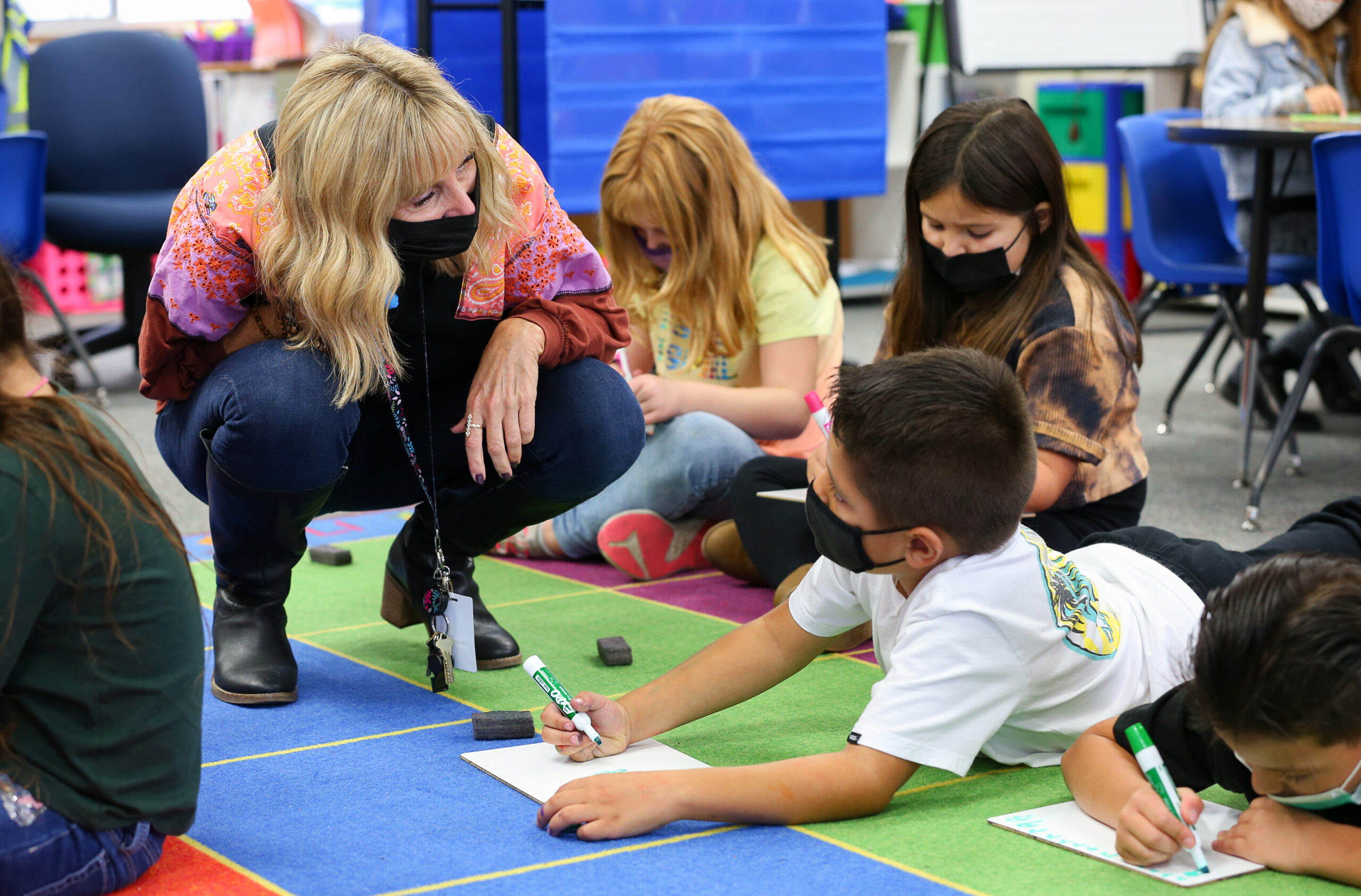
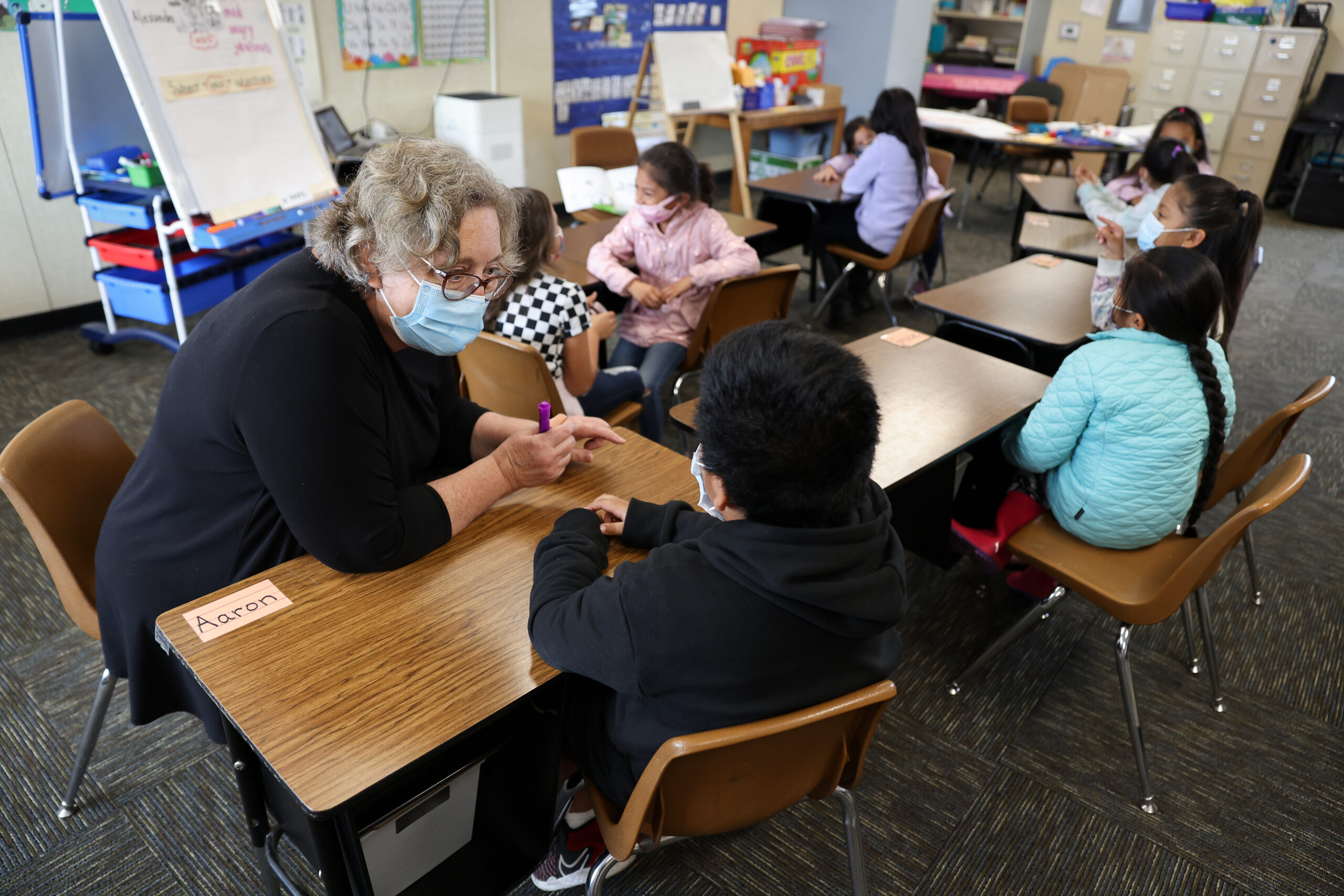
At Mattie Washburn Elementary School, teacher Jen Grady works with student Andrew Ceja on his writing (Christopher Chung/The Press Democrat)
Sonoma County school administrators have often described their efforts in the current school year as “learning acceleration,” rather than remediation or recovery. The distinction is more than parsing words, according to Snyder, the deputy superintendent with the county’s office of education. It denotes a markedly different approach.
Typically, remediation prioritizes catching students up on grade-level skills they lack from the previous year, before moving into content for their current grade. Alternatively, learning acceleration emphasizes lessons and material appropriate for students’ current grade, using assessments to determine which skills from their previous grade the students need to improve. Teachers then build that content into lessons, as well.
“We began to hear in the spring, ‘We’ve got to reteach and remediate,’” Snyder says. “What the research has really shown is that kind of approach actually sets kids back even further.” She was referring to a 2018 report by the nonprofit New Teacher Project, based in New York, that relied on nearly 30,000 student surveys, more than 20,000 work samples, and several thousand assignments and lessons to assess which students made larger gains throughout a school year.
“We saw a promising trend,” the report’s authors conclude. “When we make different choices about how resources are allocated — when all kids get access to grade-appropriate assignments, strong instruction, deep engagement, and high expectations, but particularly when students who start the year behind receive these resources — achievement gaps shrink.”
The application can look different in each classroom. Elizabeth Olah, an English language development specialist at Mattie Washburn, describes her approach as being guided by her students’ engagement with the skills she’s teaching. “I’m using what’s called the push approach,” she says. “I’m trying to push vocab that is more than what they already know, more than what they’re going to come up with on their own. They might have come in very comfortable with short vowel sounds. Now I’m pushing them to think way beyond that, to words that have multiple syllables.”
“Teachers are being asked to do a lot more than they’ve been asked to do in the past … They need more resources so that they can adequately meet their students’ needs. SSU’s Rhianna Casesa
Jimena Mendoza is a second-grader who spends time with Olah each week. Her mother, Yvonne, said she thought the biggest setback for her daughter during the year of distance learning was with her progress in English language. The Mendoza family speaks Spanish and English at home.
But back in the classroom now, with Olah’s help, Jimena is often the first student to speak up when Olah asks her students to read aloud. Jimena even helps her classmates sound out words and sentences.
Second-grader Jimena Mendoza-Rios practices writing during her English language development class at Mattie Washburn Elementary School in Windsor. (Christopher Chung/The Press Democrat)
Students, Olah says, have “tells” when they’re ready to move on from one lesson or skill to another. “In the beginning, it’s too hard,” Olah explains. “And then once they get the hang of it, as a group, it comes too easy and they do it too quickly. And then I know they’re ready for more, and I begin to push.”
Casesa, the SSU professor, says it’s important to remind kids that though they lost skills during the year of distance learning, their schools are striving to help them recover. “If you are a fourth-grader and you’re coming into your first day, and your teacher’s already telling you that you need to catch up, it’s pretty defeating,” she says.
A mother to an elementary-age daughter herself, Casesa encourages parents worried about their children to have faith in educators to address students’ needs—as long as they get the proper support from their districts.
“Teachers have been trained on meeting kids where they are in differentiating instruction, and working with small groups of kids to get them from point A to point B,” Casesa says. “Teachers are being asked to do a lot more than they’ve been asked to do in the past. And so they really need a lot more support, they need classroom aides, they need paid prep time. They need more resources so that they can adequately meet their students’ needs. Because they know what to do.”
Back in Jen Grady’s classroom, Andrew Ceja lay quietly on the floor, carefully writing a lowercase “r” on his whiteboard.
Grady has had to train several first- and even second-graders on how to properly hold a writing utensil this fall, something she has rarely encountered with prior classes over her two decades of work. But Andrew was not one of them. “Because his parents worked on it with him,” she says.
Parents’ involvement in distance learning played a key role in young students’ overall retention of skills, Grady and other teachers across the county say. This year, they’ve seen firsthand the impacts on children who had less support. “Normally, the reading intervention program services kids who … (are) on the cusp of learning,” Grady says. “But now I’m getting a lot of kids that have very (few) skills.”
“A lot of kids’ parents just didn’t know how to help their kids or didn’t have time,” she says. “(It’s) no fault of theirs. As far as distance learning went, parents did the best they could.”
Even with his parents’ support, Andrew entered first grade behind in some kindergarten- level skills, including his ability to blend and segment syllables in a word. To catch up, he spends time outside of his regular classroom with Grady four days a week.
His mother, Yuset, feels distance learning was largely ineffective. As Andrew stayed home with his older sister and brother under Yuset’s supervision, internet connectivity issues and problems logging into Zoom class hampered his lessons most days. Yuset, a stay-at-home mom, would go up and down the stairs of their Windsor home several times each day, checking in on Joe, then an eighth-grader at Windsor Middle School, and KK, then a fourth-grader at Brooks Elementary, in each of their rooms. After that, she would head back to the kitchen table, where she and Andrew would work together on his lessons.
At least one student would usually be in tears at some point during their Zoom lessons. Andrew got stressed, asking her why he had to participate. He struggled to retain reading and math lessons. “It was really tough,” she says.
Yuset had to fill many of his hours each week with supplemental work, teaching him colors and reading to him, she said. But she still was grateful for the ability to do so. “Thank God, every single day I can stay home,” she says. “There were a lot of kids (on Zoom) by themselves.”
Yvonne Mendoza, second-grader Jimena’s mother, was able to bring her children to her parents’ house on the days when both she and her husband needed to work. She bought iPads for Jimena and her brother, Esteban, in fourth grade at Brooks Elementary, so they could have reliable technology to access their schoolwork.
“They got very techie,” Yvonne says. “My daughter was able to screenshot and send me a picture of her assignment. ‘Mom, I’m stuck on this problem.’ I had my phone right next to my computer, and whenever I saw Jimena’s name pop up, I would go to the break room.”
Elizabeth Olah, Jimena’s teacher, saw students dealing with all kinds of situations during the year of distance learning. Sliding her finger down her attendance sheet, she points to the names of a couple of students who spent a month or more in Mexico last year, logging onto their class via Zoom. Several students gave the class online tours of their new quarters. Another student who lived on a farm was regularly accompanied on Zoom by the sounds of cows and other animals.
“There were some definitely difficult situations they had to work through,” Olah says, adding that some students who were left unsupervised would simply stay in bed. “They had their Zoom on, but they were sitting in their bed and they were not getting up and they weren’t getting near the screen and they weren’t participating.”
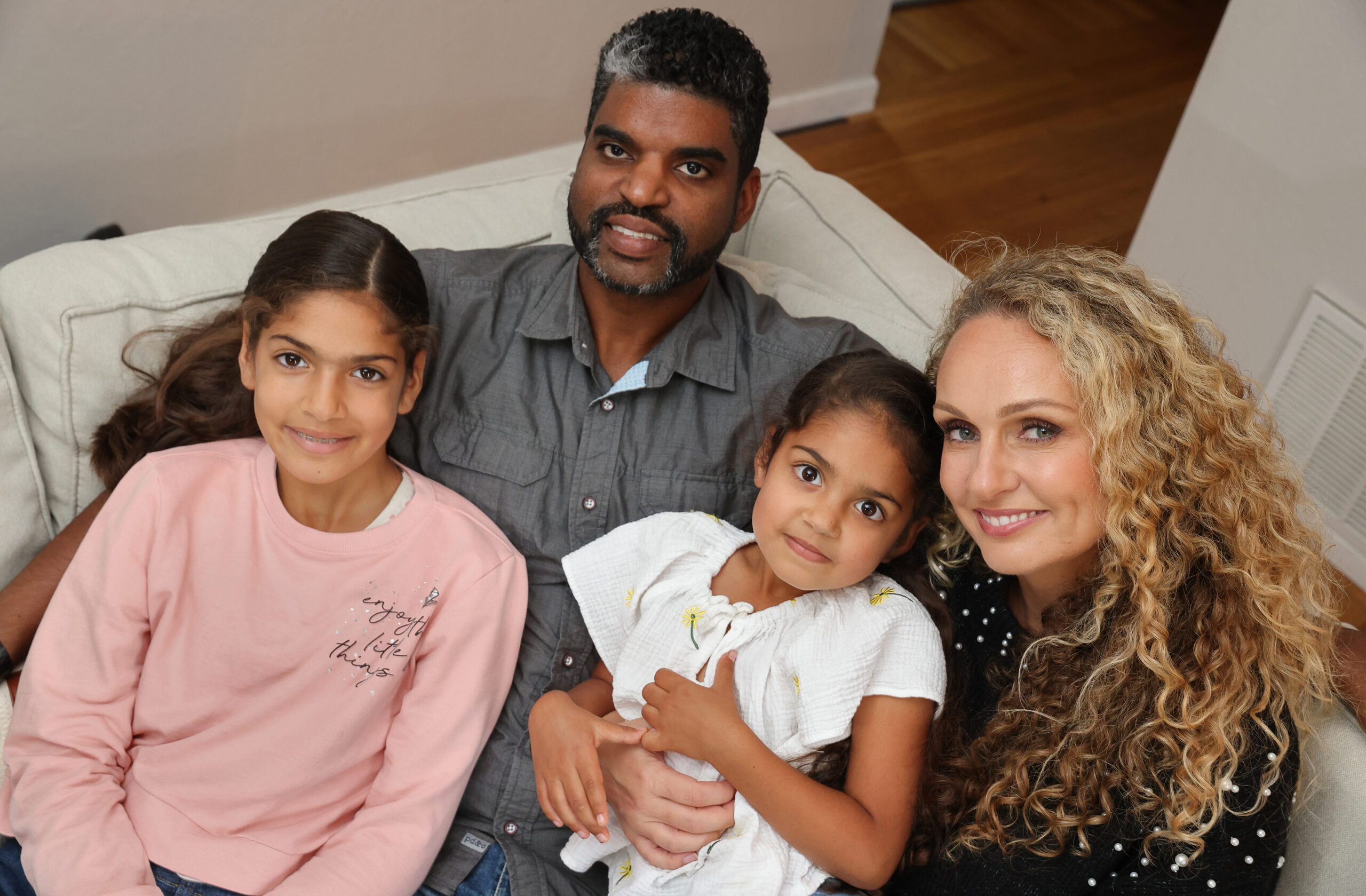
Xavier and Karolina Nazario with their daughters Zosia, 9, and Hania, 5. (Christopher Chung/The Press Democrat)
Xavier Nazario, the father of Cesar Chavez kindergartner Hania and her sister, Zosia, a fourth-grader, voices the same uncertainty shared by other parents and teachers about the pandemic’s long-term fallout for children. “I think the challenging thing is, we don’t know (all) the impacts this pandemic has had,” Nazario says.
The disparities that divide students could widen and the barriers that many face as they grow older could rise, with implications echoing across the rest of their lives. “I don’t think we’ll know until our kids, if they’re fortunate enough, go to college, what type of anxiety they’ll have or how they’ll view the world,” Nazario says.
Some educators, including Olah, are almost defiant in their optimistic outlook. They remain encouraged by the progress they’re seeing students make back in the classroom. “I am very excited to see what happens by the end of the year,” Olah says. “I think we may get there. They’re running from way behind, but they are making up ground and they’re making it up pretty quickly.”
Others, like Montgomery High’s Jeanelle Payne, are still wrestling with doubts about how their students will fare, both now and into the future. “We had high hopes for coming back, but now we’re in it, and it feels like just another year to survive,” she says. “(We have) some who are awesome, and some that are really struggling.”
Some students are bouncing back, “but that’s not everybody.”
“This is just the state of education right now,” she says. “We’re trying to teach academics, but there’s so many other needs.”
Teacher Elizabeth Olah works with a student during an English language development class at Mattie Washburn Elementary School in Windsor. (Christopher Chung/The Press Democrat)
Mental Health Support
Now, perhaps more than ever, school leaders have prioritized behavioral health and emotional support initiatives to help with student wellness. The recognition of this need is unfolding on a national scale: in December, the U.S. Surgeon General, Dr. Vivek Murthy, issued an advisory with recommendations to marshal a “swift and coordinated response” to the growing student mental health crisis.
Sonoma County’s 40 public school districts and 56 charter schools were allocated $228.4 million in pandemic-related aid to bring those plans to life. Here are a few examples of ways schools are working to address students’ mental and behavioral health needs:
• In Petaluma schools, Covid money is paying for teacher training to address students’ social and emotional needs and engage their families. The training is just one part of a total $2.2 million geared toward support strategies for learning loss.
• Officials in the Windsor Unified School District allocated nearly $400,000 to professional development on social and emotional learning.
• Santa Rosa in the fall deployed a new social/ emotional assessment tool called Pandora, to gather information from its students on their social and emotional awareness and needs. District staff were set to begin to examine that data in November and December.
• Most districts have launched after-school tutoring in math and English, often with a particular eye toward English language learners, students from low-income households, and foster youth.
• Many schools have also boosted credit recovery options to help secondary students who failed courses during distance learning stay on track to graduate.
Anna Trunnell, superintendent of Santa Rosa City Schools, says plans to support students with pandemic-related issues need to have a perspective extending beyond even this school year. Schools have through September 2024 to spend the last of their federal Covid dollars.
“We know that the shift won’t happen overnight,” Trunnell says.
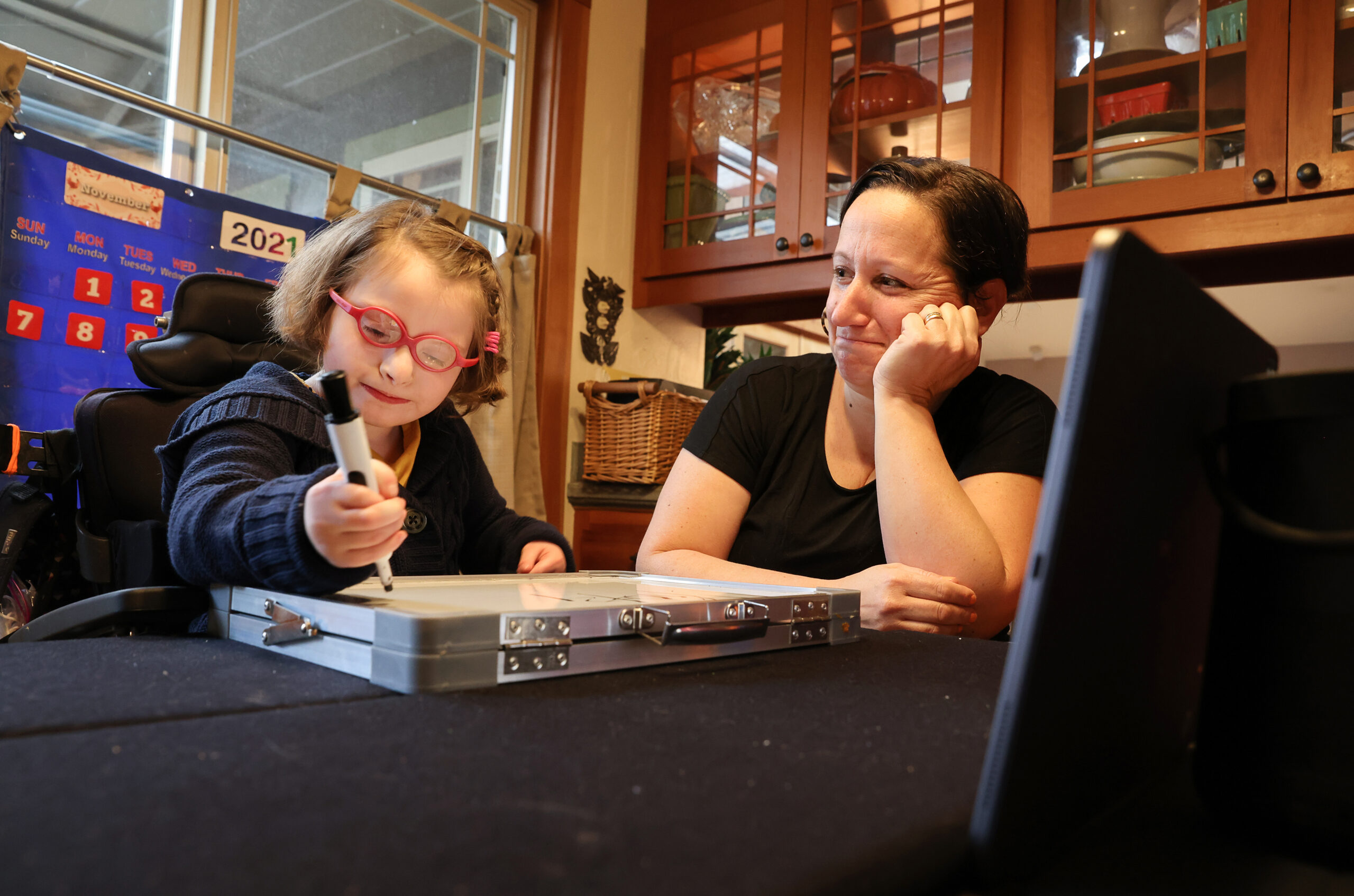
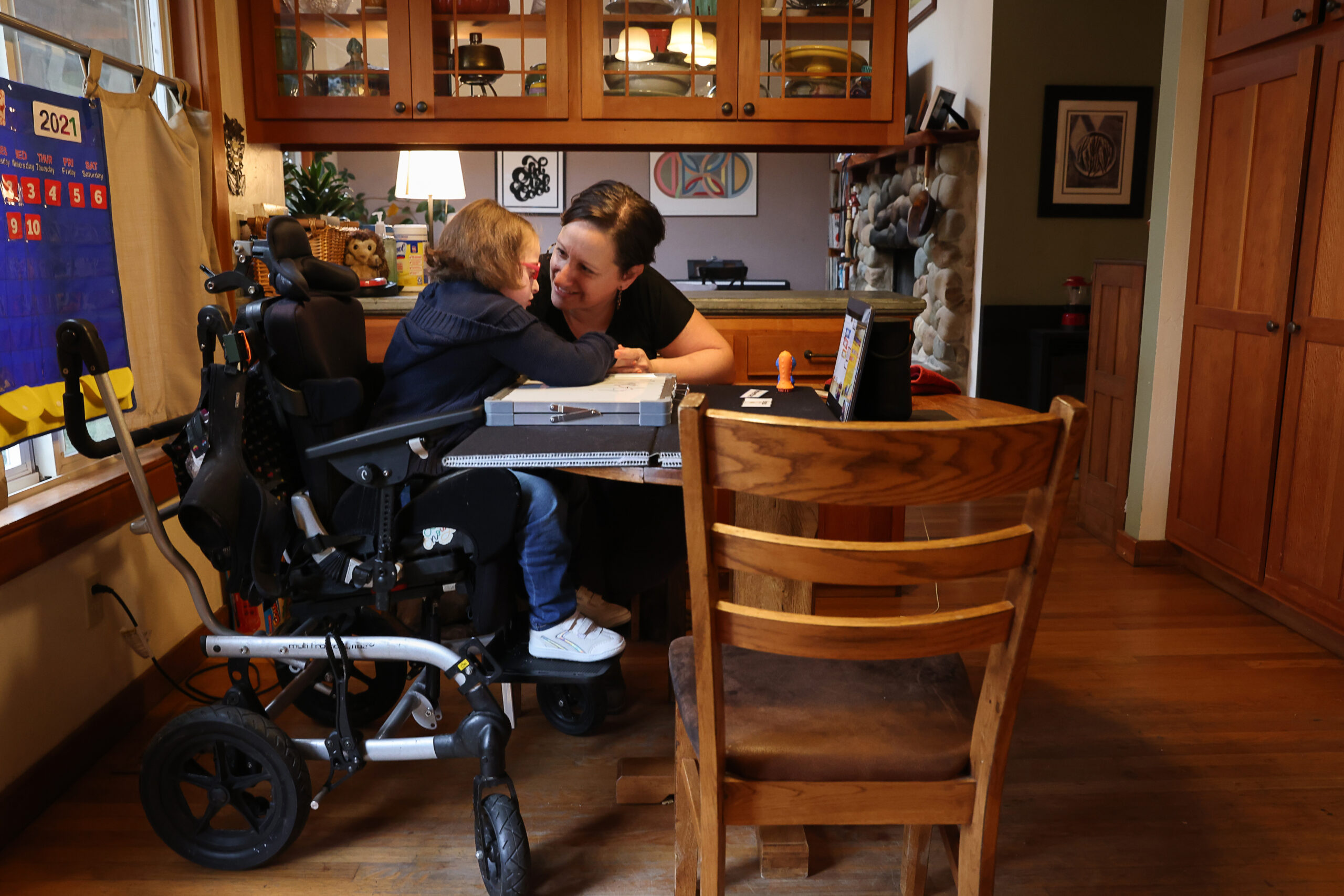
Andrea Loveday-Brown watches her daughter, April, 8, write on a white board during her online special day class in the West County Consortium at home in Sebastopol. (Christopher Chung/The Press Democrat)Andrea Loveday-Brown interacts with her daughter, April, 8, during her online special day class in the West County Consortium at home in Sebastopol. (Christopher Chung/The Press Democrat)
‘We’ve never felt this invisible’
Not all students returned to the classroom at the start of the school year. April Loveday-Brown, who is disabled and has complex medical needs, is one of them. Each day, her mother, Andrea, logs her onto Zoom to attend classes at Parkside Elementary and receive therapy from home.
Andrea says parents of special education students face an ongoing struggle to get their children enough access to instruction. “We have never felt this invisible. And that’s coming from someone already raising a kid that feels very marginalized in general.”
At the beginning of the current school year, April was only receiving around four hours of instruction and therapy a week. Her mother pushed for three months to get that number up to nearly eight hours.
She wants local families to understand that for students like April, things have not gone back to normal. “The language at the beginning of the pandemic was, ‘We need to take care of our most vulnerable,’” Andrea says. She finds it ironic that now that things are moving forward for so many others, the families of special needs students continue to feel unseen.
Many families in 2020 and 2021 protested the limits of remote learning for children with disabilities, as well as Sonoma County’s months-long delay in bringing special education students back for in-person instruction.
This year, many of those students have returned to their classrooms, says Adam Stein, executive director of Sonoma County’s special education agency.
Stein says he is hearing a mix of positive experiences, especially from families whose children are back in class. But even those families have had tenuous access to services at times.
Staff shortages and the lack of substitute teachers are disproportionately affecting students with disabilities, says Stein. “If you’re a district and you can’t find anyone to step into basic instructional teaching programs, how are you going to find someone who’s going to go into homes? We’ve got great ideas, we’ve got funding. We don’t have any people to provide that (service).”
Tracy Emerson serves drinks to guests, Kevin and Jamie Pottorff, at a riverfront table on Water Street in Petaluma where Cucina Paradiso and other downtown restaurants have set up outdoor dining. (Crissy Pascual/Petaluma Argus-Courier)
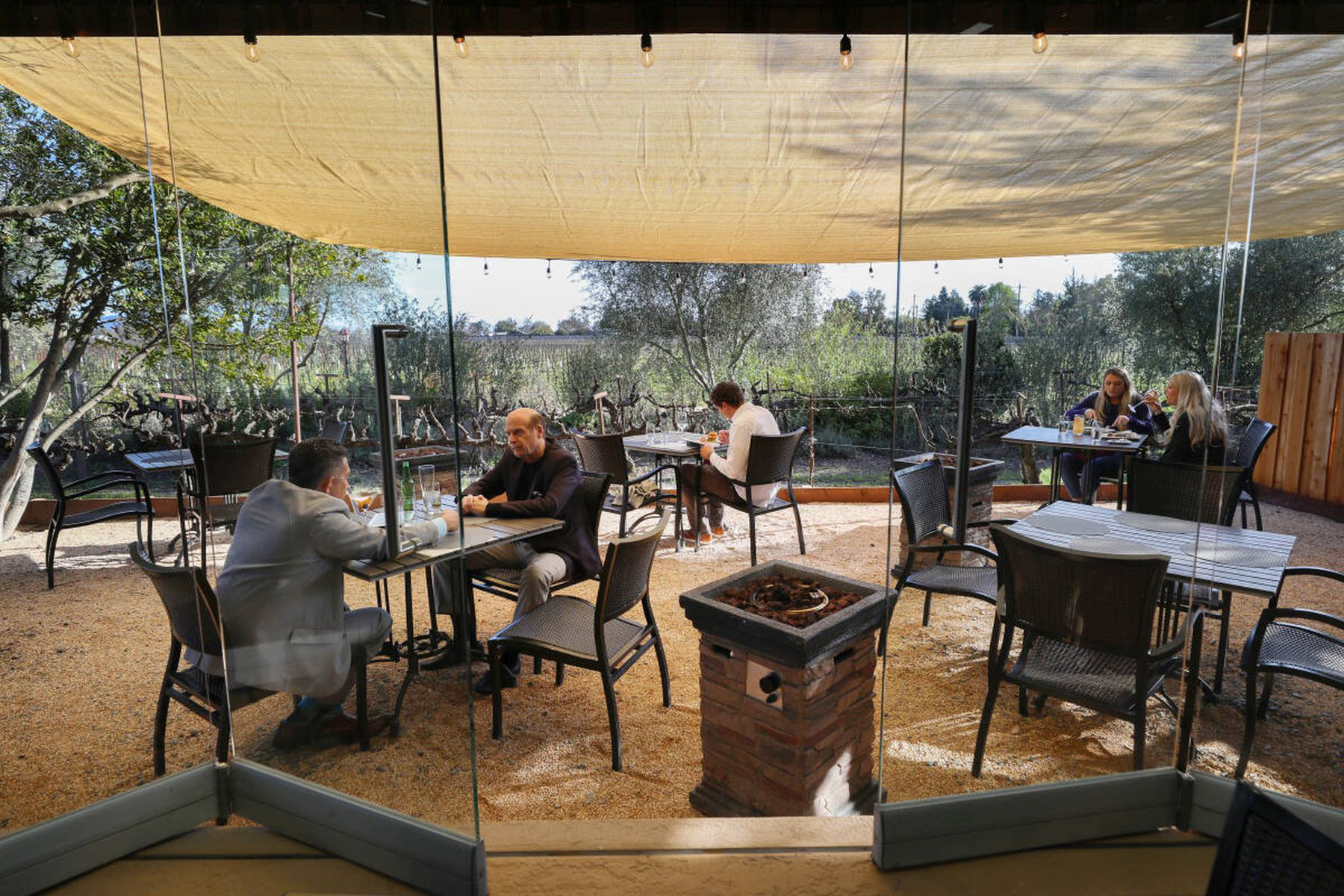
In an ever-changing pandemic landscape, outdoor dining remains a constant. From Cloverdale to Petaluma, restaurants have created al fresco dining retreats, some with tents or artsy parklets. Most have equipped their patios and outdoor dining areas with heaters but, no matter the season, make sure to dress appropriately. During winter months and chilly nights, savvy diners know to bring a seat-warmer (an old coat will do) and wear cozy socks. Yes, it’s California, but we ain’t Palm Springs. Here are 35 favorite patios with heaters and a cozy ambiance for winter dining outdoors. Click through the above gallery for a peek at the patios.
Note: Some restaurants are closed for winter break over the next few weeks, so be sure to check hours before heading out.
Santa Rosa
Bird & The Bottle: You’re front and center on busy Fourth Street downstairs, but get a second story view from the deck at this happy hour hotspot. 1055 4th St., Santa Rosa, 707-568-4000, birdandthebottle.com
Brew Coffee & Beer House: A large patio and new takeout window for a lovely outdoor afternoon with a hot pour-over coffee, a cold brew, avocado toast or breakfast sandwich. 555 Healdsburg Ave., 707-303-7372, brewcoffeeandbeer.com
Dierk’s Parkside: It’s not fancy and the heaters don’t seem to beat cold mornings, but you’ll find us happily chowing down on pancakes and Benedicts with a glass of hot coffee warming our fingers frequently. 404 Santa Rosa Ave., 707-573-5955, dierksparkside.com
East West Cafe: If you’re craving the best meze plate in town, East West Cafe is a family-friendly spot right across from Howarth Park with plenty of plant-based options. 557 Summerfield Road, Santa Rosa, 707-546-6142, facebook.com/eastwestcafesantarosa
The new patio area at John Ash & Co. restaurant in Santa Rosa. (Christopher Chung/The Press Democrat)
John Ash & Co: Vineyard views and cozy tents with plenty of heat. 4350 Barnes Road, Santa Rosa, 707- 575-7350, vintnersresort.com
La Gare: Traditional French cuisine under the twinkle lights of this longtime Railroad Square destination. 208 Wilson St., Santa Rosa, 707-528-4355, lagarerestaurant.com
La Rosa Tequileria & Grille: A huge tequila bar and the best chips and guac in Santa Rosa. 500 4th St., 707-523-3663, larosasantarosa.com
Rohnert Park
Hana Japanese: Stay snug while eating your sushi at this Rohnert Park spot. 101 Golf Course Drive, Rohnert Park, 707-586-0270, hanajapanese.com
Makimono Deluxe Sushi Platter at Hana Japanese Restaurant in Rohnert Park. (Erik Castro/for The Press Democrat)
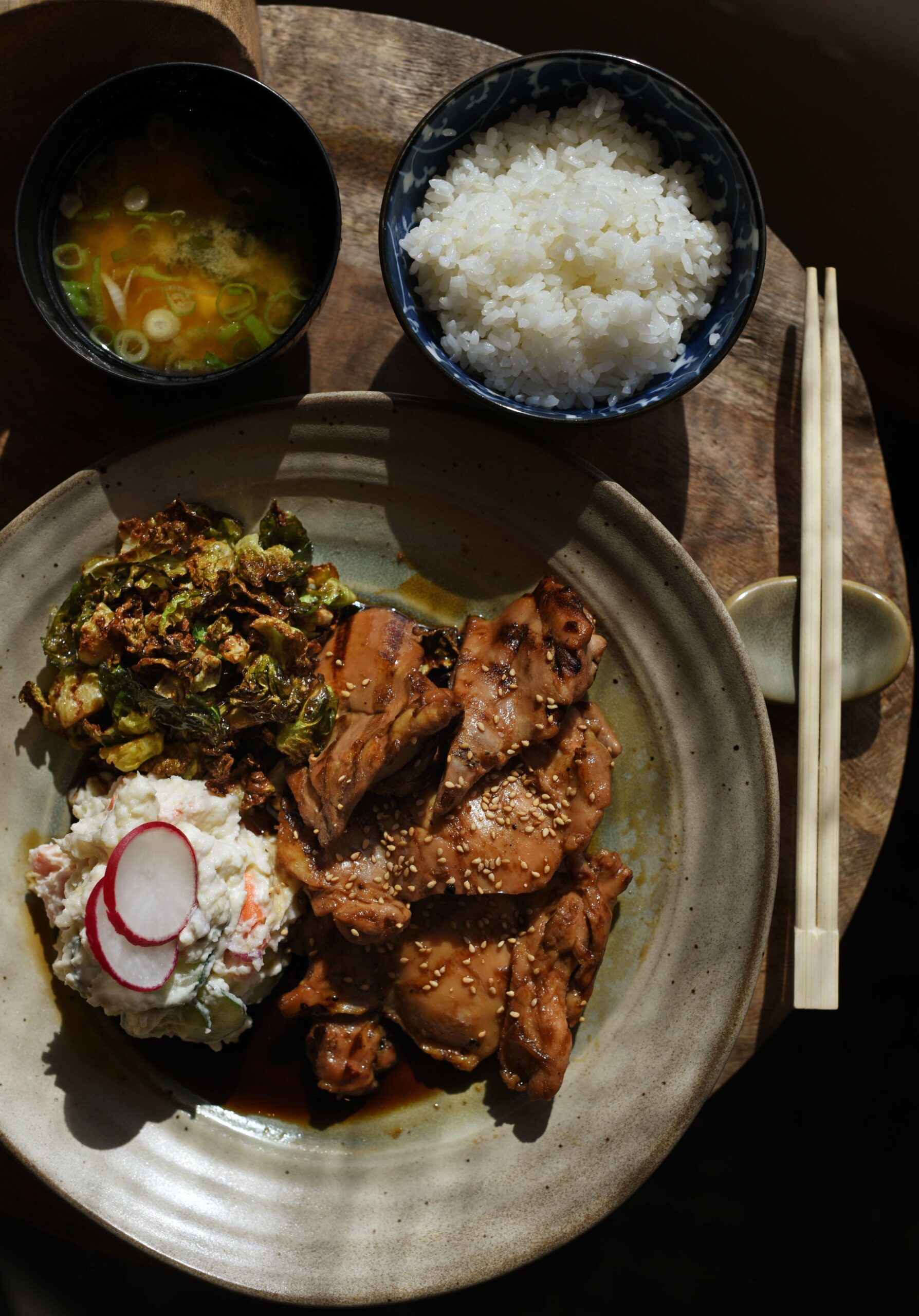
Jidori Teriyaki chicken with Japanese-style potato salad and fried Brussels sprouts served with a side of miso soup and rice at Hana Japanese Restaurant in Rohnert Park. (Erik Castro/for The Press Democrat)
Petaluma
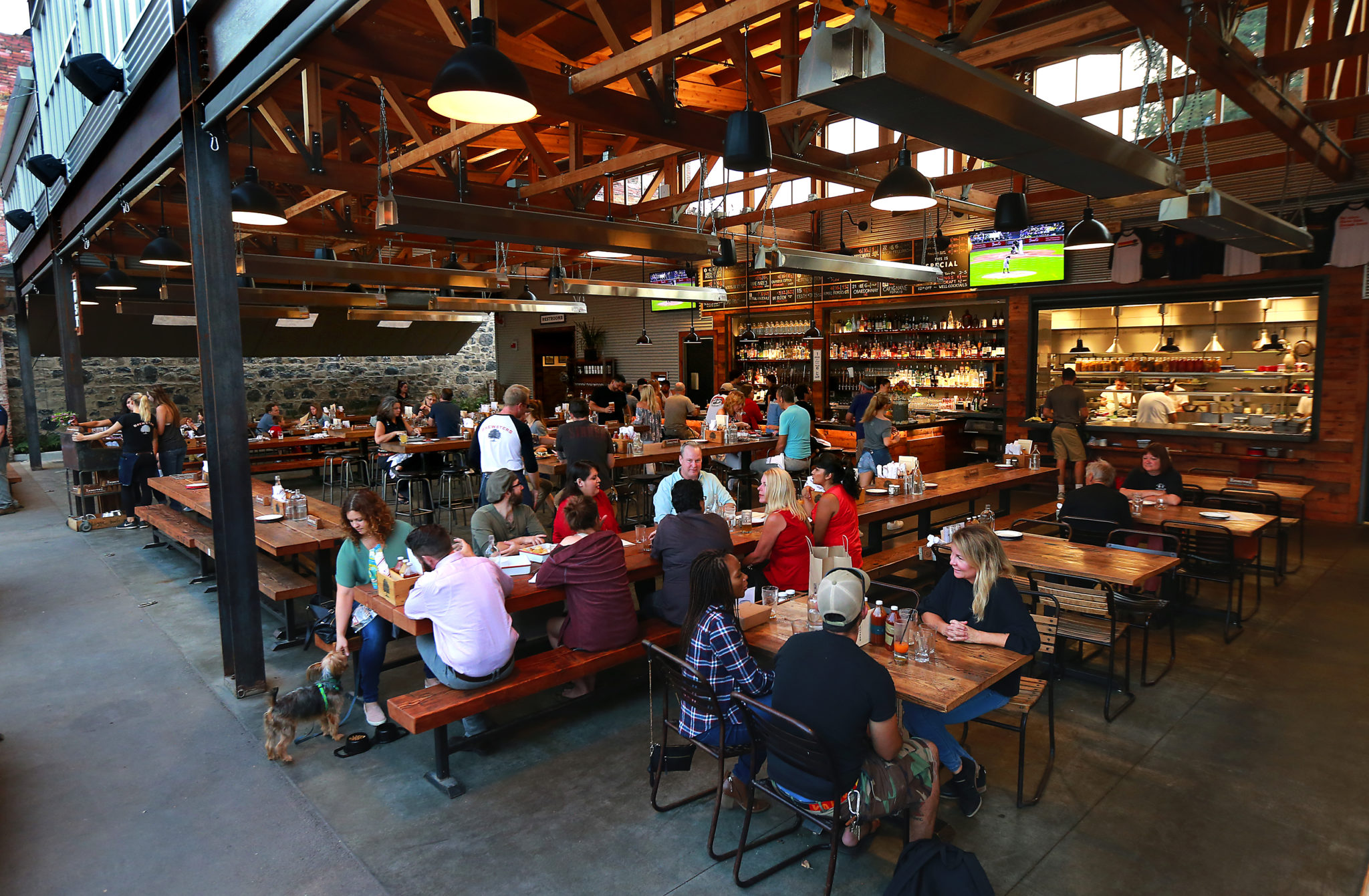
Brewster’s Beer Garden: Large picnic tables for family gatherings (or social pods) to keep safe and drink up. 229 Water St. N., Petaluma, 707-981-8330, brewstersbeergarden.com
Cucina Paradiso: Delicious Italian dining along the Petaluma riverfront. 114 Petaluma Blvd. N., Petaluma, 707-782-1130, cucinaparadisopetaluma.com
Risibisi: Another excellent Italian restaurant by the Petaluma River. 154 Petaluma Blvd. N., 707-766-7600, risibisirestaurant.com
Seared: Large heaters, bistro tables and great steaks by the river. Dress for the occasion as evenings can get nippy. 170 Petaluma Blvd. N., Petaluma, 707-762-5997, petalumaseared.com
Brewsters Beer Garden in Petaluma. (John Burgess/The Press Democrat)
Windsor
KC’s American Kitchen: Be seated and heated at this lovely outdoor dining space that serves up breakfast classics along with 1950s diner-style burgers, sandwiches and entrees. 9501 Duvander Lane, Windsor, 707-838-7800, kcsamericankitchen.com
Kin: A lovely parklet for grabbing a family-friendly bite or casual lunch. 740 McClelland Drive, Windsor, 707-837-7546, kinwindsor.com
Healdsburg
Bravas Bar de Tapas: “Jamon In” points a neon arrow to the patio that Healdsburgers flock to year-round. Sangrias, paella and tasty tapas are what you’ll find at this popular watering hole and restaurant. 420 Center St., Healdsburg, 707-433-7700, starkrestaurants.com
Campo Fina: For now, you’ll have to enter through the back alley (indoor dining is closed), but this hidden outdoor patio is where to get some of the best pizza in the county. Real-deal Italian with a California flair also includes burgers, gourmet panini, calzone and OMG meatballs. 330 Healdsburg Ave., 707-395-4640, campofina.com
Healdsburg Bar & Grill: Known to locals as HBG, this buzzy cafe serves up comfort classics like macaroni and cheese, seared tuna burgers and their classic HBG’s Burger, recently voted one of Food and Wine Magazine’s 25 Best in the U.S. 245 Healdsburg Ave., 707-433-3333, healdsburgbarandgrill.com
Roof 106: The casual upstairs section of the new Matheson restaurant (no reservations needed) features an indoor-outdoor dining room and seating by a cozy fire pit, if you get there early. 106 Matheson St., Healdsburg, thematheson.com
Valette: Healsburg’s luxe off-square restaurant has created a lively and toasty tented area for diners. 344 Center St., Healdsburg, 707-473-0946, valettehealdsburg.com
Ten-layer lasagna at Catelli’s in Geyserville. (Chris Hardy/for Sonoma Magazine)Ultimate Burger at Catelli’s in Geyserville. (Chris Hardy/for Sonoma Magazine)
Geyserville
Diavola Pizzeria and Salumeria: Opens Thursday, Jan. 28. This just might be our favorite outdoor space. Walk past the hanging laundry (part of the charm) and into the covered, arched outdoor area sheltered by greenery. Plenty of heat and plenty of plates to impress. 21021 Geyserville Ave., Geyserville, 707-814-0111, diavolapizzeria.com
Cloverdale
El Milagro: Authentic Mexican cuisine made from scratch, with a spacious patio in the historic Owl building, which dates back to 1929. 485 S. Cloverdale Blvd., Cloverdale, 707-894-6334, elmilagrocloverdale.com
Sebastopol, West County
Barlow: This outdoor marketplace has plenty of outdoor seating where you can spread out with a meal from any of the restaurants — from sandwiches and pizza to sushi and upscale casual eats. 6770 McKinley St., Sebastopol, thebarlow.net
Dinucci’s: Opens Thursday, Jan. 28. It’s balmy inside these tents, despite the coastal cool, for your favorite pasta and cocktails. 14485 Valley Ford Road, Valley Ford, 707-876-3260, dinuccisrestaurant.com
Fern Bar: An expanded covered patio has opened up dining options for this cocktail-friendly spot at the Barlow. 6780 Depot St. Suite 120, Sebastopol, 707-861-9603, fernbar.com
Fork Roadhouse and Catering: The large outdoor patio behind this tiny roadhouse is a ton of fun. Chef/owner Sarah Piccolo is a devout advocate for small, local farmers, and her food is spot-on every time. 9890 Bodega Highway, forkcatering.com
Handline, Sebastopol: “Our upper patio is now one big, heated umbrella! All the rain asmr with none of the wetness. We’ve got you covered… literally,” say owners. Who can argue with that? 935 Gravenstein Ave. S., Sebastopol, 707-827-3744, handline.com
HopMonk Taverns, Sebastopol and Sonoma; Twin Oaks, Penngrove: Heated and tented beer gardens with a pubby vibe. 230 Petaluma Ave, Sebastopol; 691 Broadway, Sonoma; 5745 Old Redwood Highway, Penngrove, hopmonk.com
Union Hotel: A special outdoor dining parklet with plenty of room to spread out at this Occidental classic. 3731 Main St., Occidental, 707-874-3555, unionhoteloccidental.com
Sonoma Valley
Della Santina’s: This cute little heated parklet is ready to serve up a tasty toasty dinner. 133 E Napa St., Sonoma, 707-935-0576
El Dorado Kitchen: Away from the bustling Plaza, this cozy tree-lined back patio is an intimate spot for dining year-round. 405 1st St. W., Sonoma, 707-996-3030, eldoradosonoma.com
Folktable: Destination-worthy dining from celebrity chef Casey Thompson and crew. Part of Cornerstone gardens and marketplace, you can eat your meal anywhere on the property. 23584 Arnold Drive, Sonoma, 707-356-3567, folktable.com
Girl & The Fig: This popular French cafe has a cozy enclosed patio that’s just the spot for date night. Save room for a plate of artisan cheese and a glass of wine from the restaurant’s incredible collection of Rhones. 110 W. Spain St., Sonoma, 707-938-3634, thegirlandthefig.com
Layla: The Mediterranean cuisine of MacArthur Place’s upscale restaurant will have you dreaming of warm summer afternoons, even if it’s chilly outside. 29 E. MacArthur St., Sonoma, 707-938-2929, macarthurplace.com
Palooza Brewery and Gastropub: Patio dining with burgers, wood-fired pizza and more. The outdoor space has towering heaters and plenty of coverage to keep you warm during chilly evenings. 8910 Sonoma Highway, Kenwood, 707-833-4000, paloozafresh.com
Sunflower Caffe: This cafe is located in in historic landmark building #501, which was once home to captain Salvador Vallejo, the brother of Sonoma’s founder Mariano Guadalupe Vallejo. Outdoor dining is available on the street-side patio and in the shaded garden. 421 1st St. W., Sonoma, sonomasunflower.com
Tips Roadside: A lively, large outdoor patio with live music and family-friendly food. Hint, tri-tip is kinda their thing, along with elevated comfort classics with a Southern twang. 8445 Sonoma Highway, Sonoma, 707-509-0078, tipsroadside.com
Wit and Wisdom: An enclosed patio and toasty heaters keep Chef Michael Mina’s American restaurant on the list of our favorite outdoor dining spots. 1325 Broadway, Sonoma, 707-931-3405, witandwisdomsonoma.com
I wasn’t planning on writing a story about my favorite Sonoma County restaurants for food delivery this week, but then the pandemic hit. My family was exposed to COVID-19, so we quarantined and ate like a bunch of bored people whose biggest thrill of the day is a pile of delivery boxes left on our doorstep.
It was delicious.
Gaining confidence in the online delivery process, we explored the variety of food our local restaurants have to offer: Korean, Chinese, Greek, American, healthy, not-so-healthy, tacos, tempura and on and on and on.
By now, most restaurants have adjusted to the ever-changing pandemic landscape, and we soon realized you can get almost anything delivered — hot dogs, wine, banh mi, warm cookies, milkshakes and munchies and much more.
Santa Rosa, where we live, has the most delivery options in Sonoma County, including late-night eats and alcohol. The Petaluma Food Taxi has partnered with just about every restaurant in Petaluma, making this local third-party delivery service a great choice for more upscale meals when you get sick of fried chicken and pizza.
Those who live in Windsor, Rohnert Park and Cotati benefit from the proximity to Santa Rosa and Petaluma restaurants with delivery services, as well as neighborhood restaurants. In Healdsburg and Sonoma, pickings are a bit slimmer for delivery, though expanding (takeout is more popular there).
Click through the above gallery for 23 local spots that delivered excellent meals during our quarantine in recent weeks, with restaurant websites and phone numbers for placing orders, as well as third-party services such as Doordash and Grubhub for restaurants that only use these for delivery.
About Third-Party Delivery Services
If you eat food, you’ve probably heard the ambivalent feelings restaurant staff have toward third-party delivery services like Grubhub, Doordash and UberEats.
These third-party delivery services charge commissions and fees for providing restaurants with drivers, a seamless ordering system and marketing. Restaurants pay a high — some say excessive — price for the convenience and so do customers. It’s an unwelcome surprise when your $70 order skyrockets to $100 with taxes, service charges and tip.
Local delivery services like Redwood Food Taxi and Petaluma Food Taxi also take a percentage of restaurant sales, but only charge a flat $5 delivery fee for an entirely local service. The best bet, when possible, is ordering directly from the restaurant, allowing local business owners to keep most of their profit.
As a side note, a new state law is coming into effect this year that aims to ensure delivery drivers get tips directly; it’s now illegal for food delivery apps to keep tips. And when you order through one of these apps but choose pickup instead of delivery, the food delivery app now must pass the gratuity on to the restaurant.
A variety of cocktails made with Hanson Organic Vodka at Hanson of Sonoma Distillery in Sonoma, Calif. on Wednesday, February 24, 2021. (Erik Castro/for The Press Democrat)
Sonoma County may be known for its wine, but locals are concocting a variety of drinks, from vodka, whiskey and gin to cider and aperitifs — even mead. If you want to change things up in the new year, here are nine local tasting rooms to visit, perhaps once pandemic conditions improve (or order your drinks online on company websites for delivery or pickup). Click through the above gallery for a peek at the tasting rooms and drinks.
Hanson of Sonoma
Move over grains and potatoes — Hanson of Sonoma is one of a few distilleries to produce vodka from grapes. The finished product can be enjoyed on its own or in one of the creative cocktails made and served in the distillery’s tasting room. Pair your drink with a wood-fired pizza, available Friday through Sunday.
Hanson has a variety of tasting options, from a standard tour and tasting to martini and caviar or vodka and chocolate truffle pairings. Their current vodka lineup includes the award-winning Organic Original as well as flavored vodkas — cucumber, Meyer lemon, mandarin, habañero and other limited-edition flavors, such as boysenberry, ginger and espresso.
A Mandarin Greyhouse made with Hanson Organic Mandarin Vodka and garnished with a dehydrated grapefruit peel at Hanson of Sonoma Distillery in Sonoma. (Erik Castro/for The Press Democrat)
Young & Yonder
Young & Yonder was founded in 2017 by husband-and-wife team Joshua and Sarah Opatz. One thing that makes this tasting room stand out is its variety of spirits. While most distilleries specialize in one or two spirit types, Young & Yonder serves a flight of five: vodka, whiskey, gin, absinthe and amaro.
Visitors can lounge on the tasting room patio and sip on cocktails made with Young & Yonder spirits. The menu features classic cocktails and rotating seasonal drinks. The tasting room is open for cocktails and tastings noon to 5 p.m. Friday to Sunday. Reservations are encouraged; groups larger than eight people must make a reservation.
This brewery started as a hobby project for a group of friends and eventually turned into a full-time business. Since opening in 2016, Crooked Goat has brewed more than 350 types of beer. They offer a wide selection of brews on rotating taps, including traditional and nontraditional ales, sours, IPAs and even a seltzer.
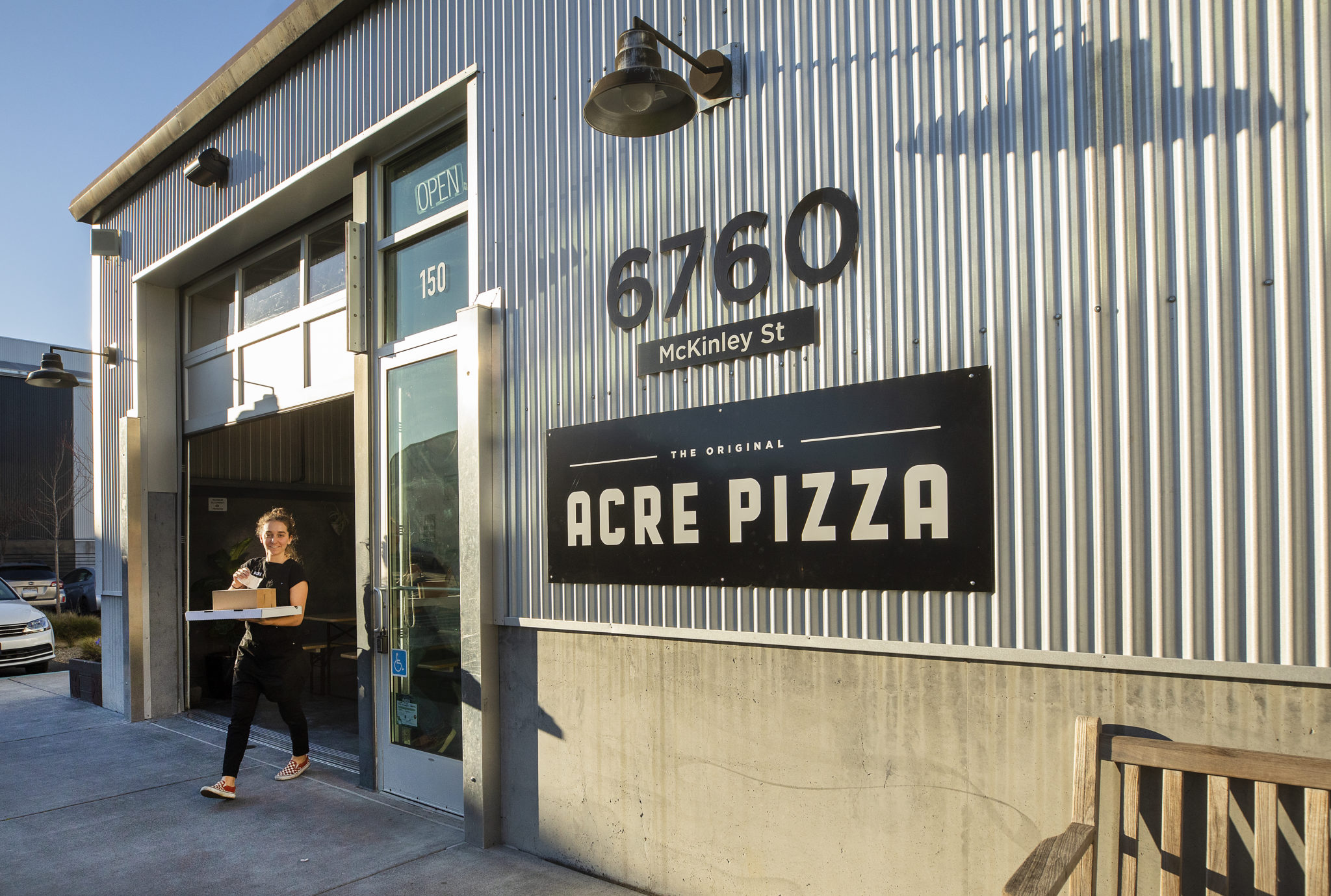
The brewery’s west county taproom, located in The Barlow in downtown Sebastopol, has a friendly and lively vibe. The taproom doesn’t have a kitchen, so the brewery has partnered with Barlow restaurants to offer a variety of dishes to pair with your brew. Partner restaurants include Acre Pizza, The Farmer’s Wife and Sushi Kosho.
Wila Imhoff heads across the street to Crooked Goat Brewing with a to go Acre Pizza in Sebastopol’s Barlow district. (John Burgess/The Press Democrat)
HenHouse Brewing Company
Since opening in 2012, HenHouse Brewing has become a staple on the Sonoma County craft beer scene. Their Big Chicken IPA, available for only for a few days each February, has achieved cult status in the beer world.
The brewery’s original tasting room is in Santa Rosa, but you also can get HenHouse brews at the Palace of Barrels in Petaluma. Each location is visited by a different food truck every day — January’s food truck schedule includes Damn Dogs, Galvan’s Eatery, Red Horse Pizza, Streetside Asian Grill and Tacos Los Iñiguez.
HenHouses’s selection of IPAs and constantly changing limited releases are top-notch. To celebrate its 10th anniversary, HenHouse has partnered with nine American breweries and one in England to create 10 beers that will be released over five weeks, ending on Feb. 5.
322 Bellevue Ave., Santa Rosa, 707-978-4577; 1333 N. McDowell Blvd., Petaluma, henhousebrewing.com
Golden State Cider
Hard ciders are having a moment. In Sonoma County, cider makers are reviving local orchards; among them is Golden State Cider, owned by Jolie Devoto-Wade and her husband, Hunter Wade. The Devoto family has been farming apples in Sonoma County since the late 1970s, and Jolie and Hunter continue to make great things with the fruit.
Visit the Golden State Cider taproom in The Barlow and try their 12 ciders, available on rotating taps. Don’t miss Save the Gravenstein, a heritage-style cider made exclusively from Gravenstein apples grown in the Sebastopol hills. The cidery’s Harvest Series features ciders made from local fruit and includes Fool’s Gold, an aromatic cider made from organic apple varieties grown on Gold Ridge Road in Sebastopol, and The Elder Tree, with Newtown Pippin and Arkansas Black apple varieties.
Fresh-squeezed apple juice at Tilted Shed Ciderworks near Forestville. (Kent Porter/The Press Democrat)
Tilted Shed Ciderworks
Tilted Shed Ciderworks was launched in 2011 by husband-and-wife team Scott Heath and Ellen Cavelli. They use organically grown heirloom and cider apples from local orchards, as well as fruit from their Sebastopol farm, where they grow more than 120 cider apple and Perry pear varieties. The couple founded and managed the first Sonoma County Cider Week in 2018 and launched their own cider-focused quarterly print magazine, Malus.
Each Tilted Shed cider is inspired by the people, places and flavors of Sonoma County. The 2020 Block Party is a collaboration with neighboring Two Shepherds Winery (“love thy neighbor, share thy fruit” reads the label) and includes organic dry-farmed Jonathan apples from Nana Mae’s Organics in Sebastopol. The 2020 Still Standing canned cider is a wild-fermented blend of locally grown and organically farmed apples — Jonathan, Golden Delicious, Gravenstein, Rhode Island Greening, Wickson, Nehou and Muscat de Bernay. The cider is “a testament to the resilience and tenacity of Sonoma County.”
The cidery taproom is open Saturdays from noon to 5 p.m. for tastings in a barn or outdoors (due to the omicron surge, the taproom is currently open for socially distant outdoor tastings only; guests need to be vaccinated — preferably boosted — and wear an N95 or other high-quality mask).
Aperitifs rarely make the traditional American cocktail list, but they can be just as dynamic as wine or spirits. Popular in France and Italy as a post-work, pre-dinner drink, the aperitif is a fortified alcoholic beverage infused with fresh herbs, fruit and other botanicals — vermouth, pastis and Campari are common aperitifs.
Based in Healdsburg, Haus was founded by Helena Price Hambrecht and Woody Hambrecht, who previously ran a wine label together called Alysian. Their concoctions contain a fraction of the sugar of big-brand aperitifs and have a low-alcohol content “for more hangouts and fewer hangovers.” The aperitifs are naturally colorful, with refreshing flavors that range from citrus flower to bitter clove.
Haus doesn’t have a tasting room, but you can order their unique beverages online as single bottles or in custom sampler kits that include four smaller bottles of your choice. Each purchase includes information about each drink and suggestions on how to best enjoy them — sipped as they are or mixed into cocktails.
Hard kombucha is a growing trend and can be a healthier alternative to beer, wine or cider. Like its nonalcoholic counterpart, hard kombucha is a fermented tea packed with probiotics and prebiotics and is gluten-free.
Hoocha Brewing was started in Petaluma by a group of friends who wanted to turn the popular beverage into an evening favorite. They create simple yet refreshing beverages in flavors like grapefruit, crisp apple and their original flavor, a slightly tart dry kombucha with a kick. Their current offerings include cocktail-inspired flavors like Mojito and Moscow Mule.
Hoocha doesn’t have a tasting room, but you can find one of their beverages at local markets and restaurants, including Trail House in Santa Rosa, HopMonk Tavern in Sebastopol, Brewsters Beer Garden in Petaluma, Jack’s Filling Station in Sonoma and at all Oliver’s Markets. Also available online.
Petaluma, 707-583-1997, hoochabrewing.com
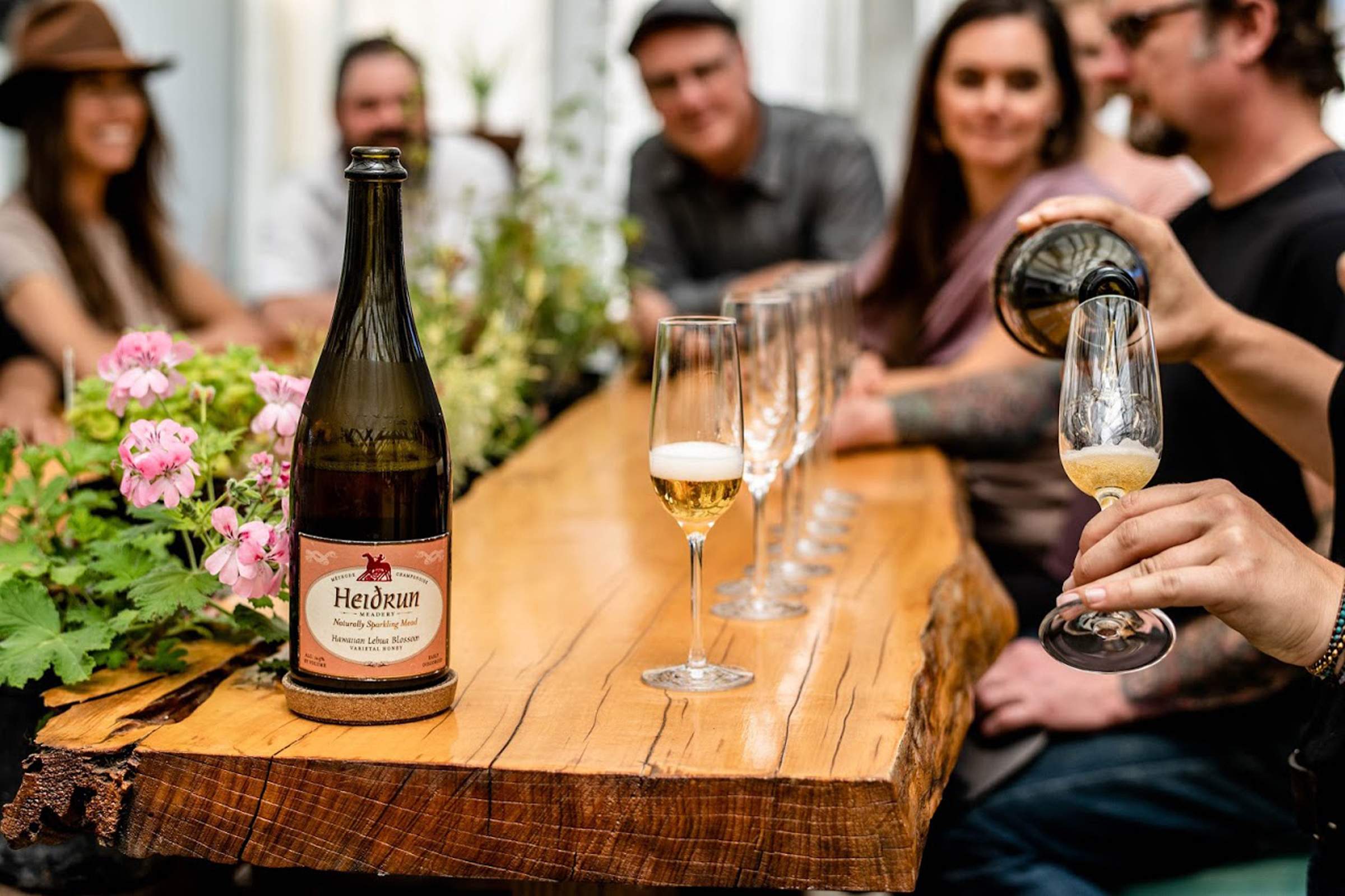
Heidrun Meadery in Point Reyes Station. (Courtesy of Heidrun Meadery)
Heidrun Meadery
Heidrun Meadery is located in the hills of Point Reyes in Marin County, but their floral sparkling beverage makes the trip across the county line worthwhile. The meadery, founded in 1995 by geologist-turned-brewer Gordon Hull, was originally located in Arcata. It moved to its current spot in 2012.
Mead is made by fermenting honey in water and is one of the oldest alcoholic beverages. Heidrun meads are produced with a Champagne method and feature floral honey from local hives in Northern California and around the world. Each honey adds a unique flavor, depending on what flowers the bees feed on.
Heidrun Meadery is open for tastings by reservation from 11 a.m. to 5 p.m. every day. Try their famous California Orange Blossom or one of their more unusual meads, the Hawaiian Macadamia Nut Blossom. Then wander through their bee foraging gardens and see the buzzing hives of worker bees that make this effervescent beverage possible.
Korean Burrito with Marin sun Farms ground beef marinated with soy, brown sugar, garlic and ginger, Korean BBQ sauce, avocado, mint cilantro, pickled daikon and carrot, organic brown rice, and kimchi at Zoftig in Santa Rosa. (Chris Hardy/For Sonoma Magazine)
Amid a surge in COVID-19 cases, Sonoma County health officials have asked residents to avoid leaving their homes except for work, school or necessary trips, alongside a ban on large gatherings.
Those who want to support local restaurants while helping to prevent the spread of the coronavirus can still enjoy delicious meals via takeout, curbside pickup or delivery. We’ve compiled a list of local favorites, from delicious burritos delivered to your doorstep to takeout dim sum and French cuisine. Scroll through the gallery above for some stay-at-home inspiration.
Barndiva in Healdsburg won a 2021 Michelin star, making it one of only two Michelin-starred restaurants in Sonoma County. (Jil Hales)
Chef Erik Anderson has left the recently-opened Truss Restaurant and Bar at the Four Seasons Napa Valley in Calistoga for Michelin-starred Barndiva in Healdsburg.
Before taking the reins at Truss, Anderson was Executive Chef at the groundbreaking, two-starred Coi restaurant in San Francisco. He previously was a founding co-chef of Catbird Seat in Nashville and has a lengthy resume that includes stints at the French Laundry in Yountville, three-Michelin-star restaurant Noma in Copenhagen (named “best restaurant in the world” in 2021) and other top-rated restaurants.
At Barndiva, Anderson will replace Executive Chef Jordan Rosas, who started at the Healdsburg restaurant just as the pandemic took hold in 2020. Rosas, together with Executive Pastry Chef Neidy Venegas, led Barndiva to its first Michelin star in 2021.
In addition to Anderson, Barndiva has announced the hiring of several new staff members following a temporary winter closure. Mixologist Scott Beattie will join the restaurant as Beverage Director after a stint at Montage Healdsburg and a longtime gig at St. Helena’s Meadowood. Sally Kim of the Delfina Restaurant Group will head Barndiva’s wine program.
Finally (but certainly not least), Executive Pastry Chef Neidy Venegas will expand her Viennoiserie and bread program at the restaurant.