


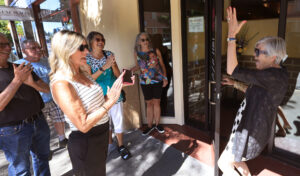



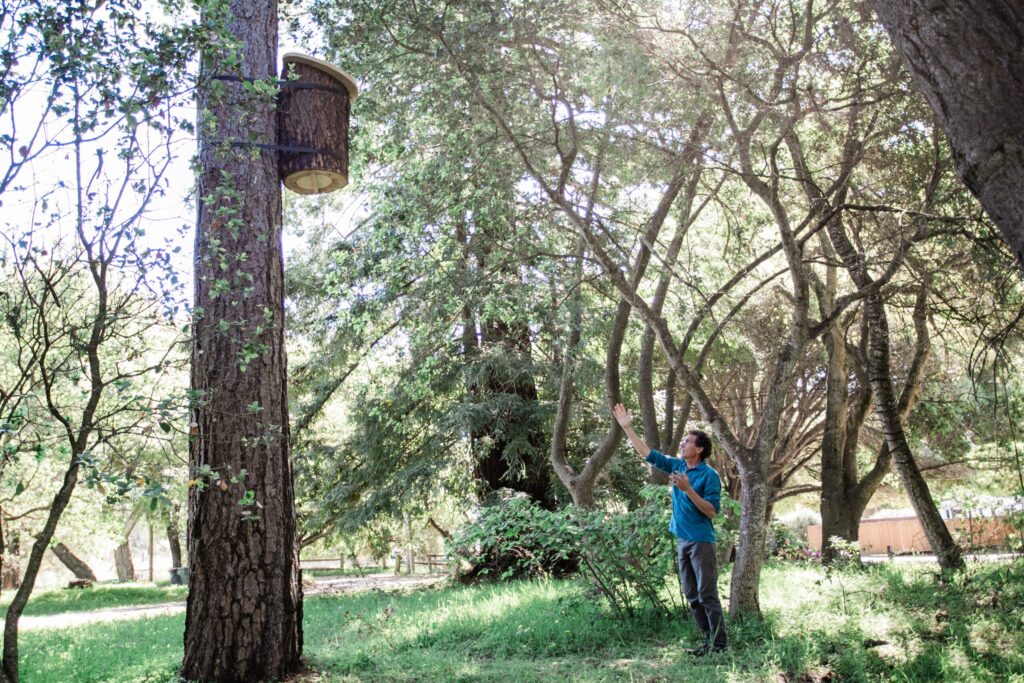
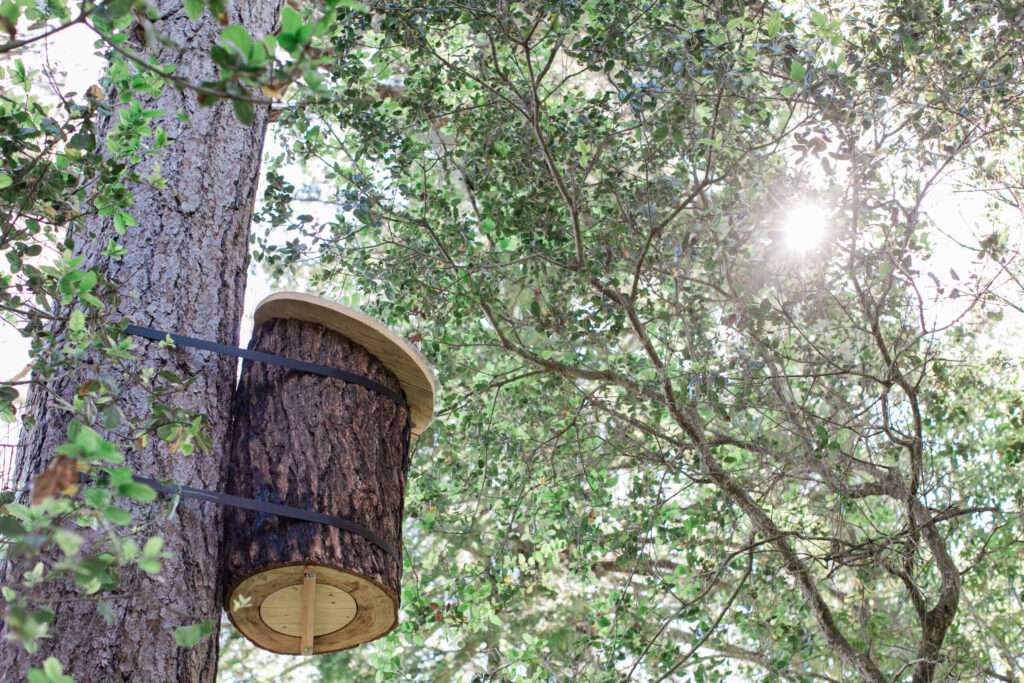
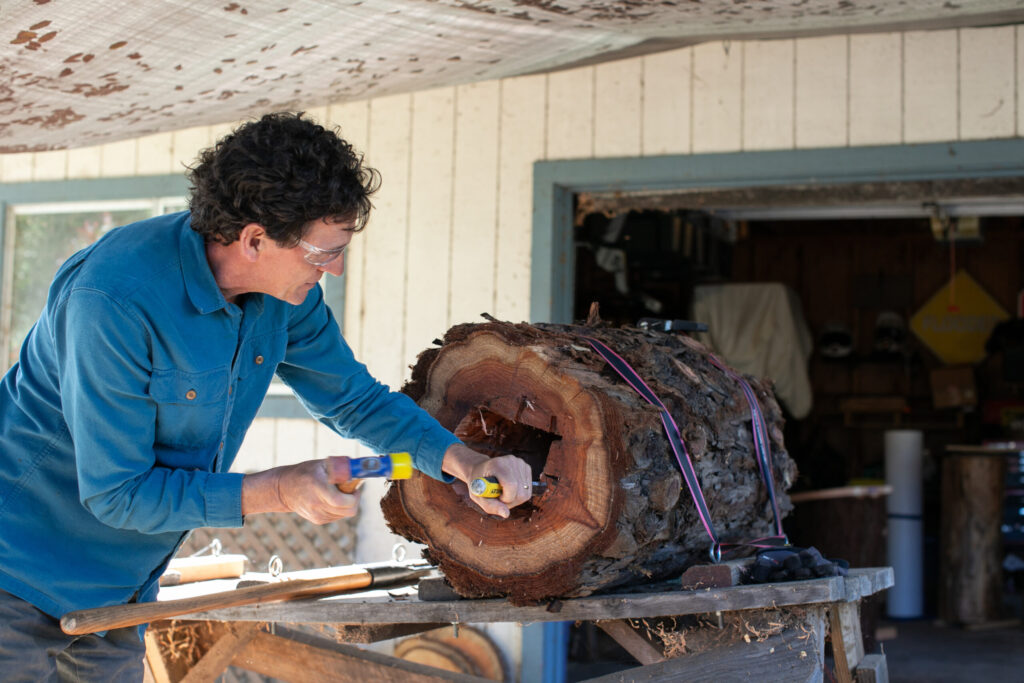
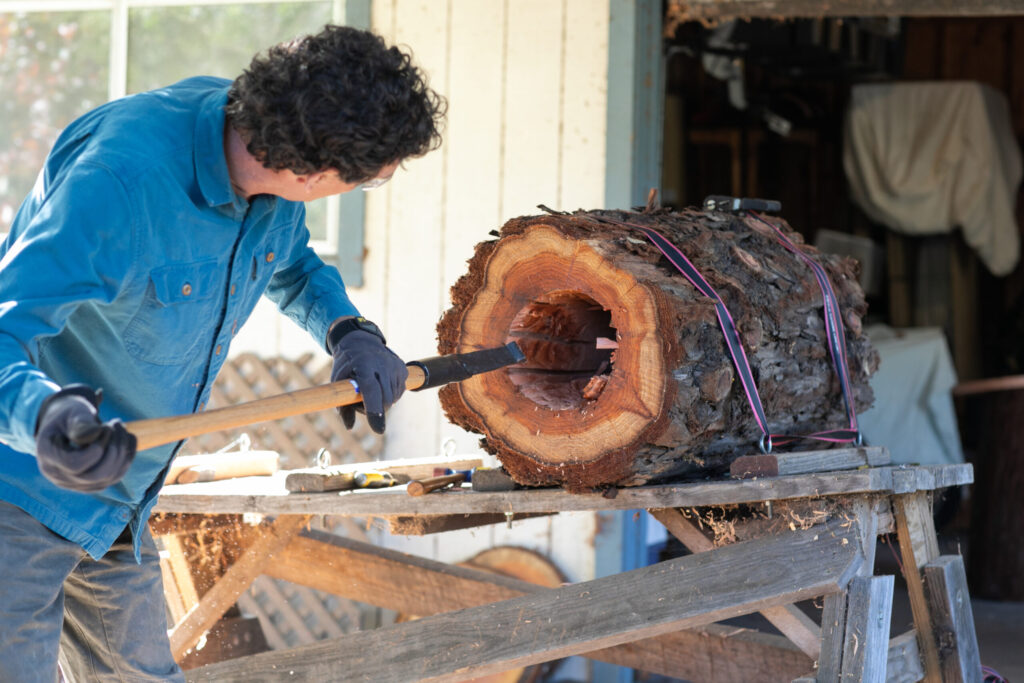
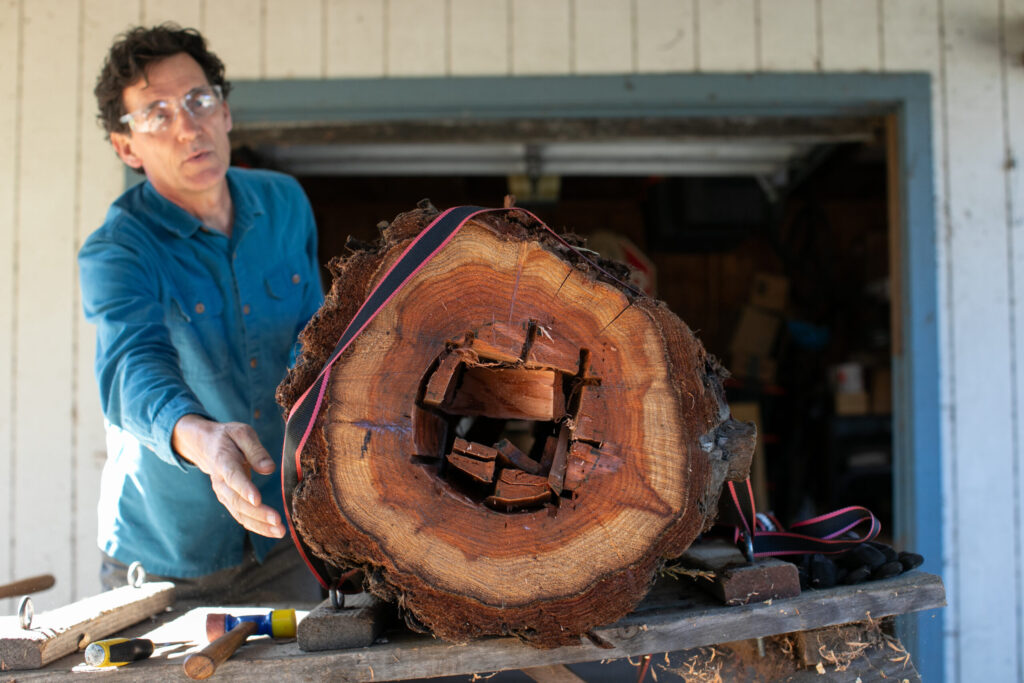
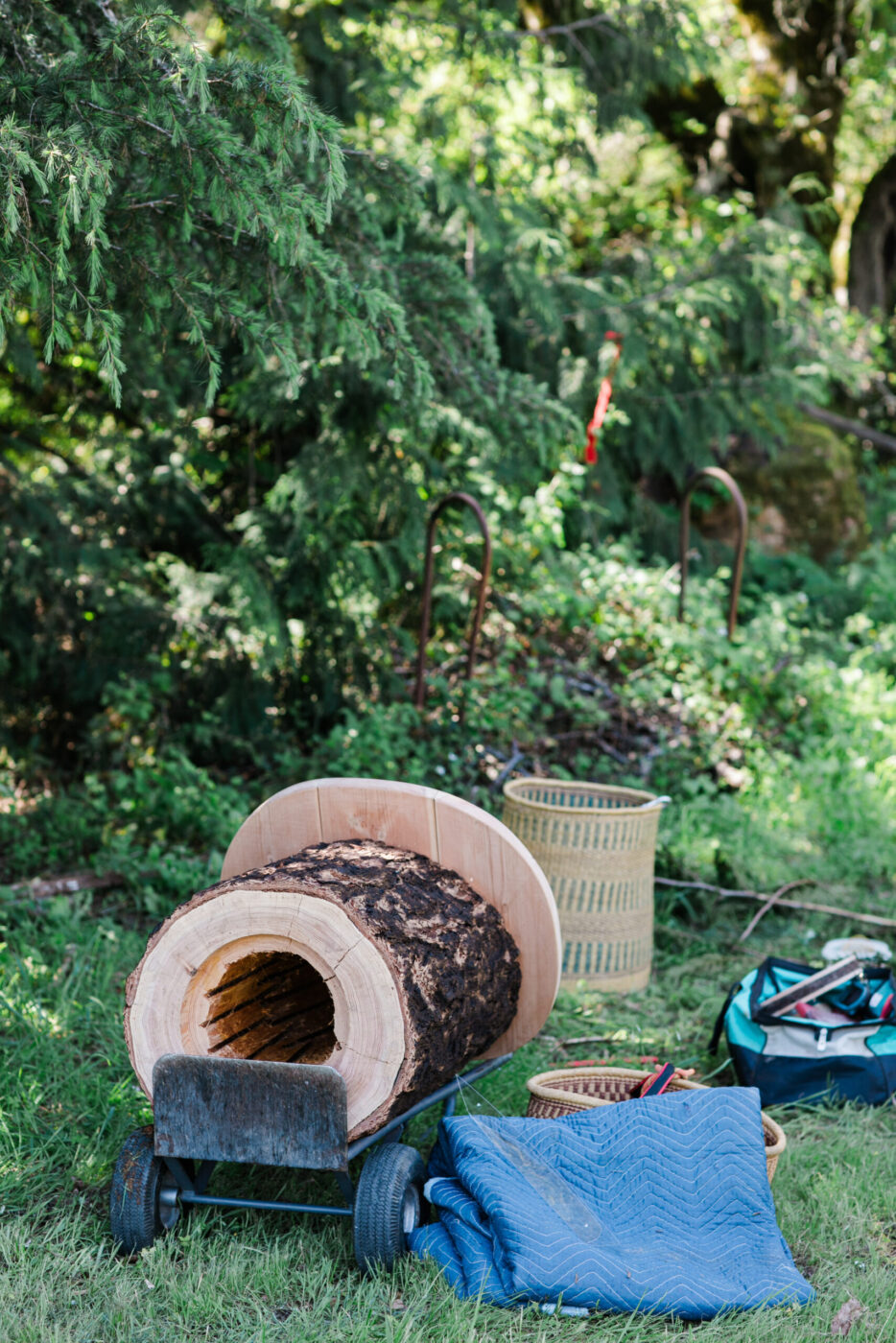
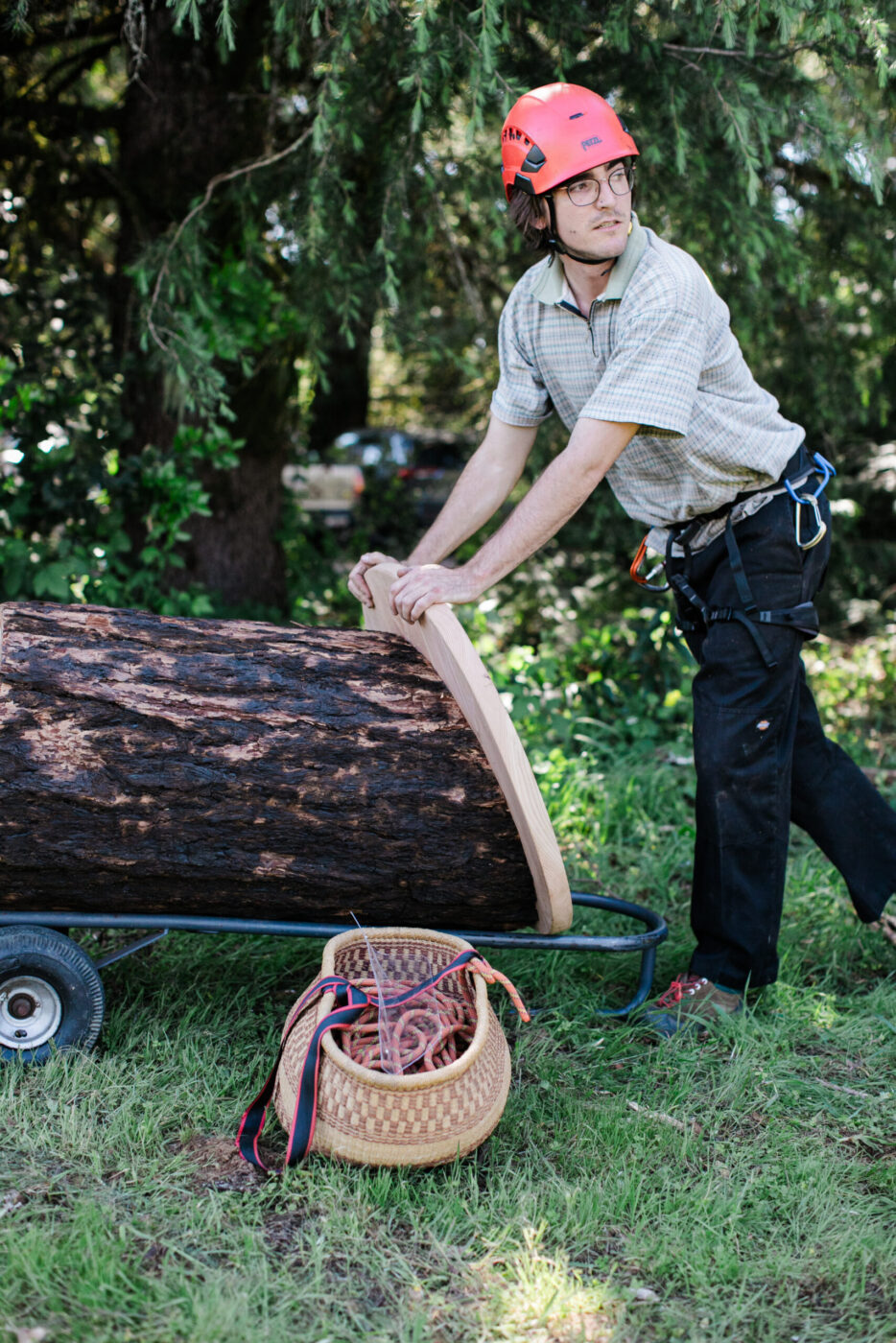
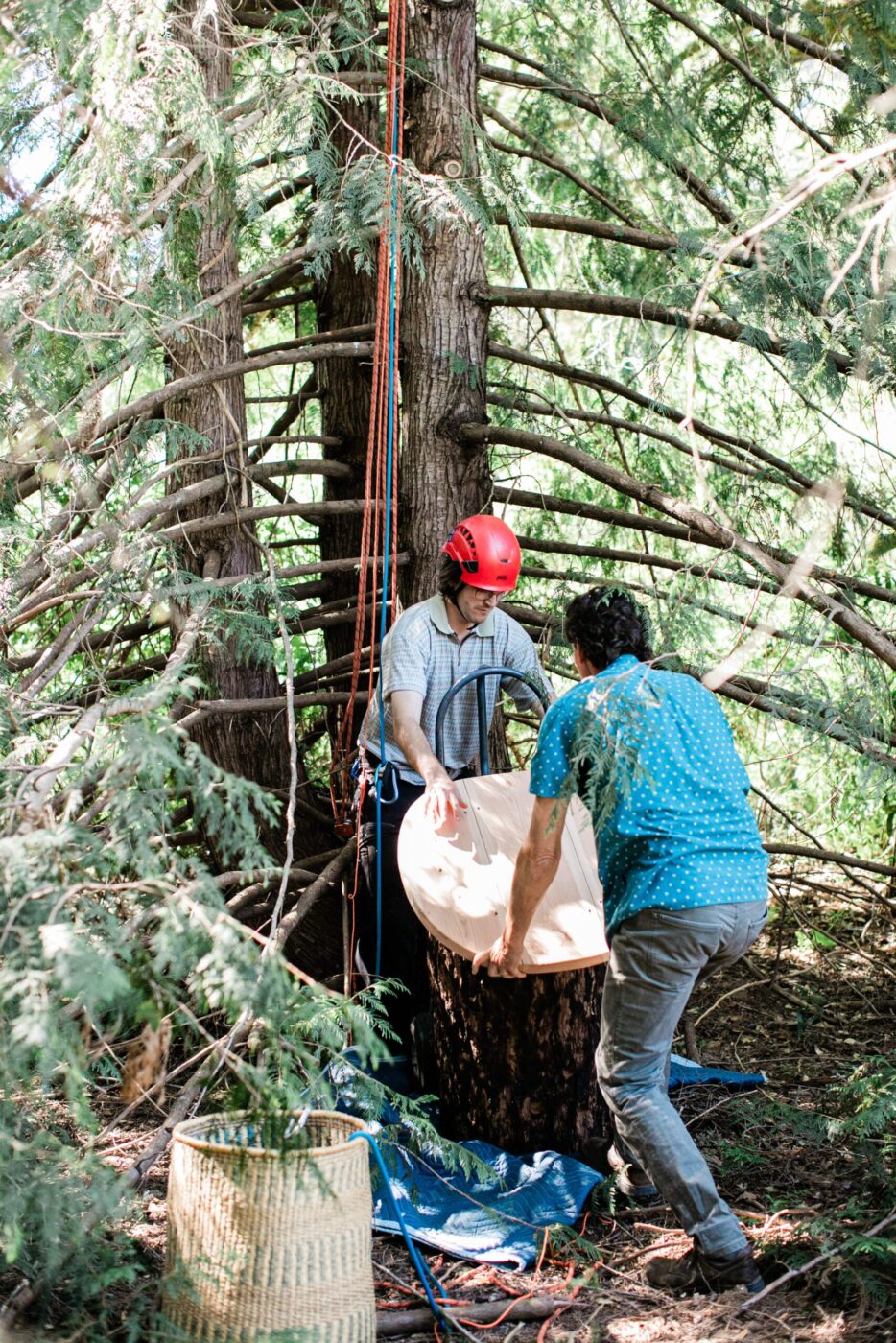
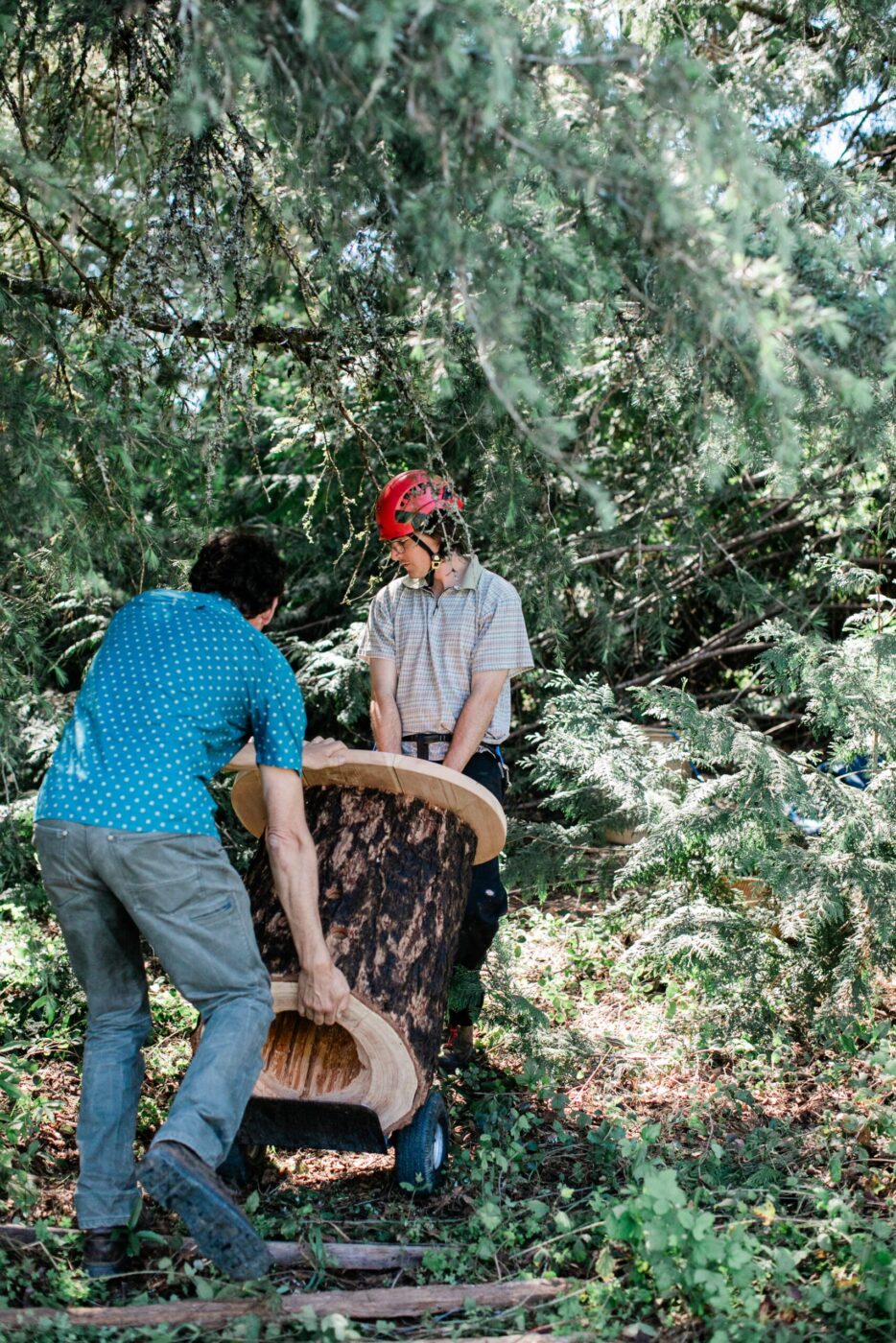
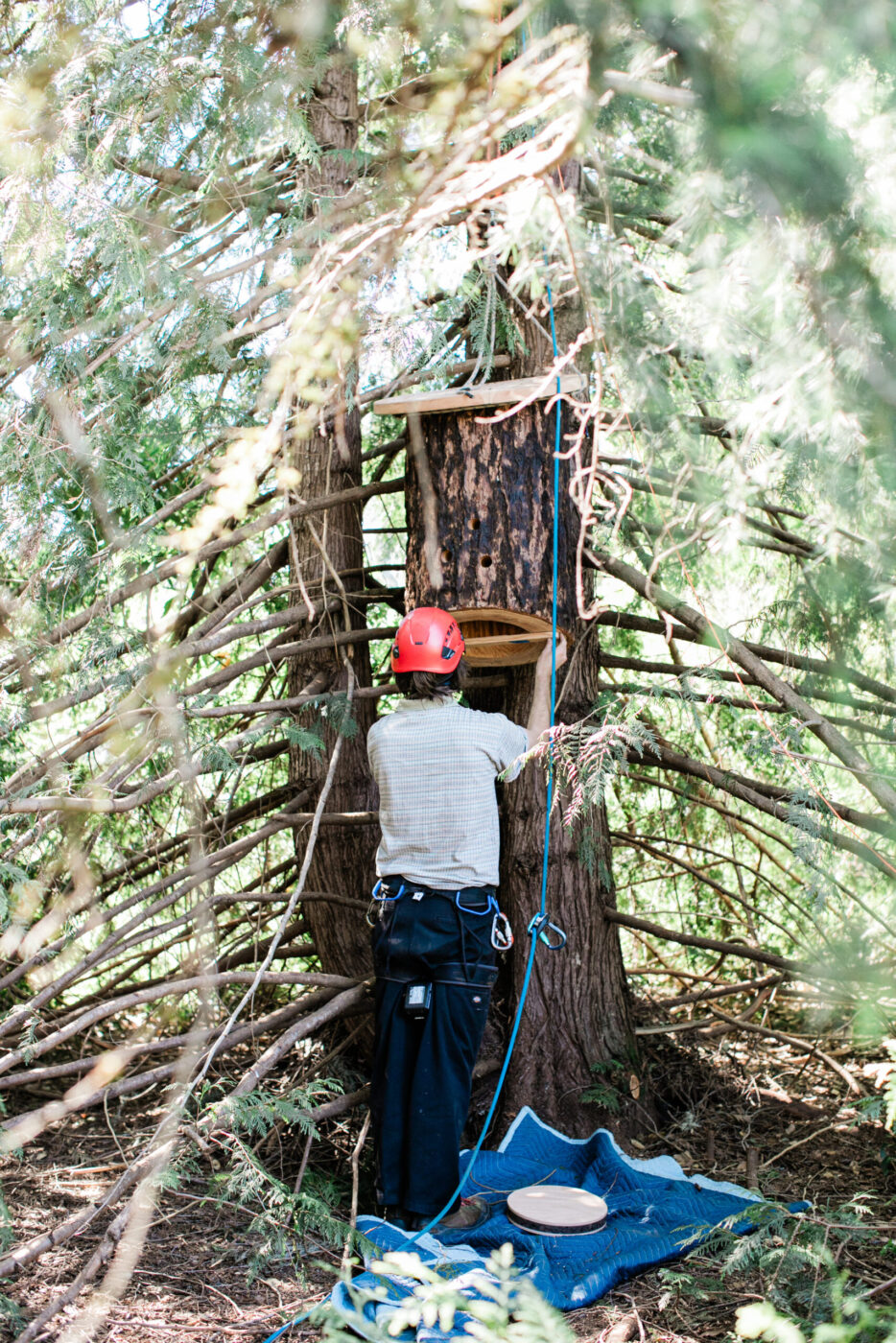
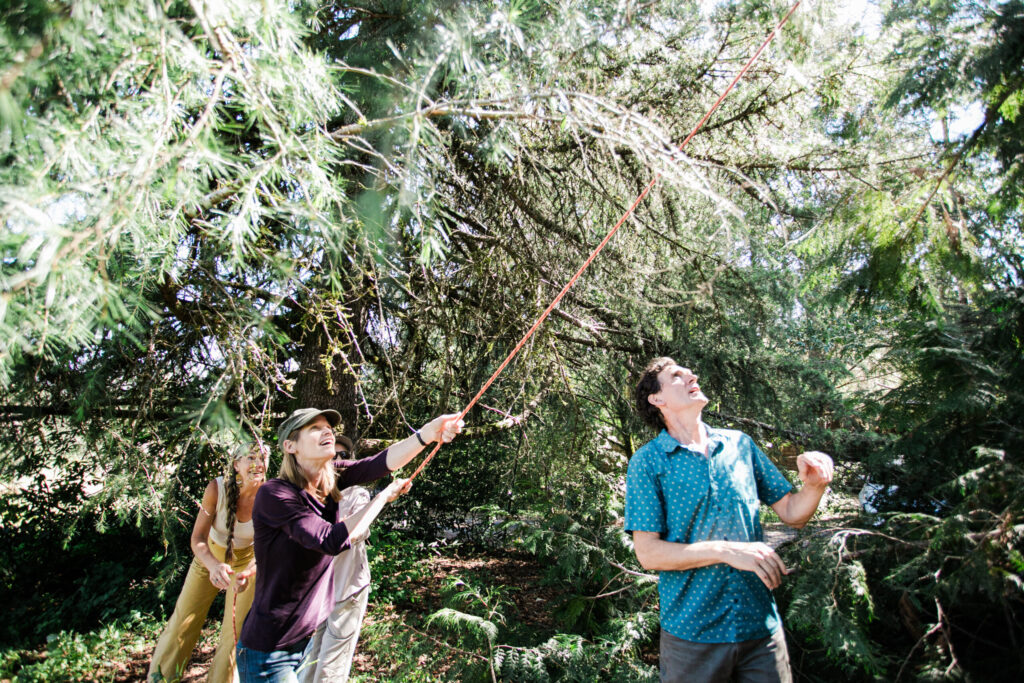
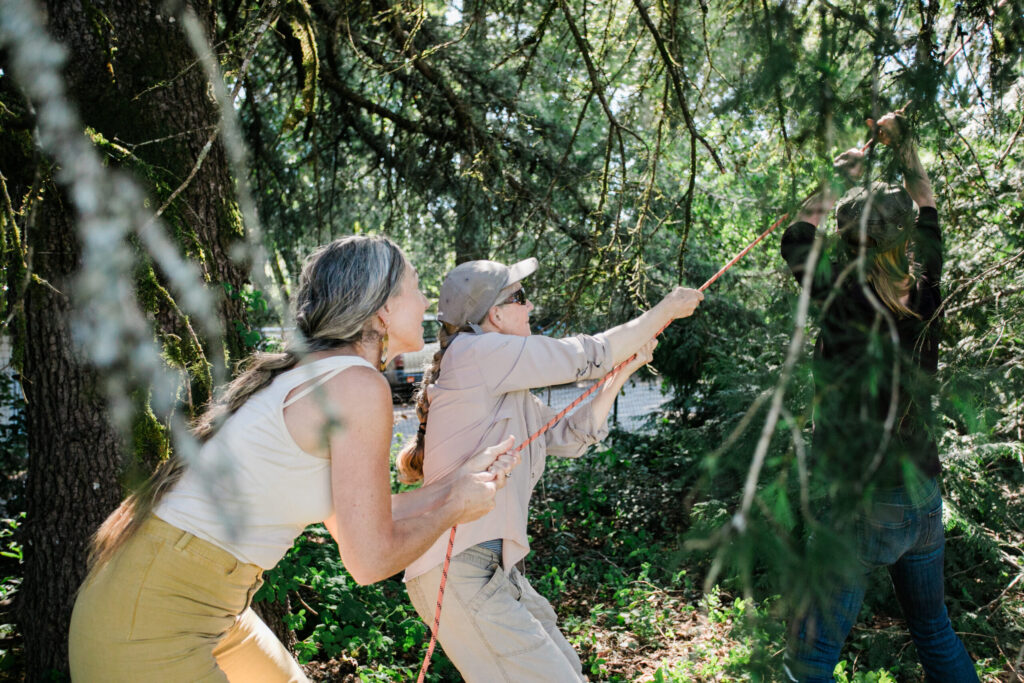
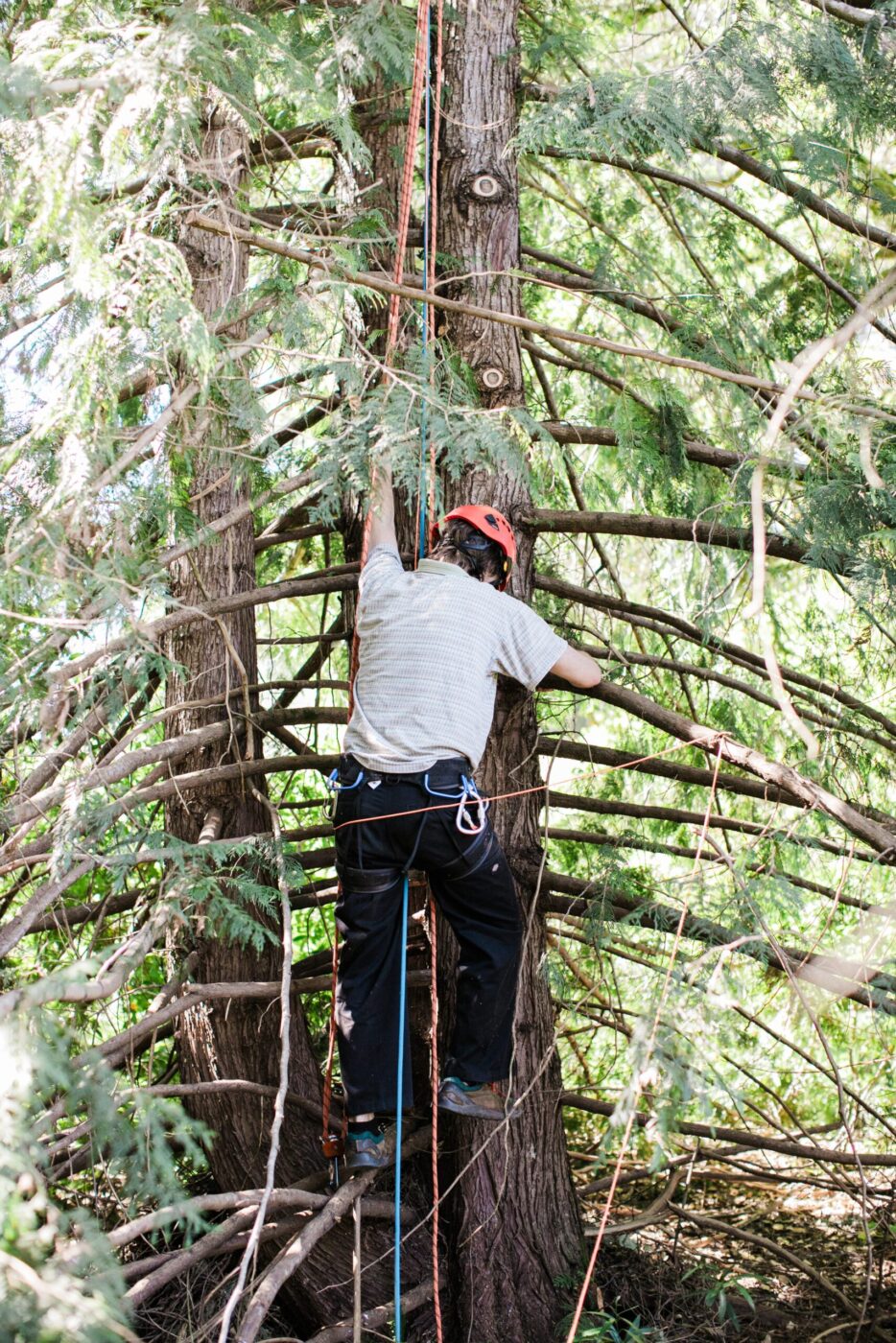
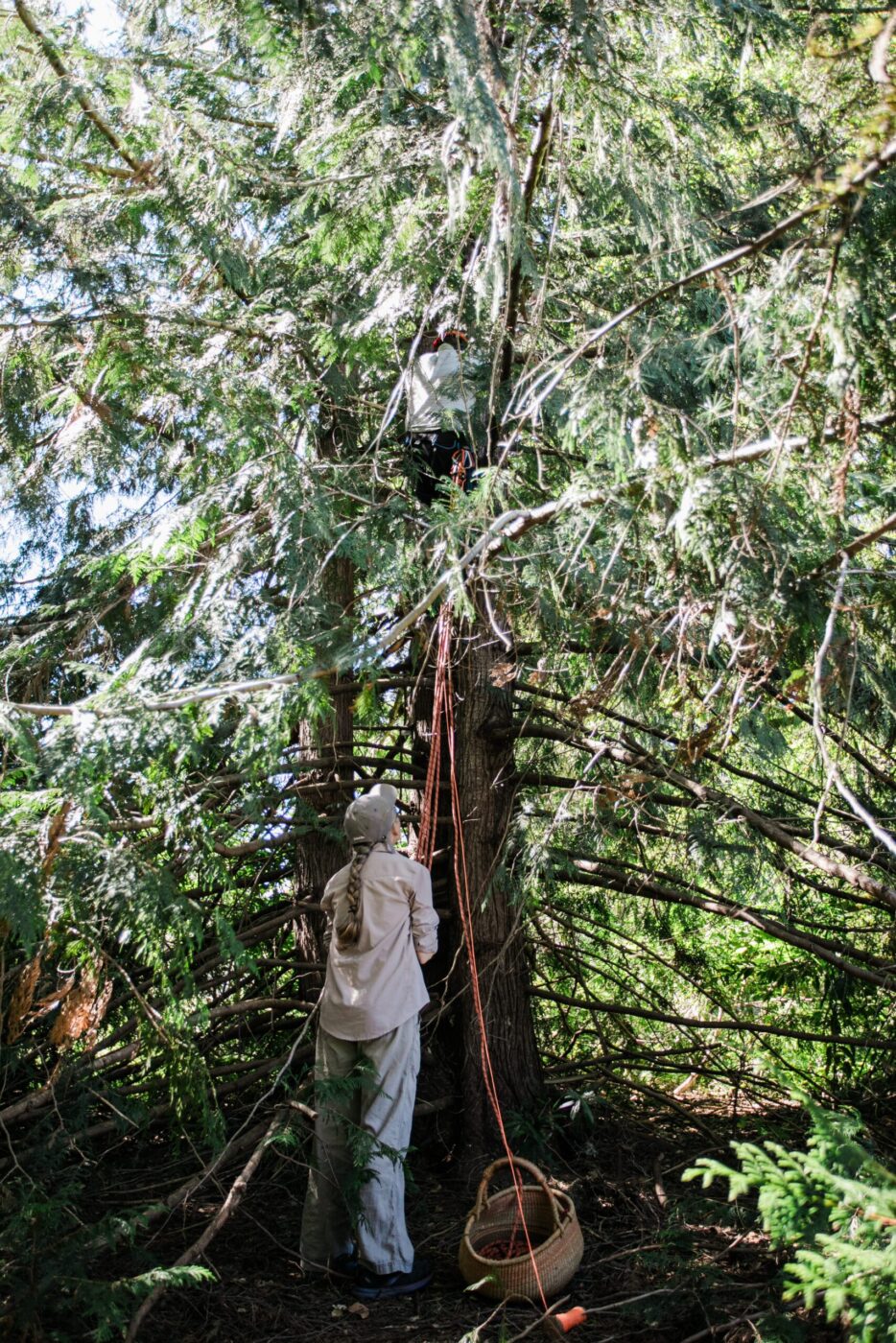
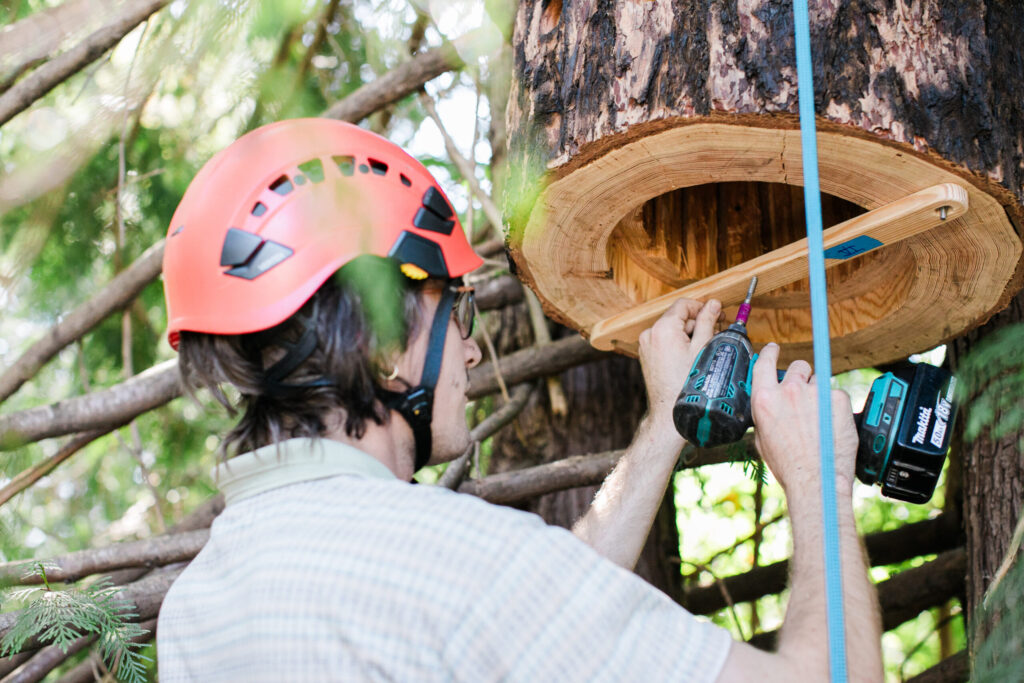
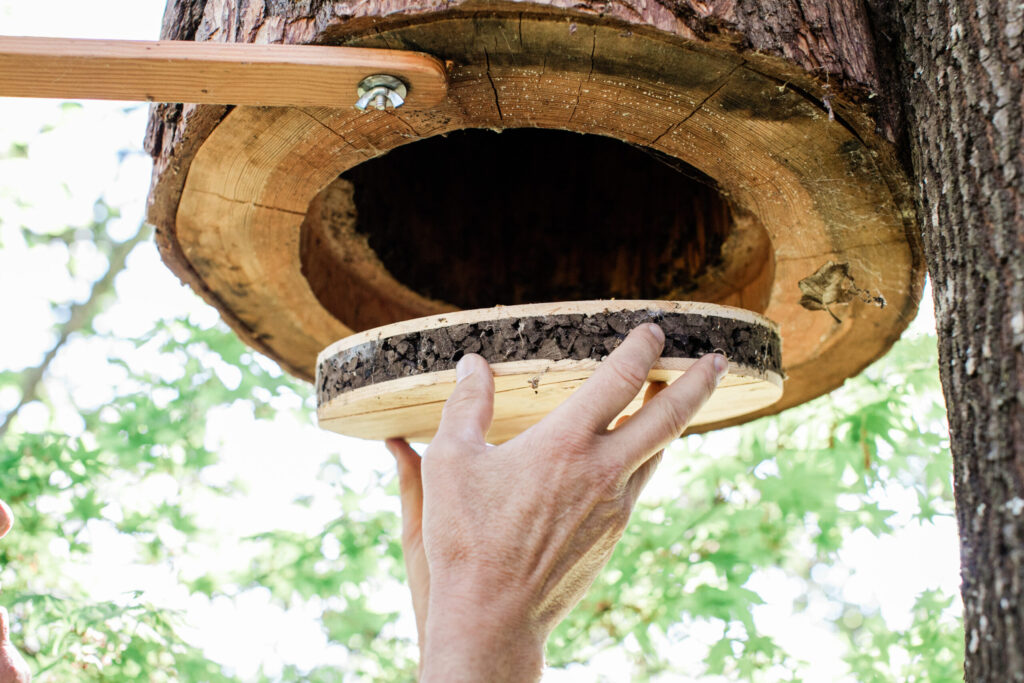
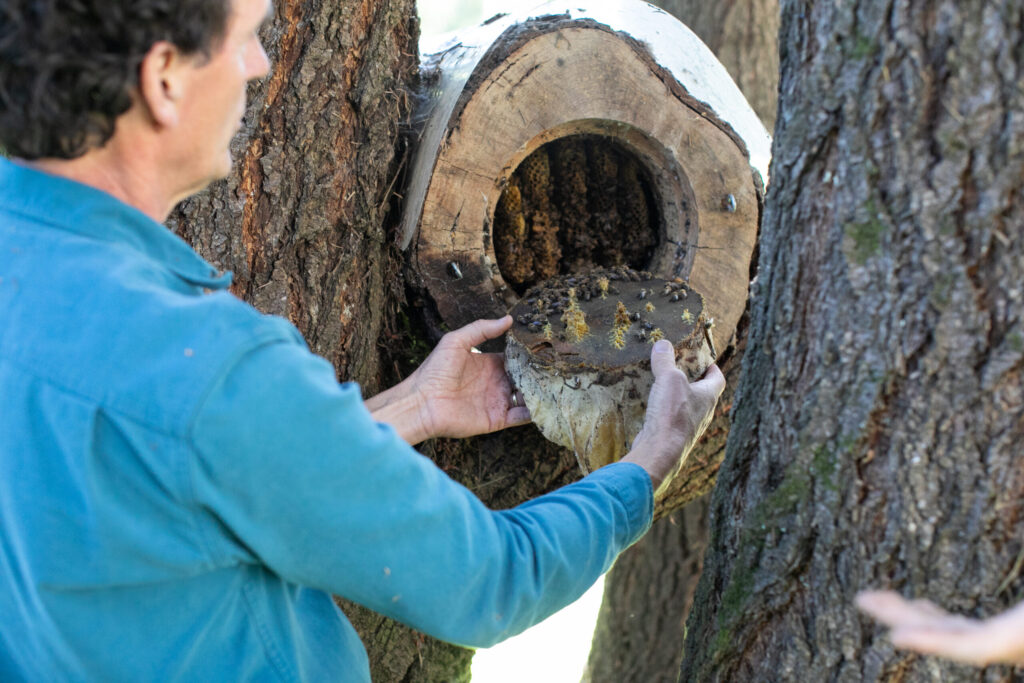
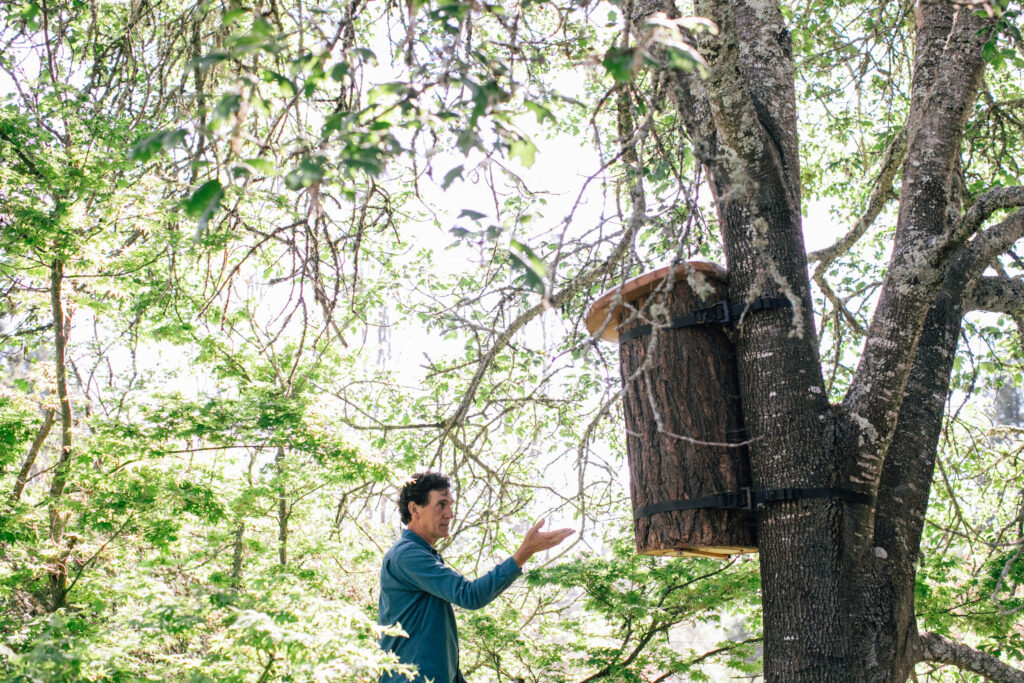
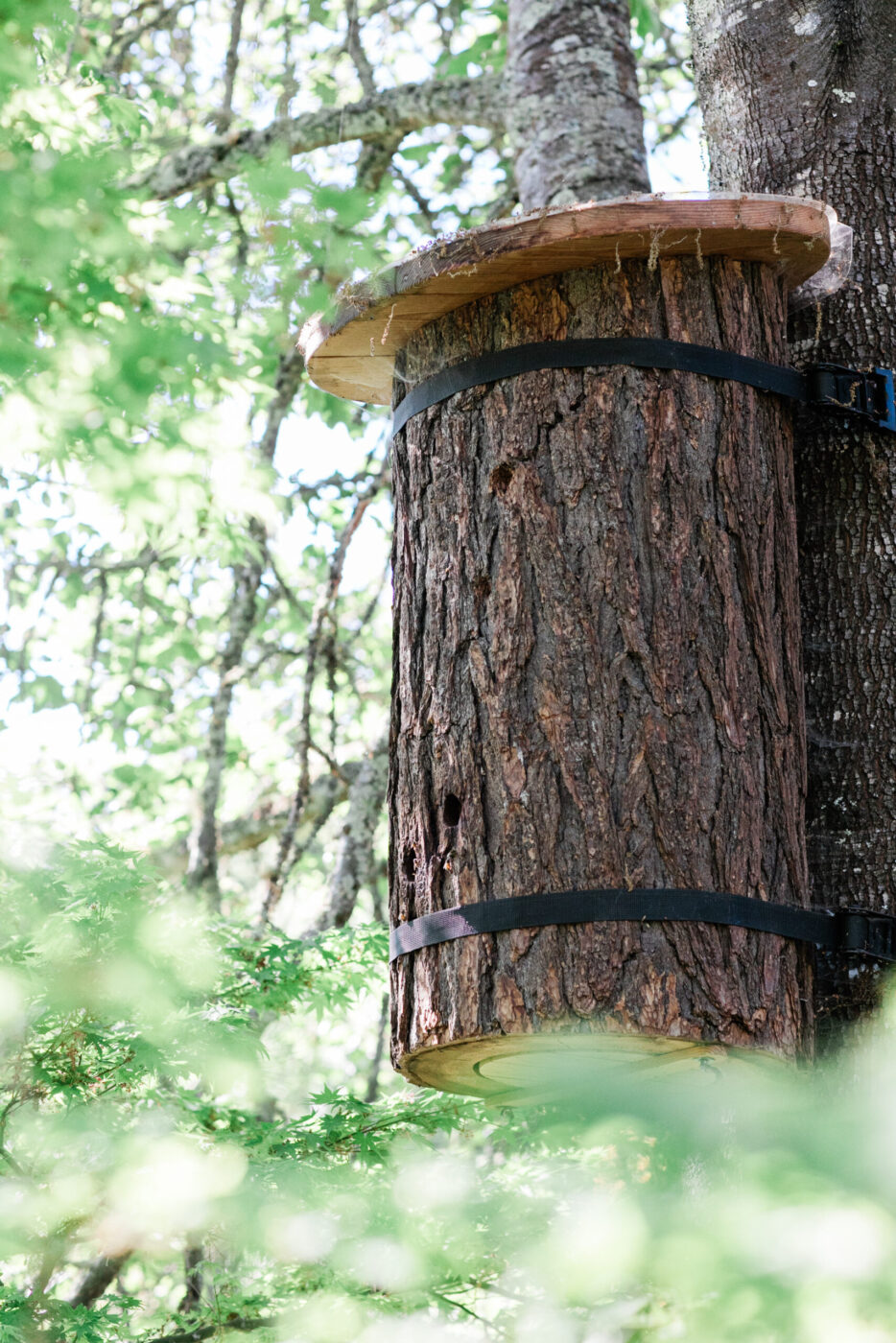

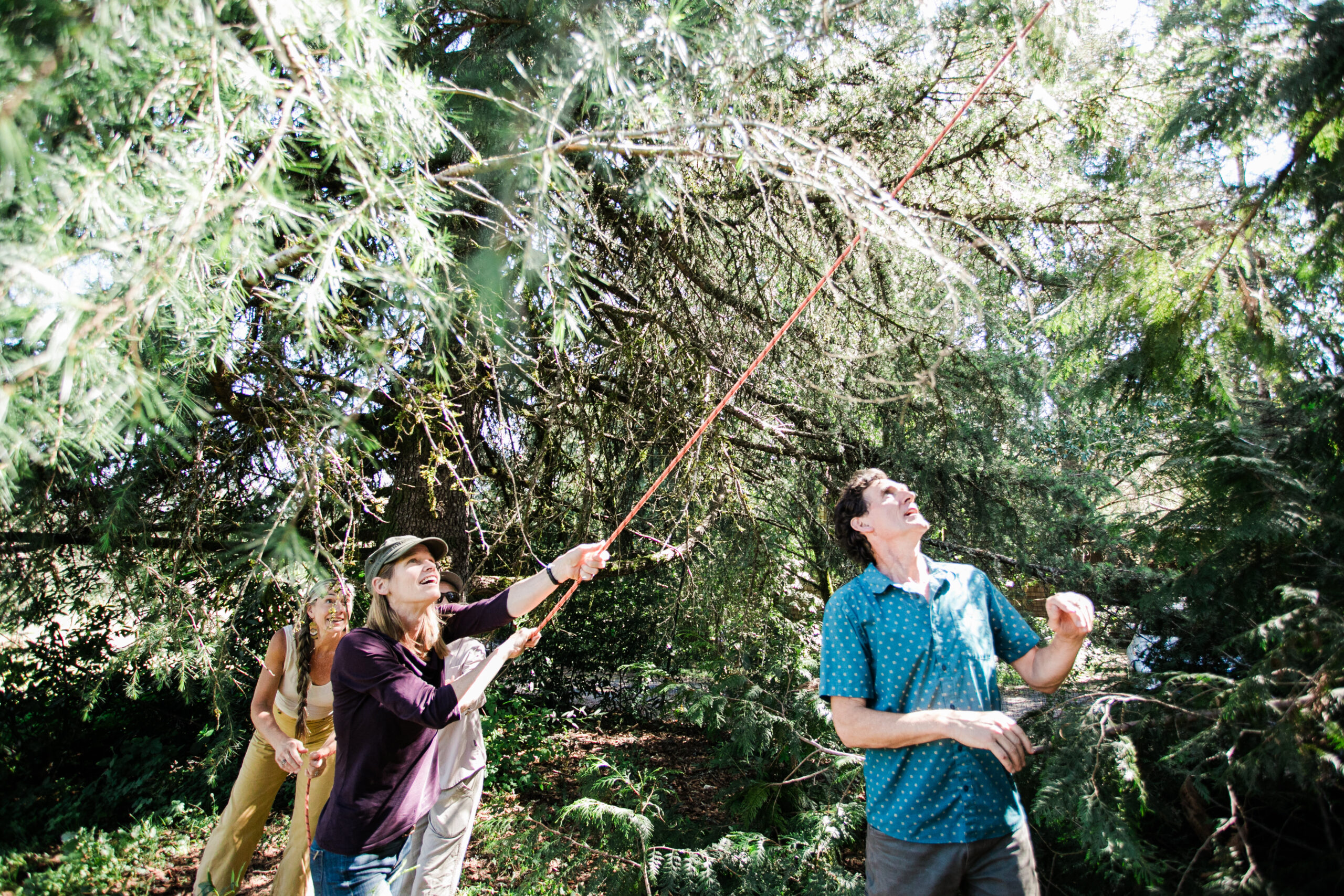
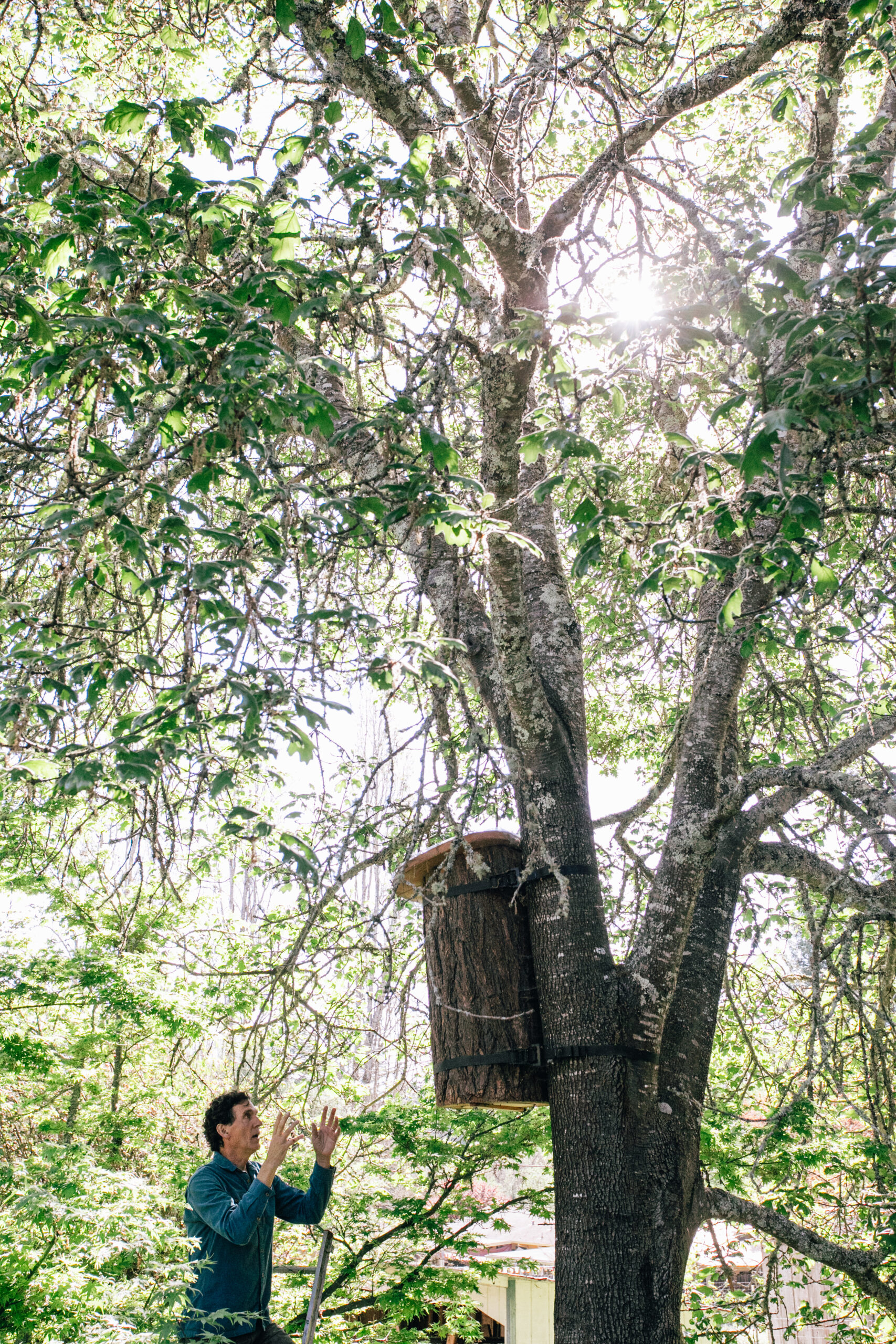
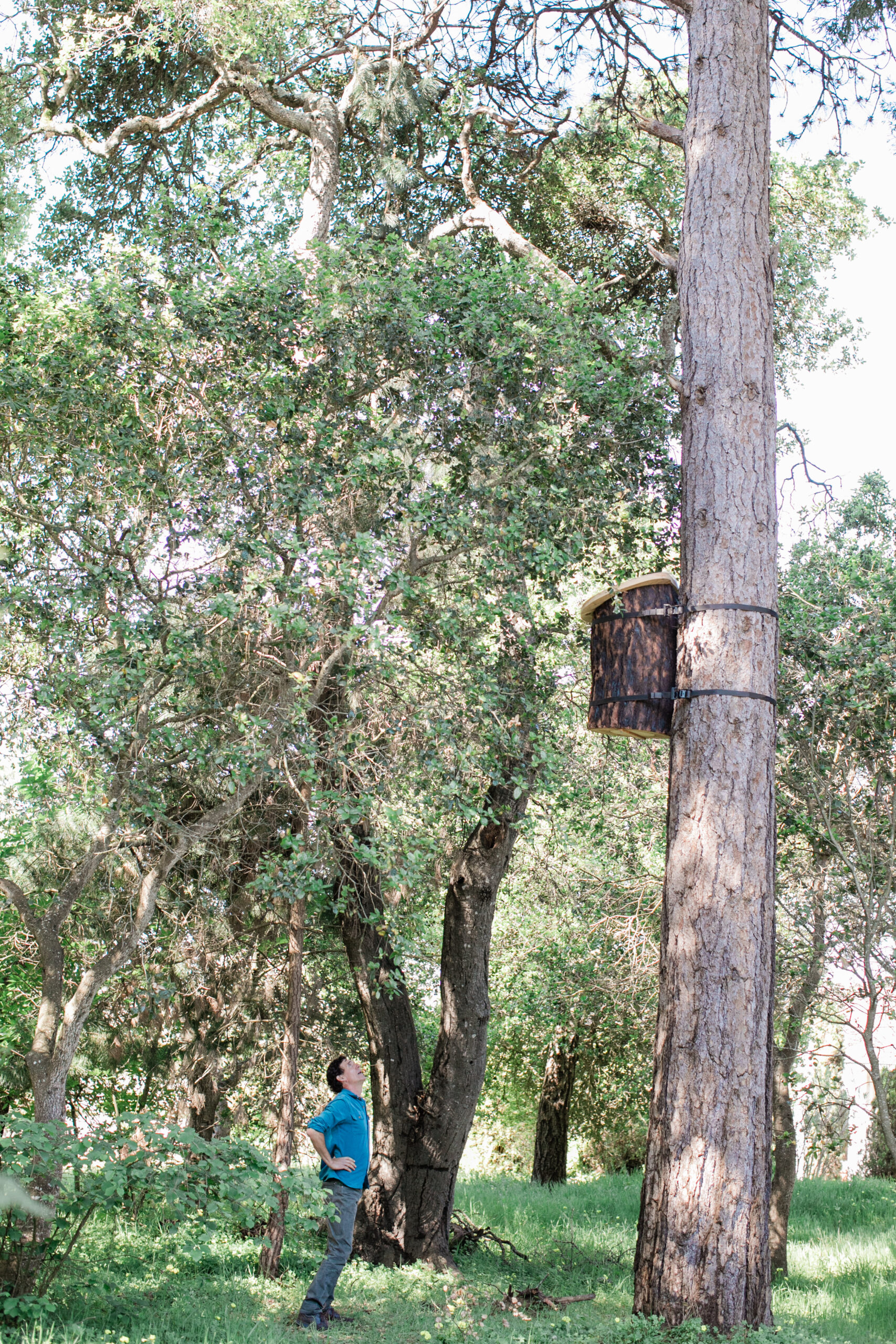
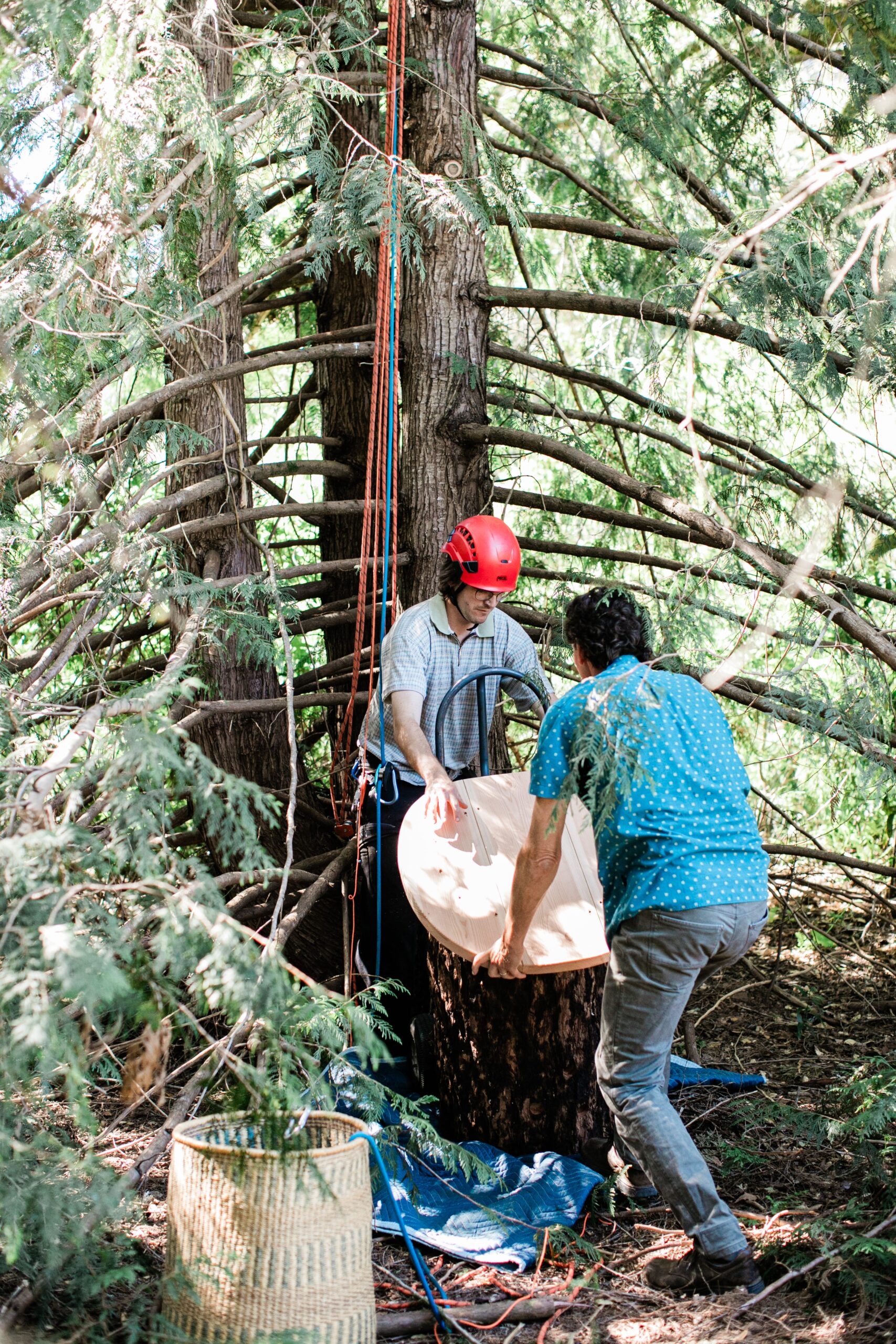
It’s hard not to notice the grin on Michael Thiele’s face as he watches several women tug on a rope and pulley to hoist a 4-foot, 200-pound hollow Douglas fir log about 25 feet in the air. From afar, it looks almost like they’re lifting a piece of furniture—maybe a coffee table or end table—into a 50-foot cedar tree.
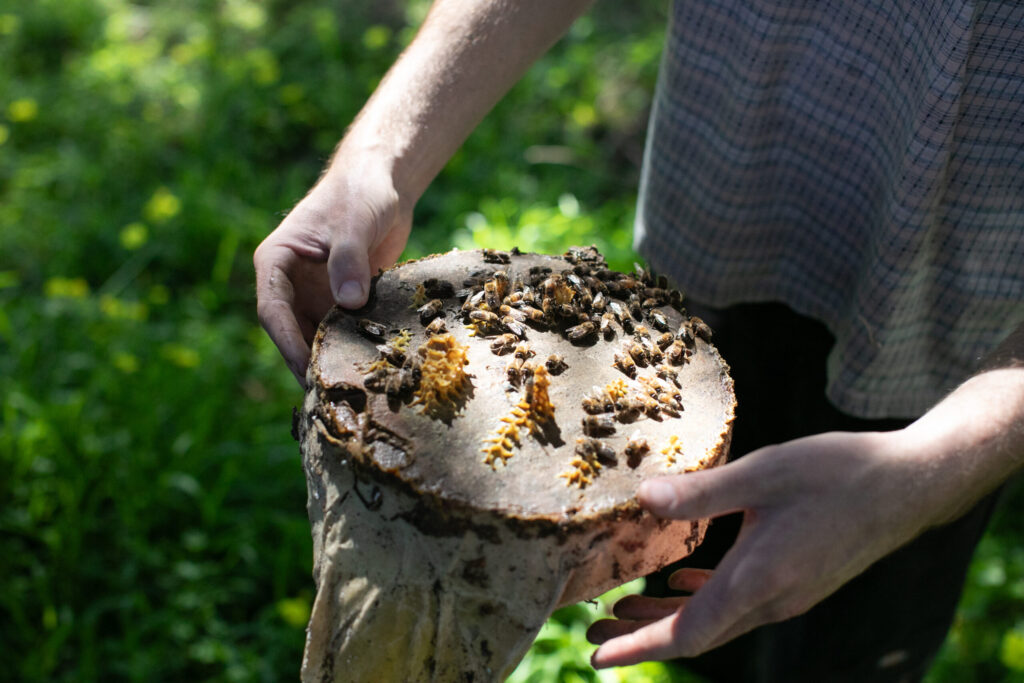
“This is the exciting part,” says Thiele, founder of Apis Arborea, a grassroots nonprofit that has installed hundreds of these log hives, or “TreeNests,” across Northern California as part of its controversial mission to “wild” honeybees by encouraging them to live outside of box hives and in trees.
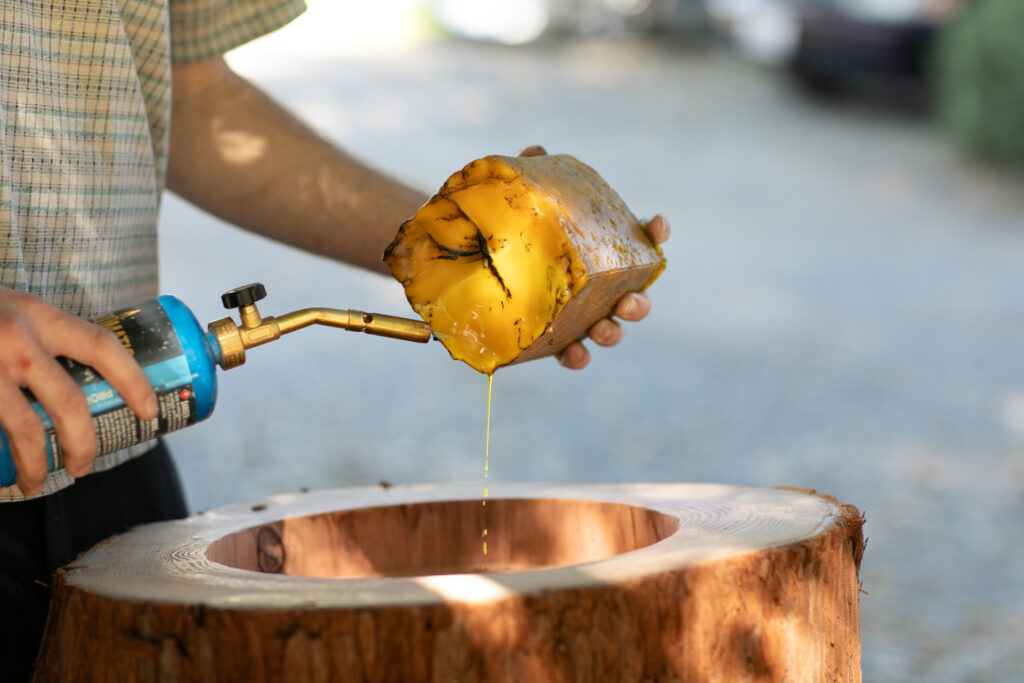
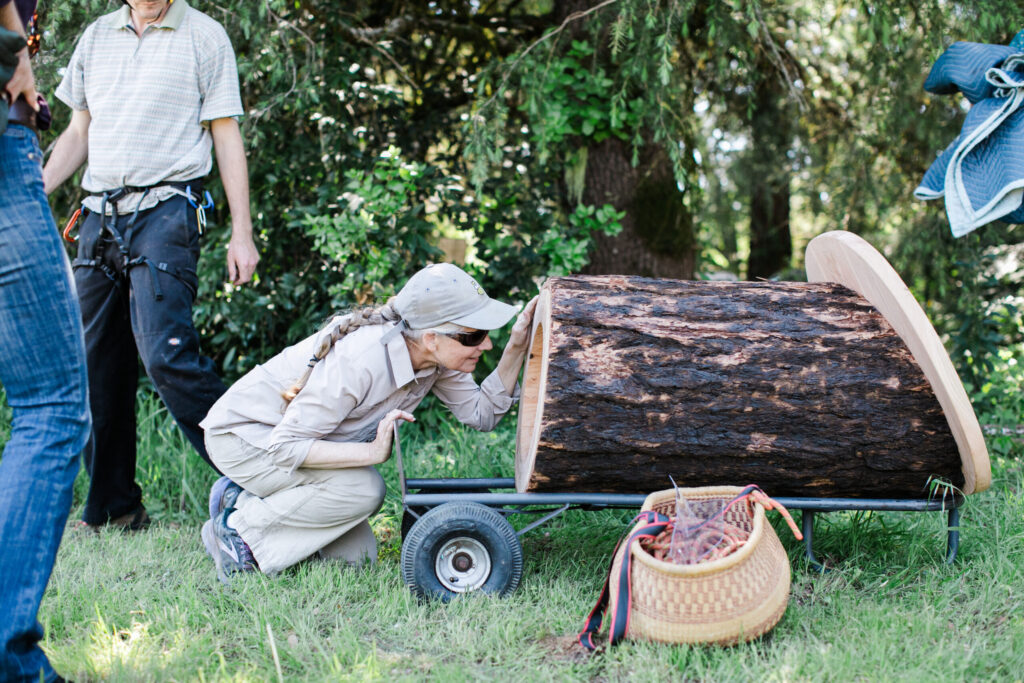
It’s a sunny Wednesday afternoon on an apple orchard in the hilly backcountry between Sebastopol and Occidental. One of the women helping install the nest is Laura Cheever, owner of Laura’s Apples. A few moments before lifting the hollow log, she leans into an opening at the bottom to smell melted beeswax and propolis inside—a concoction designed to attract honeybees.
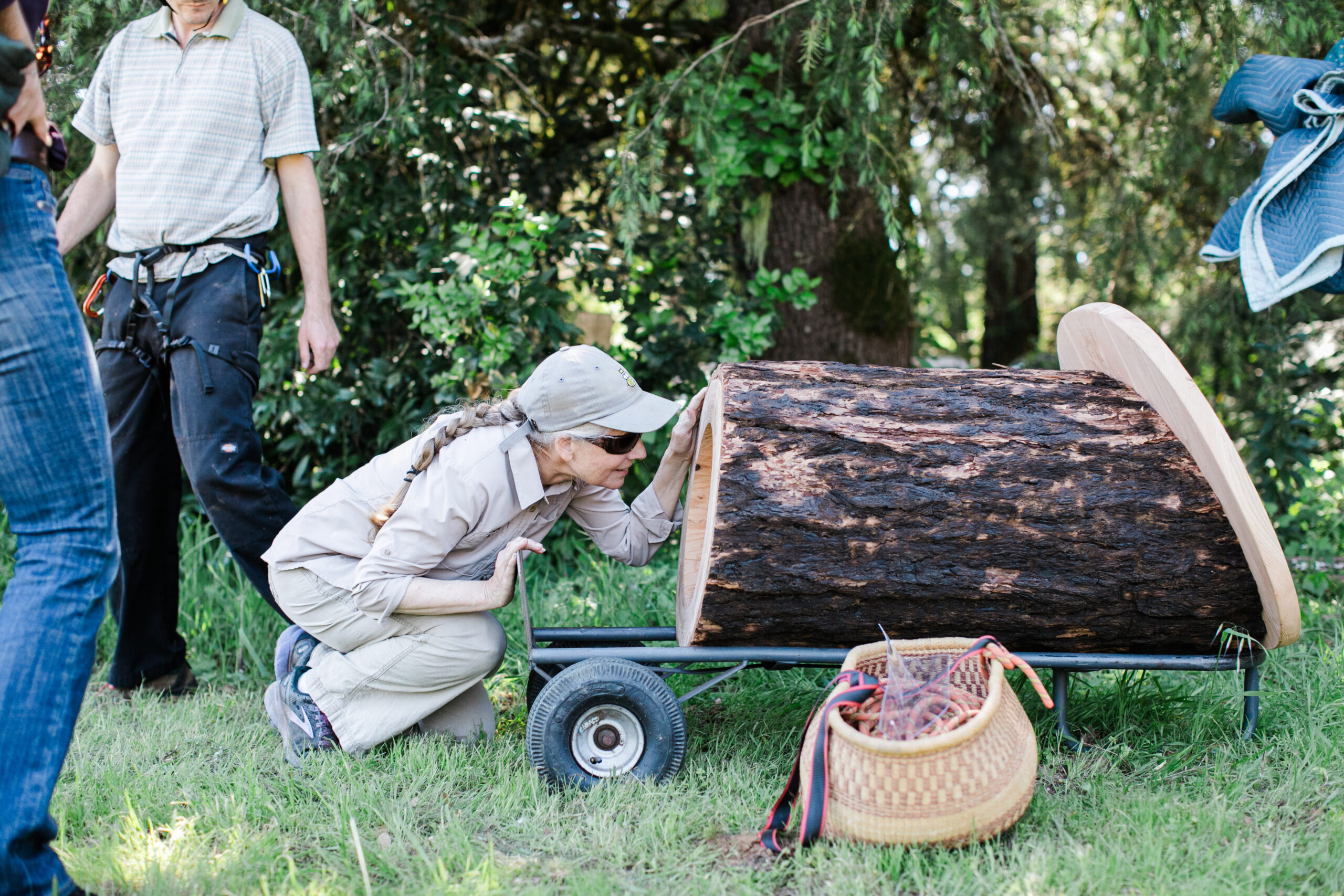
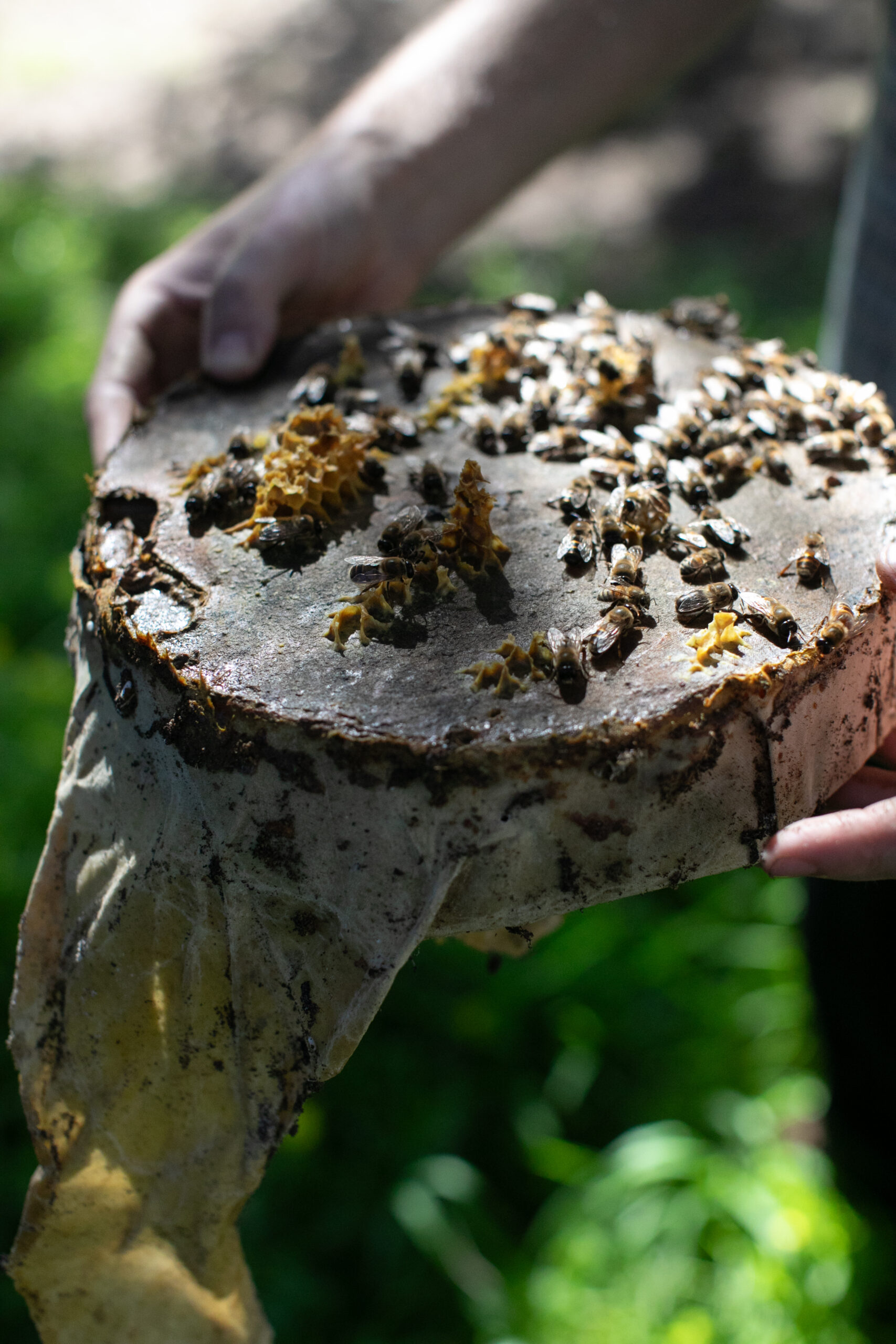
“I expected it to smell like honey, but it doesn’t,” Cheever says. “It smells like that warm beehive smell.”
A few months ago, when she was approached by Noelle Johnson, deputy director of Gold Ridge Resource Conservation District—one of the women also helping heave the rope—Cheever had no reservations about hosting a TreeNest on her apple farm. Back in 2018, she allowed a beekeeper to park around 40 hives in her orchard. It seemed like a win-win. Her apple blossoms would get pollinated and the honeybees would get some much-needed R&R after a busy almond season in the Central Valley. It’s something that happens all across the more temperate North Coast every year.
“But they got very, very aggressive to passersby,” Cheever says. “So, I only did it once, and I won’t do it again.”
This time, there are no Langstroth box hives stacked on pallets beside the orchard. In a test of “biomimicry,” once the log is firmly strapped to the cedar trunk 30 feet in the air, the only thing left to do is wait for a new colony of bees to find it. Of the roughly 200 nests Thiele has installed across Northern California, this one is special. It’s the first time Apis Arborea has collaborated with a public agency willing to fund a TreeNest to host feral honeybees. Several years ago, Thiele tried unsuccessfully to lobby the California Department of Fish and Wildlife. Unfortunately, he says, government officials “often look at bees as livestock that comes with an ecological impact.”
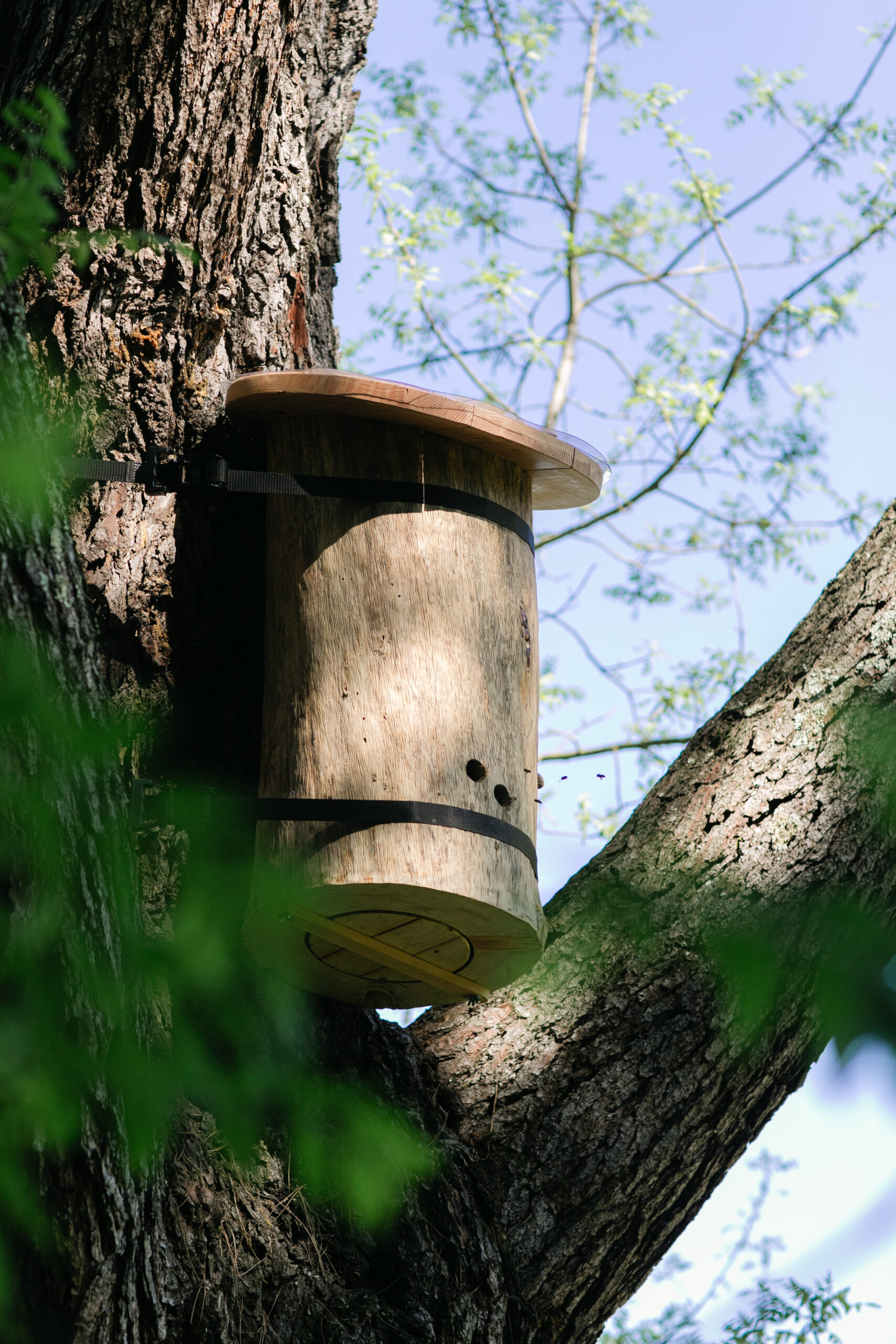
But, two days after the installation, Johnson is having second thoughts. She follows up to say she’s worried what native bee advocates will think when they hear that Gold Ridge RCD is funding even the marginal installation of a $795 TreeNest. For the past 15 years, RCD has been planting hedgerows around farms throughout west county to encourage healthy habitats for fragile native bee populations. Installing a nest to attract honeybees will likely be seen as direct competition to native bees such as bumblebees, carpenter bees, mason bees, and leafcutter bees, she says. Johnson wants to stress that the nest is only being used in an agricultural setting, employed as an alternative to large-scale commercial beehives that can spread viruses and are more likely to crowd out native bee foraging.
“One reason Michael is controversial is because he’s also putting those TreeNests in the wildland areas,” she says, citing a nest he installed in the Grove of the Old Trees west of Occidental.
She points out that honeybees are an introduced species and are not native to North America. As a result, biologists don’t use the term “wild” to describe non-native animals. Instead, they use “feral” to refer to free-roaming, non-native honeybees that live in tree nests rather than captivity in box hives.
“They’re native to where he’s from,” Johnson says. “So back home in Germany, people are talking about ‘rewilding’ bees. They’re part of the ecosystem there—that makes sense for Europe, but not North America.”
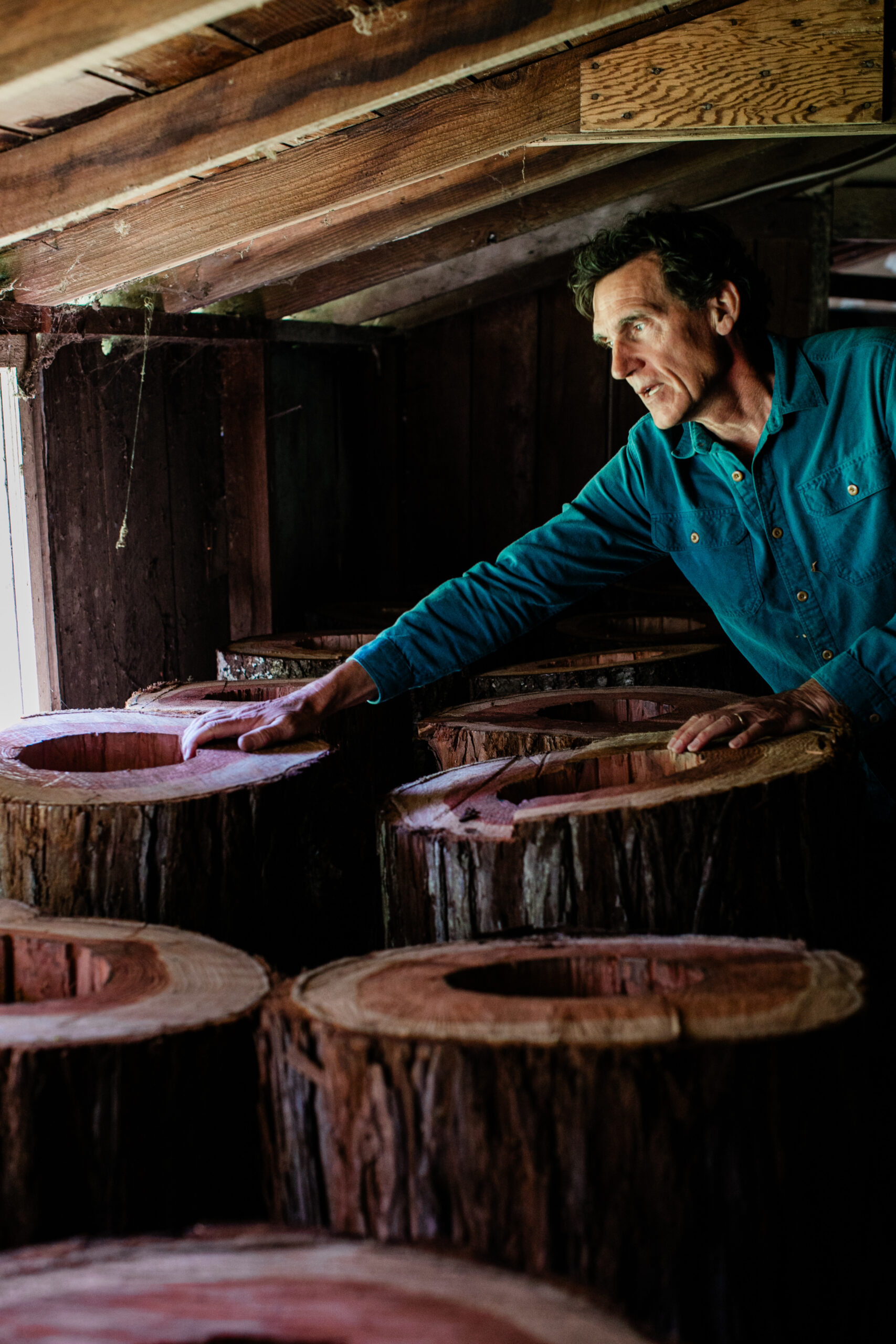
Although he’s somewhat surprised to hear that RCD is having reservations, it’s nothing new to Thiele, who has been fighting the native vs. non-native battle for years. When he met with Johnson and RCD last October, he says he felt like they understood the difference. “They said, ‘Oh yeah, you are actually serving native pollinator communities through your programming.’”
For now, he’s looking forward to seeing what happens next at the orchard. “There’s so much more to come,” he says.
It’s a debate many centuries in the making when you consider the European honeybee (Apis mellifera)—somewhat of a misnomer since it originated, not in Europe, but likely in Africa, the Middle East, and Asia—was brought to America by English settlers in 1622 before making its way to California in 1853. Pointing out that the Gravenstein apples in Cheever’s orchard are also non-native, Thiele sees the debate between native and non-native as outdated.
“The whole world has become a migrant,” he says in a rhythmic German accent that occasionally channels the enthusiasm of documentary filmmaker Werner Herzog. “It’s not only people. All species are migrating.”
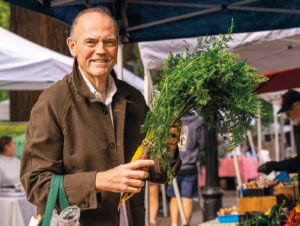
Thiele could be talking about himself. A native of Germany, he grew up in a small town about two hours north of Frankfurt, on a farm where “we fixed all of our own things.” Some of his heroes are German bee expert Jurgen Tautz and British author Isabella Tree, who wrote a book about rewilding her farm.
Thiele is quick to cite numerous studies of honeybees, including work by renowned University of Georgia professor Keith Delaplane, who argues that supporting a wide diversity of bee species—including both commercially managed honeybees and free-roaming, feral honeybees—“is critical for the future of agriculture,” he says.
From 2023-2024, more than 55% of managed honeybee colonies died, according to the U.S. Beekeeping Survey. Another study in 2025, by Project Apis m., found that commercial operations (those with more than 500 colonies) lost 62% of their hives, whereas in the wild, Thiele has documented honeybee survival rates soaring above 80%.
His mission at Apis Arborea is to support and boost the survival of wild honeybees, while collecting data, encouraging scientific study, and educating the public and other beekeepers about the benefits of “wilding.” In an age where honeybee survival numbers have plummeted, many beekeepers point to varroa mites and a host of viruses as the major culprits. Instead, Thiele sees pesticides, over-crowding, lack of foraging habitat, boxed beehive management, and breeding as the major factors.
To some in the commercial beekeeping world, Thiele is almost a pariah, though some large-scale beekeepers are willing to engage with him, like Tauzer Apiaries owner Trevor Tauzer, whose family has been keeping bees in Northern California for more than 50 years. “He and I do not always see eye to eye,” Tauzer says, but admits they have found some common ground. “We align as we are committed to giving disparate voices space to be heard.”
To others, he’s celebrated as the local guru of wild honeybees. “He’s thought of as like the god of natural beekeeping,” says Healdsburg organic beekeeper Candice Koseba, owner of Sonoma County Bee Company. She’s using the term “beekeeping” loosely. Thiele might bristle at the description, since he’s not interested in “keeping bees” or harvesting honey.
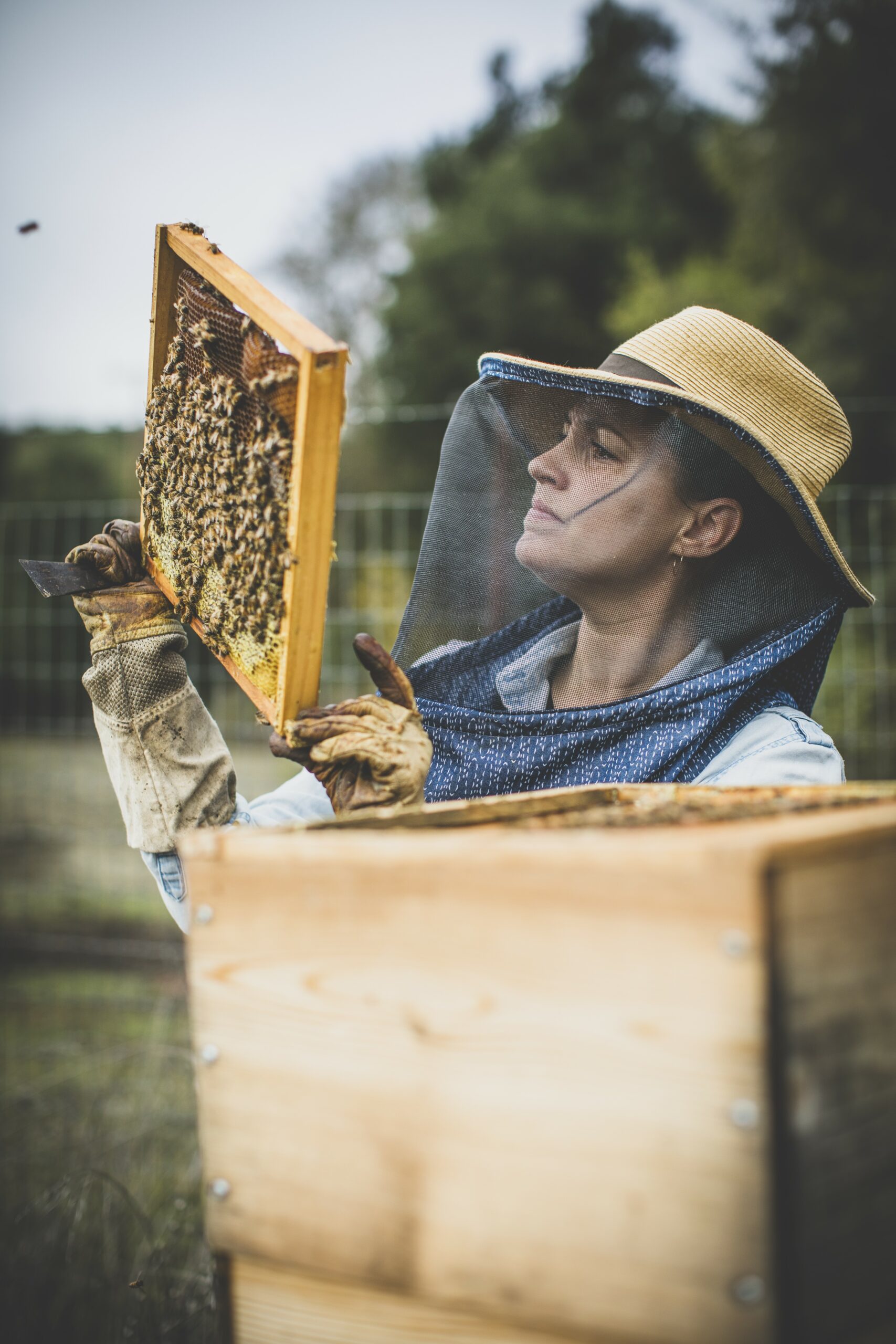
Like Koseba, Bee Focused beekeeper Joy Wesley was immediately hooked when she heard Thiele talk at an industry event nearly a decade ago. “He spoke on honeybees in a way that I hadn’t heard before,” she remembers. “He was more honeybee-centric, like from the point of view of the honeybee as opposed to the point of view of the human.”
Boonville farmer Chris Tebbutt likens him to a bee whisperer. “He’s got a really unique, incredibly sensitive approach.” Tebbutt hired Thiele to install a handful of TreeNests at his 50-acre Filigreen Farm, where honeybees are crucial for pollinating apples, pears, peaches, plums, blueberries, and olives. “The way he handles bees and how he imagines conditions in the hive, it’s not a product. Bees are not just some commodity for him.”
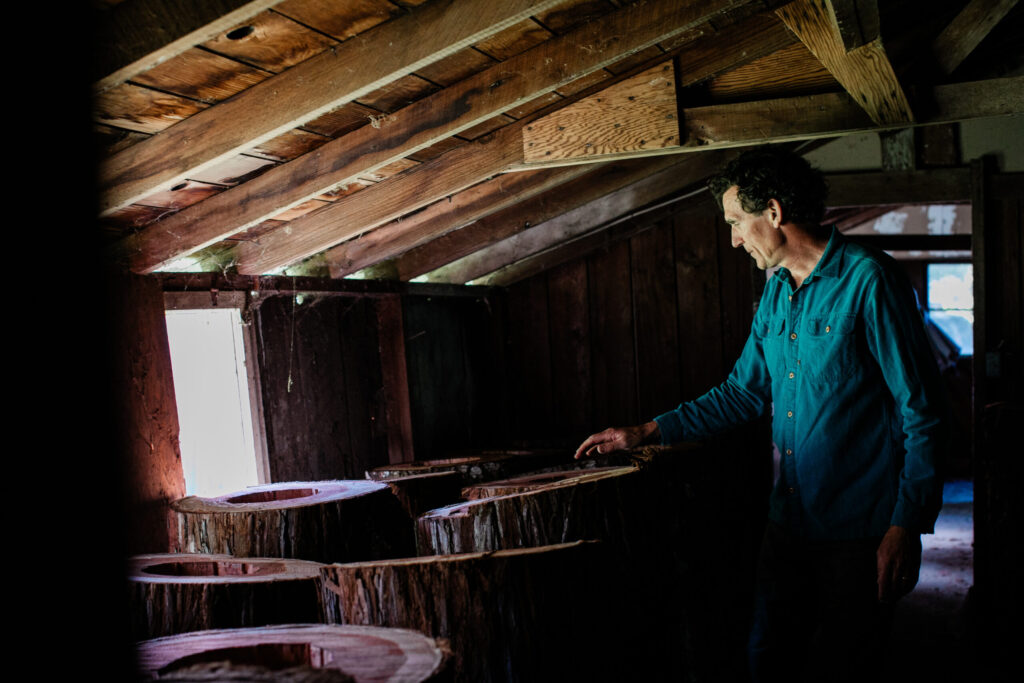
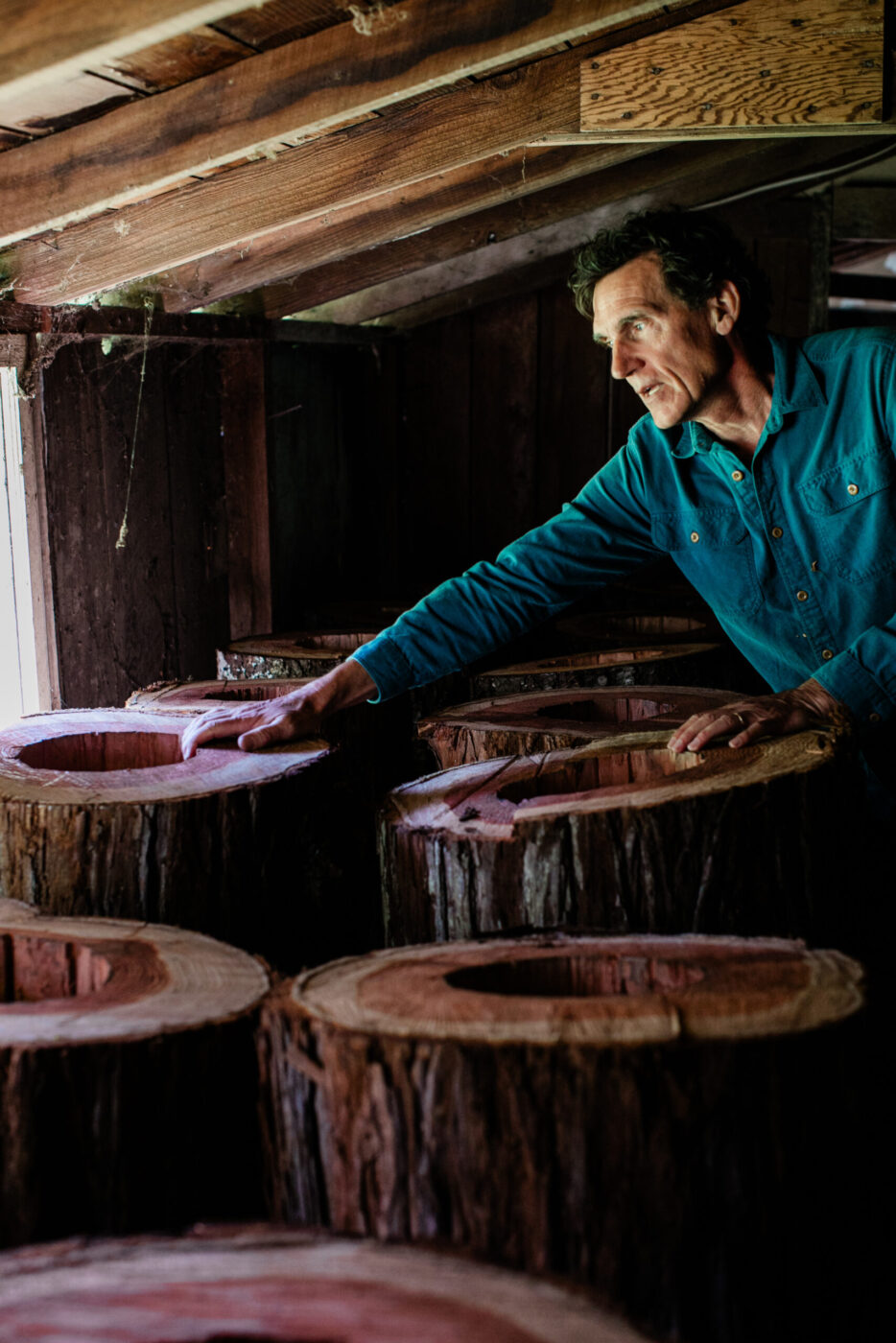
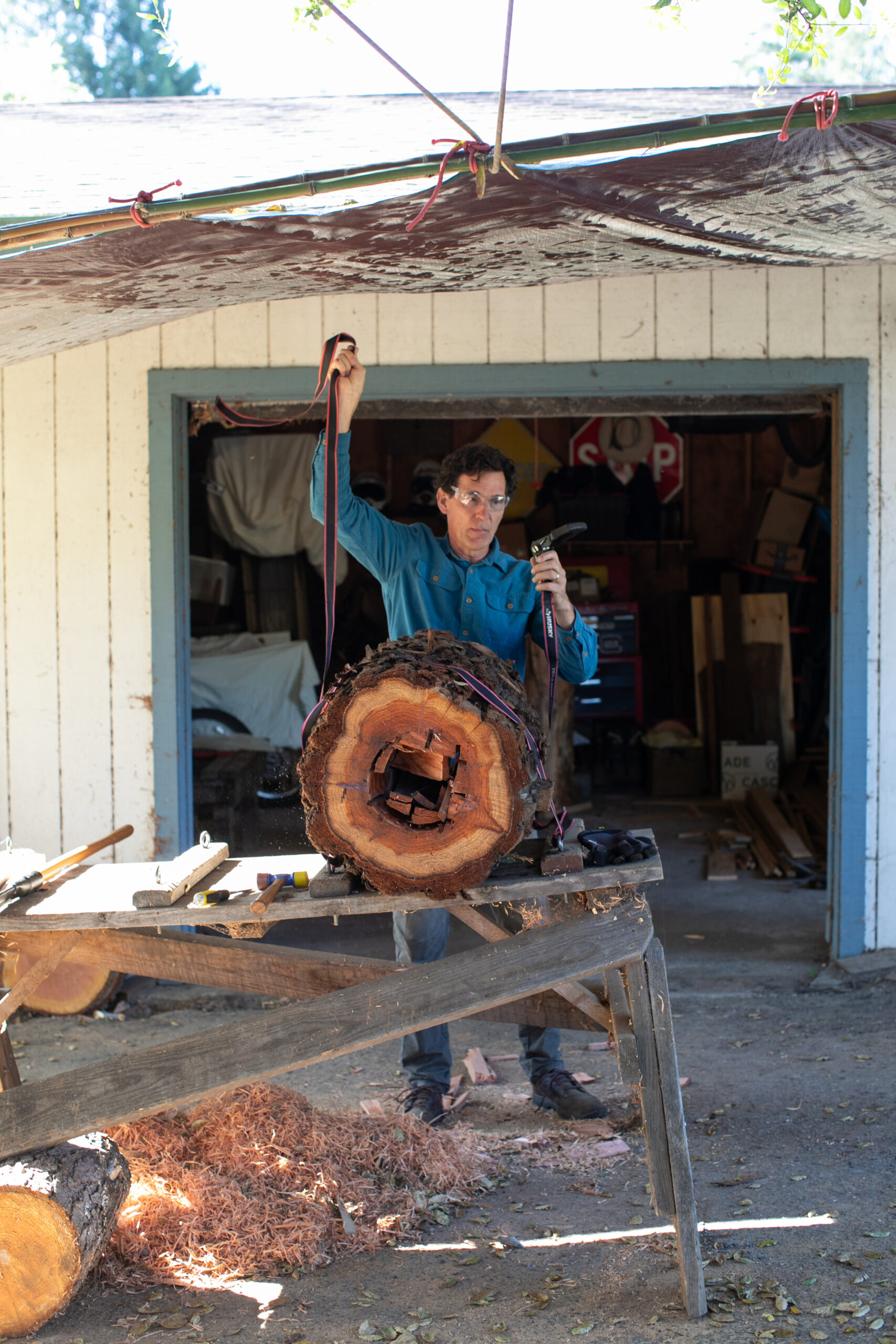
But to truly appreciate Thiele, you have to understand his zen approach to science. Inventing his own language, he calls honeybees “apians,” recasting the adjective “apian” (from Latin root word “apis” for bee) as a noun. He named his 5-year-old nonprofit “Apis Arborea,” meaning bees that live in trees. He calls his installations “TreeNests” instead of log hives because he feels the word “hive” is a man-made construct.
Standing outside his workshop one morning, Thiele scrolls through his cellphone, poring across five years of research compiled at Sonoma State University’s Galbreath Wildlands Preserve in Mendocino County, where Thiele and collaborators are studying more than 70 wild bee trees where honeybees have nested on their own without human intervention. Last year the survival rate was 83%.
Monthly monitoring data on his phone includes temperature, weather conditions, moon phases, and a detailed count of bees, both leaving and returning. His approach isn’t merely data-driven, but also philosophical, using poetic language to describe their nests (“Light angel, dancing oak”) and pondering the “apians’” state of consciousness.
In the spirit of San Francisco Zen master Shunryu Suzuki Roshi, whose face is on a poster hanging in his workshop, Thiele often invokes the unity and interconnectedness of bees to all life around them. A colony of bees, he points out, will act as an individual, functioning as what is referred to in biology as a superorganism, like a coral reef or termites.
“Here we have 20,000 individuals on one hand, but they are not individuals because they need everybody to exist,” he says.
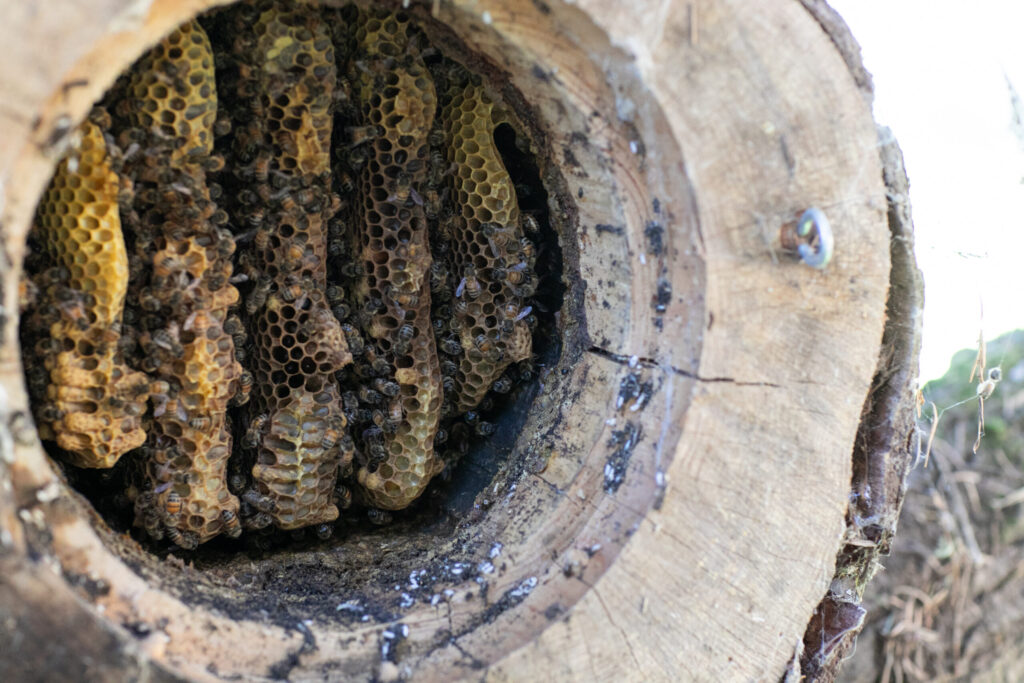
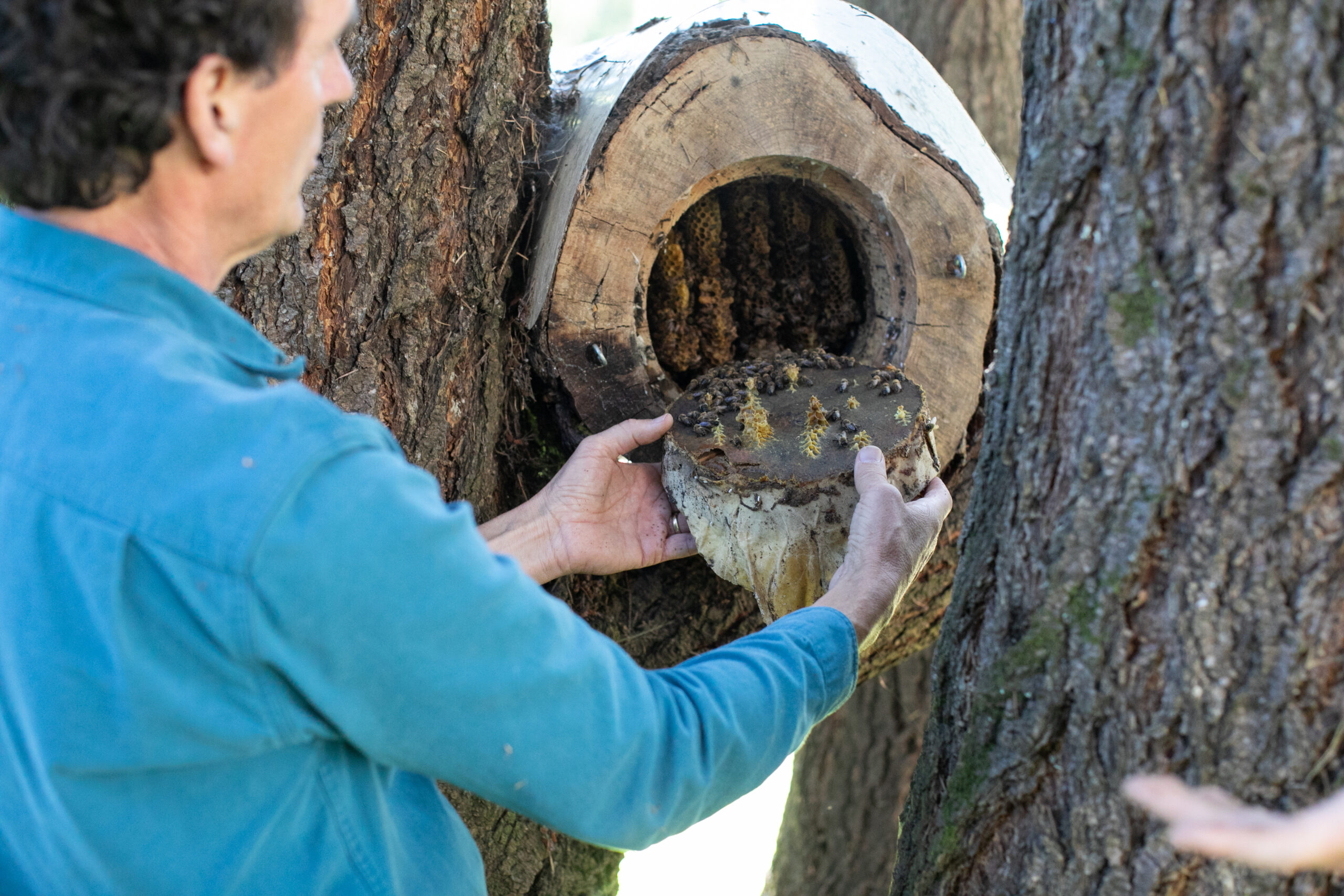
It’s all part of a spiritual quest that goes back to his time at Green Gulch Farm Zen Center in Marin. After his first wife died of cancer, Thiele moved to the United States and lived for eight years at Green Gulch, where he met his new wife. After they left the community with two kids in tow, Thiele got a job at a water treatment plant to pay the bills. But beekeeping was his passion. He named his first company Gaia Bees. Soon after, he co-founded the honeybee sanctuary Melissa Garden, where he had a log-hive epiphany. After honeybees settled into the log, he took a peek inside the log for the first time. “What I saw was completely outside of my reference frames,” he remembers. “It was like, ‘What is this? What’s happening here?’”
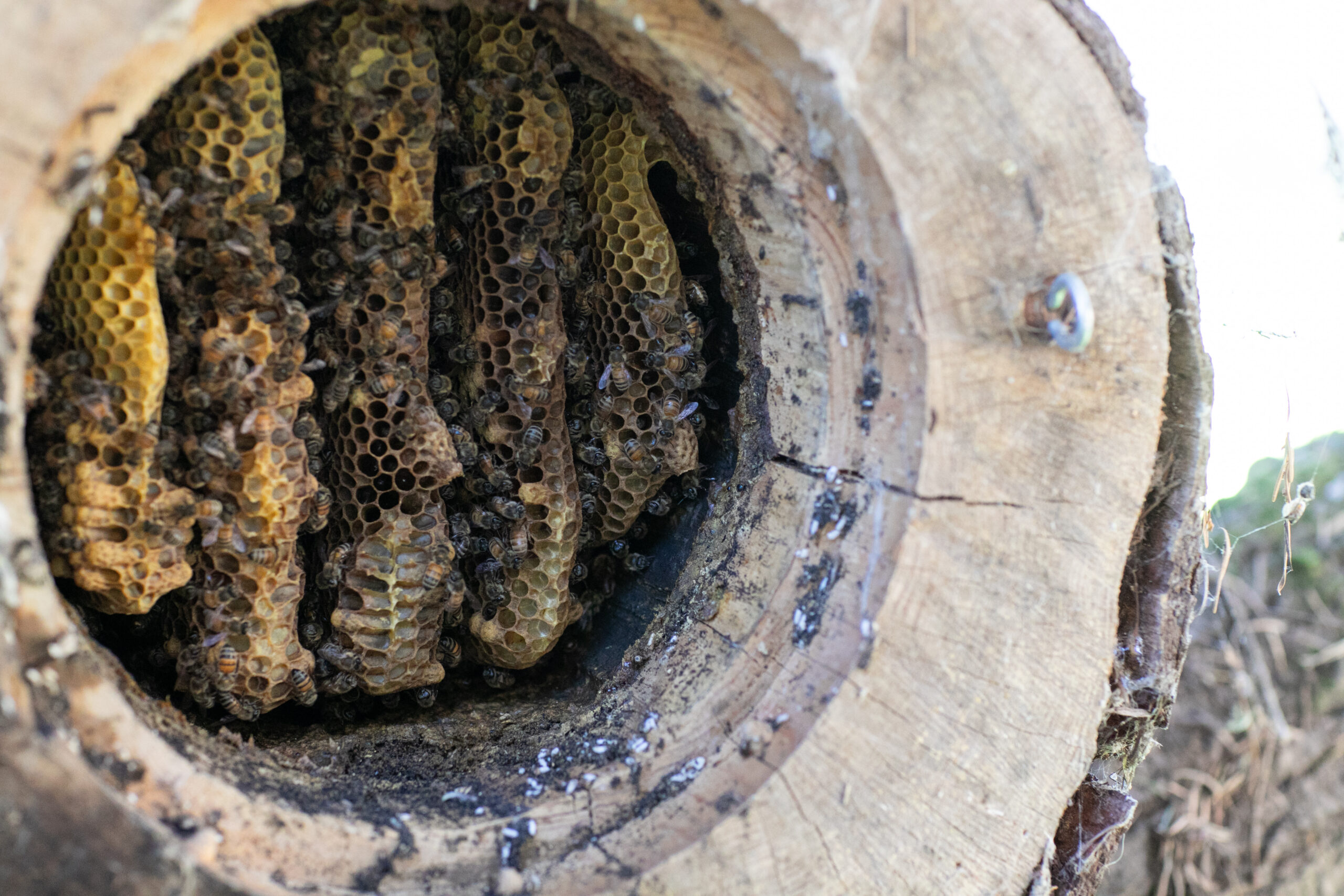
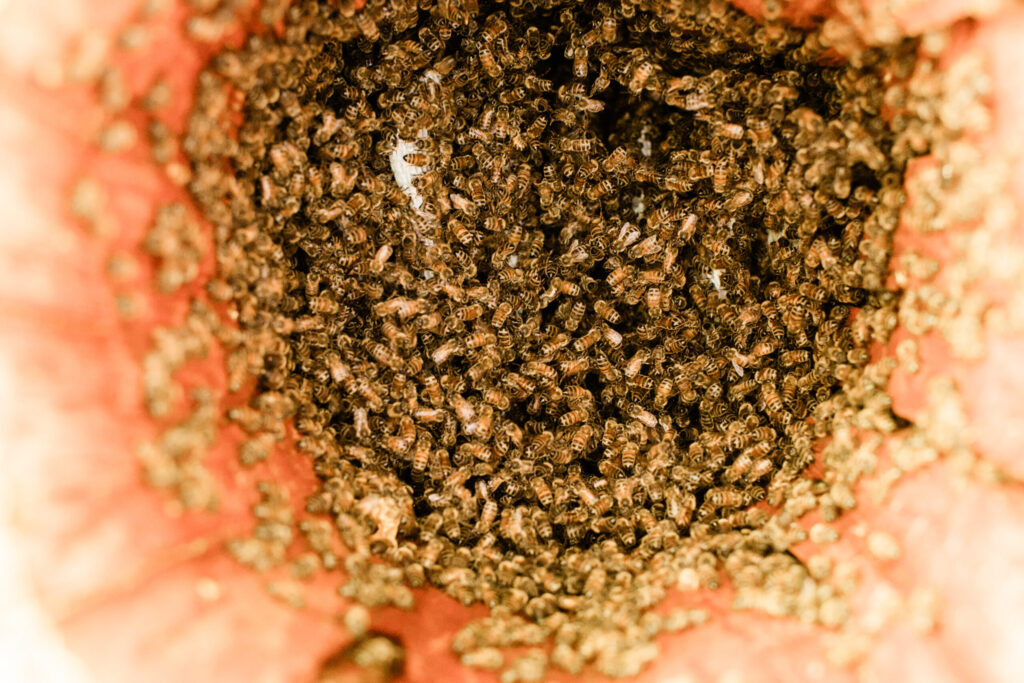
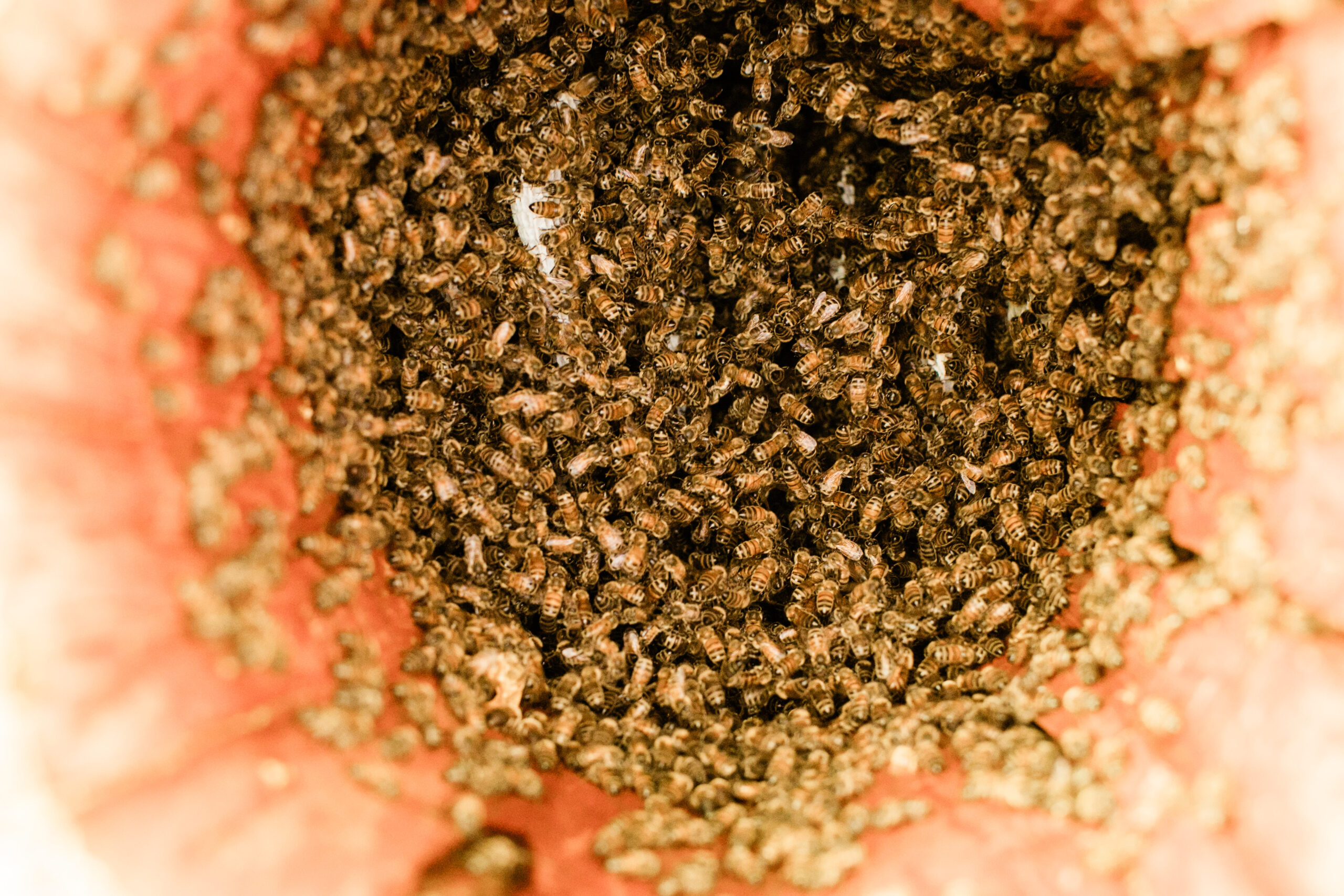
What he observed was a conical shape forming from the ceiling of the nest, as the bees populated in layers creating “a sheath of living bees that almost looked like a skin.”
At that point, he says, “I realized beekeeping is such a contrived practice and paradigm. I felt it with my whole body, with my whole being, and I knew that I had to shift and start learning about the species and how they live in the wild.”
Another watershed moment occurred at Green Gulch Farm, where Thiele began experimenting with log hives in 2014. For the first four years, the annual survival rate was around 20%. When it plummeted to total losses in the fifth and sixth years, “I sat there in the winter fields, with blossoming brassica all around me, literally crying,” he remembers.
But in the seventh year, the log-hive populations began to rebound, he says. Now, 12 years later, the health of the feral honeybees is thriving, with an 87% survival rate last year, he says.
One of the biggest threats to local honeybees he sees is the unregulated seasonal influx of large-scale commercial beekeepers who rotate thousands of hives in and out of Sonoma County throughout the year. The issue came to a head three years ago when Tauzer contracted with the county to park his hives at a county disposal site across the street from Koseba’s bees in Healdsburg. Alarmed by the proximity, Koseba raised the issue at a Healdsburg City Council meeting, where Thiele spoke in her support. Eventually, Tauzer’s contract was canceled. It led Thiele and Bee Focused owner Wesley to form the Pollinator Advocacy Alliance, with the goal of negotiating apiary size limits in Sonoma County. Along with Koseba and other small organic beekeepers, they are including Tauzer in a working group to draft language for a proposed county ordinance.
Thiele is also working on a new model for local beekeepers who are willing to agree to a handful of rules: no treatment or pesticides, embracing swarming as propagation, not moving beehives farther than a half-mile, and not purchasing bees from anywhere to put in your apiary.
It’s called “LocApiary,” as a play on locavore, and the goal is to create what Thiele describes as “a watershed-wide apiary.” He’s putting it forth almost as a challenge. “We want to get beekeepers involved, to see who is brave enough or feels called to take that next step.”
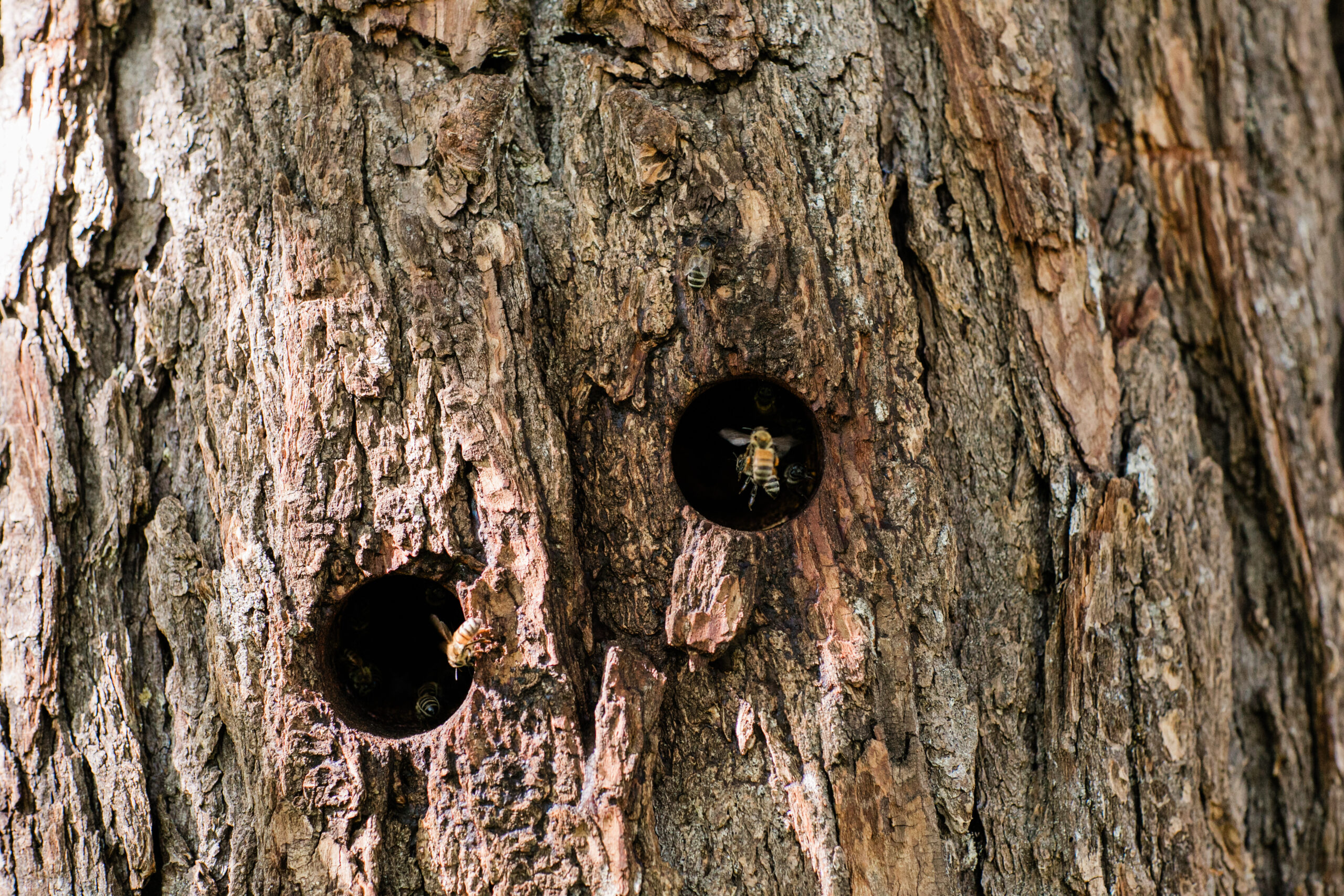
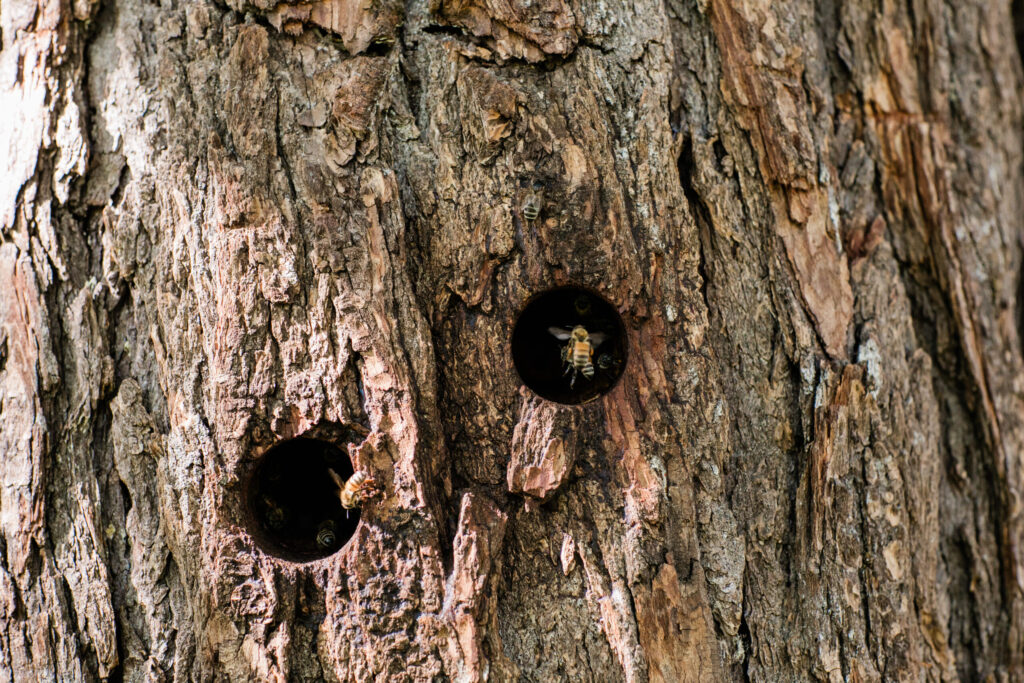
Back at Laura’s Apples, the 6-acre orchard west of Sebastopol, it only takes four days for a new colony of bees to discover the new TreeNest. Cheever sends a video of hundreds of bees buzzing around the opening, with a note that reads, “I’m just so excited. Bees are moving in already!”
Thiele is happy, but hardly surprised. In his experience, the record time for bees to inhabit a new TreeNest is two hours. It’s a migration he has witnessed again and again, giving him hope for the future of wilding.
A few days before, while standing below a 20-foot-high nest he installed on a neighbor’s property, he watches several bees buzz around two half-dollar-size entrance holes.
“Did someone move in?” he wonders, watching scouts come and go. “It could be imminent today. It could be that there’s a swarm sitting somewhere, and when it’s warmer, they’ll move in in two hours.”
He explains how a roaming scout likely found the new location first and returned to the old hive to communicate through dance, saying, “I found something really cool that could work for us.” After other scouts zero in on it, soon around 50 scouts are coming and going, dancing about this new location. While maybe only five scouts are dancing about another location. Eventually, they decide to move.
“It’s not about vanity,” he says, anthropomorphizing the lives of bees. “Like saying, ‘I’m the most successful experienced scout, and we should go to what I found.’ Because it’s a life and death decision. If you’re driven by pride and vanity and ego, that could be devastating.
“We humans do that, too,” he says, laughing.
After a brief moment of self-reflection, he’s consumed again by wayward “apians”; his eyes dart across the sky, hoping a few buzzing scouts might lead him to their old home. He has perfected a field practice called “beelining,” where he lures honeybees with a sweet liquid and then, using a soft-bristled brush, paints different watercolors on the abdomens or thorax of several bees to track them. After timing their departing and returning flights, he can ultimately follow them to their hive. It’s a technique that’s helped Thiele find 77 bee trees over the course of six years at Galbreath Preserve, an exercise in patience to be sure.
It’s a testament to the old saying, “It’s the journey, not the destination,” or as Thiele learned in his Zen studies: “It’s the path and not the destiny.”
Coming out in late May, The Wild Honeybee Atlas is a community-based, open-data platform similar to an app that can be used to find and monitor honeybee populations in your area. Once it’s available, users can sign up and become custodians on the website (apisarborea.org).
Also on the website, check out the podcast Arboreal Apiculture Salon, featuring scholars, scientists, and activists from around the world, engaged in long-form interviews and discussions about honeybees.
Upcoming events
May 9: “Spring Field Trip to the Wild Honeybee Populations of the Galbreath Wildlands Preserve,” 9:30 a.m. to 4 p.m. in Yorkville. $10.
May 22 & Aug. 8: “Honeybee (Re-)Wilding Walk with Apis Arborea,” 10:30 a.m. to noon at Sonoma Botanical Garden, 12841 Sonoma Highway, Glen Ellen. $10-$20, available at sonomabg.org.
May 29: “Learning from Wild Honeybees” A first-ever overnight immersion invites a small group into the living interior of Galbreath Wildland Preserve. 3 p.m., May 29 – 2 p.m., May 31. $300.
June 17: “TreeNest Tutorial: Designing and Building Arboreal Nest Habitats,” 5:30-7 p.m. $20-$35.