The 10-week pop-up restaurant at Omelette Express (112 Fourth St., Santa Rosa) run by local butcheress, Berry Salinas, is adding Friday night festivities with a $15 prix fixe dinner (recent meals included pork belly with creamy grits, hand pies with Meyer Lemon Cheesecake), wine and beer by the glass and rockin’ tunes from the North Bay Hootenany.
Check out The Crux on Jan. 18 and Marty O’Reilly and Sean Carscadden on the 25th from 7-9pm.
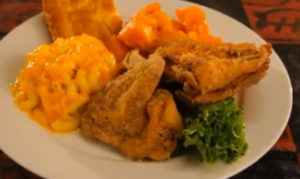
They’ll still have Sunday fried chicken pick-up dinners from 5-7p.m. at 555 Sebastopol Rd., Santa Rosa. More details at butcherandcook.com.
Check out updated details on the Barlow Center Sebastopol
Current tenants at Sebastopol’s Barlow Center, now slated for a spring 2013 opening.
THE BARLOW: Estimated opening April 2013 (in Phases)
The Concept: An 222,000 square-foot artisan marketplace and production facility
The Pitch: “The Barlow will also incorporate a carefully chosen selection of restaurants to create a comfortable, fun atmosphere where the community can come together and enjoy, art, wine and time with one another.”
Cost: $23.5 million
The Developer: Barney Aldridge, real estate developer
Major Tenants: Kosta Browne, Taylor Maid, Community Market
The Barlow, named after an old apple plant that once stood on the site, has been plugging away since announcing its intentions in 2010. After a number of delays (including a fire) construction is near completion and tenant improvement permitting began in earnest in October 2013. Most recently Noah and Mirjam Bolmer of Occidental’s Barley and Hops started tenant-improvements for their micro-brewery project, Warped Brewing along with Taylor Maid Farms, who are beginning interior construction on a coffee bar and roasting facility.
Other tenants who’ve announced their intention to be involved include Other food and wine tenants include Kosta Browne Winery, Guayaki Yerba Mate, Wine Gap Wines, Community Market, Spirit Works Distillery, Village Bakery, MacPhail Family Wines, FEED Sonoma, La Follette Wines, Marimar Estates, Whole Spice and Gypsy Bay Laurel.
In late December, Sub Zero Ice Cream and antiquarian bookseller Ben Kinmont were also announced. Sub Zero is a Utah-based ice cream chain that uses liquid nitrogen to make “instant” ice cream flavors for customers. Ben Kinmont is the nation’s foremost antiquarian bookseller specializing in 15th to early 19th works on gastronomy and related topics. John Stewart and Duskie Estes of Zazu have also announced their intention to lease space at the Barlow which would include a space for production of their Black Pig Meat Company.
The Buzz: There’s been plenty of press about tenants who’ve planned to move in, then changed their minds. That’s not too surprising, since many paid nominal fees early on to “reserve” a spot. Most folks are curious to see whether the mix of production and retail will be a big enough draw to casual shoppers, but there’s a lot of excitement in Sebastopol about this massive project — BiteClub included.
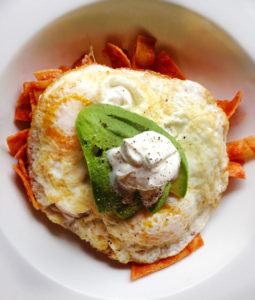
Chilaquiles, pronounced chil-a-KEE-les are a tried-and-truer hangover remedy you’ll be hard-pressed not to love. Translated as either “broken up old sombrero” or “herbs in a chili broth”, they’re a smart way to use up old corn tortillas as well as a hearty morning repast, and pretty easy to find throughout Sonoma County.
Despite being deadly simple to make, but hard to get just right — soft and crispy at the same time. Whether soaked overnight or given a quick spritz, the idea is to give stale corn tortillas a quick fry, then a leisurely bath in either salsa or mole until they’re pliable. Scramble in some eggs, top with cheese, sour cream, avocados and a side of beans and you’re fueled up for the day.
Most taquerias serve them for breakfast (and even into lunch), but snazzier spots are also getting in on the action. Here are some favorite places to find this Mexican morning treat. Prices range from $9 to $20, depending on what you add on.
Uptown Chilaquiles
Chilaquiles with some chef-inspired flair.
Chilaquiles at Jeffrey’s Hillside Cafe in Santa Rosa
Jeffrey’s Hillside Cafe:Another reader favorite, the secret here is the sauce. Chef Madura does a blend of tomatillos, cilantro, chilies and garlic that hugs the fried tortilla strips. Eggs and beans are served on the side.2901 4th Street Santa Rosa, (707) 546-6317.
Gypsy Cafe:A bowl of eggs scrambled with tortilla strips, cheddar, red tomato chile sauce, avocado and cilantro pesto with toast. 162 North Main Street Sebastopol, (707) 861-3825.
Flavor Bistro: They’ve just started serving breakfast Wednesday through Sunday, and chilaquiles is on the menu with a zesty red sauce. 96 Old Courthouse Square Santa Rosa, (707) 573-9600.
Downtown Chilaquiles
Demolished chilaquiles
More authentic Mexican versions of chilaquiles, made with traditional ingredients.
La Texanita: The chilaquiles that started a quest for great chilaquiles began at this unassuming Roseland eatery years ago. This authentic version is simple and straightforward, served with either red or green sauce. Go for the green and add some carnitas to really spice things up. (1667 Sebastopol Road, Santa Rosa).
Las Palmas: Readers raved about this real-deal version at one of Santa Rosa’s best Mexican taquerias. 415 Santa Rosa Avenue Santa Rosa, (707) 546-3091.
Agave: I’m a huge fan of the mole, made daily by Octavio Diaz’ Oaxacan mother in Healdsburg. Their version of chilaquiles comes with tasajo, thinly sliced grilled beef. 1063 Vine Street Healdsburg, (707) 433-2411.
El Molino Central:Everything here is done from scratch, including the stone-ground masa for the ultra-fresh tortillas. They’re thick and toothy, with a spicy roasted tomato and chipotle sauce, soft scrambled eggs and Rancho Gordo beans on the side. Chilaquiles “El Cardenal”, $10.50, available before 11a.m.
Just weeks after closing, the former Fresh Choice soup and salad eatery in Rohnert Park has reopened, causing not a little bit of head-scratching from local diners. Some of whom never realized it closed.
According to the SacBee, after Fresh Choice slid into Chapter 7 liquidation in November (closing dozens of restaurants including the RP and Santa Rosa Plaza locations), former company president David Boyd reincarnated four locations in Cupertino, San Leandro, Rohnert Park and Sacramento as California Fresh in late December and early January.
The Bee says more California Fresh locations will reopen in the coming weeks.
One Fresh Choice that isn’t slated for re-opening, however, is Santa Rosa Plaza. Spokeswoman Kim Hall says they’re in talks with a number of businesses for the now-vacant location, but California Fresh — at least for now — isn’t one of them.
Also closed is Sweet River Grill at Coddingtown Mall in Santa Rosa. The restaurant quietly shuttered in late December after being at the location for nearly 26 years. Hall, says “He made the decision that it was time for him to close and move on to another chapter in his life. He had a great run for many years.”
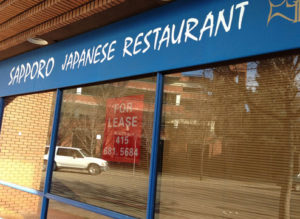
Gone too, as of January 1, 2013 are California Thai and Sapporo Japanese Restaurant at the Brickyard Center.
Healdsburg chefs Ari Rosen (Campo Fina, Scopa), Dustin Valette (Dry Creek Kitchen), Jeff Mall (ZIN) and Mark Stark (Willi’s Seafood, Bravas) will host intimate Chef’s Table dinners at Relish Culinary Center January 14-Feb. 4, 2013.
Rosen will feature his “perfect polenta” and handmade papardelle pasta on Jan 14 at 6p.m., $98, (14 Matheson St., Healdsburg) followed by Valette (vanilla brown butter pot de creme) on Jan. 21, Mall (Jan. 28, featuring Zin-braised Liberty duck) and Stark (Feb. 4, Maine Lobster rolls).
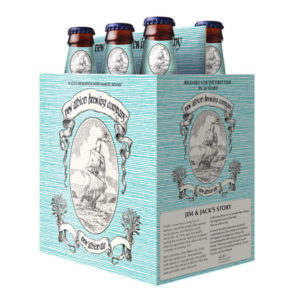
But hold onto your pint glasses because there’s more. On tap will be a revival of the original New Albion Ale, recognized by beer experts as the “original American craft beer”. McAuliffe and Koch resurrected the brew with New Albion yeast preserved at the University of California since 1977 using the original recipe. Russian River Brew Pub will be serving the brew “that evening and hopefully for a few days after,” according to their Facebook page.
The Boston Beer Company will release the ale commercially this month, the first time its been available in more than 30 years.
McAuliffe, locals may remember, founded New Albion Brewing Company in Sonoma in 1976. Although it closed in 1983, McAuliffe is considered by many to be the inspiration for the American microbrewery movement.
All profits from the beer will go directly to Jack McAuliffe. The beer will be served at special events during the 2012 Great American Beer Festival (October 13), in Denver, CO and available nationwide beginning in January of 2013. New Albion Ale will be available in six-packs with a suggested retail price of $7.99.
Have you always wanted to learn how to make naturally fermented sauerkraut?Since antiquity fermented foods have been a part of the human diet in cultures all around the world, yet the techniques of home fermentation have been lost to most of us. Fermentation is an extremely useful tool both to preserve food and activate its nutritional potential. Raw, live, fermented foods such as sauerkraut have increased vitamin levels, the power to aid digestion, and even antibiotic and anti carcinogenic properties. Join Trish Carty, professional Chef, Nutritional Therapy Practitioner, and Certified Healing Foods specialist in this introductory two-hour class that will include a tasting of a variety of fermented foods, a demonstration in preparing fermented foods, and hands-on experience. Walk away with your first jar of sauerkraut and the skills to prepare your own fermented foods! Led by: Trish Carty, Professional Chef, Nutritional Therapy Practitioner, Certified Healing Foods Specialist, Certified GAPS Practitioner. $49 per person
An educational and interactive culinary experience Everyone likes options. But a stroll down the dairy aisle of your local grocery store can these days leave you feeling dizzy. Whole milk or 2%? Pasteurized or unpasteurized? And what about ultra-pasteurized? Is that different from homogenized? Can I still get raw milk? From a Jersey cow or a Holstein? Does it matter? Or maybe from a goat? And then there’s the matter of organic versus… While we should celebrate the growing diversity of our food, it requires us to use our brains in addition to our stomachs. But no matter how many books you read or experts you consult, let’s not forget to trust our own tongues. Join us at the GrowKitchen for an afternoon of mindful tasting, interactive education and a conversation about how and why all these gastronomic choices came to be. Stop by the Grow Kitchen during our afternoon of mindful tasting, interactive education and conversations with chefs and farmers from the area about how and why all these gastronomic choices came to be.
Some of the tastes we’ll explore:
Grass-fed beef / Grain-finished beef
Biscuits made with butter / Biscuits made with lard
Tuesday, Jan 8, 2013, 7:00p to 8:45p
at Rialto Cinemas, Sebastopol, CA
Soul Food Junkies film | see trailer
Soul food is a quintessential American cuisine, with a rich history and an abiding significance to black cultural identity. But with its core celebration of all things fried and smothered, it has also had lasting effects on African Americans – health, both for better and for worse. Filmmaker Byron Hurt looks at the past and future of soul food – from its roots in Western Africa, to its incarnation in the American South, to its contribution to modern health crises in communities of color. Soul Food Junkies also looks at the socioeconomics of the modern American diet, and how the food industry profits from making calories cheap, but healthy options expensive and hard to find.
The film will be shown at Rialto Cinemas in Sebastopol ( 6868 Mckinley Ave.) and a discussion will follow the showing. More details. The event is FREE.
Missed the movie? PBS will air the movie January 14 at 10 PM.
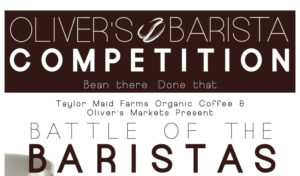
After three months of training thirty baristas from Oliver’s Market, Taylor Maid Farms will crown a barista champion on January 17, 2013 during the Battle of the Baristas Final Showdown from 6-8pm.
The winning barista will choose between two coveted prizes: a trip to a Guatemalan coffee farm with Taylor Maid Farms or a high-end espresso machine.
A panel of technical and sensory judges will evaluate contestants on a range of areas including knowledge of coffee harvesting and processing techniques; taste, volume and texture of espresso; and presentation of drinks including latte art.
Each Oliver’s Market will host a semi-final competition featuring their best baristas, sending one winner onto the Final Throwdown. All events are open to the public with the following schedule:
Oliver’s Market, Stonypoint Semi-Final: January 7th, 2-3pm Oliver’s Market, Montecito Semi-Final: January 8th, 1-2pm Oliver’s Market, Cotati Semi-Final January 9th, 2-3pm. Final Throwdown: Taylor Maid Farms Organic Coffee, January 17th, 6-8pm
The competition reflects a growing global awareness of the professionalism and technical skill-set required to make specialty coffee, a movement chronicled in the New York Times’ December 31, 2012 article: “Learning to Create the Perfect Cup of Coffee.”
The professional barista movement will also be on display at Barista Nation in San Francisco on January 19th, a forum for professional baristas to gather, share best practices, and take their artisanal coffee skills to the next level.
The trip to Guatemala will take place in early February with the goal of building closer relationships with coffee farmers and learning more about farm-level coffee processing.
California Cottage Food industry law goes into effect
UPDATE: The Petaluma Seed Bank is offering a class on starting your own cottage food biz on Jan. 10, 2013. This special free talk will be presented by Frederick Smith, COO/CFO of Forage Kitchen, SBDC Consultant, and active member of Slow Money Northern California. Frederick’s talk will specifically address the implications of the Homemade Food Act for Sonoma County citizens. The event will be held Thursday, January 10, at 7 p.m. (199 Petaluma Blvd. North in downtown Petaluma) and will be focused on the California Homemade Food Act (“cottage food law”), which makes it easier for people to make food products in their homes and sell them to the public.
Sonoma County has rolled out the welcome mat for a new breed of small business: The cottage food industry.
Though home-based bakers, candy-makers, picklers and condiment producers have long-operated the margins of legality, the recently enacted California Cottage Food Law now allows for legal public food production in residential kitchens.
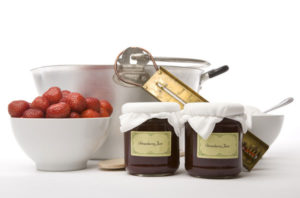
But that doesn’t mean just anyone can set up a bake sale in their front yard. The list of foods given the thumbs-up by the California Department of Public Health for sale is restricted to those deemed “non-potentially hazardous”. That includes baked goods without cream, custard or meat fillings (cookies, tortillas, churros, pastries, bread); candy, dried fruit and pasta; dry baking mixes, granolas and cereals; fruit pies, empanadas and tamales; honey, jams, jellies and fruit butters; nut mixes and popcorn; vinegar and mustards; roasted coffee or dried tea; waffle cones or pizelles. According to the California Cottage Food Law, any food outside of that list currently requires the use of a commercial kitchen or additional county approval.
The recent Cottage Food Law does require permitting from the county, with an annual fee of up to $347 in addition to local zoning approval, and passing a state-sanctioned food handling course. Also, the food must be labeled according to federal requirements and cottage food operations cannot exceed $35,000 in sales in 2013.
Despite the hurdles, for many start-up food businesses the law is a much-needed economic incentive that allows them to ramp up production to farm markets, small retailers and online sales without having to rent a commercial kitchen — which can cost upwards of $25 per hour to use. A number of counties including Sonoma and Los Angeles have embraced the law, which went into effect Jan. 1, 2013. However, San Francisco and Alameda counties, which have a thriving cottage food industry are still not up and running. Throughout the country, more than 30 states have already enacted cottage food business laws.
For more details on Sonoma County’s Department of Health Services Cottage Food permitting process, to to sonoma-county.org.



 The 10-week pop-up restaurant at Omelette Express (112 Fourth St., Santa Rosa) run by local butcheress, Berry Salinas, is adding Friday night festivities with a $15 prix fixe dinner (recent meals included pork belly with creamy grits, hand pies with Meyer Lemon Cheesecake), wine and beer by the glass and rockin’ tunes from the North Bay Hootenany.