
The Costco Report: Eating My (Cheesy) Words

I received some criticism for yesterday’s post – some silly (“Why do you even shop at Costco?”), and some quite fair (“Maybe it’s uneconomic for smaller local dairies to supply Costco.”). I like to think that I can take it as well as I can dish it out and, while I sometimes like to play rough, I also like to play fair, so here’s my mea culpa de fromage: While I may decry my inability to source local cheeses from the Santa Rosa Costco, and while I may now have to drive further and pay more to procure some of my favorite products as a result, that is not necessarily any fault of the Big C.
Case-in-point: I just got off the phone with Linda, the delightful and very helpful national account manager over at Fiscalini Cheese, the producer of what I believe to be one of America’s finest cheddars as well as an exceptional smoked mozzarella (try it on pizza with spicy sausage and caramelized onions – outrageous), who took time out of her morning to set me straight on a few things:

  • Fiscalini often chooses, of their own accord, to restrict distribution to Costco due to capacity constraints and Fiscalini’s need to maintain a diversified distribution base.
  • Costco has always respected Fiscalini’s position and, when supply contracts have been negotiated, the economics have been fair and reasonable.

I also got to speak with Ken, the CEO of Redwood Hill (home to one of my favorite goat’s milk cheddars, which happens to be downright revelatory in my Custard Style Mac-N-Cheese, as well as a fantastic Camembert-style cheese called Camellia), who explained that their situation is a little different:

  • Their foray into the Costco cheese aisle was only ever intended to be a “pilot” program (Costco apparently does quite a bit of this “rotation”, by design). Ken also emphasized that the program was a great success in terms of sales, that Redwood Hill had the capacity to keep delivering, but when the program ended (after 3 months), that was simply that.
  • He also told me that he found the negotiation of the original deal to be fair and that he hoped to be on-board for another program in 2011, and at which point I’ll be stocking up on that ethereal goat’s milk cheddar.

Finally – if for no other reason than because I’d prefer not to be printing retractions all day long – I also rang the lovely Leah at Point Reyes Cheese (producer of what, with its salty tang and pitch-perfect balance between crumbly and creamy, has become my go-to bleu for salads and dressings) who again had a slightly different experience:

  • Point Reyes maintains a supply contract with Costco, has the capacity (and desire) to deliver whatever Costco orders, but remains at the mercy of Costco purchasing, and Costco purchasing has historically viewed the Point Reyes produce as a “seasonal specialty item” for the holidays.

I remain in mourning for their absence (yes, I know where I can buy all those cheeses, but I like to buy good local products and I like to be efficient about it), and I sincerely wish that Costco would procure a bit more from my local faves, but I still have to credit them for doing it at all, and I certainly have to admit that my implicit characterization of the big, bad retailer abandoning the small, downtrodden supplier simply wasn’t fair. There, I said it.

Sift wins Cupcake Wars!

Winning cupcakes from the Food Network

Their cupcakes runneth over:  Sift Cupcake and Dessert Bar took home the big win last night on the Food Network’s Cupcake Wars with owner Andrea Ballus’ (recipe) Raspberry Cupcake with Champagne Butter Cream Frosting. Ballus competed against three other bakers for the win and takes home a $10,000 grand prize.

Ballus, who has three cupcake and dessert bakeries in Sonoma and Napa (downtown Napa, Cotati and Santa Rosa), focused on a Wine Country theme for her winning cupcakes which included the popular pink champagne cupcake, a ginger and gingerbread cupcake with zinfandel frosting and a version of their Samoa cupcake with a caramel center.

She plans to use the winnings to get her first mobile cupcake unit on the streets.

From Judge Candace Nelson, founder of Sprinkle’s Cupcakes: “Andrea’s (cupcakes) screamed outdoor wedding and rustic Wine Country elegance. Florian, Mindy and I had to deliberate for longer than normal, but in the end, the lush colors and personalized cupcakes as well as her consistent theme throughout the day meant Andrea was the winner!

Sift's Andrea Ballus

The Sift crew celebrated with a party and big screen viewing at Toad in the Hole and plenty of buttercream treats. See the photos of the event on ShopSoCo.com. Their Facebook page is bursting with congratulations.

Ballus’ bakery recently changed its cupcake focus to a dessert bar, adding whoopee pies, profiteroles, ice cream sandwiches, cupcake truffles and frosting shots to their menu.

Says Ballus: “From the moment we first saw Cupcake Wars we knew that the Sift team had what it takes to frost our way to the top. Baking has always been a passion of mine and now it is so much more. During the show, the competition was intense, but in the end our creativity, dedication, and talent paid off. We couldn’t have done this without the support from our team, family, and, the best fans ever: I would like to thank them all.  Turns out victory is indeed sweet.”

Share your congratulations!

Shabu Shabu at Hana

Shabu Shabu at Hana Sushi

Sushi fondue? Well, sort of.

Shabu-shabu, which is as fun to say as it is to eat, is a Japanese hot pot.  Like Chinese or Korean versions, it’s little more than a bowl of broth brought to the table roiling, bubbling and generally threatening to instantaneously melt anything that gets within a foot of it.

With a sputtering flame beneath to maintain a constant level of molten-ness, the pot becomes a DIY meat cooker with a personal thermostat. Thin slices of meat (usually beef) are given a brief swish through the liquid — the sound of that swish lending itself to the dish’s name — then dunked in sauce for a few seconds or more and eaten tongue-searingly hot.

Like fondue, shabu-shabu is best celebrated as a communal event with one, two or a crowd — everyone taking turns at the pot, then fishing out the bits and pieces left behind. The more gets left behind, the better the flavor of the broth, though no one really eats the broth by itself.

Almost unheard of in the North Bay, Hana Japanese (101 Golf Course Drive, Rohnert Park, 586-0270) recently introduced a seafood version to their ososume dinner menu (though you can sometimes get it at lunch). The dish arrives sputtering with a blue flame beneath and several slices of raw whitefish, hamachi and scallops that  meet their fate in the sake-infused broth. Sesame and soy-ponzu sauces, along with a nip of chili, lemon or green onion are set out to garnish each bite.

My impatient version is more warmed sashimi than bouillabaise — because it seems almost tragic to cook a piece of fish this perfect. But that’s exactly the fun of this multicultural dish usually found in touristy spots around Tokyo — a dish steeped, but not especially in Japanese culture.

Eventually the flame flickers out, the broth goes tepid and the last bites of fish, tofu and mushrooms are plucked from the bowl. Swish, swish. It’s the last chance to knock that piece off your partners fork and demand a kiss, according to fondue tradition. Or, well, at least another round of sake.

Do you shabu shabu?

A Rainy-Day Braise: Ancho Chilis, Zinfandel, and Beets

Goat shanks braised with Zinfandel, Ancho Chilis, and BeetsI think this is a killer one-pot dish for a dank, inclement night although, in point of fact, I’m cheating, because neither beets, nor my protein of choice – young goat shanks, from the Owen Family Farm up in Hopland – are technically in season right now. But the mild heat and smoky undertone from the chilies, together with the spicy-sweet peppery jam of the wine, seemed a natural bedfellow for the  dense, rich, and slightly gamy flavors of the goat (I find it similar to mild, young lamb), and patiently stewed comfort foods always have a seat at the proximal winter table (e.g., check out the Gospel of Braising posted here).
You’d be right to question the beets: Typically a late-summer/early-fall crop and not, insofar as I can tell, a classic pairing for goat shanks. (Then again, I thumbed through at least a dozen classic cookbooks without securing a single recipe for goat, so maybe beets would be a classic match, if only more people bothered to eat goat?) But our local natural foods store had several kinds of fresh, organic beetroots in stock (the classic Bull’s Blood, Golden, and – although they claimed Chioggia – what looked to be Candy Cane to me), with smooth skin, skinny little rat’s tails, and excitable, bright green leafy afros, all of which signify a good beet, and got me thinking: With their mysterious amalgamation of sweetness and earth, beets have always made for an irreproachable date with goat’s milk cheeses, and the uniquely goat-y flavor of goat’s milk very much reflects the flavor profile of its parents, so why not put beets and goat in a single pot? In my experience, “why not” precedes unmitigated disaster at least as often as it does revelatory success, but, like a partially broken clock awaiting the sweep of its working hand, sometimes things just line up right.
As far as the rest of it goes, it’s all pretty basic, and based on the same essential techniques I always use when braising (e.g., the post above, or here); the only curve ball, aside from the beets, is the ancho chili, which I love to use for the mild heat, rich color, and sweet-smoky undertones which they add when stewed. Unless you count the goat itself, which you probably should, and which I highly recommend if you have a goat rancher in the ‘hood, but I think this dish would be just as successful – different, and perhaps less interesting, but successful – with beef or lamb. Recipe and technique to follow in tomorrow’s post.

Favorite Churros and Hot Chocolate?

The Costco Report: Who Moved My Cheese?

The Costco Report: Episodic observations on where to port safely, and what to avoid like a pestilence, when navigating an ocean of consumer non-durables under a sheet metal sky… In today’s edition, a big finger wag at the Big C for abandoning some of our local dairies, and Taquitos From Hell.

First up, and most importantly, cheese: As recently as late summer, Costco – to their credit – carried several exceptional cheeses from no less than four local* dairies: Pt Reyes (home of my favorite bleu for salads), Fiscalini (outstanding cheddar and one of the better versions of smoked mozzarella), Redwood Hill (a goat’s milk cheddar that makes a spectacular in mac-n-cheese), and Laura Chenel (the archetypal Sonoma County chevre). Come Autumn, this had been reduced to the Pt Reyes and the Laura Chenel, and by the end of October, I was faced with the null set.

So I asked the custy service dude what was up. It has to be said, Costco consistently offers good customer service, and this was no exception: He looked up every cheese I asked about, checked stock and order books, and explained that their collective absence was just a seasonal thing (true, lots of good imported cheeses were out of stock as well), that they knew their buyer demographic here in SoCo (which I took to be code for: “Corporate knows you all consume wine and cheese like whales at a baleen buffet”), and that they would assuredly bring back all the good stuff come the holidays. Well, I’ve seen the Pt Reyes and Laura Chenel resurface only episodically, I’ve noticed the welcome addition of Belwhether Farms (home to what is, in my estimation, the finest creme fraiche outside the French countryside),  and I’ve never heard from Fiscalini or Redwood Hill again, which is why I’m calling Costco out on this one: Why, in Sonoma County of all places, would you abandon some of your best local dairies? It’s not like we don’t produce a lot of milk and, last time I checked, management agrees that the natives are hardly restrained in their proclivity to consume massive quantities of local cheese and wine, so why? Bad dog, Big C.

Next, just because I’m feeling kind of grumpy about the whole cheese thing, an honorable mention for Worst Nibble on Planet Earth goes out to the free sample of horrid, boxed, fried, reheated tube of congealed grease, encasing some fetid, stringy mystery meat, and called a “taquito”. Whether Mexicans eat a tasty version of this dish, or whether the diminutive of taco is, in historical fact, a genetically engineered atrocity escaped from a high security sub-floor of the Taco Bell research labs, I cannot say. But I can tell you this: There was nothing “free” about that free sample. It left my mouth at Top Gun seat-ejection velocity, and I had to drink some cloyingly sweet sample of a vaguely “chai”-like liquid just to dilute the acrid taste on my tongue. But, really, this one’s on me: What WAS I thinking?!

*Yes, I know, Fiscalini and Pt Reyes technically come from area codes other than my beloved 707. But they’re at least in neighboring counties (well, Marin at least is a neighboring county; I don’t really know where Modesto is, but I think I could ride my bike there, if I really put my mind to it, which is as good a working definition of “local” as any).

Munch Monday | Santa Rosa

Dim sum / Photo John Burgess, PD

When the line for Dim Sum Charlie’s snaked to 45 people, there was no question that Santa Rosa’s first food truck Monday was officially a success.

The first of eight scheduled Munch Mondays taking place downtown between January 10 and February 28, 2011, organizers watched as eager eaters arrived, cash in hand, to snap up dim sum, tacos, agedashi, carne asada French fries, grass-fed burgers, whoopee pies and hot dogs.  No tables or chairs. — just paper (or in one case bamboo) plates, the adept balancing of forks, napkins and soda cans, and the great outdoors as the backdrop.

Over the hum of whirring generators and gently chattering teeth, groups two or three merged into growing queues, rubbing hands together and peering over shoulders to see chalk-written menus in this impromptu public dining room between the post office and public library. The general discourse: Wow, this is awesome. What are you ordering?

Hundreds in line | Photo John Burgess, PD

Officially sanctioned by the city, it’s something of an experiment in dining. Throughout the country, but most notably in cities like San Francisco, Portland, Los Angeles and New York, a new breed mobile eateries are popping up by the hundreds. Unlike old school “roach coaches” as they were often referred to, these converted kitchens are licensed, bonded and health department certified, sometimes featuring highly trained chefs and gourmet foods from cupcakes to dim sum.

In Wine Country, the scene is still emerging, but in downtown Santa Rosa, vendors have been planning a group round-up of diverse offerings since last fall. In this week’s inaugural lineup: Street-eatz Mobile Kitchen, La Texanita Truck (from La Texanita Restaurant), Chicago Style Hot Dogs, Fork Catering and Napa’s Dim Sum Charlie’s. Conspicuously missing was Karma Bistro. The truck was hit by another driver on Saturday while returning home from another food truck event in Napa.

Interest at Monday’s event pleasantly surprise the vendors, who had hoped for a welcome reception, but ended up selling out of popular dishes within an hour or less as lines continued to grow. Procrastinators were met with an ever-dwindling selection, and snapping up the last whoopee pie (which I did) was cause for near riot. Many eaters took a smorgasbord approach, gathering something from several of the vendors and sharing bites with friends.

What’s heartening is that, for the most part, brick and mortar restaurants in nearby downtown Santa Rosa seem to be on board. The mobile vendors have worked with downtown organizers and restaurants to help allay fears of unfair competition. And although not everyone is thrilled to see the trucks, the city is presenting the seeming dichotomy with an advertising campaign called “Sit Down” and “Stand Up” — recommending a trip to the trucks for folks in a hurry and more traditional sit-down eateries for executive luncheons and meetings.

The only fly in the ointment: Several diners noticed parking enforcement officers ticketing cars around the parking lot targeting cars parked in the lot and on side streets in the area. Not a great foot forward for a city clamoring for more downtown engagement.

But there’s more to come as Santa Rosans embrace stand-up al fresco dining and the food truck culture — even in the dead of winter. And frankly, my fork is ready and waiting.

Woodruff’s Artisan Foods & Cafe | Sebastopol

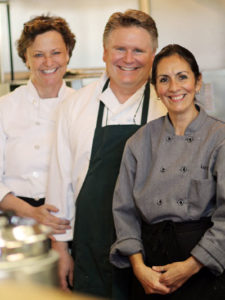
Marcella, David and Luz in the kitchen at Woodruff’s
Marcella, David and Luz in the kitchen at Woodruff's
Marcella, David and Luz in the kitchen at Woodruff’s

CLOSED

Market eateries are a hot trend for 2011, and Woodruff’s Artisan Foods & Cafe in Sebastopol is the second to open in recent in recent months (the first being Fresh by Lisa Hemenway in Santa Rosa). Part restaurant, part take-out, part gourmet food market and wine shop they’re hybrid culinary one-stops inspired by European food halls.

Housed in a former bowling alley, owner David Woodruff is an SRJC culinary grad embarking on his second career after 25 years in the automotive industry. Lending serious culinary cred is Luz Quiroz, a native of Colombia who was the private chef of both the Swarovski (as in crystal) family and Rush Limbaugh.

With a mix of grab and go sandwiches, cheeses, gourmet groceries and sit-down dining, the crew is hoping to keep you coming back. The seasonal, local menu changes up frequently, and Quiroz’s Latin flair — including fresh arepas, (toasted corn cakes) and homemade chimichurri —  keeps things interesting.

Steak au poivre
Steak au poivre

At opening, the crew are serving up impressive breakfast, weekend brunches and lunches inside the cafe (named after Woodruff’s fiance, Marcella, who also helps in the kitchen) with plans to launch dinner within a year. Homemade breads and pastries are baked daily in house, and menu items include dishes like French Toast Souffle, fresh blueberry scones, ragu Bolognese, steak au poivre, savory bread pudding with applewood smoked bacon and Point Reyes blue cheese, homemade soups and lighter salads.

Breakfast entrees range from $4.25 to $9 and lunch is $6.95 to about $12.

Adding to the mix is David’s special passion for handcrafted beers, which he’s included in the grocery section, along with local artisan foods, cheeses and wines. All menu items can be taken to-go.

It’s a welcome addition to the neighborhood.

Woodruff’s Artisan Foods and Cafe Marcella, 966 Gravenstein Hwy S., Sebastopol, (707) 829-2141. Open Tuesday through Saturday, 7:30 am to 6pm, Sunday from 10am to 4pm. Menus and daily specials online at Woodruff’s Facebook page.

Safeway Avocado Update

About a month ago, I bitched about out-of-season avocados, specifically the dark green monuments of Giza on display at my local Safeway, on sale at a seemingly unbeatable price of a buck per. For whatever reason – I, of course, speculate in that earlier post, but can’t say definitively – they were appalling: Watery, mealy, flavorless, an ultimately disgusting pale green mush and affront to guacamole everywhere. Well, today (in point of historical fact, two nights ago) I got to eat my words: Said avocados are now $1.25, but – and this is the important thing – they actually taste pretty damn good. No, not the dense, creamy confection of the mid-summer California version, but still and all, a far cry better than most of my local taquerias have been serving up, and a worthy bridge-loan from last season to next for those of us, myself included, in the throes of mid-winter guacamole withdrawal.

Because, even as I kvetch unrelenting about stuff I don’t like, I try to be fair – harsh, perhaps, but fair, regardless – here is my official Tip of the Hat to the produce buyers over at Safeway: We weren’t even on speaking terms when I wrote that other column, but you just saved my wife’s burrito from its tragically banal meatless destiny, and got my freshly fried tortilla chips their sorely needed fix.

In-N-Out’s “Animal Style” Onions, Home Edition

Caramelized Onions, In-N-Out "Animal Style"At some point, I’ll get around to writing a longer treatise on the wonders –  consisting, in roughly equal proportion, of cardiac perfidy and gustatory revelation – of In-N-Out’s “Animal Style” offerings. But not today. Today – and, if you saw my recent column on Savory Onion Jam, I guess you’d say all week – I have eyes only for condiments, and few condiments inspire like In-N-Out’s insanely caramelized onions.
But to relegate Animal status to that of the generically caramelized onion would be to call a dinosaur a lizard or your spouse a good friend, because Animal Style onions are to your garden-variety caramelized onion what the Autobahn is to a carpool lane: Made from the same stuff, designed for the same purpose, but pushed to the very logical extreme of its functional existence. Animal Style onions aren’t just caramelized, they’re stewed into oblivion, until they are no longer even recognizable as onions per se, but rather as some freakish fantasy version of French onion soup that could suspend a spoon vertically by virtue of its sheer density. (Mandatory hat-tip to Kenji over at The Burger Lab, who first got me thinking about blurring the line between onions and soup in this post.)
I actually have no insight, literally none whatsoever, into how In-N-Out makes theirs, and to be perfectly In-N-Out "Animal Style" Cheeseburgerhonest, I’m not sure I should care; what matters is that I’ve constructed an exceptional reproduction – dare I say, a better version than the mold form whence it was borne – in my own kitchen, and out of really good, local ingredients. The stuff would probably keep for months in the fridge, but I go through it far too quickly for that: Slathered on cheeseburgers (see picture inset), as a condiment for a juicy steak, in omelets… Really, this stuff just rocks, and I’d put it virtually anywhere that a sweet, onion-y flavor is welcome without thinking too hard about it.
Caramelized Onion Jam, “Animal Style”

  1. Finely chop 2-3lbs of sweet onions (I’ve been using local Cipollini’s since late summer from Love Farms, Bernier Farms, and Foggy River Farms, and they are exceptional, but they seem to be out of season now; a decent Walla Walla, Maui, or Vidalia will work just fine, and – given the abuse they’re going to get – the generic yellow supermarket “Spanish” onion would probably be almost indistinguishable.)
  2. Slowly caramelize the onions in peanut or canola oil in a large pan over medium-low heat, along with a healthy sprinkling of sugar and salt. As they start to dry out, deglaze with a half cup or so of good-quality balsamic vinegar, and let them cook all the way out again. Go on like this for up to an hour, until the onions start to darken and are very fragrant and soft all the way through.
  3. Cover the onions in stock (I used chicken, but you could make it even richer with dark beef or veal stock; or you could use veggie stock and have an acceptable and vegetarian-friendly version – why you’d do such a thing, well, that’s for you to decide) and slowly braise them for another 1-2 hours, until all the liquid has been cooked away and you’re left with a very thick stew.