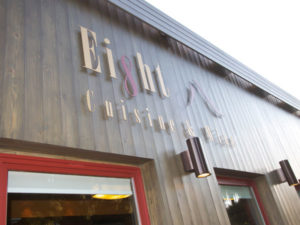
Get out your chopsticks because not one, not two, but three new Asian eateries have opened in the last month. In Sebastopol, Eight Cuisine and Wine (7501 Healdsburg Ave., Sebastopol, 823-8189), it’s a geographically-inspired menu spanning the eight culinary regions of China — from spicy Szechuan and Hunan styles to Cantonese dim sum and lesser-known Northern Chinese culinary traditions.
[sh-slideshow-post id=”25628″]
It’s a, well, Chinese menu of dishes, ranging from cream cheese wontons and minced chicken lettuce cups to sizzling rice soup, steamed dumplings, sweet sour pork and wok classics like Mongolian beef, mu shu, walnut prawns (natch) and Kung Pao chicken. Not enough to choose from? A number of dishes take a quick trip South to street-food inspired flavors of Vietnam, Malaysia and Singapore with crowd-pleasers like fresh spring rolls, fried prawns, pad thai and spicy laska soup. Expect an upscale, but affordable experience in the new, eco-friendly space owned by the Sushi Tozai folks. http://www.eightcuisineandwine.com/
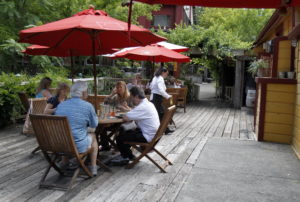
Nearby, Formosa Bistro (799 Gravenstein Hwy. South, Sebastopol, 823-6688) has replaced Tosaki Sushi, offering a massive menu of sushi, along with teriyaki, spring rolls, sweet sour pork and curry beef and dozens of other Asian entrees. One has to wonder how one kitchen can do it all. Lunch specials from 11:30a.m. to 3p.m. weekdays. In Santa Rosa, O Sushi! has opened in the heart of Roseland (433 Dutton Ave., Suite 2, 544-1799) in a revolving space that’s seen its share of culinary concepts come and go (Laotian, Indian, Ice Cream). It’s solid “strip mall” sushi, what most folks refer to as “utility sushi” for when the craving can’t be denied, but your wallet’s a bit thin.
SRJC’s Shone Farm celebrates its 40th anniversary with a Fall Festival on Saturday, Oct. 6 from 10am to 3pm. The 365-acre farm will feature U-pick pumpkins and vegetables, heirloom tomato tasting, wood milling demonstration, wine tasting, apple pressing, hayrides, the wheel of agriculture, and scarecrow building. Students will be leading frequent tours of Shone Farm, including its forest, during the event.
There will also be a farm stand with “Shone Grown” products for sale, including fruit and vegetables, and the farm’s award-winning wine and olive oil. The college’s Agriculture Ambassadors will be preparing a lunch made entirely with “Shone Grown” ingredients, including beef for hamburgers, with lettuce and tomatoes and potato salad cultivated and harvested by students.
The event is free to the public. 7450 Steve Olson Lane near Forestville, approximately 12 miles from the Santa Rosa Campus. More details at shonefarm.com.
The spacious Glen Ellen restaurant that was once a grist mill has seen its share of owners come and go. And come and go. After a false start last summer under new owner Narayan Somname of nearby Yeti, the restaurant has hired former Starlight Wine Bar Thaddeus Palmese and a former Cyrus vet, Will Inadomi, to head up the kitchen. Palmese is well known around Sonoma County for his take on Creole cuisine, and says he’s got a smoker at the restaurant “the size of a Suburu.”
The new menu, which debuted just a few weeks ago, will include some favorites from Starlight (gumbo, beet salad with goat cheese croquets and his famous burger), but will add a host of new dishes including buttermilk brined fried chicken, Gypsy Girl sausage with dirty rice, homemade buttermilk biscuits, grits and baked mac and cheese.
Oh, and Palmese says leaving Starlight (which is owned by family members) was purely amicable, and a way for him to stretch his wings with a new project.
Hours are 11:30a.m. to 2:30p.m. for lunch, 5-9p.m. for dinner. The restaurant is closed on Tuesday and will feature Monday Night Football specials. 1403 Arnold Drive, Ste19, Glen Ellen, 933-3005.
Friday, Saturday and Sunday, October 5,6 and 7, 4p.m. to 9:30p.m.
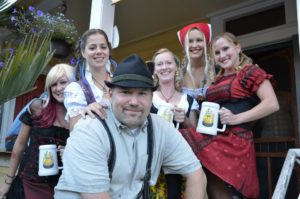
Barley and Hops Tavern’s biggest event of the year is finally here. Can you wear my lederhosen and/or dirndl? The answer is a resounding YES!
They’ll be serving up liters of their very own Pimpsnhosenfest Marzen Lager 2! This is the second collaboration between Tavernkeep Noah, and Brewmaster Tim from Ruth McGowan’s Brewpub in Cloverdale – and it will go FAST.
For Oktoberfest, they’ll switch to a 100% from-scratch authentic Bavarian menu – no burgers, no fries – this is the genuine article down tohouse-made brats and weisswurst (NO VEAL!), Koningsburger Klops, Schnitzel (PIG) and Spaetzle. Music line-up includes Elephant, Earstu, and more!
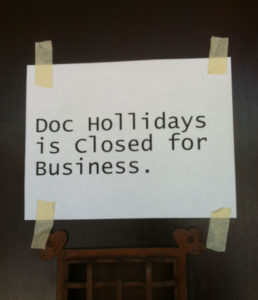
Without warning, Doc Hollidays (which replaced Rita’s) has closed. Okay, almost.
The karaoke/bar/restaurant/club will host a Farewell Party on Oct. 6, 2012 with free appetizers and half-off booze (while supplies last) starting at 7p.m. The band Cruella, an all-female Motley Crue tribute band, will play at 9 p.m.
Tickets are $5 general admission, $10 reserved seating.
The Sonoma County Single Malt Society will present a special tasting of aged whiskeys from Anthony Wills of Kilchoman, Louisa Young of Isle of Arran and Ed Kohl presenting Chieftains independent bottlings. Saturday, Oct. 6, 7pm., Courtyard by Marriot, 175 Railroad St., Santa Rosa. $35 for Society Members, $50 for non-members.
To celebrate the launch of their new espresso, Sweetwater, Taylor Maid Farms will offer free espresso and cappucino from 11am to 2pm on Oct. 5, 2012 at all three Oliver’s market locations (Stony Point Road, Monticeto Center and Cotati). The new espresso uses a post-roast blending method and contains Arabica beans from Honduras, Guatemala and Brazil. taylormaidfarms.com.
Local chef and food tinkerer, Chris Hanson channels his inner Alton Brown to explain how to break down flavors into their most basic elements. We’ll make balsamic vinegar “caviar”, 63 degree eggs, lemon “powder”, instant infused apple cider and show you how to build your own sous vide using safe, organic ingredients. Includes a discussion about molecular gastronomy techniques and some fun tastings. $20 or whatever you can pay. Wednesday, Oct., 3, 6:30p.m., Square Belly Food Theater (a monthly pay-what-you-can food experience for the eating-obsessed) at the Arlene Francis Center, 99 Sixth St., Santa Rosa. biteclubeats.com/squarebelly.
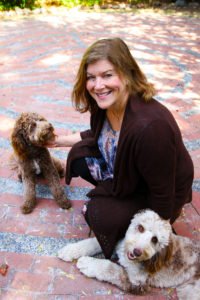
Standing at the entrance to the 22-foot labyrinth in Lea Goode-Harris’ backyard, all she’ll say is that there is no right way to enter.
There is also no wrong way, apparently. But somehow knowing there are no rules adds even more weight to the first step; increases the pressure to perform some quiet ritual, maybe a dance of some sort. I look toward her, watching me with anticipation.
“I’m not going to say anything until you’ve experienced it,” says the world-renowned labyrinth designer who makes her home in Santa Rosa’s JC neighborhood. “Your first walk is really precious, because you don’t know what to expect,” says Goode-Harris, who has created at least 100 meditative pathways that include the Snoopy Labyrinth at the Charles Schulz Museum, The Sebastopol Labyrinth of Life, two labyrinths at the Center for Spiritual Living along with many private and temporary labyrinths throughout the county.
But her most well-known labyrinth is the Santa Rosa Labyrinth, a unique labyrinth design which she created by accident in 1997. Inspired by walks at the Angela Center (a Santa Rosa retreat) and at San Francisco’s Grace Cathedral, Goode-Harris, who was an art therapist working toward her doctorate in psychology, began sketching mandalas (sacred circles with clear geometric designs) for inspiration. Those turned into compass-drawn concentric circles, and Goode-Harris says one day the pattern just “sort of rose up” from the paper. Not all at once, but over several days of picking up her pad and pencil, she refined the design until it became the seven-circle labyrinth was complete. The design was verified as unique (though it shares aspects with an 11th century labyrinth), and copyrighted. Thus, the Santa Rosa Labyrinth–named for her hometown–was born. She keeps the original sketch to show visitors. “The maze became my dissertation,” says Goode-Harris, who finally earned a PhD after writing about the psychology of labyrinths.
Over the years she’s built and rebuilt the version of the Santa Rosa Labyrinth in her yard, first in grass, then in brick, and finally in very concrete. Santa Rosa Labyrinths have been built in Washington DC at the American Psychological Association, Standing Bear Native American Park in Oklahoma and worldwide.
I decide a deep breath and a purposeful step forward into the curling path of the labyrinth ahead of me. Cutting through with my toe, then my torso and finally pushing into the eight concentric circles, the space inside seems weightier. While Goode watches my progress I try to tune out the world and follow the winding bricks that first curve wide the circle back on itself like a winding mountain road. Unlike a maze there are no high walls, dead ends or false paths to trick you.
“It’s a visceral experience between conscious and unconscious,” says Goode-Harris. Labyrinths are typically low or flat to the ground, and have a single path leading to the center, the point of which is meditative and contemplative rather than merely cerebral.
No one knows exactly who drew the first labyrinth, but they seem to span most of modern history and cultures as far-flung as the North American Hopi and ancient Minoan, reach geographically from India to northern Russia. One of the most famous is the labyrinth at Chartres Cathedral in Paris, a similar version of which is inside Grace Cathedral.Want to experience a labyrinth yourself? Here’s where to find some locally…
– Snoopy Labyrinth at the Charles M. Schulz Museum, 2301 Hardies Lane, Santa Rosa.
– Center for Spiritual Living, 2075 Occidental Road Santa Rosa.
– Christ Church United Methodist Church, 1717 Yulupa Avenue Santa Rosa
– Oak Hill Park, Petaluma
– Kaiser Medical Clinic Stein Building, 3975 Old Redwood Highway, Santa Rosa
“Labyrinths are a tool to listen to ourselves. They aren’t magic, but an archetypical design that slows us down to listen to ourselves for prayer, meditation or creative thinking. It’s about what is important to you and it allows you to get in touch with that,” she said.
One of the most unique aspects of this particular pathway a small open space half-way between the opening and the center, which Goode-Harris calls the “heart space”. The quiet, empty spot is often filled with small offerings, flowers or a candle. Sometimes not.
The original drawing for The Santa Rosa Labyrinth
Reaching the center of the labyrinth, it seems appropriate to stop. Some people, says Goode, just walk across the circles and are done. Others retrace the route to the start. With the Santa Rosa Labyrinth, you can shortcut the exit by taking a wide step onto the heart space and then to the entrance.
“It still surprises me. I know the pattern so well I can just walk it with my eyes closed,” she says. Like many who use a labyrinth as a way to meditate, it seems to be the perfect distance to sort out whatever’s on your mind.
Re-walking the labyrinth, Goode-Harris starts a few seconds behind me. The parallel geometry of the paths bring us together in spots, move us to opposite sides and back together. Clearly it’s a metaphor. “Muslims, Jews, Christians can all walk it. We’re all on the same path. We just see it from a different viewpoint,” she says.
There is no right or wrong way to experience a labyrinth, Goode-Harris reminds me, as I ponder which path to follow out of the labyrinth. Carefully, thoughtfully I make my way out the same way I went in as one of Goode-Harris’ friends jumps back and forth between the lines, teasing me — the one who can’t bear to step outside the path. Finally stepping out of the maze, its clear there is no right or wrong path. Whatever the route, the journey through a labyrinth is truly the destination.
You can find out more about Lea Goode-Harris including how to make your own labyrinth at srlabyrinthfoundation.com.
Backstory: The Kefir Guys
An ancient crystal becomes a new health tonic?
Thousands of years ago, the story goes, a shepherd filled his leather water pouch with cool, crisp water from a high mountain stream in the Caucasus Mountains. In the water were grains of kefir, which naturally fermented in the water, creating a beverage rich with good bacteria — what we now call probiotics. Or, maybe it was monks in Tibet who cultivated these magical bits of fermented goodness, then presented them to Mother Teresa of Calcutta as a gift. Then again, maybe water kefir crystals were first discovered in Mexico, where their existence was first documented in 1899, occurring in the naturally sugared water of the Ountia cactus.
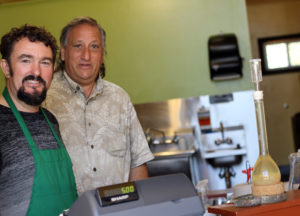
The point is, water kefir grains have been around for a long time propagated and used by cultures throughout the world, says Tom Boyd, owner of the newly-opened Kefiry in Sebastopol. The tiny shop is where Boyd and his business partners Deana Dennard and Jeffrey Edelheit both ferment and sell their naturally-fermented sodas, called Enlivened. “We are the first live-cultured soda sold in America,” says Boyd. “It’s really a living drink,” he adds.
If this is all Greek to you, you’re not alone. Because most Americans aren’t familiar with this ancient fermentation process, Boyd’s job is as much about education as it is selling his soda. That’s where a glass beaker filled with what looks like lemonade and sediment comes into play. Tiny bubbles rise through the fluid, created by the water kefir grains at the bottom — carbon dioxide being released by the hungry, sugar-eating bacteria.
“Each crystal of kefir is like Whoville,” says Boyd. There are 30 to 60 bacteria colonies inside and as many micro-organisms as all the people on earth,” he says. The kefir grains self-propagate, and can be grown and shared with others.
Like dairy kefir which has been popularized as a health tonic, water kefir is a fermented food that is thought to promote digestion and healthy flora in the digestive system. Unlike dairy kefir, water kefir grains are lactose free. But its a lot easier just to explain water kefir as naturally fermented soda that contains no alcohol and only a small amount of sugar. Flavors include Holy Basil, Dragon’s Blood (with hibiscus), Tulsi Kola (which tastes the most similar to Coke) and lemon-ginger.
Boyd and Edelheit have perfected the process over the last eight years, breaking down the entire process, from the kefir grains to a proprietary water purifying technology.
“This is really going back to our ancestors. Before the industrial revolution, most beverages were fermented,” says Boyd. In the back are buckets of the grains, which look like little florets of milky gelatin. Eaten raw, they’re a bit floral in flavor, but unremarkable. Fermented with herbs like lavender, basil or hibiscus and their own specially filtered water, they become a fizzy, more healthful alternative to sugary drinks. Boyd suggests that the combination of purified water and kefir can help with immunity and provide anti-oxidants in addition to healthy bacteria for the body.
Whether or not probiotics like water kefir are a panacea is something scientists are still debating (though current literature points to a number of health benefits). But there’s not doubt that The Kefiry is fermenting loyal local following.
Want to try it: The Kefiry, 972 Gravenstein Hwy South, #120, Sebastopol. You can try their water kefir on tap at the Arlene Francis Center’s new cafe at 99 Sixth St., Santa Rosa.