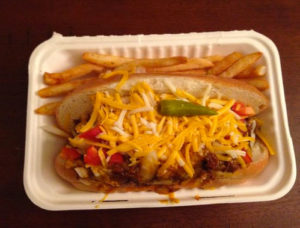
Sebastian T. captured the essence, I think, in this photo posted to Yelp. So, I stole it.
Sebastian T. captured the essence, I think, in this photo posted to Yelp. So, I stole it.
Midwestern weenies have arrived in Guerneville! And this corn-fed flatlander couldn’t be more excited to take a bite.
3 Alarm Grill, which opened on Dec. 5, 2014 is serving up wet and messy Italian beef on a bun, hand cut fries and of course, a Classic Chicago dog made with Vienna sausage (natch) mustard, onions, neon green relish, tomato and pickles so authentic, you’ll think you’re at Wrigley.
Ya can’t have a serious dog with chili, so the folks at Three Alarm Grill will beserving up their signature beef chili on top or by the bowl (no word on whether it beats Cincinnati’s Skyline). What we’re especially loving are funnel cakes for dessert, dontcha know.
For you hippy Californians, there are salads, cedar plank salmon and chicken breasts as well. Uff da!
16218 Main St., Guerneville. Open 11a.m. to 9p.m. (closed on Tuesday and Wednesday until the season picks up in April).
*Since I stole the picture (um, hint hint, I need a better photo), I feel it’s only right to link to the Yelp reviews, even though it pains me.
We’re chomping at the bit for Napa’s Atlas Social, slated for an early January opening.
Headed by Michael and Christina Gyetvan of Azzurro Pizzeria & Enoteca and Norman Rose Tavern, the kitchen will be in the hands of Nick Ritchie (named Rising Star Chef in 2009 and Chef de Cuisine at Michael Chiarello’s Bottega. Industry veteran Pat Jeffries will run the front of house.
Opening menu items will include Chef’s Crispy Fried Farm Egg with Bacon Jam; Salad of Winter Greens, Apple and Persimmon with a Grilled Sweet Onion-Macadamia Nut Dressing; a Jar of Smoked Trout Rillettes with Caraway-Rye Crostini and Onion-Crème Fraiche; and Citrus Braised Pork Belly Tacos with Avocado, Vegetable Escabeche, and Salsa Roja. Atlas Social will also feature family style platters, including a Garlic and Chili Pepper Roasted Dungeness Crab with Grilled Bread and Spicy Aioli, and an Ale Braised Boneless Beef Rib with Root Vegetable Gratin and 5-Onion Kale.
Cook Tavern in St. Helena opened in Dec. 2014, a sister restaurant to Cook St. Helena.
Cook Tavern in St. Helena opened in Dec. 2014, a sister restaurant to Cook St. Helena.
Cook Tavern in St. Helena opened this week with a seriously noshable menu that includes house made fried pickles, poutine with beef cheeks, sautéed sweetbreads with red wine veal jus, mini grilled cheese sandwiches with tomato soup and bigger plates of buttermilk fried chicken wings, a house ground burger, slow roasted pork Cubano, and steak frites among the offerings.
Potables include an old school daiquiri, barrel aged Manhattan, hot toddy, and crafty cocktails like the Cougar Juice (Grey Goose, St. Germain, peach shrub, lemon juice and wine). Why do I feel slightly offended, yet thirsty?
The tavern is the little sister restaurant of the popular Cook Restaurant 1310 Main St., St. Helena, (707) 963-7088.
New Year’s Eve in Wine Country is always a food and wine-centric affair, making the dress code more about casual comfort and fun than, well, six-inch stilettos and micro minis (though you’re welcome if that’s your bag). Here are a few of our top picks to celebrate the dawn of 2015.
Mateo’s Cocina Latina: A tribute to Drakes Bay with the last clams from the coastal farms, Drakes Bake oyster shooters, Bolinas halibut ceviche, Estero clam soup with local Dungeness crab and Fort Bragg uni (OMG, please); rabbit with pear demi-glace, goat with ancho chile demi-glace or yellow tail rock cod, persimmon upside down cake. $75 per person. 214 Healdsburg Ave., Healdsburg, (707) 433-1520.
Backyard: A Forestville fave. Chose from California oysters, mackerel crudo, roasted bone marrow, Dungeness crab stuffed sole, roasted quail, purple potato gnocchi with foraged mushrooms, chocolate budino (best in the County), tiramisu and Meyer lemon tart. Three courses, $44; four, $65 and five courses, $75pp. Reservations required. 6566 Front St., Forestville, (707) 820-8445.
Solbar: A twelve item menu includes buckwheat blini with caviar, chilled Maine lobster, Kobe beef carpaccio, grilled yellowfin tuna, petrel sole, veal tenderloin with sweetbreads and black truffle, Black Forest cake. $90 for four courses, $20 for each additional course. 755 Silverado Trail North, Calistoga, (707) 226-0800.
Village Inn & Restaurant: One of the best values for NYE is in the quaint West County village of Monte Rio. Chef William Oliver prepares a three-course prix fixe that includes mustard seed crusted smoked trout, lobster bisque, Beef Wellington, poached Maine lobster, cornish game hen with herb gnocchi and foie gras jus, black truffle gnocchi with roasted chanterelles and a champagne tart with berries. $55 per person, reservations required, (707) 865-2304.
Centre du Vin Bistro: Five courses of classic French bistro fare includes Oysters Rockefeller, roasted chestnut soup, butternut squash ravioli, Filet Mignon Oscar and chocolate orange pot de creme. 480 First St., Sonoma, (707) 996-9779. $100pp, $150 with wine pairing.
Spinster Sisters: Three course prix fixe, $65 pp, includes Dungeness crab with Meyer lemon aioli, duck liver mousse with port wine gelee and candied kumquats, tangerine brown butter scallops, grilled beef cheek, rabbit pappardelle, Moroccan vegetable tagine, steamed chocolate cake, or Meyer lemon meringue tart. We’re also loving the idea of their New Year’s Day Brunch, celebrated from 9am to 3pm. Reservations, (707) 528-7100, 401 South A St., Santa Rosa.
I’ll be adding more spots as I find them at BiteClubEats.com.
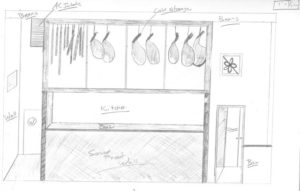
Chef Dustin Valette’s drawing for a new charcuterie box at his forthcoming restaurant.
Just off the press, Chef Dustin Valette’s new Healdsburg restaurant project officially has a name: Valette. This ain’t about ego, however. We’re wiping a tiny tear from our eyes after Dustin explained that the building (which has housed local institution Zin Restaurant & Wine Barfor years was once owned by his grandfather Honore Valette in the 1940’s.
Chef Dustin Valette’s drawing for a new charcuterie box at his forthcoming restaurant.
“We spent some serious time thinking about what to call our new little ‘baby’ and we couldn’t get away from Valette. It pays homage to our family’s history with the building,” said Valette.
So. Sweet.
Adding to the charm factor is the all-in-the-family vibe: Brother Les Garzini of Garzini Welding is making the restaurant’s charcuterie box and bro Aaron is co-owner of the forthcoming restaurant. Look for a spring opening.
Old redwood planks will be used for the furniture at Valette, opening in Healdsburg
Yes, Virginia, you can actually feed eight adults a locally-sourced, sustainable healthy holiday dinner for under $75? You just have to believe.
BiteClub and Angela Wooton of FoodiesProject.com teamed up with Chef Christopher Hanson (my partner in cooking crime) to create the ultimate holiday meals on a budget this year.
Here’s the Menu:
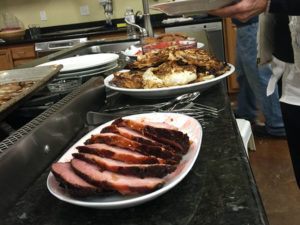
– Sonoma County Meat Company’s Hamlette (a petite smoked ham around $24)
– Creamed Kale with bacon (bacon can be eliminated for a vegetarian version)
– Glazed roasted cabbage steaks
– Mashed potatoes
– Fresh Cranberry Sauce
– Citrus Salad with Orange Blossom sauce
– Cheese straws
– Ginger spice cookies
Citrus Salad
It took less than two hours to create the dinner (okay we had a couple people, but several items could be made ahead) at G + G Market’s Ginger Grill Kitchen. Our appreciative audience gave rave reviews. We think you will too.
(Most produce was purchased at G+G Market, pantry staples like flour, sugar and spices weren’t figured in).
Sonoma County Meat Company’s Hamlette
You can download a PDF packet (DemoRecipes PDF) with most of the recipes and great tips on shopping for sustainable food when you’re pinching pennies. We ad-libbed the citrus salad (which was just a variety of oranges and grapefruit sliced into circles and dressed with orange blossom water, sugar and vanilla), and reached into the archive for Amy Meier’s Sugar and Spice Cookies cookies from the BiteClub Cookie contest.
Check out the Foodies Project, a great local Meetup group that brings people and producers together in really fun ways.
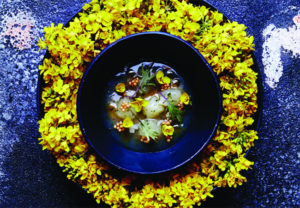
Kohlrabi mustard rye from A New Napa Cuisine, by Chef Christopher Kostow.
Photo by Peden + Monk.
Kohlrabi mustard rye from A New Napa Cuisine, by Chef Christopher Kostow. Photo by Peden + Monk.
Just when it seems like there couldn’t possibly be room for another cookbook on our shelves, a flood of irresistible new tomes lands in bookstores. This fall, local chefs and food writers are at the top of our holiday wish lists with delicious coffee-table inspirations, master classes on bread, pizza and pasta making, spicy ethnic cooking and thought-provoking literature that we’ll be cuddled up with all winter. So clear out some space in your culinary library and get ready to get cooking.
“Della Fattoria Bread: 63 Foolproof Recipes for Yeasted, Enriched & Naturally Leavened Breads” by Kathleen Weber ($29.95, Artisan): Bread-baking isn’t for the faint of heart, despite being one of the simplest foods we eat. Water, flour, yeast and time are about all that’s required of the baker, but it can take a lifetime to perfect the perfect loaf. Petaluman Kathleen Weber of the legendary Della Fattoria bakery and cafe has the art of wood-fired breads down to a science, with many top chefs throughout the Bay Area (including Thomas Keller) clamoring for her rustic Pugliese Boule and sweet baguettes, while locals snap up her homey Pullman loaves by the armful. Her cookbook includes “foolproof” recipes for 63 types of bread — from dinner rolls and sticky buns to naturally leavened rustic loaves, crackers, flatbreads and the dressy Pain d’Epi loaf (a loaf that looks like a stalk of wheat). Interspersed are spreads and accompaniments (olive tapenade, panzanella salad) and slice-of-life stories about Weber’s life and love of Sonoma County. Don’t miss the story about their visit from Martha Stewart, who helicoptered into their farm.
Tyler Florence Inside The Test Kitchen Cookbook
“Inside the Test Kitchen, 120 New Recipes Perfected” by Tyler Florence ($35, Clarkson Potter): At a recent event, Marin’s Tyler Florence pulled an advance copy of his new cookbook, a faux journal (think Moleskine) filled with recipes that seemed too simple to need, well, a recipe. But that was just the point. Crowd-sourced from his Twitter followers (#tftestkitchen) and tested by friends and family in his Mill Valley test kitchen, it’s a compendium of perfected classics like meatloaf and grilled cheese (they “stretch-tested” cheeses); they gave an update to spaghetti and meatballs, tarted up tired old pork chops and created what’s destined to be the definitive cornbread recipe using corn meal fried in bacon fat. (We didn’t say these were healthy recipes.) It’s a tasty romp through Tyler’s frenetically creative world, complete with handwritten margin notes and plenty of pictures to make sure you’re on the right track.
“New Napa Cuisine” by Christopher Kostow ($50, Ten Speed Press): Three-Michelin-starred chefs don’t write cookbooks. They create aspirational works of food art that double-dog dare you to even attempt cooking them — that is, if you could actually find acorn flour, trimoline (a sugar syrup requiring a Ph.D. to prepare) and mallow leaves at your local supermarket. Kostow, who has been called “one of the greatest chefs of our generation” by his three-starred peers, is executive chef at St. Helena’s Meadowood Resort, earned his elite status before the age of 40 and is heir-apparent to fellow Napa chef, Thomas Keller. With 100 recipes (frog ravioli, grappa marshmallow, cockscomb spelt porridge), stories of Kostow’s charmed life and his favorite local purveyors, just paging through this epic coffee-table book, filled with moody tableaux of local preserves, foraged vegetables and wild game, is reward enough. Leave the recipes to the professionals.
“The Pizza Bible” by Tony Gemignani ($29.95, Ten Speed Press): Making pizza, according to a chef who’s dedicated more than half his life to the craft, isn’t as easy as throwing together some flour and water. For 11-time world Pizza Champion Tony Gemignani (with restaurants in San Francisco and Rohnert Park), every pizza is a quest for pie perfection. And while not everyone gets the subtleties between Neapolitan pizza versus Chicago-style, Roman, Sicilian or Californian, “The Pizza Bible” inspires cooks of any skill level to lean into the dough and knead. There’s a step-by-step dough-making master class, providing exhaustive detail on ingredients, tools and technique, including a guide to different types of flour. You’ll never look at a pizza the same way again.
“Fog Valley Crush” by Frances Rivetti ($20, Fog Valley Press): Everyone in Petaluma knows British-born writer and gal-about-town Frances Rivetti. For years, she’s written about the people, places and food purveyors of southern Sonoma County with a combination of wit, humor and passion in her popular blog, Southern Sonoma Country Life, and in the Argus-Courier. Including her larger-than-life band of friends, neighbors and family, the book documents her foraging for food at a “tribal dinner” on a friend’s ranch, tolerating her husband’s obsession for garage winemaking, traveling the back roads of west Sonoma County tasting regional cheeses, wine and olive oils, and celebrating the distinctly west county cast of characters with terroir under their nails, a wheel of Red Hawk in the fridge and a farm table set for 20. Self-published, Rivetti’s charming tome is truly a “love letter to a micro-region of farmers, food innovators, artists and dreamers.” Recipes complement the narrative.
Tony Gemignani The Pizza Bible Cookbook
“Spice to Plate” by Savory Spice Shop ($24.95, available at Savory Spice, 317 D, Santa Rosa or online at savoryspiceshop.com): Exotic herbs and spices can be intimidating, like the bottle of Vadouvan (a blend of French and Indian spices) that’s been sitting on a shelf for a year, taunting. Taking the fear out of kicking your dinner up a notch is this simple little cookbook that includes 30 recipes inspired by 10 Savory Spice signature blends. Ranging from creamed corn and chorizo-spiced flatbread to grilled chicken lettuce wraps and chicken biryani, it’s a primer to expanding your palate. The book comes with one free blend, but makes a great gift with four or even all 10 of the spice combos to boot.
“Local: The New Face of Food and Farming in America” by Douglas Gayeton ($35, Harper Design): The co-founder of the Lexicon of Sustainability and force behind hundreds of photo/art pieces about food, farming and sustainability, Douglas Gayeton is hard to describe. He and his wife live on a goat farm in Petaluma (she is the force behind Laloo’s and his co-conspirator), making it their mission to help all of us understand the language of sustainability through photography, art, movies and discussion. Dive into Gayeton’s colorful world, and learn the words and ideals of a more perfect food system.
“Tacolicious” by Sara Deseran ($22, Ten Speed Press): Food writer and co-owner of SF’s Tacolicious restaurants, Sara Deseran has modern Cal-Mexican antojitos (street food) dialed in. Not to mention infused tequilas, margaritas, horchatas and other libations perfect for pairing. Recipes aren’t especially challenging (and even include the legendary chile con queso with Velveeta), but you’ll need to get familiar with a variety of dried chilies and ingredients like achiote paste, banana leaves and really good corn tortillas to make the recipes properly.
Flour Water Pasta Cookbook
“Flour + Water: Pasta” by Thomas McNaughton ($35, Ten Speed Press): It’s hard to explain the kind of passion Italians — and specifically the Bolognese — have for pasta. With hundreds of shapes, sizes and colors, each with a unique purpose or geographic heritage, included, this cookbook, by the chef of SF’s popular Italian eatery, Flour + Water, is an education in craft, seasonality and tradition. Starting with creating a perfect dough, through complicated pasta folding (tortellini, or the unusual scarpinocc) and rich sauces, “Flour + Water: Pasta” is an education for even the most savvy of Italian gourmets.
“French Roots” by Jean-Pierre Moulle and Denise Lurton Moulle ($35, Ten Speed Press): The story of two cooks, who eventually married, through food. Jean-Pierre is a former executive chef at Chez Panisse and Denise imported French wine in the Bay Area throughout the 1970s and ’80s.
Not to say that I’m not giving an Emerald Scratcher some serious consideration. Because I mean…it is the French Laundry and that’s some serious cheddar. But…oh man. Thomas must be cringing.
If you can’t handle all the exclamation points, the gist is that you buy an Emerald 10 scratcher lotto ticket and take a picture of yourself with it. Then write in 500 characters (roughly 100 words) the who and why of the person you want to share it with.
Lotto mania ensues.
++++++++++++++
Calling out all Foodies! The California Lottery is proud to offer a promotion unlike anything we’ve ever offered before.
Beginning January 5, 2015 the Lottery will begin its Ultimate Foodie Experience promotion that can only whet your appetite. The lucky winner will receive an 18-course tasting menu at the world renowned THEFRENCHLAUNDRY restaurant in the Napa Valley! This dining event for two starts off with a bottle of champagne. Then enjoy Chef/Owner Thomas Keller’s amazing meal paired with wines selected by THE FRENCHLAUNDRY Sommeliers.
Food aficionados are well aware that THEFRENCHLAUNDRY is a three-star Michelin Guide restaurant and it is considered one of the top 50 gourmet restaurants in the world.
“We’re pleased to give California Lottery players a chance to taste what it’s all about. Throughout our history, the California Lottery has offered our players a variety of prizes that gives them additional opportunities to win big,” said Russ Lopez, Deputy Director of Corporate Communications. “What better way to celebrate California, our farm-to-fork movement and one of the world’s best restaurants than to offer them the ultimate THE FRENCH LAUNDRY experience. If you love food, then buy a ticket, take a chance and join the ultimate ‘foodie’ club!’”
Starting January 5, participants must purchase the Lottery’s Emerald 10’s Scratchers® ticket (image below). Our (hopefully) hungry customers will then have to take a photo of themselves clearly showing off the Emerald 10’s Scratchers ticket. They must send us that photo with the best caption they’ve even written telling us who they’d share this exceptional dinner with and why. The caption must not exceed 500 characters (not words). Don’t worry, our submission form will not let you go over 500 characters! It’s that easy! Sorry creative people, the photo cannot be Photoshopped! All the final details of this exciting promotion will be unveiled at or around Jan. 1.
Hold on! If that isn’t enough to make you run out and buy an Emerald 10’s Scratchers ticket, consider that we’re throwing in a two-night stay at a Napa Valley spa and resort! You’ll be picked up from the hotel by one of THEFRENCHLAUNDRY’S custom BMW cars, and Chef Keller will wind up your night with a special personal gift!
THEFRENCHLAUNDRY is considered one of the top 50 restaurants in the world and has earned top honors in the prestigious Michelin Guide book. Michelin has been awarding 0-3 stars to restaurants around the world since the early 1900s, with a three-star rating considered the ultimate international recognition in the culinary world.
Adam Parks and his family have worked so hard to create a local, sustainable meat company in Sonoma County. He’s fought many battles with permitting, slaughterhouses, pricing and the inherent difficulties of being at the forefront of this movement. And now, he’s asking the food community to give him a hand.
He’s making a big ask, but unlike many Kickstarter campaigns, has a proven record of selling a great product. Adam has always been super helpful to me, a great supporter of the food community and a hardworking local guy.
I’ll let you make the decision whether you can afford to help out. He’s asking for folks to donate $50, buy meat from his stand, or even just buy a tree at his Christmas tree farm.
If you’re thinking about donating this holiday, maybe this is the place to start.
This is by far the scariest thing I have ever written. Our business is in trouble and I have to ask for help. I’m pretty good when it comes to proposals and showing potential investors our plan and why we will succeed. But I have never had to figure out what to do when things look bleak. And so, I am writing this to ask for your help. I truly believe in what we do and I am 100% confident that we can make this company successful. I decided to write this in the hope that explaining our situation to our faithful will do a couple of things: generate a much needed cash infusion quickly and get some fresh business management ideas from others that have been where I am before. So here goes…
This has been a very tough year for Victorian Farmstead and I take most of the blame. In the early part of this year the cost of meat started to rapidly rise. Prices on commodity beef, pork and chicken rose quickly as talk of the ongoing drought reached panic stage everywhere. My ranchers did what they were supposed to do and raised the price I paid for whole animals accordingly. I decided to hold my ground. I thought that raising my prices would be the wrong message to send. I thought I could make up the cost difference through increasing volume. I was very wrong.
What happened is that by the time I realized how poorly that decision affected our bottom line, I had put us in a fairly deep hole. We got behind with our suppliers and processors. I am very fortunate that we had good relationships to begin with, as they have ALL bent over backwards to stretch terms as far as I could hope. And for the most part I have been able to keep up with these payment plans. Now we are at a point where the weekly struggle to meet those terms is getting harder and harder.
The problem is the “got behind” money. As most of you know, we raised prices in the early fall. Much to my chagrin, it did not affect volume much at all. Had I done that early this year we would not be in the situation we are now. Hind sight is, as they say, 20/20. But when I look at the revenue today, we would be getting by if we didn’t have to pay the weekly payments on the past due amounts. We would not be rolling in it or anything close to that, but our weekly revenue covers our weekly expenses. What is happening is that the revenue is not supporting the amount we have to pay to catch up. How do I fix that?
The only solution I can see is a significant cash infusion, and quick. I don’t have the time or credit score to go to a bank. So what do I have to offer? I have a reputation and a history with you, my supporters and customers. I have come up with a plan that will do everything we need to get over this rough patch. I am asking each one of you to put up $50. If everyone that opens my newsletter each week does this, we can not only get out of the hole we are in, but we can pay for the professional advice I need to make sure this doesn’t happen again. In exchange we will send you a $50 gift certificate good after April 1st, 2015. This will give us time to recuperate and plan. If you want to pitch in more or less that’s great too. $50 just seemed to be the most meaningful amount I could come up with.
I know that there are those out there that will say “why am I going to donate to a for-profit business?”. Here is my answer. What we have built is more than just a meat company. For so many it has become their only trusted source of protein. We, as a company, have become a resource. We make sure that you are getting what you pay for, that the animals are treated the way they should be, fed what they should be and harvested the way they should be. We have educated ourselves so that when you ask us what to buy, or how to cook it, we can answer with confidence. At the end of the day, I am hoping that I have built up $50 or more of goodwill with every one of you.
You should also know that this was a very hard decision to make. I have almost as much pride as confidence and I am setting that pride aside to ask for your help. I know this also comes at a time of year where you are probably inundated with requests for handouts and donations. I would prefer this wasn’t seen that way but I understand why it will be. We have considered in the past doing a Kickstarter campaign, but there is not the time to do something formal at this point. I have set up a PayPal account or you can drop a check in the mail. Just make sure that you include your email address so we can send the gift certificate.
What else can be done if you can’t afford to donate? Place your holiday orders and shop at the farmers market this weekend! Every order we get helps. Come see us this weekend and buy a Christmas tree! The Christmas tree farm is a part of our overall business and every dollar counts. Pass this email on to someone you know that might be able to help and share with them your thoughts on the importance of our company to you. We see odd things go viral on the web all the time these days. If everyone who reads this shares it with their social media network, word will spread quickly. Help me get the message out that this business we built and love is worth saving!
Finally, thank you for reading this. If nothing comes of it, I will deal with it. I’m not scared of failing personally. I am scared of failing my wife and kids and my mom. But even if I do, they will still love me and help me get back up on my feet. I am terrified of failing those that have supported us through the first 5 years. I’m scared of failing my employees. And I am scared that many who count on us will not have access to the quality of protein that we provide. And so I’m asking you to take a $50 risk that we can turn this thing around. Thank you for your consideration.
Recently, Madrona Manor chef Jesse Mallgren (@madronachef on Twitter) hosted a dinner with Chef Scott Anderson of Elements Restaurant in New Jersey. It’s not often that you get two amazing chefs cooking at the height of Dungeness season, pairing 9-plus courses with incredible wines, sake and a pear cider than nearly made me weep.
If you haven’t been to the Manor, you’re missing out. Mallgren is one of my very favorite chefs in Wine Country, and has quietly been turning out some of the most creative, forward-thinking food for several years.
Just to torture you, the following food porn…
Cured Wagyu, ginkgo nuts, purple yam at Madrona ManorThe menu at Madrona ManorOyster and ham fritters at Madrona ManorSazae, celery, eucalyptussmoked black codScallop crudo, lovage, fresh wasabiAlbacore, miso, garlic, yuzuLiberty Farms Duck, quince, yuzu, chili
Q&A
how did you arrange the dinner? it started on twitter and moved to email. I have followed Scott of a couple of years on twitter and have read a few blog posts about Elements. I think most chefs are introverts so social media is a good platform for us
I sent Scott a list of all the available produce from our garden and the farmer’s market as well as a list of local fish and meats. He then wrote a menu utilizing things he thought would be nice to work with. I wrote a menu with the remaining ingredients. We both like food that becomes bolder as the night goes along so it was easy to fit them together.
were there any special techniques you used in any of the dishes? Scott crusted the duck breasts in a mixture of salt and citrus leaves. He the cooked them sous vide for an hour to impart the flavor. After the duck was cooled he took the meat off the bone and grilled it over apple wood. When Scott and his sous chef showed up we walked thru the garden and changed the menu. When you are working with products you are unfamiliar with you have to adjust. Scott and his sous chef did an amazing job taking what I gave them and making beautiful dishes.
The Producers?
The smoked black cod was trap caught just off of the Golden Gate, The duck was Liberty Farms, most of the produce came from the Madrona Garden, Mix Gardens in Healdsburg and various people form the Santa Rosa farmer’s market. I love Liberty Farms duck. Jim is a great guy who delivers an amazing product. He is a local treasure. His ducks are shipped all over the county to some of the best restaurants