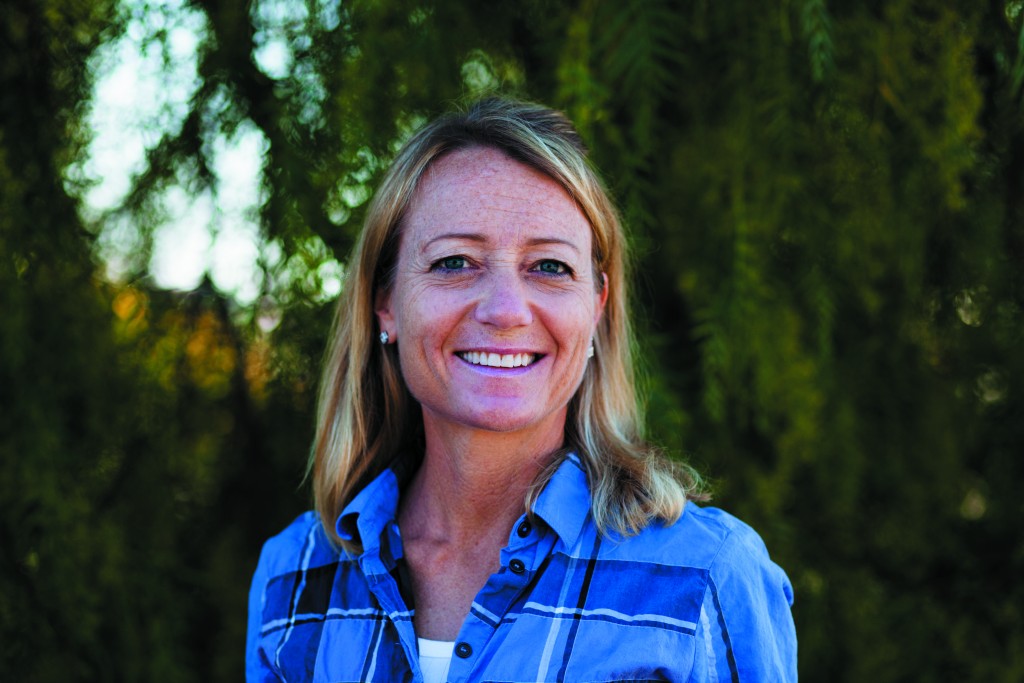
No Wine Country is too far for Nick Goldschmidt. The winemaker’s home base is Healdsburg, and his Cabernet Sauvignons and Merlots from Alexander and Dry Creek valleys are typically terrific
(two made our Top 100).
Once the Sonoma Crush is over, Goldschmidt hops on an airplane for New Zealand, Chile, Argentina or some other far-flung country, as a
consulting winemaker for 26 wineries. It’s a brutal life of travel, winemaking and sales calls across two hemispheres, but his five kids are
mostly grown, and Goldschmidt seems to thrive under the pressure. He was once asked, “How do you get it all done?” “I don’t do any of it very well,” he replied with a laugh.
He lied.
A New Zealand native, Goldschmidt moved to Sonoma full time in 1989 and was hired as associate winemaker at Simi Winery under Zelma Long and Paul Hobbs a year later. He became Simi’s chief winemaker in 1991, and later rose to vice-president positions at Allied Domecq Wines USA and Beam Estates.
Convinced that Alexander and Dry Creek valleys are ideal for growing Cabernet Sauvignon and Merlot, Goldschmidt’s own Goldschmidt Vineyards brand focuses on those varietals (there’s also a rogue Napa
Cab). Under his Forefathers label comes an Alexander Valley Cabernet Sauvignon and New Zealand Sauvignon Blanc. Other Goldschmidt brands include Trig Point (Sonoma Coast), Fidelity (Alexander Valley), Chelsea Goldschmidt (Alexander and Dry Creek valleys), Katherine
Goldschmidt (Alexander Valley), Boulder Bank (New Zealand) and Chacras (Argentina).
This doesn’t count the wineries for which he
consults. Whew.
Open for a little more than a year, Hamel Family Wines is one of Sonoma’s most stylish — and ambitious — wineries. Evidence of that ambition? Owners George and Pam Hamel brought in Martha McClellan, one of Napa Valley’s most accomplished winemakers, to work with their winemaker son, John B. Hamel II, and their estate-grown grapes.
McClellan and her husband, longtime Harlan Estate winemaker Bob Levy, have their own Napa Valley label, Levy & McClellan, a tiny-production, Cabernet Sauvignon-based wine that is being offered by a Napa Valley fine-wine shop for $600 a bottle. Her winemaking
skills are also behind the success of the Checkerboard Vineyard and Vineyard 7 & 8 Napa brands.
While living in Germany, McClellan graduated from Geisenheim University, the only American woman to complete a degree in enology and viticulture there. She worked six vintages (1995-2000) at Harlan Estate in Napa Valley, which led to similarly prestigious positions and consulting work throughout Napa Valley. At Hamel, she produces Sauvignon Blanc, rosé, Isthmus (a Bordeaux-style red blend) and our Top 100 pick, an estate Zinfandel.
They all show the finesse of an experienced winemaking hand. That Hamel looked to a Napa winemaker doesn’t mean its wines will automatically be outstanding, or better than anything else produced in Sonoma. It means that the winery found the right fit.
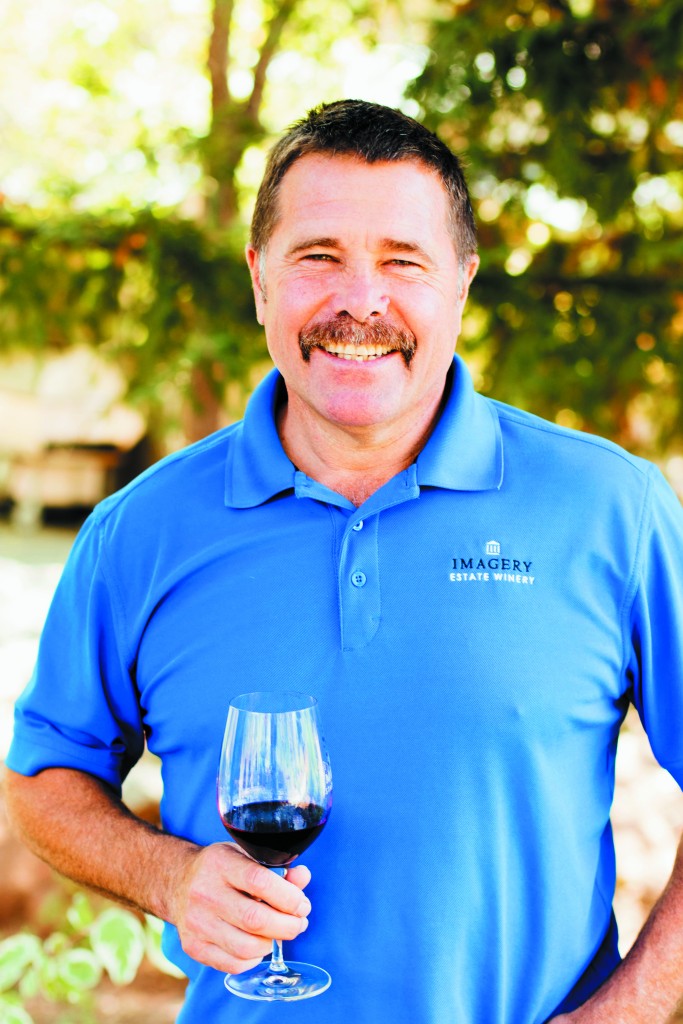
Cinsault , Lagrein, Mourvedre, Tannat, Teroldego … not your everyday grape varieties in Sonoma, but they’re a big part of Joe Benziger’s life.
As winemaker at Imagery Estate Winery, Benziger never met a wine grape he didn’t like. Sure, he produces more recognizable wines, too, such as Sauvignon Blanc, Pinot Gris, Cabernet Sauvignon and Merlot, yet it’s the oddballs he embraces, from grapes he says are too good to get swallowed up in blends. They deserve to stand on their own.
Take Barbera. The workhorse grape in the Northern Italy region of Piedmont, it produces wines with high acidity and crunchy tannins. Imagery’s version is a bit softer and fruitier, with full body and deep, rich flavors, yet retains the expected refreshing acidity. Sodelicious is the 2012 Imagery Sonoma Valley Barbera that it won the Best of Show Red award at the 2015 North Coast Wine Challenge. Benziger’s 2012 Pine
Mountain-Cloverdale Peak Teroldego, another obscure (for here) variety, won a gold medal.
Case production of his wines is typically limited, and most are sold in the Glen Ellen tasting room. They come adorned with labels bearing contemporary art commissioned by Imagery art curator Bob Nugent.
In June 2015, Benziger’s family sold Imagery and the flagship Benziger Family Winery, also in Glen Ellen, to San Francisco-based The Wine Group. Joe is expected to continue making the Imagery wines, and keep the Sonoma diversity drive going.
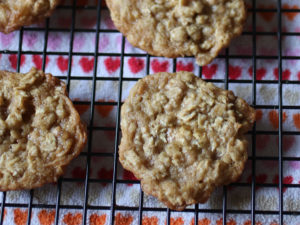
Best EVER Toffee Oatmeal Cookie Recipe, Nancy Cole
These are super-decadent cookies that you can justify eating because they have old-fashioned oats. I let my dough sit overnight in the fridge, but beware, because the it’s addictive. Actually, I almost like the batter better than the cookies!
2 1/4 cups Old-fashioned oats
1 pkg. toffee bits
1 cup brown sugar
1 cup butter, softened
1 T. vanilla
3/4 cup sugar
1 2/3 cup flour
1 tsp. baking soda
1 tsp. baking powder
1/2 tsp. salt
2 large eggs
Preheat oven to 375 degrees. Mix oats and toffee bits and set aside. Sift flour, baking soda, baking powder, and salt together and set aside. Mix sugars until blended. Add butter and beat until creamy and smooth. Add eggs and vanilla. Add flour mixture and mix until just combined. Stir is oats and toffee bits and mix to combine.
Drop by Tablespoon on ungreased cookie sheet or silpat, 2″ apart. Bake 9-11 minutes or until golden brown*. After 3 to 4 minutes on the cookie sheet, transfer to wire rack and cool. Makes about 5 dozen cookies.
*Helpful hint: Take the cookies out of the oven when they are just starting to turn brown around the edges. The middle will look unbaked but by leaving them on the pans to set for 3-4 minutes they finish up and can easily be removed without falling apart. The longer you bake them, the crispier they will be. Store in air tight container to maintain chewiness of the cookies, although they won’t be around long enough!
This recipe comes from a treasured community cookbook from small town near Humboldt Bay, with recipes spanning almost 100 years. Cook received a copy from her grandmother and cherishes the stories and memories of the community. We love these cookies, because they’re simple and old-fashioned, reminding us of the cookies we used to set out for Santa.
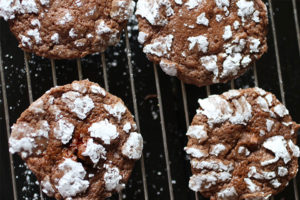
Chocolate Crinkles, Tianne Cook Makes about 4 dozen
4 ounces bittersweet chocolate
½ cup vegetable oil
2 cups granulated sugar
4 unbeaten eggs
2 teaspoons vanilla
2 cups sifted flour
2 teaspoons baking powder
½ teaspoon salt
½ cup chopped walnuts
1 cup confectioner’s sugar
Line 2 baking sheets with parchment paper. Melt the Bittersweet Chocolate in a double boiler or mixing bowl over bowl of hot water. Remove from water and blend in oil and sugar. Add eggs one at a time and beat well after each addition and then beat in the vanilla.
Sift together flour, baking powder and salt. Stir into chocolate mixture; add nuts and mix. Chill soft dough for several hours or overnight.
Drop a slightly heaping tablespoon of dough into the confectioners’ sugar and roll to coat and form into a ball; repeat with remaining dough. Place the dough balls on a prepared baking sheet approximately 2 inches apart and refrigerate until chilled, about 30 minutes. Bake approximately 10-12 minutes at 350 degrees. Let cool on pan 10 minutes before transferring to cooling rack.
Over seven years of the BiteClub Holiday Cookie Contest, this time of year finds me anchored to my stand mixer, whipping up dozens of recipes submitted by local bakers. I have tested hundreds of recipes, softened hundreds of pounds of butter, bought bag after bag of flour and wound up with a kitchen floor that’s sticky with powdered sugar until mid-May.
I thought maybe I had exhausted every possible version of chocolate chip, ginger, biscotti, thumbprint and caramel-coated cookies, but I was wrong.
This year, I tested about a dozen recipes and carefully considered the taste, the ease of construction and the story behind each one. A panel of friends, family and co-workers helped me select the winner.
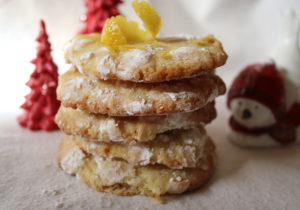
The lemon snowflake cookies were standouts because of their unique refreshing quality and the heartfelt story behind Tonia Seidita’s favorite holiday cookie.
Here are some of this year, and previous years’ favorites.
With so much chocolate and ginger this time of year, a nice tart lemon cookie is a refreshing change of pace. These are very lemony, but also very rich and buttery. They’re one of my personal favorites.
Submitted by Tonia Seidita
Recipe
1⁄2 cup butter, soft
1 cup granulated sugar
1⁄2 teaspoon vanilla
1⁄2 teaspoon lemon extract
1 egg
1 tablespoon lemon zest
2 tablespoons lemon juice
1⁄4 teaspoon salt
1⁄4 teaspoon baking soda
1⁄4 teaspoon baking powder
11/2 cup flour
1⁄2 cup powdered sugar
Process zest and granulated sugar in food processor for 30 seconds, until zest is ground fine. Cream together the zest and sugar with butter until light and fluffy. Mix in egg, vanilla, lemon extract and lemon juice, scrape sides and mix again. Stir together flour, salt, baking powder and soda just until mixed. Add flour mixture into wet mixture and mix together just until dough is formed, scrape sides and mix again. Refrigerate for 1⁄2 hour.
Meanwhile preheat oven to 350 degrees and line cookie sheets with parchment paper. Roll heaping teaspoons of dough into balls and cover in powdered sugar (be sure to cover thickly). Place balls 2 inches apart on cookie sheets and bake for 9-11 minutes or until tops have cracked and bottoms are just slightly golden. Rotate cookie sheets half way through.
Let cookies cool on sheets for 3 minutes and move to rack to cool thoroughly.
Tonia’s Story: I love anything lemon flavored. These cookies have a great lemon flavor and their texture is delicate. I got a Blue ribbon for these at the Sonoma County Fair.
I am dedicating this recipe to my mother in-law, Jo, who always enjoyed all of the cookies I would bake for the Holidays. Last week I baked 5 types of cookies, including these, for Jo’s memorial.
Salted Caramel Apple Cookies from the 2015 BiteClub Cookie contest
First you taste the buttery caramel, then the sweet apple, and finally a nip of salt. These were huge favorites for the 2015 BiteClubCookie Contest — and for good reason.
Submitted by Kathleen White
Cookie
3/4 cup powdered sugar
2/3 cup unsalted butter, softened
1 tbsp. apple juice concentrate
1 1/2 cup flour
1/4 tsp. salt
Drizzle
30 vanilla caramels
2 tbsp. apple juice concentrate
2 tbsp. water
sea salt
Preheat over to 350 degrees.
In large bowl, cream sugar, butter and 1 tablespoon apple juice concentrate until light and fluffy. Stir in flour and salt.
Spoon onto an ungreased cookie sheet and bake in a 350 degree oven for 12 to 15 minutes or until edges are light golden brown. Cool.
Drizzle: In heavy saucepan, combine caramels, 2 tablespoons apple juice concentrate and water. Cook until mixture is smooth, stirring constantly. Ribbon the caramel on the cookie, set with sea salt.
Ed note: I used frozen apple juice concentrate, which you can find near the frozen orange juice. For the caramels, I used just the regular old wrapped caramels, but honestly, I think these would be EVEN BETTER if you make your own caramel. Flaked salt would be really pretty too. For the drizzle (and I learned this the hard way), a spoon works best using a gentle “M” motion. For something really fancy, you could try using a squeeze bottle, but wait until the caramel is cool enough to handle.
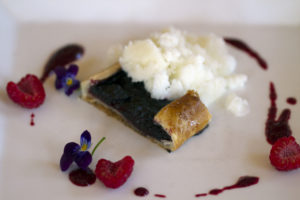
Blackberry Galette with creme fraiche granita, raspberry coulis paired with St. Francis’ 2014 Sauvignon Blanc, Uboldi Vineyard, Sonoma Valley. From the June 2015 menu. Photo: Heather Irwin.
For the second year, OpenTable.com has tapped Sonoma Valley’s St. Francis Winery as the nation’s number one restaurant, beating out culinary superheroes in New York, San Francisco and Napa Valley.
Yup, a winery has been named Best Restaurant in America. Twice.
“We are still pinching ourselves,” said Chris Silva, President and CEO of St. Francis Winery and Vineyards. “The real irony is that we aren’t actually a restaurant,” he added, acknowledging the, well, uniqueness of his situation. St. Francis won the coveted top spot in 2013, under Chef David Bush (now of Oso).
The view from the dining room at St. Francis WInery and Vineyards, which won Opentable.com’s Best Restaurant in America in 2014 and 2015.
But it also isn’t an accident that St. Francis Winery’s Executive Chef Bryan Jones’ luxe five-course tasting menu and wine pairings have attracted a lot of attention. Using ingredients from the winery’s 2-acre garden, classical fine dining techniques and presentations, and luxury ingredients ranging from local Wild King Salmon and braised duck to local blackberries, carrots and chanterelle mushrooms, this isn’t exactly picnic fodder. And then there’s idyllic scenery surrounding the dining room, with million dollar views of Mount Hood, the vineyards and historic winery. At $68 per person, it’s relative steal for this kind of dining experience.
But still, a winery?
We went right to the top Opentable.com brass for some answers.
Grilled Snake River Bavette Steak with Honey Lavender Carrots, Spinich Puree, Onion Powder, Onion-Butter Foam paired with St. Francis 2012 Red Wine, Rockpile Red, Sonoma County. Photo: Heather Irwin.
“While St. Francis isn’t a traditional restaurant, they offer a positively magical dining experience,” said Caroline Potter, Chief Dining Officer for Opentable.com, who has dined there herself.
“It truly dazzles all the senses, from the sublime wines and delightful seasonal plates to the welcoming hospitality and pastoral setting. When you dine there, you are part of an intimate group sharing a journey through local food and wine with expert guides, and by the time you leave you feel as if made new friends with the St. Francis staff and your fellow diners,” she said. “In fact, my husband and I are still in touch with our table mates,” Potter added.
Silva agrees that the kinship, as well as the detailed wine pairings (they are a winery, after all) are really what makes the experience.
Red Wine Braised Duck with COriander Spatzle, Endive, Pistachio, Tart Cherry Apricot Mostara paired with St. Francis 2013 Pinot Noir, Russian River Valley from the June 2015 menu. Photo: Heather Irwin.
“We have received a lot of attention over the fact that one of the key themes of this experience is that of community: 16 guests sit together at a round, communal table with one of the best vineyard views in the world and share about 90 minutes of world class wine, food, and conversation—and what we hope will be a sense of awe—with people they have never met,” he said.
So, how’d St. Francis get to #1? OpenTable generates their list of the 100 Best Restaurants in America from more than 5 million restaurant reviews collected from verified OpenTable diners between November 1, 2014 and October 31, 2015. Reps tell us that restaurants are sorted according to a score calculated from each restaurant’s average rating in the “overall” category along with that restaurant’s rating relative to others in the same metropolitan area and the average number of restaurants reviewed by diners who reviewed that restaurant.
That’s a bit too much head scratching for us, but a quick look online reveals that St. Francis has about 462 reviews, with an average of 4.9 stars. Rutherford’s Auberge du Soleil , which also made the Top 100, has over 2,000 reviews, but ranks an average of 4.7 stars. Other restaurants in the lineup Blue Hill at Stone Barns in New York, SF’s Benu and Acquerello, NYC’s Daniel, along with neighboring Wine Country restaurants Farmhouse Inn and The French Laundry.
Outsiders also seem to see something that maybe we natives have become all too accustomed to.
“The experience provides a great deal of value to diners with its modest price, but they don’t skimp on time or attentiveness. You are treated with so much care, questions about the wine and the pairings are not only encouraged, they¹re solicited, and you really come away not just satiated but also enlightened,” Potter said.
“We have the dream team at St. Francis right now, and to be named #1 Restaurant in America is really the icing on the cake,” he said.
Want to see for yourself? St. Francis Winery, 100 Pythian Road, takes reservations for food and wine pairings Friday through Monday (closed Tuesday and Wednesday). 538-9463, stfranciswinery.com.
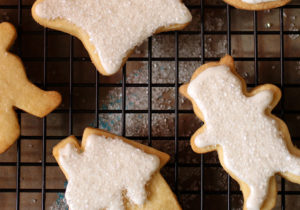
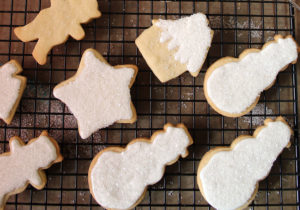
These really are the best sugar cookies I’ve ever had. Usually they’re pretty ho-hum, but the buttery, crisp cookie tastes wonderful by itself, but gets a classy upgrade with some sugar snow.
Best Iced Sugar Cookie Recipe
Submitted by Carina Lopez
Preheat oven to 350 degrees.
Cream the the butter and sugar. Add the 3 egg yolks and vanilla extract, then scrape sides. Add salt and flour and mix until dough comes together.
Flatten dough into a large disk, wrap in plastic or waxed paper and place in refrigerator for one hour, or until ready to bake.
When ready to bake, let warm up slightly, then roll to the desired thickness (about 1/4 inch). Use cookie cutters to shape. Use a silpat or parchment paper on the cookie tray to avoid burning. Cook until edges are slightly golden, about 9-12 minutes.
Allow to cool fully.
Ed. note: The original recipe calls for meringue powder for the royal icing, but it can be hard to find. If you have a stand mixer, its just as simple to make it using pasteurized egg whites and powdered sugar. I followed Alton Brown’s recipe.
For frosting, its easiest to pipe around the edges, then fill in. I used some crystalized sugar for a snowy appearance.


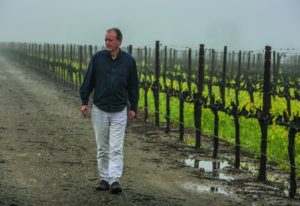
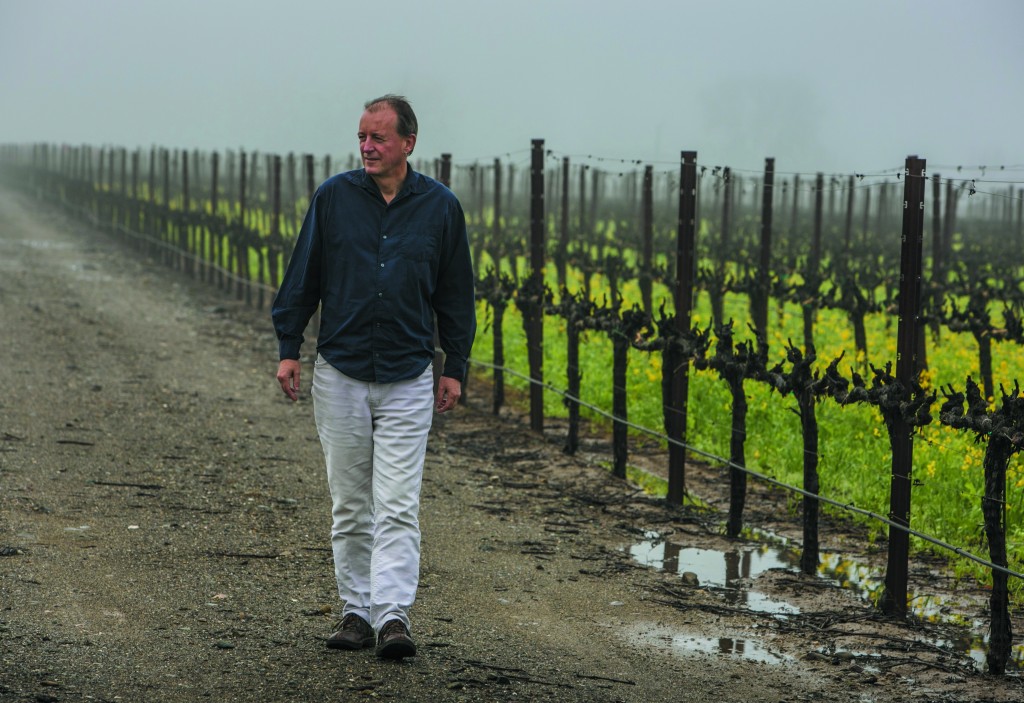 No Wine Country is too far for Nick Goldschmidt. The winemaker’s home base is Healdsburg, and his Cabernet Sauvignons and Merlots from Alexander and Dry Creek valleys are typically terrific